Accredited Employer Work Visa Requirements: Accreditation, Job Check and the Worker Application

The Accredited Employer Work Visa, usually shortened to AEWV, is New Zealand’s main temporary work visa, and it runs in the opposite order to what most people expect. The worker applies last, not first. Before any migrant can lodge an application, Immigration New Zealand (INZ) has to approve the employer, and then approve the specific job. An offer from an employer who has not completed those two steps cannot support this visa.
This guide covers both sides: what an employer must do, and what the worker must then show. BusinessKiwi’s broader work visa guide covers the full range of New Zealand work visas.
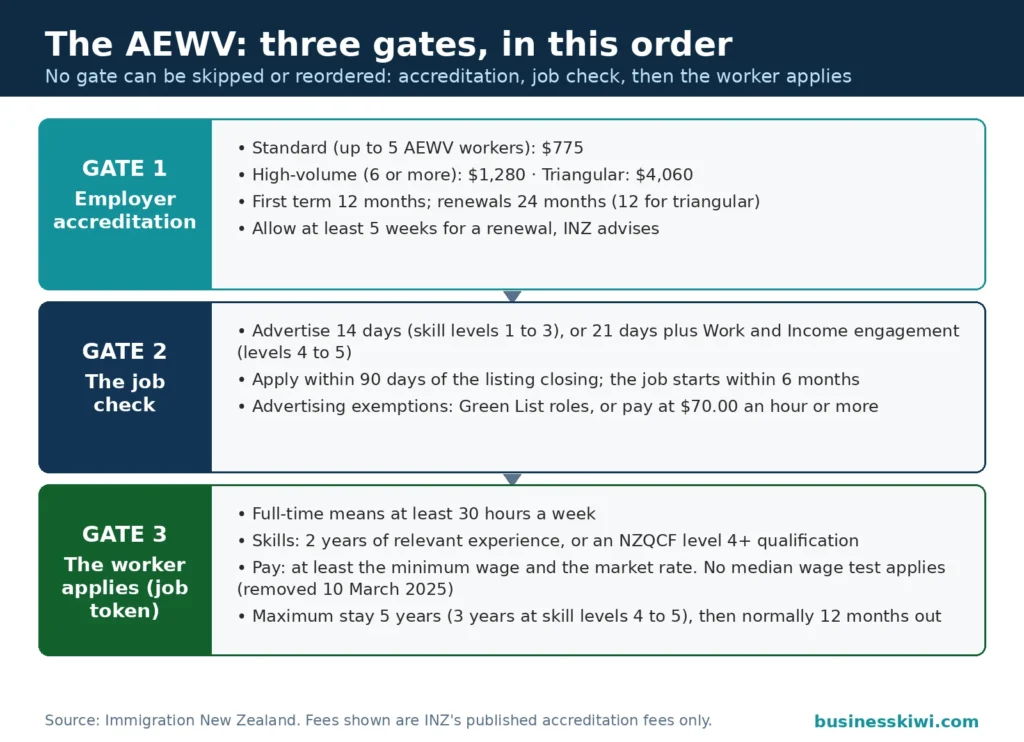
The three steps, in order
INZ runs the scheme as a fixed sequence:
- Employer accreditation. The employer applies to INZ and is approved as an accredited employer.
- Job check. The accredited employer applies for a job check for the role it wants to fill. INZ tests whether the job is genuine, its terms comply with New Zealand law, and no New Zealander is available to do it.
- The worker application. Only once a job check is approved can the employer invite a named worker, using the job token INZ issues for that job check, and only then can the worker apply.

Step 1: Employer accreditation
Who needs it, and the three types
Any employer who wants to hire a migrant on an AEWV needs accreditation. It is held by the legal entity that holds the New Zealand Business Number (NZBN), so a trading name is not enough, and the employer named on the employment agreement has to be that entity.
INZ publishes three types. Standard accreditation suits businesses employing up to 5 AEWV holders at a time. High-volume accreditation is for businesses employing 6 or more. Triangular employer accreditation covers businesses that employ migrants directly but place them to work with controlling third parties. It has no cap on numbers but extra requirements, covered below. A separate franchisee category closed on 16 June 2024; franchisees now use these types.
What an employer must show
The business must be viable and genuinely operating and meet INZ’s financial requirements. It must not be bankrupt or in a No Asset Procedure. Nobody in the organisation can be on the employer stand-down list or the immigration stand-down list, or permanently banned from hiring migrants.
The financial test is met through any one of four routes INZ publishes: no loss before depreciation and tax over the last 2 years; positive cash flow in each of the last 6 months; enough capital or outside investment to stay viable; or a credible business plan for at least the next 2 years.
Triangular employers face extra conditions: a 12-month history of placing staff in New Zealand, and at least 15 percent of placed staff must be New Zealand citizens or residents, each guaranteed at least 30 hours a week throughout the accreditation period. Trusts, partnerships and sole traders have their own additions: at least one partner, trustee or the sole trader must be primarily resident in New Zealand, and the employer named in the agreement must be the legal entity itself.
The employer and its key people must also have a clean record: no employing migrants who had no right to work in the job, no false or misleading information given to INZ, and no stand-downs for breaching minimum employment standards.
How long accreditation lasts, and what it costs
A first accreditation lasts 12 months. On renewal, standard and high-volume accreditation last 24 months, while triangular accreditation renews for 12 months at a time. If accreditation expired more than 12 months ago, a fresh grant is only 12 months. INZ recommends allowing at least 5 weeks for a renewal. If accreditation lapses, existing job tokens lapse with it and the employer cannot run new job checks or support further applications until accredited again.
INZ publishes the accreditation fees on its fees page, payable online: standard accreditation NZD $775, high-volume NZD $1,280, triangular NZD $4,060, an upgrade from standard to high-volume NZD $505, and reconsideration of a declined application NZD $250. The job check also carries a fee: NZD $735, paid by the employer. The worker’s application carries its own fee of NZD $1,540, plus a levy. INZ states both amounts on its Hiring migrants for seasonal peaks page, so check the current figures in INZ’s fees, decision times and where to apply tool before budgeting. The employer side costs are the employer’s, and recruitment costs cannot be passed on to the worker.
Step 2: The job check
Accreditation says the employer can be trusted. The job check says this job, on these terms, can be offered to a migrant. Each distinct job needs its own approved job check. Several vacancies can share one application only where the details genuinely match: same occupation code, pay, location and minimum requirements, under the same advertising.
What INZ is testing
Three things. The job must be genuine. Its terms must meet New Zealand employment law. And for most roles the employer must show no suitable and available New Zealander can do it: a citizen or resident visa holder who is qualified for the job, or has the right experience or skills, or could be trained into it, who lives near the work or can move there and is available for full-time work in the hours needed.
The application asks for a job description, pay rate details, the size of the business and how many New Zealanders it employs, and the recruitment, training or equipment costs attached to the role. The employer declares that the employment agreement behind the offer meets employment law, including paid leave and maximum hours, and contains no trial period clause. Unlawful deductions and bonding clauses that force a worker to repay money simply for leaving are prohibited.
The job also needs a start date within 6 months of the job check application, and the occupation code matters more than the job title: INZ grades jobs under ANZSCO, its longstanding classification, or the newer National Occupation List (NOL), which is gradually replacing it. Apply at skill level 1, 2 or 3 for a job INZ assesses as level 4 or 5, and the employer must start again with the correct code.
Advertising and the labour market test
Unless the job is exempt, the employer must advertise before applying, on a general national job listing website or platform where New Zealanders are likely to see it. The advertisement must carry the key tasks, the minimum and maximum pay, minimum guaranteed hours, the location, and the minimum qualifications, experience and skills needed.
Duration depends on skill level. Skill level 1, 2 or 3 jobs, under ANZSCO or on the NOL list recognised for this visa, need at least 14 calendar days. ANZSCO skill level 4 or 5 jobs need at least 21 calendar days, and the employer must also engage with Work and Income in good faith. INZ can ask for evidence of that engagement, and can check with Work and Income itself.
The listing must have closed before the application goes in, and the application must follow within 90 days of closing. The employer declares it made genuine attempts to attract New Zealand workers and reports how many people applied, how many were citizens or residents, how many of those were suitable, and how many were hired. For skill level 4 and 5 jobs it must also say why New Zealand applicants were not suitable or available. If its own information shows a suitable and available New Zealander existed, INZ will decline the job check.
Two kinds of job skip advertising: Green List jobs that meet the Green List requirements for the role, and jobs paying at least NZD $70.00 an hour, the high pay exemption as INZ currently publishes it.
Pay: market rate, and what happened to the median wage
Older guides talk about a median wage threshold, and many employers assume it still applies. It does not. INZ records that from 10 March 2025 the median wage requirement was removed from the AEWV. There is now no set pay threshold for the visa itself beyond the New Zealand minimum wage. In its place sits the market rate: the job must pay at least what a New Zealander or resident would be paid for that job, or equivalent work, in that place. INZ treats the market rate as a range, weighed against collective agreements, the job’s location and duration, its other terms, and the experience the work needs.
That makes the job check the moment pay is truly tested. An offer below the market range for the occupation and region is a job check problem and then a visa problem. Median based figures still apply elsewhere, including residence pathways and family support. For the AEWV itself, market rate is the test to plan around.

Step 3: The worker application
Once the job token exists, the worker’s part begins, online, and INZ tests the person as well as the paperwork. The token is a unique link from the approved job check, and the offer must match the job approved: same occupation, location, pay and terms.
The job offer
The worker needs a current offer of full-time work from the accredited employer, for the job covered by the approved job check. Full-time here means at least 30 hours of work a week. The application includes a signed copy of the offer, the employment agreement and the job description. INZ checks the agreement closely: it must name the employer and worker, give the job title, workplace address and the work involved, state any qualifications or experience needed and whether occupational registration is required, set out hours and duration and how long the worker has to take up the offer, and provide lawful pay and conditions. Clauses breaching employment law, unlawful deductions, a trial period or unacceptable bonding clauses can sink an application. Some work cannot be offered on this visa at all: crop work in horticulture or viticulture, foreign fishing vessel crew work, and self-employed work.
One warning INZ repeats deserves repeating. Job offer scams target applicants in some regions heavily, and INZ states it will decline an application where the worker, or their agent, offered or promised money to the employer in exchange for the offer. A genuine AEWV job does not come with a price tag for the worker.
Minimum skills: experience or a qualification
On top of the employer’s own requirements, INZ sets a minimum skills threshold. The worker must have either at least 2 years of relevant work experience, or a qualification at level 4 or higher on the New Zealand Qualifications and Credentials Framework (NZQCF). Relevant means the same field or industry as the job offered, except that a bachelor’s degree or higher can be in any field. Experience need not be consecutive or full-time throughout, but it must total the equivalent of 2 years of full-time work, with the hours evidenced.
The evidence rules are stricter than many expect. Experience must be backed by documents from someone other than the applicant: certificates of employment, payslips and tax certificates are the core items, and reference letters count only when supported by that kind of record. A CV alone is not sufficient, and INZ warns that a lone reference letter or employment certificate may not satisfy the requirement. Overseas qualifications below bachelor’s level need an International Qualification Assessment from NZQA to compare them with a level 4 qualification.
Extra evidence is not required in some cases: Green List jobs where the worker shows they meet the Green List requirements; occupational registration that itself required experience or qualification evidence; pay of at least NZD $67.12 an hour, described by INZ as twice the 2024 median wage; or evidence already given to INZ earlier. The worker must still meet the employer’s stated requirements, and hold occupational registration where the law requires it.
English language
English depends on skill level. Skill level 1 and 2 applicants do not need to show English ability. Skill level 3, 4 and 5 applicants must show they can speak and understand English, through citizenship, work or study history, or an approved test with results meeting INZ’s minimum scores and no more than 2 years old at application. Exemptions cover people who showed English ability in an earlier AEWV application, and skill level 3 applicants whose current AEWV expires on or before 1 December 2026.
Health and character
Every applicant must be in good health and of good character, and must genuinely intend to meet the visa’s conditions. Anyone staying more than 6 months needs a chest X-ray certificate if they are a citizen of a country without a low incidence of tuberculosis, or have spent more than 3 months in the last 5 years in such a country. Police certificates are needed from applicants aged 17 or over whose total time in New Zealand will reach 24 months or more. They must be less than 6 months old at application and come from countries of citizenship and any country lived in for more than 5 years since turning 17. A valid, complete certificate must be uploaded with the application; a receipt showing one has been applied for is not accepted, with narrow exceptions for Fiji, Hong Kong and Israel. Secure the police certificate early, not last.
How long the visa lasts
The total time on one or more AEWVs, the maximum continuous stay, depends on when the first AEWV was applied for, the job’s skill level, and pay. For most jobs the maximum is 5 years. For ANZSCO skill level 4 and 5 jobs it is 3 years. A single visa can be shorter than the maximum: someone granted 2 years against a 5 year maximum can apply for further AEWVs to use the balance without leaving. Once the maximum is reached, the worker must leave for a period, normally 12 months in a row, before another AEWV.
The visa is tied to the accredited employer, role and location in the approved job check. Changing any of them means applying through INZ’s Job Change process, a variation of conditions, and getting approval before the move.
Partners and children
Partners and dependent children cannot be included in the AEWV application. A holder may be able to support a partner for a visitor or work visa, and children for visitor or student visas, under separate applications. Whether support is available turns on the holder’s earnings and the job’s skill level, so families should check the current settings on INZ’s site rather than assume the household moves on one approval.
What changed in 2025 and 2026
The settings have shifted several times since the scheme tightened in April 2024, when INZ introduced English for lower skilled roles, the minimum skills threshold, Work and Income engagement for skill level 4 and 5 jobs, and the 3 year maximum stay for those roles.
From 10 March 2025, in phase 2 of the reforms announced in December 2024, INZ removed the median wage requirement and replaced it with the market rate test, cut the work experience requirement from 3 years to 2 years, and made MSD engagement for lower skilled roles declaration based. Visa length for new skill level 4 and 5 AEWVs rose to 3 years, matching their maximum continuous stay, and the income threshold for supporting dependent children rose to NZD $55,844 a year.
From 1 June 2026, the English requirement was extended to skill level 3 occupations, announced by INZ on 25 May 2026. It applies the same minimum standard as levels 4 and 5, and does not apply to Job Change applications or the seasonal categories. The transitional exemption for holders whose visa expires on or before 1 December 2026 is covered above.
Where applications commonly fail
INZ publishes no tidy table of refusal reasons for this visa, but its guidance points at the pressure points. Advertising leads: adverts running too few days, appearing in the wrong places, omitting the pay range or required hours, or a job check lodged more than 90 days after the listing closed. The wrong occupation code has the same effect, forcing a fresh application at the correct skill level with the longer advertising run that level demands. Then there is the labour market answer itself: an employer who reports that a suitable and available New Zealander applied and was not hired has answered its job check out of existence. Below market rate pay fails applications too, at job check and again at the visa stage.
Accreditation fails at the business end: finances meeting none of the four viability routes, people on stand-down lists, or an application by the wrong legal entity. On the worker’s side the recurring problems are evidence problems: experience asserted but not documented by third parties, qualifications missing their NZQA assessment, stale police certificates, and agreements carrying trial periods or bonding clauses.
After the worker starts: what employers must keep doing
Accreditation is a continuing obligation. INZ runs post-accreditation checks each year, drawn from random and targeted selection and complaint follow-ups, and an employer who does not provide information requested in a check risks revocation.
The standing duties are these. Keep the commitments made in the accreditation application. Comply with New Zealand employment law and standards and the Immigration Act 2009. Pay all recruitment costs in and outside New Zealand, including advertising, agency fees, accreditation and job check fees, trade testing and training, and never pass them to the worker or charge fees unlawful here, such as payment to secure a job. Tell INZ when things change: a worker stops working for you, key people change, or the business faces restructure, liquidation or bankruptcy. Key people changes must be reported within 10 working days, and the same duty applies where a worker leaves a month or more before their visa expires. Consequences run from suggestions for improvement to suspension or revocation, stand-down periods, infringement notices and prosecution. Suspension freezes job check decisions and revocation cancels unused job tokens.
Settlement support is the duty employers most often underestimate. Within the worker’s first month, the employer must provide information on accommodation, transport including driving and public transport, the cost of living, accessing healthcare, Citizens Advice Bureau services, community groups, getting an IRD number, industry training options, and job or industry hazards. INZ provides a template, and employers should keep evidence of what was given, such as copies, emails and induction plans. At renewal, employers can be asked to show it happened. Employers must also watch the far end of the relationship: a worker who reaches their maximum continuous stay cannot keep working, and INZ expects early conversations about options. Underneath all of it, AEWV workers have the same rights as New Zealand workers, and the written agreement, minimum wage, leave and health and safety obligations Employment New Zealand administers apply from day one.
Disclaimer
General information only. This article explains the Accredited Employer Work Visa requirements as Immigration New Zealand publishes them, checked on 7 October 2026. Settings change, sometimes at short notice, and INZ’s website is the source to confirm before acting. Nothing here is immigration advice for your situation. If your circumstances are anything other than straightforward, or a decision would be expensive to unwind, talk to a licensed immigration adviser before applying. Our immigration adviser guide explains how advisers are licensed in New Zealand.
Frequently asked questions
Can a worker apply for an AEWV before their employer is accredited?
No. The order is fixed: accreditation first, then an approved job check, then the worker’s application using the job token from that job check.
Does an AEWV job still have to pay the median wage?
No. INZ removed the median wage requirement from the AEWV on 10 March 2025. The job must instead pay at least the minimum wage and at least the market rate, the pay range a New Zealander or resident would receive for the same job in the same location.
How much experience does an AEWV applicant need?
Either 2 years of relevant work experience or a qualification at NZQCF level 4 or higher, in the same field or industry as the job, unless the qualification is a bachelor’s degree or higher, which can be in any field. Experience must be proven with third party documents such as employment certificates, payslips and tax certificates. A CV alone is not enough.
How long can someone stay in New Zealand on an AEWV?
The maximum continuous stay is 5 years for most jobs and 3 years for ANZSCO skill level 4 and 5 jobs. A single visa may be shorter, and further AEWVs can be applied for to reach the maximum. After it, the worker normally spends 12 months in a row outside New Zealand before another AEWV.
Can an AEWV holder change employers?
Not by simply resigning and starting elsewhere. The visa is tied to the accredited employer, job and location in the approved job check. Changing any of them requires a Job Change application, approved before the move. The new employer will normally need accreditation and an approved job check for the role.
Sources
All facts come from Immigration New Zealand; Employment New Zealand is referenced only for the point that migrant workers hold the same employment rights as New Zealand workers. Pages checked 7 October 2026 at immigration.govt.nz: the Accredited Employer Work Visa page; the AEWV key information and statistics page; the accreditation, job check, renewal, fees, advertising, employer requirements and settlement pages; the two AEWV changes pages; the skill level 3 English announcement; the Hiring migrants for seasonal peaks page; and Work visa wage rates.
For more guides in this section, see the Visa & Immigration hub.