Religious Worker Visa NZ: Who Qualifies, What Counts as Religious Work and How the Residence Pathway Works
New Zealand’s Religious Worker visa exists for a specific situation. A religious community here needs someone from overseas to carry out religious work, and no arrangement on the ground can fill that role. Immigration New Zealand (INZ) runs the category in two stages. The Religious Worker Work Visa brings the person in on a temporary basis, tied to a sponsoring religious organisation. The Religious Worker Resident Visa is the second stage, available only after time spent doing that work in New Zealand.
Both stages are sponsor-driven. There is no version of this visa where an individual applies on their own merits and finds a role after arriving. The organisation comes first, the offer of religious work comes with it, and INZ tests both the worker and the organisation before anything is granted. This guide works through what INZ publishes about the category: who can apply, what the sponsor has to prove, how the work itself is defined, how long each stage lasts, and what the residence pathway actually requires.
What the Religious Worker visa is for
The category is built around a simple exchange. A religious organisation in New Zealand has religious objectives it cannot advance without a particular worker, and INZ allows that worker to come and do the work. INZ frames the purpose plainly on its Religious Worker Work Visa page: religious workers come to help New Zealanders practise, maintain and advance their religious beliefs, and the pathway is designed with a view to the worker staying permanently if the residence requirements are later met.
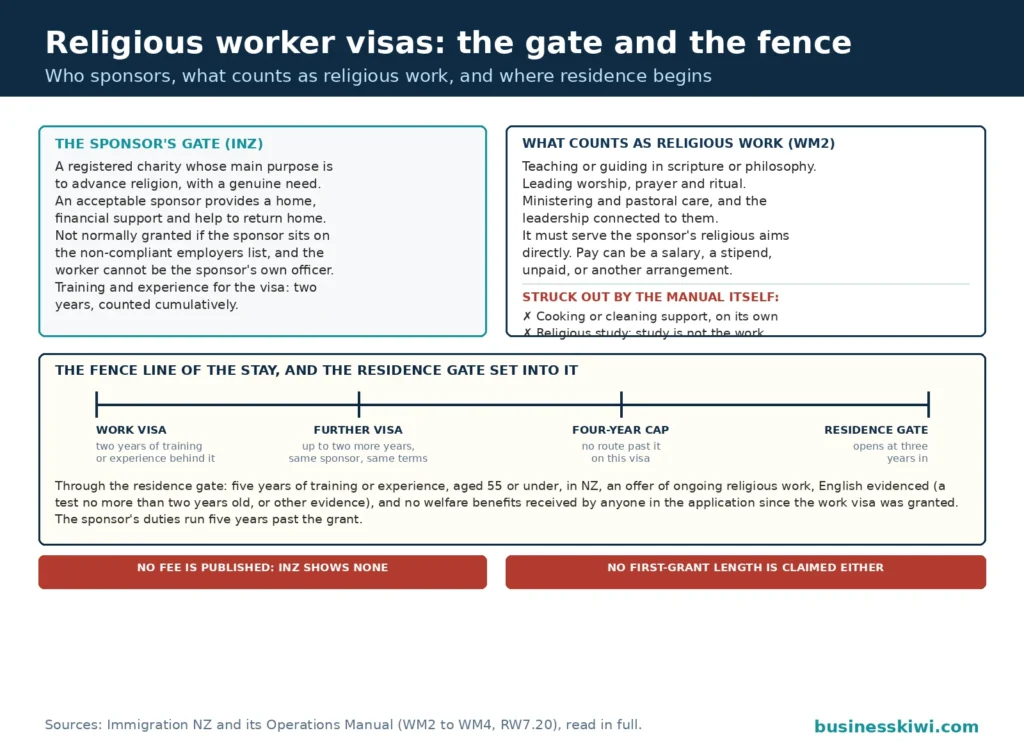
The definition of religious work does most of the heavy lifting in this category, and INZ sets it out in its Operations Manual (instruction WM2). Religious work must substantially be a primary role, and it has to involve one or more of the following: teaching or guidance in religious scripture or philosophy; leading religious practice, worship or prayer; conducting religious initiations, ordination or ritual; ministering or pastoral care; or a role of religious leadership connected with any of those activities. The visa page expresses the same list in slightly different words, covering teaching religious scripture or philosophy, leading religious ceremonies, worship or prayer, ordaining and initiating, and providing spiritual guidance and care.
Two further points in INZ’s definition matter. First, the work must directly serve the religious objectives of the sponsoring organisation. A role can sound religious in the abstract and still fail if INZ is not satisfied it advances what the sponsor actually exists to do. Second, the person doing the work does not have to be an employee in the ordinary sense. INZ’s instructions recognise that religious work may be paid through salary or wages, paid as a stipend, unpaid, or supported through some other arrangement. That flexibility reflects the reality of religious life, where many workers are maintained by their community rather than paid a market salary. What changes with the payment method is the paperwork, which is covered below.
Who can apply for the Religious Worker Work Visa
Eligibility starts with the offer. An applicant needs an offer of religious work from the religious organisation that will sponsor them, and the work offered has to fall substantially within the activities listed above. INZ is explicit that religious study is not religious work for work visa purposes, so a person coming mainly to study or train does not fit this category, whatever their intentions afterwards.
The applicant must also bring a background in the work. INZ requires at least two years of religious training and/or religious work experience relevant to the role being sponsored. Training and experience can be combined to reach the two years, an important detail in INZ’s application instructions, because many religious workers build their preparation through a mix of formal study and practical service. Evidence INZ lists includes testimonials from people in the applicant’s religious community, documents showing the applicant has been ordained, a curriculum vitae, documents showing experience of religious work relevant to the New Zealand role, and certified copies of relevant qualifications.
The standard temporary entry requirements apply on top of that. The applicant must be in good health, evidenced by a chest X-ray and a medical examination. Character is tested through police certificates: anyone aged 17 or over must provide one from their country of citizenship and from any country where they have lived for five years or more since turning 17. Certificates must be less than six months old when the application is made, and any certificate not in English needs an English translation. Identity is covered by passport and photographs, one photo for an online application or two for a paper one. INZ also assesses genuine intentions, meaning the applicant must genuinely intend to meet the conditions of the visa, judged on the application itself, the person’s circumstances and anything provided in earlier applications.
One restriction is easy to miss. A person who has already held work visas for religious work for four years or more is not eligible for another one. That cap runs through the whole category and shapes how the timeline to residence works, as explained further on.

The sponsor: what INZ requires of the organisation
Sponsorship is where this category is won or lost, and INZ’s requirements for the organisation are precise. The sponsor must be a religious organisation registered as a charity with Charities Services. Charitable registration alone is not enough: the organisation’s main purpose must be to advance religion. It must also have a genuine need for the applicant to do religious work for it. A registered charity whose purposes are mainly community welfare, education or cultural activity, with religion somewhere in the background, does not meet the test as INZ states it.
The organisation must be able to meet INZ’s requirements for acceptable sponsors. As the visa page puts it, that includes having the ability to provide the worker with accommodation and financial support, and help to return home, if the worker needs it. Sponsorship here is a real financial undertaking, not a letter of endorsement. INZ’s application instructions add that the sponsor must provide evidence of its financial ability to meet all of its sponsorship undertakings, and a statement explaining why there is a genuine need for the applicant to work as a religious worker, including information on the size of the organisation’s membership. The size of the congregation is relevant because INZ is testing whether the need is genuine and proportionate.
The formal instrument is the Sponsorship Form for Religious Workers, which the sponsor completes as evidence of the sponsorship. INZ’s Operations Manual identifies it as form INZ 1190. Where the worker will be employed by the organisation, the sponsor must provide an employment agreement covering the duration of the sponsorship obligations. Where the worker is not an employee, on a stipend, unpaid or otherwise supported, the sponsor must instead provide a description of the work setting out the primary role and any secondary roles the worker will be expected to undertake.
Compliance history matters too. INZ states it will not normally grant a visa if the sponsor appears on the list of non-compliant employers maintained by the Labour Inspectorate. The Operations Manual goes further: sponsoring organisations must comply with New Zealand employment and immigration law, the employer must have a history of compliance, and INZ will decline an application where granting the visa would undermine the integrity, credibility or reputation of the immigration or employment relations systems. One more rule catches people out. The applicant cannot be an officer or a nominated person of the organisation sponsoring them. The sponsored worker and the sponsoring body have to be genuinely separate parties.
Beyond the published pages, the detailed sponsorship tests sit in INZ’s own instructions, including the generic sponsorship requirements the Operations Manual cross-references. Organisations planning to sponsor should work through those requirements directly rather than assuming the summary on the visa page is the whole picture.
How to apply, and the evidence INZ asks for
An application under this category is a package, and INZ’s instructions (WM4) list its components. The applicant provides a completed work visa application form, together with the fee and immigration levy. No fee figure is published on the INZ pages this article is based on, so applicants should confirm the current charge with INZ when they apply rather than relying on any third-party figure.
The evidence bundle has several parts. There is the evidence of at least two years of training and/or experience described above. There is the completed Sponsorship Form for Religious Workers from the sponsoring organisation. There is the sponsor’s evidence of financial ability to meet its sponsorship undertakings, and its statement of genuine need, including membership size. There is evidence of the work arrangements: an employment agreement where the worker is employed, or a description of the work where they are not. Finally, there is evidence of health and character where required.
The split between the employment agreement and the work description deserves attention, because it follows the money. If the work is paid as salary or wages, INZ wants the employment agreement. If it is paid by any other means, a stipend arrangement for example, or it is unpaid, INZ wants a description of the work instead. Either way, INZ is looking for a document that pins down what the person will actually be doing, so it can be tested against the definition of religious work.
How long the work visa lasts, and its conditions
The work visa is a temporary visa tied to the sponsor and the sponsored work. Time in the category is capped. INZ’s further visa instructions (WM4.1) provide that a further Religious Worker Work Visa can be granted for up to two years, provided the total time spent on work visas for religious work does not exceed four years. A further visa can also be granted where the person has lodged a residence application under this category, to allow that application to be completed.
Applying for a further visa is not a formality. The applicant must hold a current Religious Worker Work Visa, be in New Zealand, and show they have been working to advance the sponsoring organisation’s religious objectives. INZ lists the evidence it may accept: letters from the sponsoring organisation, wage slips and IRD tax records. The new offer must be for religious work that continues on from the previous work, and it must be with the same religious organisation that sponsored the first visa. The sponsor, for its part, must provide a statement setting out why it considers there is an ongoing genuine need for the worker to continue. A further visa carries the same conditions as the original visa.
Two consequences follow from this structure. The four-year ceiling means the category cannot be used as an open-ended temporary arrangement; by the end of four years, the worker either moves to residence or the pathway ends. And because residence requires three years on the work visa, the timing of the first and second grants matters. A worker who reaches the three-year mark during a second visa can apply for residence from within the category’s overall limits, provided every other residence requirement is met.
The residence pathway: the Religious Worker Resident Visa
The Religious Worker Resident Visa lets the holder stay in New Zealand indefinitely, but it is only open to people already inside the category. The gateway requirement is time: the applicant must have held a Religious Worker Work Visa for at least three years. INZ checks its own records and the applicant’s passport for the current visa and the date of first arrival on it. The applicant must also be in New Zealand when applying, and must have met the conditions of the work visa throughout. Time on the visa spent breaching its conditions does not build a residence case.
Sponsorship continues into residence, and it lengthens. The sponsor must again be a religious organisation registered as a charity with Charities Services, whose main purpose is to advance religion, with a genuine need for the applicant to do religious work for them. On top of that, the organisation must be able to meet the requirements for acceptable sponsors for a period of five years after the resident visa is granted, including the ability to provide accommodation and financial support if needed. The evidence is the Sponsorship Form for Religious Workers plus a written statement from the sponsor explaining how the applicant’s work will continue to serve the organisation’s religious aims. The applicant still cannot be an officer or nominated person of the sponsor.
The work itself must continue. The applicant needs an offer of ongoing religious work from the sponsor, in substantially the same kinds of activity that define the category: teaching religious scripture or philosophy, leading religious ceremonies, worship or prayer, ordaining or initiating, and providing spiritual guidance and care. An employment agreement is required if the work is paid in salary or wages; a description of the work is required if it is paid another way or unpaid. Religious study does not count as religious work at this stage either.
The personal requirements are stricter than at the work visa stage. The applicant must be aged 55 or under. The training and experience threshold doubles: at least five years of religious training and/or work experience, evidenced by the same kinds of documents INZ lists for the work visa, from testimonials and ordination documents to a curriculum vitae and relevant qualifications. English is now tested, where the work visa page does not list it. The applicant must speak and understand English, shown by an acceptable test result, an English-speaking background, or other evidence of competence; test results must be no more than two years old. Health requires a chest X-ray and medical examination, and character requires police certificates from all countries of citizenship and any country where the applicant has stayed for 12 months or more in the last 10 years, again less than six months old.
One requirement has no equivalent in most other categories. The applicant must not have received any welfare benefits or assistance since being granted the Religious Worker Work Visa. If anyone included in the residence application has received welfare benefits or assistance in that period, they are not eligible. INZ asks, as part of the application, for the applicant’s authority to check with Work and Income. The logic connects back to the sponsor’s undertakings: the sponsorship model assumes the organisation supports the worker, and claiming welfare assistance contradicts it.
Partners and dependent children can be included in a residence application, with their own requirements. A partner must have been living with the applicant in a genuine and stable relationship for at least 12 months at the time of applying, with evidence covering that full period. Dependent children must be single and aged 24 or under; children aged 18 to 24 must have no children of their own, and those aged 21 to 24 must rely on an adult for financial support. For children aged 15 and under, the applicant must have the legal right to remove them from their home country, which usually means custody documents where parents are separated.
Conditions that follow the resident visa
Residence under this category is not unconditional at the start. INZ’s instructions (RW7.20) set conditions that run for five years from the holder’s first day as a resident in New Zealand. During that period, the holder must undertake religious work for the sponsoring organisation only. The sponsor, in turn, must meet its sponsorship obligations for the same five years, and the multiple entry travel conditions on the visa are valid for five years.
There is a controlled exception. The holder may ask INZ to vary the conditions so they can work for another registered charity of the same religious affiliation whose purpose is advancing religion. INZ gives the example of the original sponsor being deregistered as a charity. Supporting documents must show the new organisation is an acceptable sponsor and that the holder will do religious work for it. The pathway is portable within a faith tradition in defined circumstances, but it is not an open work right during those five years.
What this visa does not cover
The boundaries of the category are as instructive as its centre. Religious study is excluded at both stages: coming to New Zealand to study religion, however devout the intention, is not religious work under these instructions. Practical supporting roles sit in a grey zone that INZ resolves clearly. Cooking, cleaning and similar support work for the organisation can be secondary duties a religious worker also performs, but INZ’s definition is explicit that secondary roles will not in themselves qualify as religious work. A full-time cook for a religious community is not, on that basis alone, a religious worker for visa purposes; the primary role has to be religious work.
The visa also does not operate as a general work visa. The work visa stage is anchored to one sponsor and one body of religious work, a further visa must continue with the same organisation, and the residence stage requires an offer of ongoing work from that sponsor. Nor does the category help an organisation that is not a registered charity whose main purpose is advancing religion, or a worker who effectively controls the sponsoring body: officers and nominated persons of the sponsor are barred from being sponsored by it. Finally, because INZ publishes no list of approved religions for this category on the pages this article relies on, readers should treat any such list found elsewhere with caution.
Where applications come unstuck
INZ does not publish a league table of refusal reasons for this category, but its pages and instructions flag the pressure points plainly enough. The first is the work itself: if the role described does not substantially match the activities INZ defines as religious work, or the evidence shows study or support duties dressed up as a primary religious role, the application fails at its core. The second is the sponsor. An organisation that is not registered as a charity, whose main purpose is not advancing religion, that cannot evidence the financial ability to meet its undertakings, or that appears on the Labour Inspectorate’s list of non-compliant employers will normally sink an application before the worker’s own merits are reached.
The third pressure point is evidence of the worker’s background. Two years of training and/or experience sounds modest, but it has to be documented with testimonials, ordination records, a curriculum vitae or similar material, and relevant to the role in New Zealand. Gaps between the claimed background and the documents provided are exactly what the evidence list is designed to expose. At the residence stage the traps multiply: an applicant who has received welfare assistance, whose sponsor cannot commit to five further years, who cannot meet the English requirement, or whose three years were not spent meeting the work visa’s conditions will not qualify, whatever their service record. Genuine intentions run through everything: INZ weighs the application, the applicant’s circumstances and their immigration history together.
Frequently asked questions
How long do I need to be on the Religious Worker Work Visa before I can apply for residence?
At least three years. INZ’s Religious Worker Resident Visa page states that you must have held a Religious Worker Work Visa for at least three years, and that you must have met the conditions of that visa. You must also be in New Zealand when you apply for residence.
How much training or experience do I need?
Two years for the work visa, five years for residence. The work visa requires at least two years of religious training and/or religious work experience relevant to the sponsored role, and INZ’s instructions allow training and experience to be counted together. The resident visa raises the bar to at least five years of religious training and/or work experience.
Does my sponsor have to be a registered charity?
Yes. At both stages the sponsoring organisation must be registered as a charity with Charities Services, its main purpose must be to advance religion, and it must have a genuine need for you to do religious work for it. It must also meet INZ’s requirements for acceptable sponsors, which include being able to provide accommodation, financial support and help to return home if you need it.
Can I be sponsored by an organisation I help run?
No. INZ states that you cannot be an officer or a nominated person of the organisation that sponsors you. The rule appears on both the work visa and resident visa pages.
Is unpaid religious work covered, or do I need a salary?
Unpaid work is covered. INZ’s instructions recognise religious work paid through salary or wages, paid as a stipend, unpaid, or supported through another arrangement. The difference is documentary: salaried work requires an employment agreement, while work paid any other way, or unpaid, requires a description of the work.
What happens if I receive a benefit while on the work visa?
It can end the residence pathway. The resident visa requires that you have not received any welfare benefits or assistance since your Religious Worker Work Visa was granted, and INZ seeks your authority to check with Work and Income. Anyone included in your application is caught by the same rule.
Is there an age limit?
For residence, yes: you must be 55 or under to apply for the Religious Worker Resident Visa. INZ also flags age at the work visa stage in one specific place: a person who has already held a religious worker work visa for four years or more cannot get another one, but may be eligible for the resident visa, and will need to be 55 or under to apply for it.
Can my partner and children be included?
They can be included in the residence application. Your partner must have been living with you in a genuine and stable relationship for at least 12 months when you apply. Dependent children must be single and aged 24 or under, with extra tests for older children: those aged 18 to 24 must have no children of their own, and those aged 21 to 24 must rely on an adult for financial support.
Sources
- Immigration New Zealand, Religious Worker Work Visa (immigration.govt.nz/visas/religious-worker-work-visa/), read in full.
- Immigration New Zealand, Religious Worker Resident Visa (immigration.govt.nz/visas/religious-worker-resident-visa/), read in full.
- Immigration New Zealand, Operational Manual WM2, Definition of religious work (immigration.govt.nz/opsmanual/46203.htm), read in full.
- Immigration New Zealand, Operational Manual WM3, Who is eligible for a work visa under Religious Worker instructions (immigration.govt.nz/opsmanual/57686.htm), read in full.
- Immigration New Zealand, Operational Manual WM4, Making an application under Religious Worker instructions (immigration.govt.nz/opsmanual/59591.htm), read in full.
- Immigration New Zealand, Operational Manual WM4.1, Further work visa under Religious Worker instructions (immigration.govt.nz/opsmanual/42753.htm), read in full.
- Immigration New Zealand, Operational Manual RW7.20, Conditions and currency of Religious Worker visas (immigration.govt.nz/opsmanual/42676.htm), read in full.
This article is general information about the Religious Worker visa categories as published by Immigration New Zealand at the time of writing. It is not immigration advice, and it does not assess any individual’s eligibility. Visa settings, forms and fees change, so check the current requirements on Immigration New Zealand’s website, or take advice from a licensed immigration adviser, before applying.