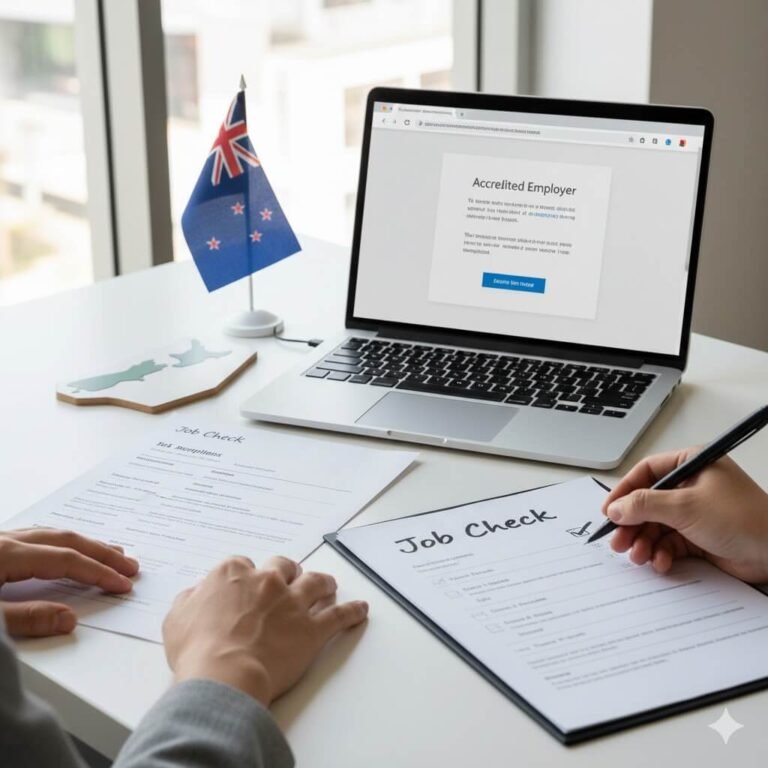
Transfer Visa to New Passport NZ: How to Move Your eVisa or Label
Passports expire. They get lost, damaged, replaced after a wedding, or swapped simply because ten years have passed. Your New Zealand visa, though, is recorded against the passport you held when the visa was granted. Immigration New Zealand (INZ) links the two together in its system, and airlines, employers and border officers check that link.
That means a fresh passport creates a small but important job. You must tell INZ about the new passport and have your visa transferred into it before you travel. It does not matter whether your visa is an electronic eVisa or a physical label stuck in your old passport. Both types need to be moved. This guide explains the two routes, what each one costs, the documents you need, and the situations that catch people out, such as lost passports and name changes.
Why the transfer matters
A New Zealand visa is not a standalone document. INZ records every visa against a specific passport, and your visa needs to sit in a valid passport if you want to travel. If you turn up at check-in with a new passport and a visa that is still attached to the old one, the records will not match.
INZ is clear about the order of events: get the visa transferred first, then travel. The transfer does not change your visa conditions, extend your visa, or give you extra time in New Zealand. It simply moves the existing visa onto your new passport number so your travel documents and INZ’s records line up again.
eVisa or label: what are you moving?
Almost all New Zealand visas are now issued as eVisas. An eVisa is granted by letter or email rather than as a sticker, and the details are held electronically. Airlines, employers, education providers and other government agencies can check an eVisa online, and you can check your own details through INZ’s Visa Verification Service.
A visa label is the physical sticker that used to be placed in passports. Some people still hold labels in older passports, and INZ will still put a label in a passport if you ask for one and pay the fee. When you transfer, you can choose either format for your new passport:
- Transfer to an eVisa: free, done online, and INZ recommends it as the quickest option.
- Transfer to a visa label: a fee applies, and you have to send your passport to INZ.
You do not need a label for your visa to be valid. If your old passport held a label, you are free to switch to an eVisa in the new passport at no cost.

Transferring an eVisa to a new passport
The eVisa transfer is an online request using INZ’s Application for Transfer or Confirmation of a Visa. There is no application fee.
What you need
- A copy of your new passport
- A copy of your old passport, if you still have it
- Evidence of any name change, if the name in your new passport differs from the old one (more on this below)
Complete the online form, upload the copies, and INZ updates your record so the visa sits against the new passport. Keep your eVisa letter once the transfer is confirmed, and check the details through the Visa Verification Service before you book travel.
Skilled Migrant Category Interim Visa holders
There is one exception to the standard form. If you hold a Skilled Migrant Category (SMC) Interim Visa, you use a separate online form, the Application for a Transfer of a Visa for Skilled Migrant Category Interim Visa Holders. You upload copies of the details pages of both passports, showing your photo, full name, date of birth and passport number, and any name change evidence. There is no fee, and SMC Interim Visa holders cannot request a visa label.
Transferring a visa label with form INZ 1023
If you want a physical label in your new passport, the process uses the same Application for Transfer or Confirmation of a Visa. Online, this is INZ’s transfer and confirmation form. On paper, it is form INZ 1023, the Application for Transfer or Confirmation of a Visa.
How it works
- Complete the application form, online or on paper, and pay the fee. Online applicants pay when they submit the form, and INZ accepts credit and debit cards.
- Send your new passport to INZ, along with a copy of your application confirmation email if you applied online, or your completed paper form and fee if you applied by paper.
- INZ places the label in the passport and couriers it back. Within New Zealand it goes to your nominated address. If you are outside New Zealand, include a pre-paid return courier bag with your application.
INZ strongly recommends sending your passport by courier so delivery is secure and trackable. The address INZ publishes for this is Immigration NZ, DX Box EP71514, 20 Fairfax Avenue, Penrose, Auckland 1061, New Zealand.
Paper form applicants also provide their previous passport (the original, or a certified copy), if it is available. This matches the residence instructions in INZ’s operations manual: a paper application needs your current original passport plus your previous passport or a certified copy of it, while an online applicant sends scanned copies with the form and then sends the current original passport to INZ.
Fees and processing time
The transfer fee for moving a visa label from one passport to another is NZD 225 for applications made in New Zealand, under the fee schedule in the Immigration (Visa, Entry Permission, and Related Matters) Regulations 2010. Fees differ by where you apply, so use INZ’s Fees, Decision Times and Where to Apply tool to confirm the current amount for your location before you pay.
For timing, INZ publishes that 80 percent of visa sticker applications are processed within 2.5 weeks, and notes that the fees and processing times for adding a sticker to a current passport are the same as for transferring a sticker to a new passport. INZ describes the eVisa transfer as the quickest way to move a visa, although it does not publish a fixed timeframe for eVisa transfers on its transfer page. Either way, start well before you intend to travel rather than in the last week.
What details must match
The point of the transfer is that INZ’s record of you matches your new passport exactly. The copies you supply need to show your photo page clearly, including your full name, date of birth and passport number.
If your name has changed
Names change for ordinary reasons: marriage, divorce, deed poll, or a correction. If your new passport is in a different name from the one on your visa, you must upload evidence of the change with your transfer request. INZ gives examples such as a marriage certificate, a new birth certificate, or another official name change document. Without that evidence linking the two names, INZ cannot be sure the visa belongs to the person holding the new passport, and the transfer will stall.
If your old passport is unavailable
The old passport copy is requested “if available”. If your old passport was destroyed by your issuing authority when the new one was made, or you no longer have it for another reason, say so in your application and provide what evidence you can. The lost and stolen passport process below covers the situation where the old passport has gone missing entirely.
Can you travel while carrying both passports?
People often ask whether they can simply carry the old passport with the visa and the new passport together, and sort the transfer out later. INZ’s guidance does not offer that as an option. Its position is that your visa must be in a valid passport to travel, and if your passport has expired or been replaced you must apply to transfer the visa to the new passport before you can travel.
In practice, that means you should not rely on presenting two passports at the airport. Complete the transfer, confirm the visa is recorded against the new passport number, and then travel. If your old passport was returned to you with the visa label in it, keep it somewhere safe anyway. It is your backup evidence of the visa while paperwork is in flight.
If your passport is lost or stolen
A lost or stolen passport adds a few steps before the transfer can happen. INZ sets out the sequence:
- Report the loss or theft to your local police station. This helps prevent anyone else using the passport.
- Contact whoever issued your passport, such as your embassy, high commission or consulate, to report it and request a replacement. They may ask for a copy of the police report. If it was a New Zealand passport, you deal with Te Mata Uruwhenua Identity and Passports at the Department of Internal Affairs through passports.govt.nz. Getting ready for that application? Our guide to NZ passport photo requirements covers the photo rules that trip people up.
- Once the new passport arrives, request the visa transfer as normal. There is no fee to move an eVisa; the label fee applies if you want a physical label, and you will need to send INZ your new passport.
Two wrinkles are worth knowing. First, if you later find the passport you reported lost, tell the police, and check with your passport issuer, because the old passport may already have been cancelled once a replacement was requested. Second, if your visa is due to expire before the replacement passport arrives, contact INZ for advice rather than assuming everything will be fine.
Applying for the balance of your visa
There is a related situation that uses the same form. Sometimes a temporary visa is granted for less time than was requested because the passport was about to expire. Once you have a new passport with a longer life, you can apply to have the balance of the visa transferred into it, so you receive the full period originally sought.
The balance can be issued as an eVisa or as a label. A label again requires the fee and sending your passport to INZ. With the application you include copies of your new passport, your old passport if available, and the letter from INZ confirming your visa balance.
Resident visas and travel conditions
Residents use the same transfer process, and it matters just as much. A resident visa still has to sit in a valid passport for you to travel on it. If your passport expires, transfer the visa before you next trip overseas. Our Resident Visa NZ guide explains the residence categories and the conditions that come with them.
Two points deserve care:
- A transfer does not change or renew your travel conditions. It moves the visa exactly as it stands. If your resident visa travel conditions have expired while you are outside New Zealand, transferring the visa will not fix that problem, and your visa may have expired. Options such as a variation of travel conditions or a Permanent Resident Visa are separate applications.
- Australian citizens and Australian permanent residents living in New Zealand can use the same form to obtain an eVisa or a label as evidence of their resident status. INZ warns that if an Australian citizen travels out of New Zealand, their resident visa expires and the eVisa or label becomes invalid. Those who want to avoid that can apply for a variation of travel conditions using form INZ 1175, the Application from a Resident or Former Resident Visa Holder.
Some long-standing residents are in a different position again. People who were granted a residence permit under the Immigration Act 1987 or the Immigration Act 1964 can apply through the same form for confirmation of their residence status, and a fee applies. People who arrived before 2 April 1974 and no longer have their original passport need to show evidence of having lived continuously in New Zealand or Australia since that date. INZ’s operations manual describes the same process: applications to endorse residence status in a passport, or to transfer a residence class visa to a new travel document, are made on the transfer or confirmation form, with the fee where one applies.
A quick checklist
- Renew or replace your passport first, and make sure any new photo meets the rules.
- Decide between an eVisa (free, online, quickest per INZ) and a label (fee, passport sent to INZ).
- Gather copies of your new passport and old passport, plus name change evidence if relevant.
- Complete the Application for Transfer or Confirmation of a Visa online, or form INZ 1023 on paper.
- For a label, pay the fee and courier your new passport to INZ with the confirmation email copy.
- Check your updated details on the Visa Verification Service before travelling.
- Give it time: label transfers can take around 2.5 weeks for most applications.
Getting a new passport is routine. Moving the visa that belongs in it is a small piece of admin, but it is the piece that keeps your travel, work checks and re-entry running smoothly. Do it as soon as the new passport lands, and the two documents will never fall out of step.
You can browse more guides like this in our Visa and Immigration section.
Sources
- Immigration New Zealand, Transferring a visa to a new passport: https://www.immigration.govt.nz/process-to-apply/once-you-have-a-visa/manage-your-visa-and-passport/transferring-a-visa-to-a-new-passport/
- Immigration New Zealand, How to get a visa sticker for a passport: https://www.immigration.govt.nz/visas/how-to-get-a-visa-sticker-for-a-passport/
- Immigration New Zealand, If your passport is lost or stolen: https://www.immigration.govt.nz/process-to-apply/once-you-have-a-visa/manage-your-visa-and-passport/if-your-passport-is-lost-or-stolen/
- Immigration New Zealand, Application for a transfer of a visa for Skilled Migrant Category (SMC) Interim Visa holders: https://www.immigration.govt.nz/formshelp/application-to-transfer-smc-iv
- Immigration New Zealand, Manage your visa and passport: https://www.immigration.govt.nz/process-to-apply/once-you-have-a-visa/manage-your-visa-and-passport/
- Immigration New Zealand, Operations Manual R7.10 Procedure for confirming or transferring a residence class visa: https://www.immigration.govt.nz/opsmanual/43638.htm
- New Zealand Legislation, Immigration (Visa, Entry Permission, and Related Matters) Regulations 2010, Schedule 4 fee table: https://legislation.govt.nz/secondary-legislation/pco-drafted/2010/241/en/latest.pdf