Travel Loan: How It Works, Costs & Key Considerations

The short answer: a travel loan is a personal loan with a holiday label. The product underneath is the same unsecured loan a bank or finance company sells for any purpose. You borrow a set amount, take the trip, and repay with interest over the term. The trip lasts weeks. The repayments can last years, and cancelling the trip does not cancel the loan. Compare loans on the total cost in the disclosure statement, and read the alternatives section before you sign anything.
Every winter, lenders advertise holidays the way airlines do: a beach, a price per week, and an invitation to book now and sort the money out later. A travel loan can be a reasonable tool in a narrow set of circumstances, such as a family event overseas that cannot move. It can also turn a two-week holiday into a three-year expense. This guide explains how travel loans work in New Zealand, what they really cost, the protections the law gives you, and the alternatives worth pricing before you borrow.
What a travel loan actually is
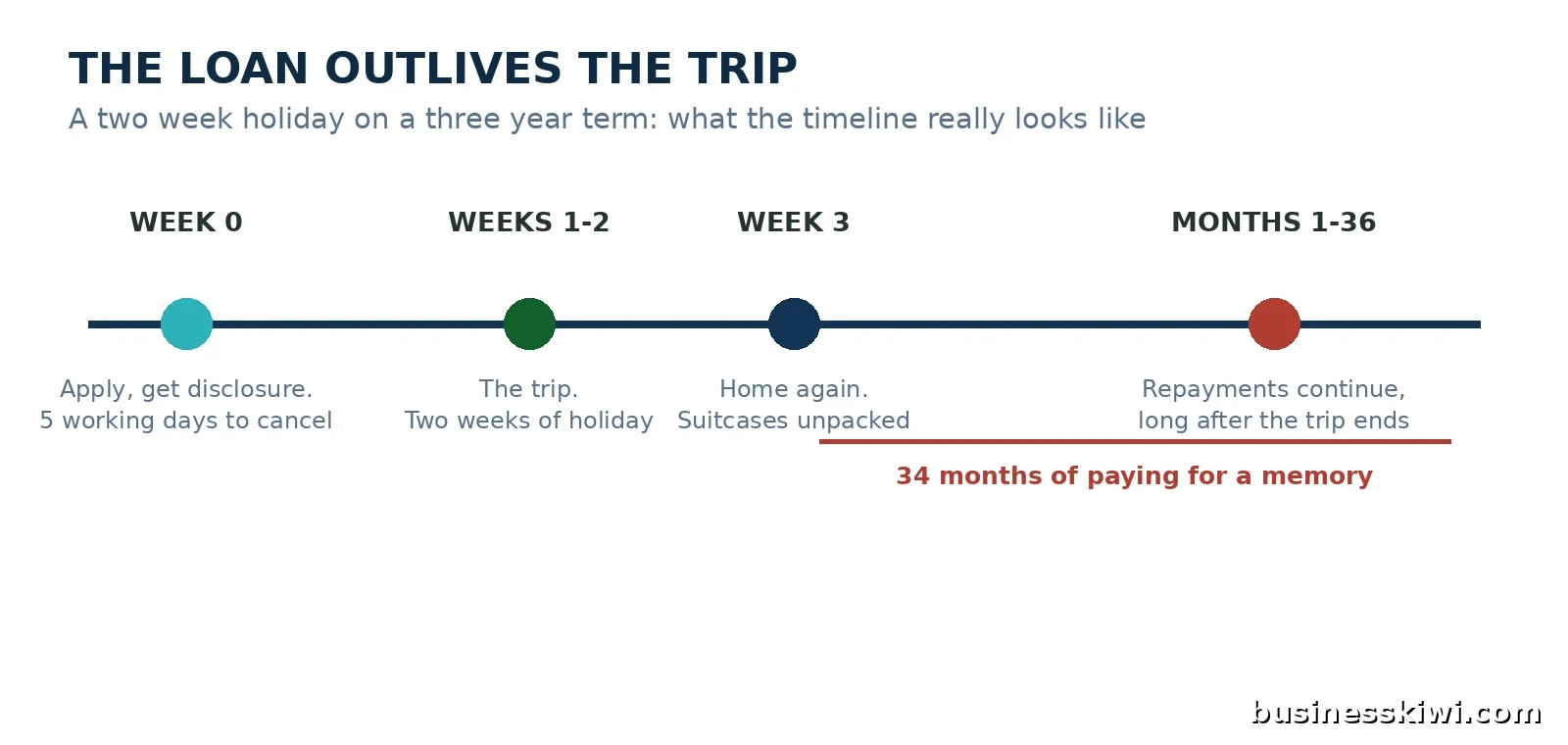
Strip away the marketing and a travel loan is an unsecured personal loan. The lender pays the money to you, not to the airline or hotel. You spend it on the trip, and you owe the lender the repayments regardless of what happens to the trip itself. That last point is the one borrowers most often miss, so it is worth repeating in plain terms: if flights are cancelled, plans change, or you simply come home early, the loan carries on exactly as before. Any refunds come from the travel providers under their own terms. The loan contract is a separate promise.
Banks, credit unions and finance companies all sell personal loans that can be used for travel, and some market them under a travel label. The label changes nothing about the contract. What varies between lenders is the interest rate you qualify for, the fees, the term, and how strict the affordability assessment is. Interest rates on unsecured personal loans are set borrower by borrower, based largely on credit history and income stability, which is why advertised rates always come with the words “from” in front of them.
Because the loan is unsecured, the lender has no asset to claim if you stop paying. That risk is priced into the interest rate, which is why unsecured borrowing costs more than a loan secured against a vehicle or a house, and why the consequences of default land on your credit record instead.
How a travel loan works, step by step
You apply and are assessed. Under the Credit Contracts and Consumer Finance Act, lenders must make reasonable enquiries that the loan is suitable and affordable for you. Expect questions about income, expenses, existing debts and the purpose of the loan, plus a credit check.
You receive disclosure. Before you are committed, the lender must disclose the interest rate, every fee, the repayment amounts and the total cost of credit over the term. This document is the single most useful comparison tool you have. Two loans with the same weekly repayment can have very different totals.
You sign, and a cancellation window opens. For consumer credit contracts you generally have 5 working days from receiving the disclosure documents to cancel, provided the statutory conditions are met. You would repay any money drawn down plus interest for those days.
The money lands and repayments start. Repayments are usually fixed and regular, weekly, fortnightly or monthly to match your pay cycle. They start immediately, not after the trip.
You repay to the end of the term. Most personal loans allow extra repayments, though some charge an early settlement fee. Check the disclosure statement if you think you might clear it early.

What it costs: the term is the trap
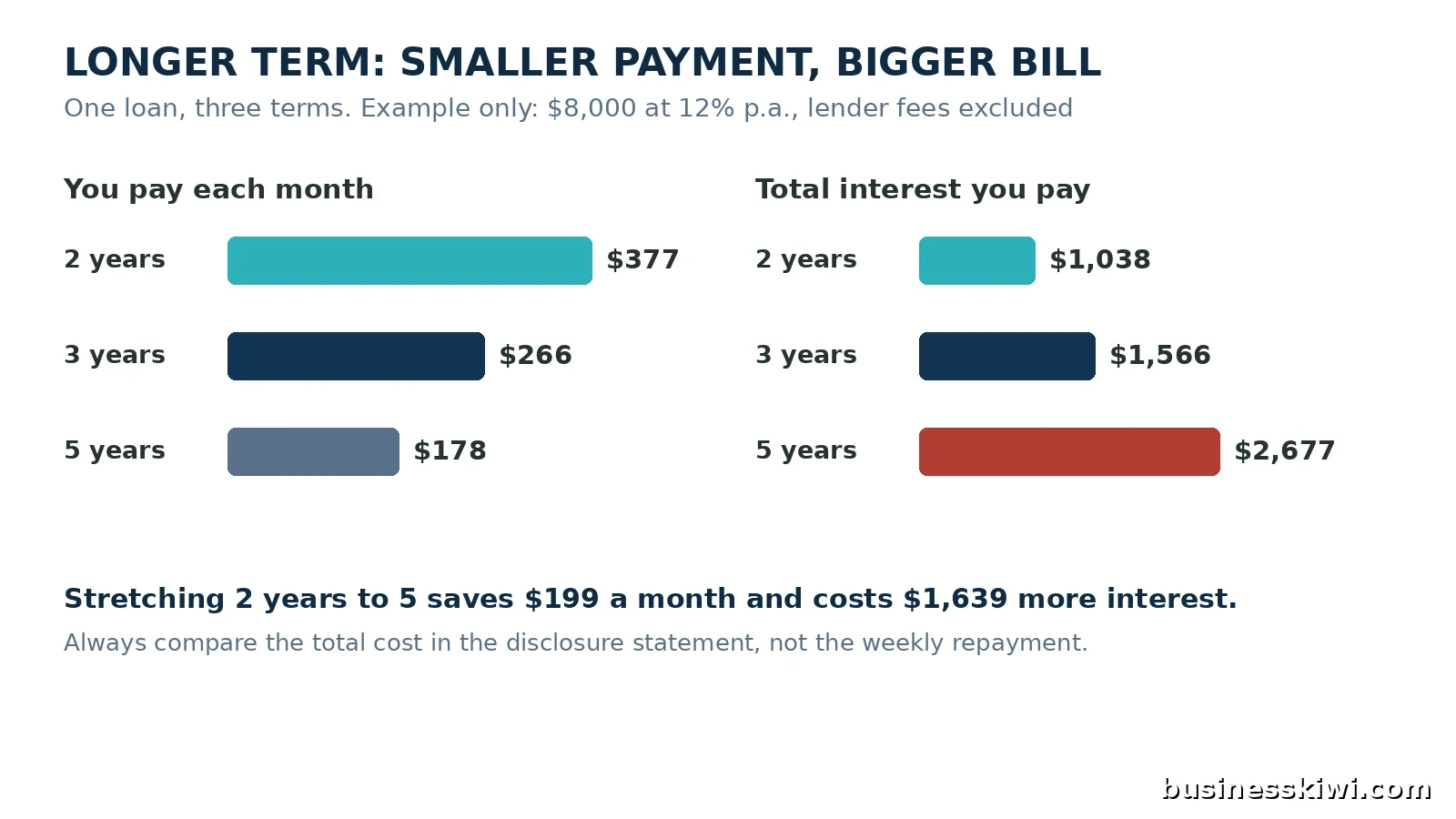
The cost of a loan is the interest plus fees over the whole term, and the term is where the real money hides. A longer term cuts the repayment and quietly multiplies the interest. The table uses one example so the shape is easy to see. The figures are an illustration, not a quote: an $8,000 loan at an example fixed rate of 12 percent a year, with lender fees left out, since fees differ by lender and would only add to these totals.
Read the table backwards for the clearest lesson. Dropping the repayment from $377 to $178 a month feels like a saving of nearly $200. It costs $1,639 in extra interest, and it means you are still paying for the holiday two years after the next one could have happened. On a real application, ask every lender for the same three numbers at your actual rate: the repayment, the total interest, and the total of all fees. The disclosure statement must show them.
Fees to look for in the disclosure include an establishment fee, monthly or annual account fees, missed payment fees, and any early settlement fee. Under the CCCFA, credit fees must be reasonable, and the total cost of credit must be disclosed. If a lender’s marketing emphasises the weekly repayment and says nothing about the total, that silence is doing work.
Why not just top up the mortgage?
Homeowners often ask this, because mortgage rates are much lower than personal loan rates. The rate is lower. The trap is the term. A mortgage top-up does not get its own short repayment schedule unless you deliberately create one. Folded into a 25 year home loan, the holiday is repaid across decades.
Run the same illustration. Borrow $8,000 at an example mortgage rate of 5.5 percent and repay it only across a full 25 year term, and the interest alone comes to about $6,738, more than four times the interest on the three year personal loan example, for the same holiday. That is not how a careful borrower uses a top-up: the careful version repays the travel amount fast, on top of the normal mortgage payment, as if it were a short loan at a cheap rate. Done that way, a top-up can be the cheapest route of all. Done the lazy way, by simply extending the mortgage balance and forgetting it, it is the most expensive holiday finance most people ever take.
There is a second difference. A personal loan that goes wrong damages your credit record. A mortgage that goes wrong puts the house in play. Borrowing against the home for consumption, a trip, furniture, a car, converts spending problems into housing problems, which is why financial mentors treat top-ups for holidays as a last resort rather than a clever hack. If the trip matters enough to borrow for, it matters enough to carry its own visible repayment with an end date you can circle on a calendar.
What lenders check, and why a decline can be useful
A responsible lender in New Zealand must be satisfied you can repay without substantial hardship. In practice that means payslips or bank statements, a look at your regular expenses, your other debts, and your credit history. Travel loans face an extra headwind in that assessment: the borrowing buys no asset and no income, so it is judged purely against your spare cash flow.
If a mainstream lender declines you, treat it as information before you treat it as an obstacle. The next lender down the chain charges more for a reason, and a high-cost loan for a holiday is how a good trip becomes a long problem. High-cost credit exists for emergencies, and a holiday, however deserved, is not one. If the numbers only work at a high rate, the honest conclusion is that the trip needs to shrink or wait.
The alternatives, priced honestly
Save first, travel second. The same $266 a month from the example, saved instead of repaid, builds the $8,000 in about 30 months with no interest paid at all, and a money-market or savings account adds a little interest instead of charging it. The trip happens later. It also happens without a repayment attached to the memory.
Credit cards. Cards suit small shortfalls repaid inside the interest-free period, and punish anything carried beyond it, because card rates are usually the highest mainstream rates going. Our guide to evaluating credit cards and personal loans in NZ walks through that comparison in depth.
Buy now, pay later for bookings. BNPL is offered on some travel and flight purchases. Since September 2024, BNPL has sat under the consumer credit framework with credit checks required, but providers remain exempt from the full affordability assessments conventional lenders must do, as MBIE’s own guidance sets out. Interest-free only stays interest-free if every instalment lands on time. Late fees are how it stops being cheap.
A smaller trip. The unglamorous option that financial mentors recommend most: spend what the savings actually cover. A loan that funds three weeks down to two weeks of spending removes both the interest and the stress, and nobody on the trip can tell the difference except the person not paying for it afterwards.
The risks that are specific to travel debt
The holiday ends. The loan does not. Every other loan in most people’s lives buys something still in front of them: a car in the driveway, a house around them. A travel loan buys memories. Repaying for a memory, month after month, is the single biggest reason travel debt turns sour psychologically as well as financially.
Plans change, contracts do not. Illness, job changes, family emergencies and airline failures all cancel trips. None of them cancel loans. Travel insurance covers defined events and is worth having, but it does not repay a loan because a trip fell through outside its terms, and the refund path runs through each provider separately.
Spending continues overseas. A loan sized to the flights and hotels does not cover the spending money, and borrowed travellers who run short mid-trip tend to reach for the credit card. Two debts for one holiday is a common pattern in financial mentoring casework.

If you decide to borrow anyway: a checklist
• Borrow the smallest amount that makes the trip work, not the largest you are approved for. Approval is a ceiling, not a target.
• Take the shortest term whose repayments sit comfortably inside your budget, and leave a buffer for the expenses you forgot.
• Compare at least two lenders on total cost from the disclosure statements: rate, fees and total repayable.
• Keep the account the repayments leave from funded ahead of time. Missed payment fees and credit record damage cost more than the holiday was worth.
• Buy travel insurance separately and early if the trip is large. It protects the trip. The loan still needs its own plan.
• Make extra repayments whenever you can if the contract allows it without penalty. Every early dollar kills interest at your full loan rate.
Frequently asked questions
Is a travel loan different from a personal loan?
No, not in substance. It is an unsecured personal loan marketed for holidays. The contract, the interest and your obligations are the same as any personal loan. The label describes the purpose, not a different product.
How much can I borrow for travel?
Lenders set limits from your income, expenses, existing debts and credit history under their responsible lending obligations. Being approved for an amount does not mean borrowing that amount is wise. The right size is the smallest amount that funds the trip.
What interest rate will I pay?
It depends on the lender and on your credit profile, which is why advertised rates say “from”. Your actual rate appears in your disclosure statement before you are committed. Compare that rate, plus fees, across lenders.
Can I cancel a travel loan after signing?
Consumer credit contracts generally carry a right to cancel within 5 working days of receiving the disclosure documents, if the statutory conditions are met. You would repay anything drawn down, plus interest for the days you held it.
What happens to the loan if my trip is cancelled?
Nothing. The loan continues on its normal schedule. Refunds, if any, come from the airlines, hotels and tour providers under their own terms and travel insurance. Chase those quickly, and consider paying any refund straight off the loan.
Is buy now, pay later a cheaper way to book travel?
Only if every instalment is paid on time. BNPL joined the consumer credit framework in September 2024 with credit checks, but without the full affordability assessments other lenders must complete. Late fees can make it more expensive than it looks, and the debt is real even when the marketing makes it feel light.
Should I use a travel loan for a honeymoon or family event?
That is the strongest case for one: a fixed date that cannot move, for an event that matters. Even then, borrow the minimum, choose the shortest manageable term, and treat the checklist above as non-negotiable. Sentiment explains the loan. It does not reduce its cost.
The bottom line
A travel loan is simple to get and slow to leave. It works exactly like any unsecured personal loan: disclosure, fixed repayments, interest that grows with the term, and obligations that survive whatever happens to the trip. If you borrow, borrow small, borrow short, and compare disclosure statements rather than weekly repayments. And price the alternative first, because the same monthly amount saved instead of repaid buys the same holiday, a little later, for about $1,500 less on an $8,000 trip.
More money guides for New Zealanders are in our finance section.