Income Protection Insurance NZ

Ask a room of New Zealanders what would happen to their income if they could not work for six months, and most will mention ACC. It is a reasonable answer, right up until the reason they are off work is an illness. ACC pays nothing for illness. It never has. Cancer, a stroke, a serious mental health condition, a back that slowly gives out over years of physical work: none of these are accidents, so the scheme many people treat as their safety net does not apply.
Income protection insurance is the private product built for that hole. It pays a monthly benefit when illness or injury stops you working, until you are back at work or the policy’s benefit period runs out. This guide explains how it works here, where ACC stops and private cover starts, the choices that shape a policy, how the tax rules operate, and what to check before you buy. General information only, not personalised financial advice.
Income protection at a glance
- It pays a regular monthly benefit if illness or injury stops you working and you meet the policy’s definition of disability.
- Cover applies to illness as well as injury. That is the fundamental difference from ACC.
- Insurers will not replace all of your pay. Indemnity benefits are tested against your earnings at claim time, commonly against a cap of 75% of pre-disability income.
- You choose a waiting period before payments start, and a benefit period that sets the longest a claim can run.
- It is voluntary, and separate from any cover an employer provides.
The gap ACC leaves
ACC is a no-fault accident scheme, and a good one. Break a leg falling off a ladder at home, injure your shoulder at work, tear a ligament playing sport: ACC can help with treatment costs and, if you cannot work, weekly compensation. The boundary is the cause. In ACC’s own words, your injury must be because of an accident, and it will not cover things like illness, conditions from ageing and emotional issues.
Even for accidents, the support has limits:
- Weekly compensation is up to 80% of your income before the injury, based on average weekly earnings. Tax and other deductions still come out.
- Payments usually start on day eight. For a work injury your employer pays 80% of your income for the first week. For an injury outside work, that week usually comes out of your own sick or annual leave.
- ACC counts earnings only up to a maximum level reset each year, so higher earners get noticeably less than 80% of their actual pay.
Illness sits outside all of this. Statutory sick leave is 10 days a year once an employee has been with an employer for six months, and unused leave can build up to 20 days at most. A major operation or a course of chemotherapy can take someone out of work for months, and once sick leave and savings are gone there is no public backstop. Self-employed people are in a thinner position still: no sick leave at all.
That gap, illness first and the accident shortfalls second, is what income protection is sold to fill. Policy offsets do limit how much extra a policy pays on top of ACC, as the worked example below shows.
The two main types: indemnity and agreed value
Every policy you will be quoted is built on one of two ways of setting the benefit. The distinction sounds technical. At claim time it is anything but.
Indemnity cover (often called loss of earnings cover) works out your benefit from the income you were earning just before you became disabled. You prove your earnings at claim time, with payslips if you are an employee or tax returns if you are self-employed. Insurer wordings apply a ceiling: AIA’s wording pays the lesser of the amount in your policy schedule or 75% of your average annual pre-disability income. Indemnity suits a steady salary that is easy to evidence. Its weakness shows when income has recently fallen, because a poor year just before you got sick can be the year your benefit is based on.
Agreed value cover fixes the monthly benefit when you apply, based on your income at that time, and the insurer verifies your income then rather than at claim time. If your earnings later drop, the agreed benefit stays where it was set. That certainty is why agreed value is popular with the self-employed, contractors and business owners whose income moves around. In exchange, insurers limit the proportion of income they will agree to cover, and the tax treatment differs, as explained below.
Some insurers also sell a hybrid, agreed loss of earnings, paying the higher of an agreed amount or a figure based on actual lost earnings. Whichever structure you hold, know which one it is: the type decides what evidence a claim requires and how the benefit is taxed.
Waiting periods: the first big price lever
The waiting period (also called a stand-down or deferred period) is the time between stopping work and the first benefit payment. Nothing is paid for the wait itself. If you recover and return to work before it ends, the policy pays nothing at all.
Options in current NZ insurer documents run wide. AIA offers 2, 4, 8, 13, 26, 52 or 104 weeks, and 4, 8 or 13 weeks are the choices most commonly taken here. The pattern is consistent: the longer the wait, the lower the premium, because you carry the early weeks of risk yourself.
Choosing well is a budgeting exercise. Add up what would actually carry you: banked sick leave, a partner’s income, accessible savings. Someone with 20 days of sick leave and three months of living costs behind them can sensibly take a 13-week wait. A sole trader with no sick leave and two weeks of buffer probably cannot, and pays more for a shorter wait because the household risk is real.
Benefit periods: the second big price lever
The benefit period is the maximum length of one claim. NZ insurer documents commonly offer 2 years, 5 years, or payments through to age 65, with some occupations able to extend to age 70. AIA also lists a 1-year option.
A two-year benefit period costs much less than cover to age 65, and most claims end well within two years. The catch is the claim that does not. A disability at 45 that permanently ends a career is exactly what insurance exists for, and a two-year policy stops paying at 47 with decades of earning life gone. Lengthening the benefit period is where premium money buys the most protection, so it usually makes sense to trim the waiting period first and this one last. Many policies can also pay a partial benefit if you return to work part time on a reduced income, though the rules are wording-specific.
A worked example (illustrative only)
The figures below are simple arithmetic on a stated salary, using percentages from the sources listed at the end of this article. They are not quotes, and your own policy wording would govern any real claim.
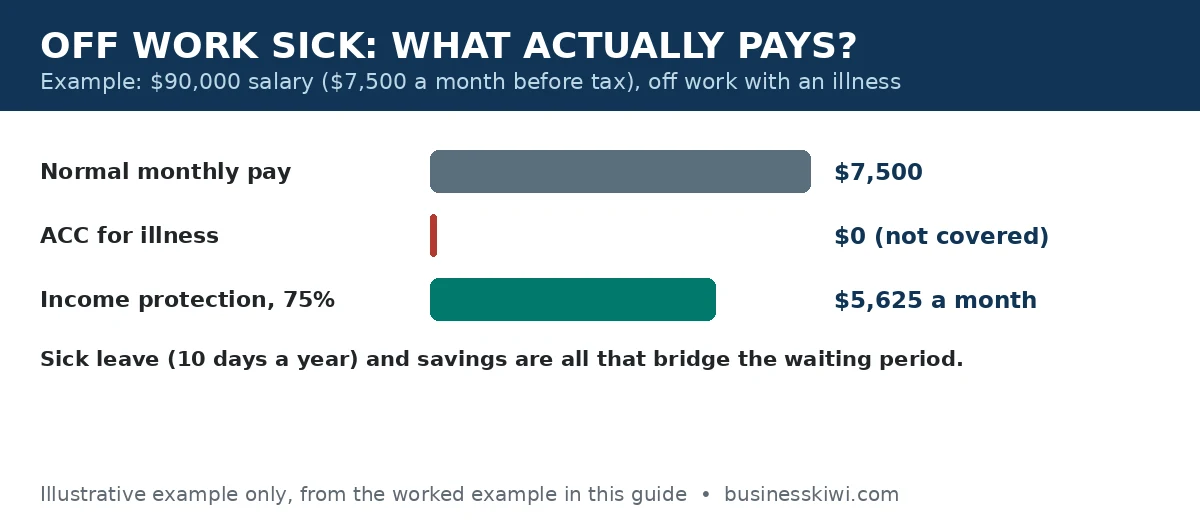
Take an employee earning $90,000 a year, or $7,500 a month before tax. She holds an indemnity policy set at 75% of income, with an 8-week waiting period and a benefit period to age 65. An illness keeps her off work for six months.
- ACC pays nothing. The cause is illness, not an accident, and the policy pays nothing during the 8-week wait either. Her sick leave and savings cover that stretch.
- From week nine, the policy pays 75% of $7,500: $5,625 a month before tax. Across the remaining four months that is $22,500 in gross benefits, taxable as income just as her salary was.
Change one fact and the picture flips. If the six months off followed a serious car accident, ACC weekly compensation of up to 80% of her pre-injury earnings works out at about $1,385 a week before tax, above the policy’s 75% level. Her policy’s offset clause then reduces the insurance benefit by what ACC pays, so it may pay little or nothing extra while ACC compensation continues. Same policy, same time off work, a very different division of who pays.
What affects the cost
No honest article can give you a typical premium, because insurers price each applicant individually. Advertised quotes are illustrations, not offers. The drivers of your price include:
- Your age, and premium structure. The FMA notes that most premiums go up annually based on your age or inflation.
- Your health, medical history, and whether you smoke, all assessed when you apply.
- Your occupation. Insurers rate a roofer and an accountant very differently, because their chances of being unable to work differ.
- The benefit amount, the waiting period, and the length of the benefit period.
- The policy type, since the two structures make different promises.
Because structure drives price, compare quotes on identical settings: same benefit amount, same wait, same benefit period. A cheaper quote built on a two-year benefit period is not a better deal than a dearer one paying to age 65. They are different products wearing similar clothes.
How income protection is taxed
This is where confident wrong answers circulate most freely, so here is the position as Inland Revenue states it.
IRD’s general rule is that premiums are deductible when the insurance receipts would be taxable. Claim payments under an income protection policy are income under section CE 11 of the Income Tax Act 2007, subject to exemptions that include payments not calculated by reference to a loss of earnings. Insurer wordings confirm the split: AIA’s policy document states that premiums for agreed value policies are not deductible and claim payments are not taxable. Put together, the working position is:
| Policy type | Premiums deductible? | Benefit taxed? |
|---|---|---|
| Indemnity / loss of earnings | Generally yes | Generally yes, it replaces taxable income |
| Agreed value | Generally no | Generally no |
Employer-paid and group schemes follow their own rules, so treat the table as a starting point. Never claim a deduction for an agreed value policy just because a website said income protection is deductible. Check which type you hold, keep the insurer’s annual statement, and confirm your position with a tax adviser. If a benefit is taxable, it is taxed at your normal marginal rates, which our Tax Rates NZ guide sets out in full.
One piece of housekeeping: a government income insurance scheme covering illness and job loss was proposed in recent years, but it was never put in place and nobody can claim under it.
Mortgage repayment insurance is a different product
Bank and insurer ranges often place mortgage repayment insurance (or mortgage protection) next to income protection, and the two are easily confused. They do different jobs.
Mortgage repayment cover pays an amount tied to your housing costs rather than your whole income. AIA’s version pays up to 115% of your mortgage or rent payments, or 45% of your gross income, and it is designed to keep a roof over your head rather than replace your pay in full. Some mortgage products also treat ACC differently: at least one NZ mortgage and income product states in its own document that it does not offset ACC payments, where most standard income protection policies do.
Neither product substitutes for the other. Mortgage cover alone leaves food, power, rates and every other bill unpaid, while full income protection costs more because it does more. Holding both can also mean paying twice for overlapping protection.
Making a claim
Claims follow a pattern across insurers, even though forms and timeframes differ.
- Tell the insurer early, ideally as soon as you know you will be off work beyond your waiting period. The wait runs from when you stopped work, not from when you call.
- Expect medical evidence: information from your GP or specialist confirming you cannot work, and why. On an indemnity policy, expect financial evidence too: payslips for employees, tax returns for the self-employed.
- While a claim runs, the insurer can ask for updated medical certificates and review whether you can return in some capacity. Partial benefits can apply if you go back part time.
- Offsets are applied at payment time. ACC weekly compensation, sick leave payments and similar benefits for the same disability are deducted under most wordings, so the combined total does not exceed the insured level.
- Many policies stop charging premiums while a claim is being paid. AIA lists waiver of premium among its built-in features. Check whether yours does the same.
If a claim is declined, complain to the insurer first. After that you can go to the insurer’s dispute resolution scheme, which is free and independent.
How to compare policies
Most households arrange this cover in the same budgeting conversation as their Car Insurance NZ and house insurance, and the discipline is the same: compare the wording, not the brochure. Our wider Finance, Tax & Money guides cover the companion decisions. For income protection, line policies up on these points:
- The disability definition. Does the policy pay when you cannot do your own occupation, or only when you cannot do any work you are suited to? The FMA warns that definitions differ between providers, and this one decides claims.
- Offsets. Find the clause dealing with ACC and other income. It is the most overlooked paragraph in these policies.
- Exclusions and pre-existing conditions. What was excluded or loaded when you applied, and what does the wording exclude outright?
- Premium structure. Are premiums stepped, rising with age, or level? Are they guaranteed, or can the insurer review them?
- The insurer behind the policy. Since 31 March 2025, insurers serving NZ consumers must hold an FMA licence and publish a fair conduct programme summary, worth reading before you commit.
- Whether you are doubling up. Group cover through work, a partner’s policy and a mortgage product can overlap, and the FMA specifically advises checking you are not paying twice for the same protection.
If you are replacing an existing policy, keep the old one running until the new one is in force. A gap, or a fresh exclusion for a condition developed since, can leave you worse off.
Common mistakes to avoid
- Assuming ACC covers illness. It does not, and this single misunderstanding is why most people who need this cover do not have it.
- Leaving something out of the application. The Insurance & Financial Services Ombudsman is blunt: you must share your medical history, including things as minor as feeling stressed or a sore back you mentioned to your doctor, even if nothing was diagnosed. Non-disclosure can see a claim declined and the policy cancelled years later, at the worst possible moment.
- Choosing the shortest waiting period by default. It is the most expensive way to buy cover, and it duplicates what sick leave and modest savings already do.
- Cutting the benefit period to cut cost. A two-year cap removes the catastrophic scenario, which is the entire point of the policy.
- Buying two policies and expecting two payments. Offsets mean the second policy commonly pays little or nothing extra.
- Setting cover once and forgetting it. A policy sized to a $60,000 income does not keep pace at $95,000. Review the amount when income, debts or dependants change.
Frequently asked questions
Does ACC make income protection unnecessary?
No. ACC covers accidental injury only, pays up to 80% of earnings up to a capped level, and starts after the first week. It pays nothing for illness. Income protection exists mainly for that gap.
Are income protection premiums tax deductible?
It depends on the type. Premiums for indemnity cover, where the benefit is taxable, are generally deductible. Premiums for agreed value cover, where the benefit is not taxed, generally are not. Employer and group arrangements have their own rules, so confirm your position with a tax adviser.
Does income protection cover mental health conditions?
It can. The trigger is meeting the policy’s definition of disability, and time off for conditions such as depression or anxiety is treated as illness under these policies. Terms vary, and some policies apply specific limits to mental health claims, so the wording matters more than the marketing. ACC covers mental injury only in narrow circumstances, such as following a physical injury or certain traumatic events.
What does income protection not cover?
It does not pay during the waiting period, it does not pay if you can still work within the policy’s definition, and it does not cover redundancy unless you have bought redundancy cover as a separate add-on. Conditions excluded at underwriting, or caught by a policy exclusion, will not be paid either.
I am self-employed. Which type should I look at?
Self-employed income is harder to prove and swings from year to year, which is why agreed value cover is often considered: the benefit is fixed at application, while your income evidence is fresh. Indemnity cover can still work, but expect any claim to be assessed against your recent tax returns, including a bad year if that is what they show. A general pointer only, not advice.
Will ACC payments reduce my income protection benefit?
Under most standard wordings, yes. An offsets clause reduces your benefit by ACC weekly compensation and similar payments for the same disability. Because ACC pays up to 80% and indemnity cover is typically capped at 75%, the policy may pay nothing extra while ACC is paying in full. Some mortgage repayment products state they do not offset ACC.
Sources
- ACC, What we cover: injury must be because of an accident; no cover for illness or conditions from ageing. https://www.acc.co.nz/im-injured/what-we-cover
- ACC, Weekly compensation and Weekly compensation for employees: up to 80% of pre-injury earnings, usually from day eight. https://www.acc.co.nz/im-injured/financial-support/weekly-compensation and https://www.acc.co.nz/im-injured/financial-support/weekly-compensation/weekly-compensation-for-employees
- Employment New Zealand, Sick leave: 10 days a year after six months, accumulating to 20 days maximum. https://www.employment.govt.nz/leave-and-holidays/sick-leave/taking-sick-leave
- AIA New Zealand, Income Protection Insurance product summary: cover types, waiting periods of 2 to 104 weeks, benefit periods of 1, 2 or 5 years or to age 65/70, mortgage cover levels. http://www.aia.co.nz/en/our-products/income-protection-insurance.html
- AIA, REAL Income Protection policy wording: the 75% indemnity test, the offsets clause, partial disability conditions, and the clause recording that agreed value premiums are not deductible and claim payments are not taxable. https://www.aia.co.nz/content/dam/nz/en/docs/our-products/policy-wordings/policy-wordings-legacy/real-personal/aia-real-income-protection-av-indemnity-policy-wordings.pdf
- Inland Revenue Tax Policy: premiums are generally deductible when the insurance receipts are taxable. https://www.taxpolicy.ird.govt.nz
- Inland Revenue, QB 18/04: claim amounts are income under section CE 11 of the Income Tax Act 2007, subject to exemptions including payments not calculated by reference to a loss of earnings. https://www.taxtechnical.ird.govt.nz/-/media/project/ir/tt/pdfs/questions-we-ve-been-asked/2018/qb18-04.pdf
- Financial Markets Authority, Insurance: insurer licensing and fair conduct programmes from 31 March 2025, differing definitions, rising premiums, doubling up, replacing policies. https://www.fma.govt.nz/consumer/everyday-finance/insurance/
- Insurance & Financial Services Ombudsman, Things to know about nondisclosure (2024): what must be disclosed for income protection, including undiagnosed symptoms discussed with a doctor. https://ifso-assets.s3.ap-southeast-2.amazonaws.com/docs/Non-disclosure.pdf
General information only. Income protection policies differ between insurers and change over time, and tax treatment depends on the type of policy and your circumstances. Always read the policy wording for any policy you are considering, and seek personalised advice from a licensed financial adviser if you need a recommendation.