Solar Buy Back Rates NZ
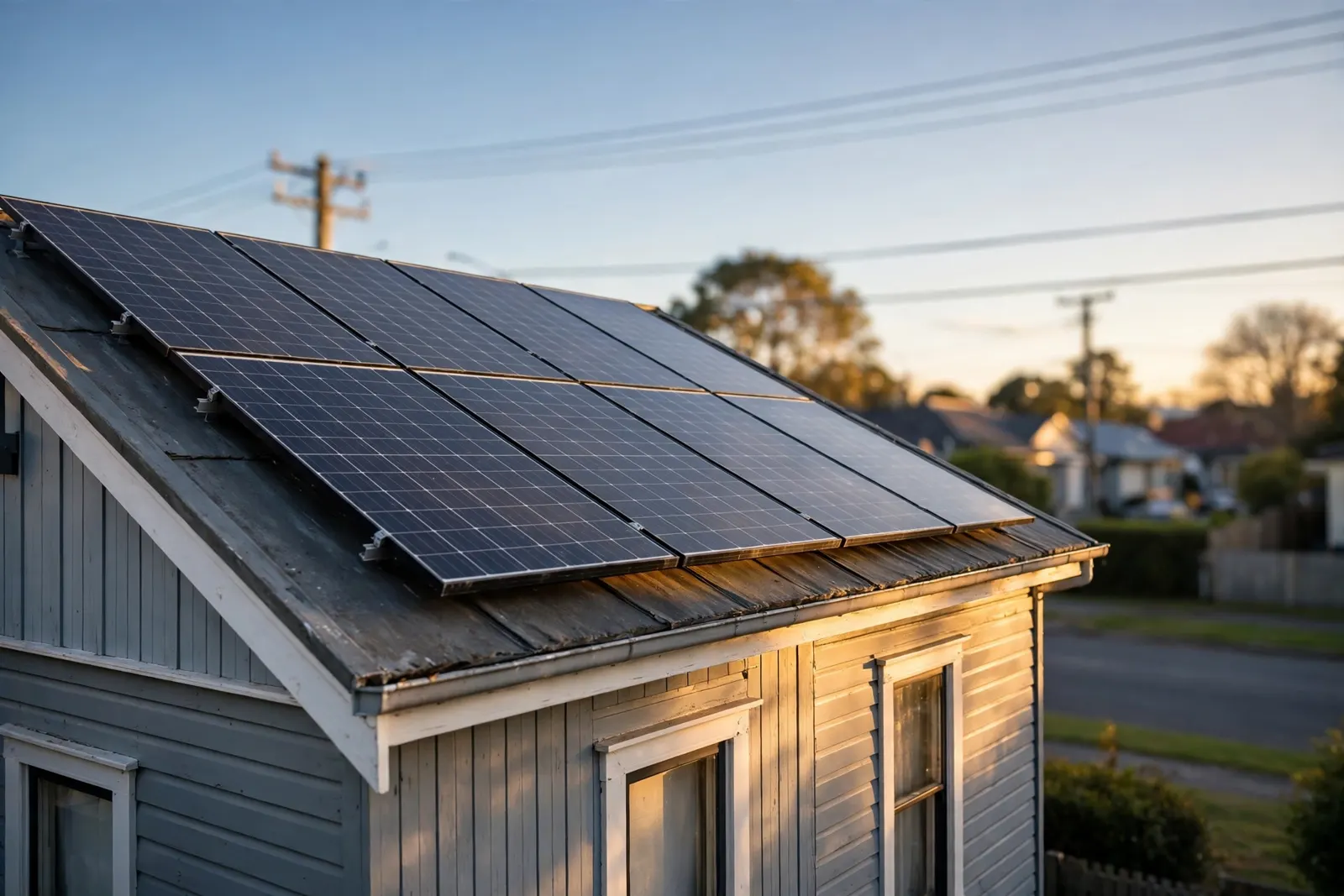
Once the panels are on the roof, the question changes. It is no longer just about what solar costs. It is about what happens at midday in January, when the house is empty, the hot water cylinder is already hot, and your system is generating far more than anyone at home can use. That surplus flows out through your meter and into the local network, and your retailer pays you for it at a buy-back rate.
The catch is that buy-back rates are the least standardised number in the whole solar equation. One retailer pays a flat 8 cents per kilowatt-hour. Another pays 15 cents most of the year and 24 cents if you can export during a winter evening peak. The rate also interacts with everything else on your bill: what you pay for imported power, whether your plan has time-of-use pricing, and whether you are registered for GST. This guide sets out the rates the major retailers publish on their own websites, checked in October 2026, so you can judge a solar plan on the whole picture rather than one headline number.
If you are still at the deciding stage, our Solar Panels NZ guide covers system sizes, costs and payback periods. This article picks up where that one leaves off.
Quick answer
Most New Zealand households exporting solar power in 2026 earn somewhere between 8c and 20c per kWh, a range EECA uses in its own research on residential solar economics. Flat rates at the big retailers currently sit between 8c and 15c per kWh. Time-of-use plans pay more for exports during morning and evening peaks, up to 25c per kWh in the sharpest cases, and less at other times. Almost every published rate excludes GST, which matters only if you are GST registered. And in nearly every scenario, a kilowatt-hour you use yourself is worth more than one you export, because using it yourself avoids the full retail price of imported power.
How solar buy-back actually works
New Zealand runs what EECA describes as a net metering regime. The order of events matters:
- Your panels generate electricity and your home uses it first. This portion never touches the meter.
- If generation exceeds what the house is drawing at that moment, the surplus is exported to the distribution network.
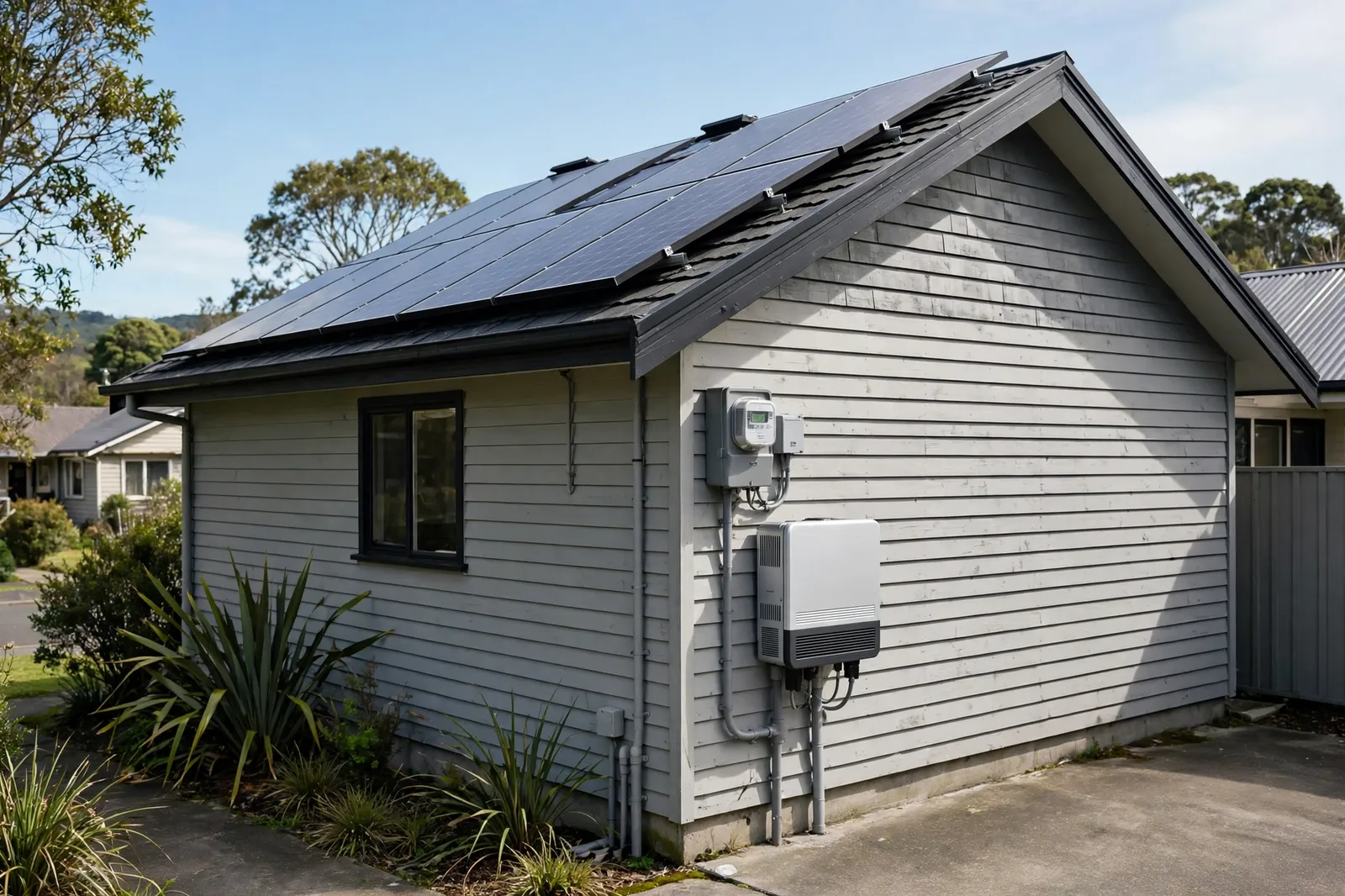
- An import/export meter records both directions separately. One register tracks what you buy, another tracks what you sell.
- Your retailer credits the exported units against your bill at the buy-back rate in your plan.
Nothing is stored, and nothing is netted off hour by hour in the way the term “net metering” sometimes suggests. You are a small generator selling a product at a price your retailer sets, while remaining a customer who buys the same product back later at full retail price.
Getting set up requires an import/export meter if you do not already have a suitable smart meter. Meridian says one costs around $150; Genesis charges $210 including GST for the meter its HomeGen customers need. Your distributor (the local lines company) also has to approve the connection, because exported power flows through its network.
Current buy-back rates by retailer
The table below uses only rates published on each retailer’s own website, checked in October 2026. Buy-back rates are variable at most retailers and can change on notice, so treat this as a snapshot and confirm the figure for your address before switching.
| Retailer and plan | Buy-back rate | Key conditions |
|---|---|---|
| Meridian, open-term plans (Freedom, Night Saver) | 15c/kWh, rising to 24c/kWh during winter peaks | Winter peak is 7am to 10am and 5pm to 9pm, July to September. Rates exclude GST. Communicating smart meter needed for the peak rate. |
| Meridian, fixed-term plans (EV, Bach) | 12c/kWh | Flat rate, excludes GST. |
| Powershop | 13c/kWh, rising to 23c/kWh during winter peaks | Winter peak is weekdays 7am to 11am and 5pm to 9pm, July to September. No buy-back cap. |
| Genesis, HomeGen | 12.5c/kWh | Flat rate, paid as a separate credit on the bill. Systems under 50 kW. Import/export meter costs $210 including GST. |
| Mercury, standard buy-back | 11.1c/kWh | A premium 18c/kWh applies on the Harrisons Solar offer for the first 500 units per billing cycle, then the standard rate applies. |
| Contact, most residential plans (including Basic and Good Weekends) | 8c/kWh | Flat rate, excludes GST. |
| Contact, Good Charge (current version) | 25c/kWh at peak, 8c/kWh at other times | Peak is weekdays 7am to 9am and 6pm to 10pm. Rates exclude GST. Customers who joined Good Charge before 29 June 2026 stay on the flat rate unless they switch to the new version. |
Two things stand out from the retailers’ own pages. First, the gap between the lowest flat rate (Contact at 8c) and the highest standard rate (Meridian at 15c) is nearly two to one, which compounds over thousands of exported units a year. Second, the highest numbers in the table are all peak rates with narrow windows. A rooftop array without a battery generates almost nothing at 7am in July or at 6pm on a winter evening, so peak rates reward batteries far more than they reward a standard north-facing roof.
Why there is no 1-for-1 net metering in NZ
People new to solar often ask why the retailer will not simply swap exported units for imported units, one for one. The answer sits inside the retail price itself.
The price you pay per kWh for imported power is a bundle. It covers the energy itself, but also transmission and local distribution charges, metering, industry levies, the retailer’s operating costs and margin, and GST. When you export a kWh, the only part your retailer genuinely avoids buying is the energy component, roughly the wholesale value of that power at that moment. Paying you the full retail price for exports would mean refunding lines charges and levies on power that still travelled over the lines to reach your neighbour.
That is why EECA’s research treats self-consumption and export as two different income streams with two different values. Every unit you use yourself displaces a purchase at the full bundled retail price, commonly 30c to 40c per kWh once GST is included. Every unit you export earns the buy-back rate, which EECA puts in a band of 8c to 20c per kWh depending on the retailer and the time of day and year. The arithmetic is not close, and it drives most of the practical advice in this area: size the system to your daytime load, run the dishwasher and hot water cylinder while the sun is up, and treat export income as a bonus rather than the point of the exercise.
The new peak rebates sitting behind the rates
Part of what you now get paid comes from a rule change most solar owners have never heard of. The Electricity Authority amended the Electricity Industry Participation Code in July 2025 so that, from 1 April 2026, electricity distribution businesses must pay rebates (negative charges) when households and small businesses supply power to the network at peak times. Eligibility covers connections up to 45kVA with export limited to 45kW or less, which includes every ordinary rooftop system and most small commercial ones.
The rebate is not paid to you directly. It flows to your retailer, which folds it into the buy-back rate or bill credit you see. The Authority has been open that retailers may repackage the rebate rather than itemise it, so you may never spot it as a line on your bill. What you will notice is the market shifting around it: peak export windows, winter premiums and battery-friendly plans have all become more common as retailers rebuild their solar offers around the new rules. The Authority has also required larger retailers to offer time-varying buy-back plans, so the price paid for exported power reflects when it was supplied.
For readers running panels on business premises, the Business & Industry hub collects our related guides in one place.
GST on exported solar power: homes versus businesses
Buy-back rates are almost always quoted excluding GST, which confuses people the first time a credit lands. The treatment is actually simple, and Meridian explains it plainly in its own solar FAQs:
- If you are not GST registered, GST does not apply to the power you export. You are paid the quoted cents per kWh as a credit and there is nothing to return to Inland Revenue. Nearly all households sit in this camp.
- If you are GST registered and your generation uses business assets (a farm, a commercial building, or a home business that has claimed GST on the system), the exported electricity is a taxable supply. You give the retailer your GST number. The retailer then issues a buyer-created tax invoice, usually shown on your monthly statement, and adds a GST credit equal to 15 percent of the GST-exclusive export amount. That GST goes into your GST return like any other output tax.
Businesses should also know the mechanics differ by retailer. Contact, for example, requires commercial and industrial customers on time-of-use metering to invoice Contact for their exported units rather than receiving an automatic credit. Whoever you are with, keep the statements. Export income and GST credits need to reconcile with your records at year end, and your accountant will ask.
One more point for GST-registered exporters: because the published rates exclude GST, a registered business effectively earns 15 percent more per exported unit than the headline figure, before returning that GST. A non-registered household earns the headline figure, full stop.
What to check in a retailer solar plan
The buy-back rate is the number retailers advertise, so it is the number worth interrogating hardest. Work through these points before you sign:
Is the rate fixed, variable or time-varying? A flat rate is predictable and suits a household that exports mostly at midday. A time-varying rate can pay two or three times more during peaks but usually pays less off-peak. Most retailers can change buy-back rates on notice even on fixed-term plans, so a high rate today is not locked in.
What are the export and system size limits? Genesis caps HomeGen at systems under 50 kW. Contact’s residential terms allow it to set a different price where generation output exceeds 10 kW. Your distributor may also cap how much your inverter can export, and the Electricity Authority’s peak rebate only applies where export is limited to 45kW.
Is there a cap on premium rates? Mercury’s Harrisons Solar offer pays its 18c premium on only the first 500 units in each billing cycle, with anything above that dropping to the standard 11.1c. Powershop, by contrast, states there is no buy-back cap on its rate. Caps matter most for larger systems in summer.
What does the import side of the plan cost? A generous buy-back rate paired with expensive imported power or a high daily charge can leave you worse off. Run the comparison on your actual usage pattern: units imported, units exported, daily charge, and any prompt payment or bundling discounts, across a full year.
How are you paid? Credits against your bill are standard. If you are a net exporter across the year, ask what happens to a growing credit balance, because policies on cashing out credits differ.
Do you need a new meter, and what does it cost? Budget for the import/export meter (around $150 at Meridian, $210 including GST at Genesis) and confirm whether your existing smart meter can simply be reconfigured.
FAQs
What is a good solar buy-back rate in NZ?
On the retailers’ own published pages in October 2026, flat rates run from 8c to 15c per kWh excluding GST, with time-of-use peak rates reaching 23c to 25c. EECA’s research band of 8c to 20c covers most of the market. Anything in the upper half of that range, on a plan whose import prices also suit you, is competitive.
Why is the buy-back rate so much lower than what I pay for power?
Your import price bundles energy with lines charges, transmission, metering, levies, retail costs and GST. An exported unit only saves your retailer the energy component, so it is priced closer to wholesale value. The difference is exactly why using your own generation is worth more than selling it.
Do I pay tax or GST on money earned from exporting solar?
GST only applies if you are GST registered and the generation is part of your taxable activity, in which case the retailer adds GST via a buyer-created tax invoice and you return it in your GST return. Non-registered households pay no GST on export credits. Income tax is a separate question and depends on your circumstances, so check with your accountant if your export income is significant.
Can I get paid in cash instead of bill credits?
Most retailers credit your account rather than paying cash. Some will refund a credit balance on request or when you close the account, but terms vary, so ask before you rely on it.
Does a battery improve what my solar earns?
Yes, mainly by changing when you export. A battery lets you store midday surplus and discharge it during the morning and evening peak windows that attract premium buy-back rates and the distributors’ peak rebates. Without a battery, most export happens at midday, when rates are at their lowest.
Will my buy-back rate change?
Probably, at some point. Most retailers describe their buy-back rate as variable and able to change on notice, and Contact’s terms promise at least 30 days’ notice of pricing changes for exported electricity. Build your payback expectations on a conservative rate rather than today’s headline.
Sources
- Electricity Authority, decision on distributor peak export rebates and small business eligibility: https://www.ea.govt.nz/news/general-news/decision-paper-on-small-business-eligibility-for-export-rebates-released/
- Electricity Authority, consumer guide to proposed time-of-use and time-varying buy-back rules: https://www.ea.govt.nz/documents/6488/ACTUAL_consumer_guide_and_survey.pdf
- EECA, Residential Solar and Energy Storage: Retail and Buyback Prices: https://www.eeca.govt.nz/assets/EECA-Resources/Research-papers-guides/Appendix-Eight-Retail-and-buyback-prices.pdf
- Meridian Energy, solar buy-back rates and GST FAQs: https://www.meridianenergy.co.nz/for-home/pricing-rates/solar
- Genesis Energy, HomeGen solar buy-back: https://www.genesisenergy.co.nz/about/sustainability/climate-change-hub/yourself/key-things-to-know-about-home-solar-battery-storage
- Contact Energy, solar and plan buy-back rates: https://contact.co.nz/personal/electricity/solar and https://contact.co.nz/personal/all-plans
- Mercury, standard buy-back rate and Harrisons Solar offer: https://ask.mercury.co.nz/app/answers/detail/a_id/4999/~/harrisons-solar-buy-back-offer
- Powershop, solar buy-back rates: https://www.powershop.co.nz/solar/
General information only. This article explains how solar buy-back pricing works in New Zealand and summarises rates retailers published on their own websites in October 2026. Rates, plan terms and eligibility rules change, and the right plan depends on your usage, your network region and your tax position. Confirm current pricing with the retailer and talk to your accountant about GST or income tax questions before making decisions.