Steel Round Bar in NZ: Grades, Sizes, Weights and How to Choose
The short answer
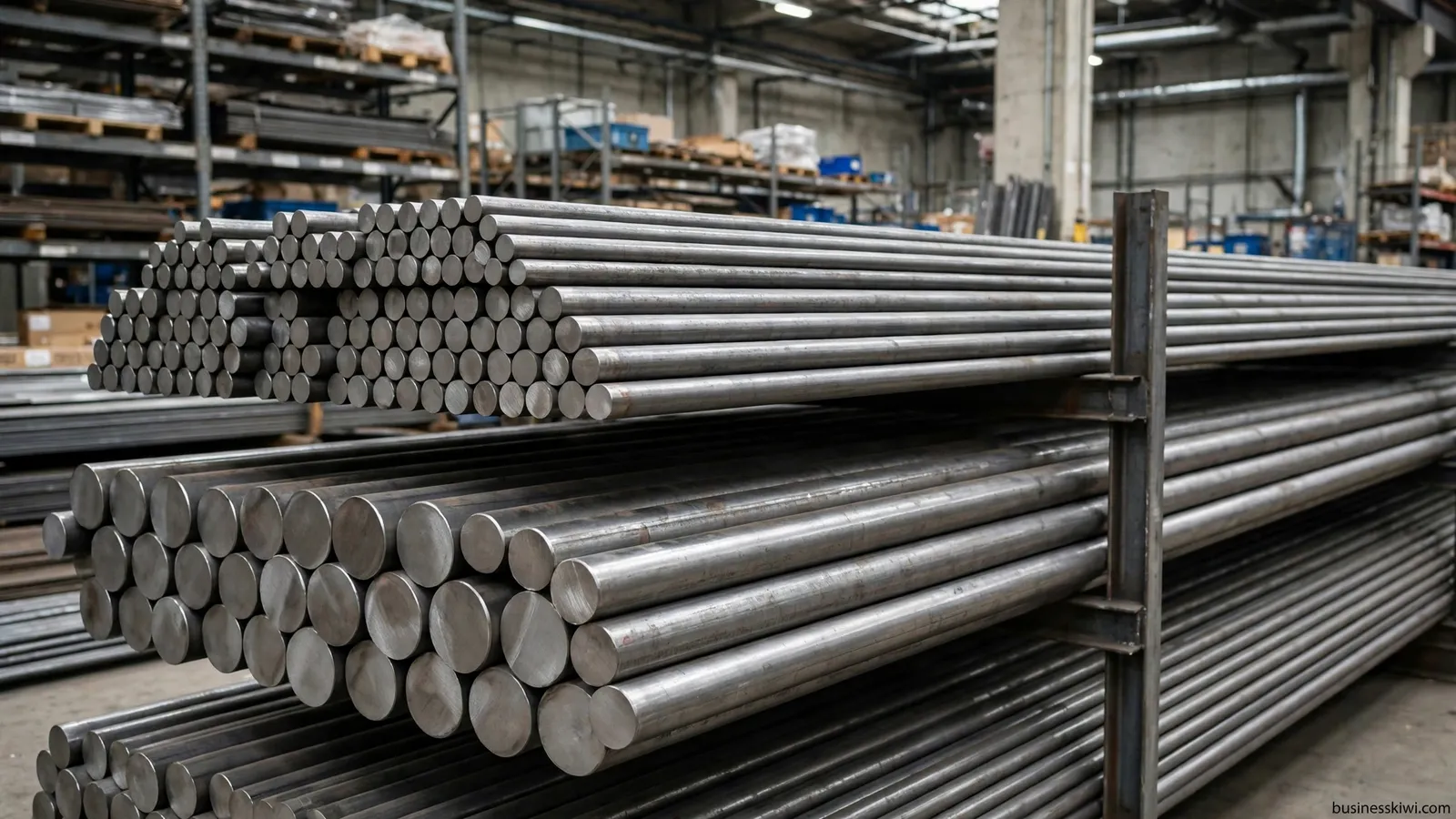
Steel round bar is a solid bar of steel with a round cross-section. Suppliers sell it by diameter, in millimetres, and by the length. Buyers often search for it as rod, and stainless steel rod is the same product as stainless round bar. The name on the supplier’s shelf is round bar.
In New Zealand you buy it from steel stockholders, not hardware stores, once you get past the smallest sizes. The standard picture looks like this. Mild steel rounds come in a Grade 300 hot rolled bar from 6mm up to 50mm or 80mm, depending on the stockholder, in 6 metre lengths. Stainless round bar comes mainly in grades 304 and 316, from about 3mm up to 300mm or more. Small stainless diameters come in 4 metre or 6 metre lengths. Big diameters come in 1 metre increments. Prices are quoted per job rather than listed, and the quote turns on grade, diameter, finish and cutting.
Stainless grades: 304 and 316
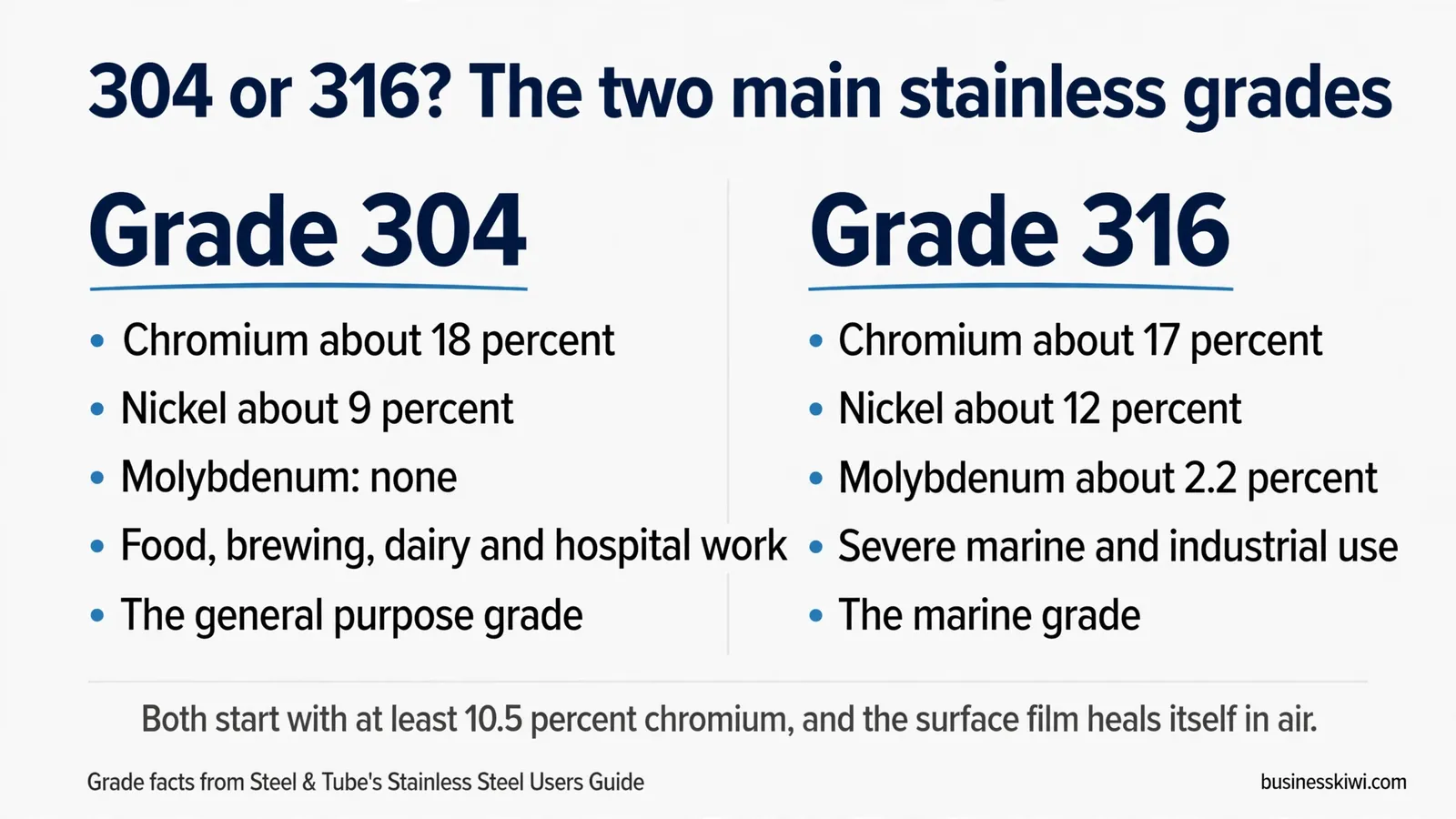
Almost every stainless round bar sold in New Zealand is one of two grades: 304 or 316. Both are austenitic stainless steels. That family starts with at least 10.5 percent chromium, and the chromium forms a thin oxide film on the surface. The film repairs itself when it is scratched, as long as air can reach the metal. That self-healing film is what makes stainless steel resist rust.
Grade 304 is the general purpose grade. Steel & Tube’s stainless guide puts its typical mix at about 18 percent chromium and 9 percent nickel, with no molybdenum. The same guide lists 304 for food processing, food handling and serving equipment, brewing and dairy equipment, hospital equipment and household items. It welds readily and polishes to a high finish. For most indoor work, most food work and most general fabrication, 304 is the right default.
Grade 316 is the marine grade. Its typical mix, again from Steel & Tube’s guide, is about 17 percent chromium, 12 percent nickel and 2.2 percent molybdenum. The molybdenum is the point of difference. Steel & Tube describes 316 as more resistant to certain corrosive conditions than the standard non-molybdenum grades, and lists it for exterior work in severe industrial or marine atmospheres, plus chemical, textile and paper-making plant. If the bar will live near the coast, on a boat, or around salt spray and chemicals, 316 is the grade to buy.
You will also see the L versions, 304L and 316L. The L means extra-low carbon, about 0.03 percent. Steel & Tube recommends the L grades where you weld thicker sections and cannot heat treat the job afterwards, because low carbon cuts the risk of corrosion starting at the weld. Vulcan’s NZ stock list shows the pattern clearly: smaller diameters in 304 and 316, then 304L and 316L taking over from about 25mm to 30mm upward.
Two more grades appear on NZ stock lists. Grade 303 is a machining grade, stocked in small diameters and certified to ASTM A582, the free-machining bar specification. Turners use it for high-volume parts on automatic lathes. Grade 2205 is a duplex stainless, stocked by Vulcan in a wide size range. Duplex grades offer higher strength and strong resistance to stress corrosion cracking, and they are specialist material rather than a general buy.
The other steels sold as round bar
Mild steel round is the workhorse. NZ stockholders sell it as merchant bar in Grade 300, to AS/NZS 3679.1, and some list the Japanese SS400 grade as an alternative. Vulcan’s merchant bar guide lists rounds from 6mm to 50mm. New Plymouth Steel Supplies lists rounds from 6mm to 80mm, in Grade 300 or SS400, and notes that Grade 500 rounds are available on enquiry. Hot rolled bar comes with its dark mill scale surface intact. It is the cheapest way to buy round steel, it welds and machines easily, and it needs paint or another coating if it will live outside, because it rusts.
Bright bar sits a step up. Easysteel lists bright bar among its special steels, separate from merchant bar. Bright bar is cold finished, usually cold drawn, so it arrives smooth, clean and close to size. Machinists buy it for shafts, pins and turned parts, where the accurate diameter saves machining time. Vulcan’s stainless list shows the same ladder of finishes in stainless: cold drawn at h9 tolerance, centreless ground at h8 for the tightest work, and peeled bar at larger diameters.
Engineering rounds are the third group. These are higher carbon and alloy steels sold for parts that will be hardened or highly stressed, such as axles and gears. They are a specialist order through the same stockholders. If your job is a simple repair or a fabrication, merchant rounds or bright bar will almost always cover it.
Diameters and lengths, and what a bar weighs
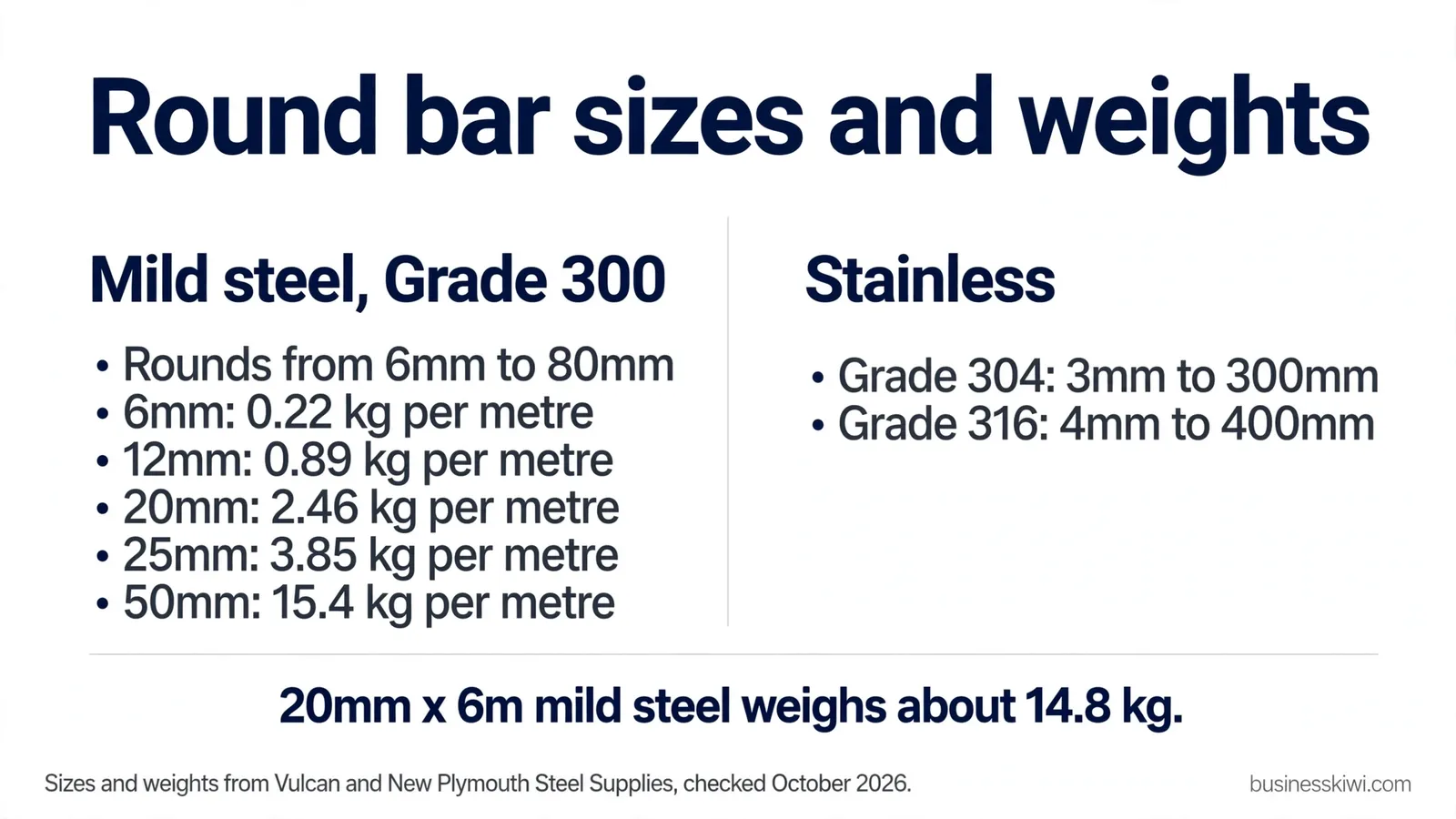
Mild steel rounds start at 6mm. New Plymouth Steel Supplies lists 6mm, 8mm, 10mm and 12mm, then 16mm, 20mm, 24mm, 25mm, 28mm, 32mm, 36mm, 40mm, 50mm and 80mm. The standard length is 6 metres, with 9 metre and 12 metre lengths listed for the middle sizes, from 10mm to 32mm. Vulcan’s merchant range runs from 6mm to 50mm in the same Grade 300 family.
Stainless runs much wider. Vulcan lists grade 304 round from 3mm up to 300mm, and grade 316 from 4mm up to 400mm. The unit of supply changes as the bar gets bigger. Diameters up to 30mm come in 4 metre or 6 metre lengths. Diameters of 30mm and above come in 1 metre increments, because a solid 100mm bar is a serious piece of metal. Imperial sizes sit alongside the metric range for replacement work on older machinery.
Weight matters for handling, freight and price, and it climbs fast with diameter. Steel weighs 7,850 kilograms per cubic metre, and the mass tables suppliers publish are built on that figure. To work out the weight of any round bar, multiply the diameter in millimetres by itself, then by 0.006165. That gives kilograms per metre.
Here is the check. A 20mm mild steel round gives 20 times 20 times 0.006165, which is 2.47 kilograms per metre. New Plymouth Steel Supplies publishes 2.46 kilograms per metre for 20mm round, and Vulcan publishes the same figure. The formula and the shelf tables agree. A standard 6 metre length of 20mm round therefore weighs about 14.8 kilograms. One person can carry it. Step up to 50mm round, at 15.4 kilograms per metre, and the same 6 metre length weighs about 92 kilograms. That one needs a forklift or a crane, and it changes the freight cost too.
Stainless weighs a touch more per metre than mild steel, because its density is slightly higher. Steel & Tube lists 2.51 kilograms per metre for 20mm stainless round, against 2.46 for mild steel. The difference is small, but it is worth knowing when you compare quotes given by weight.
Finishes and tolerances
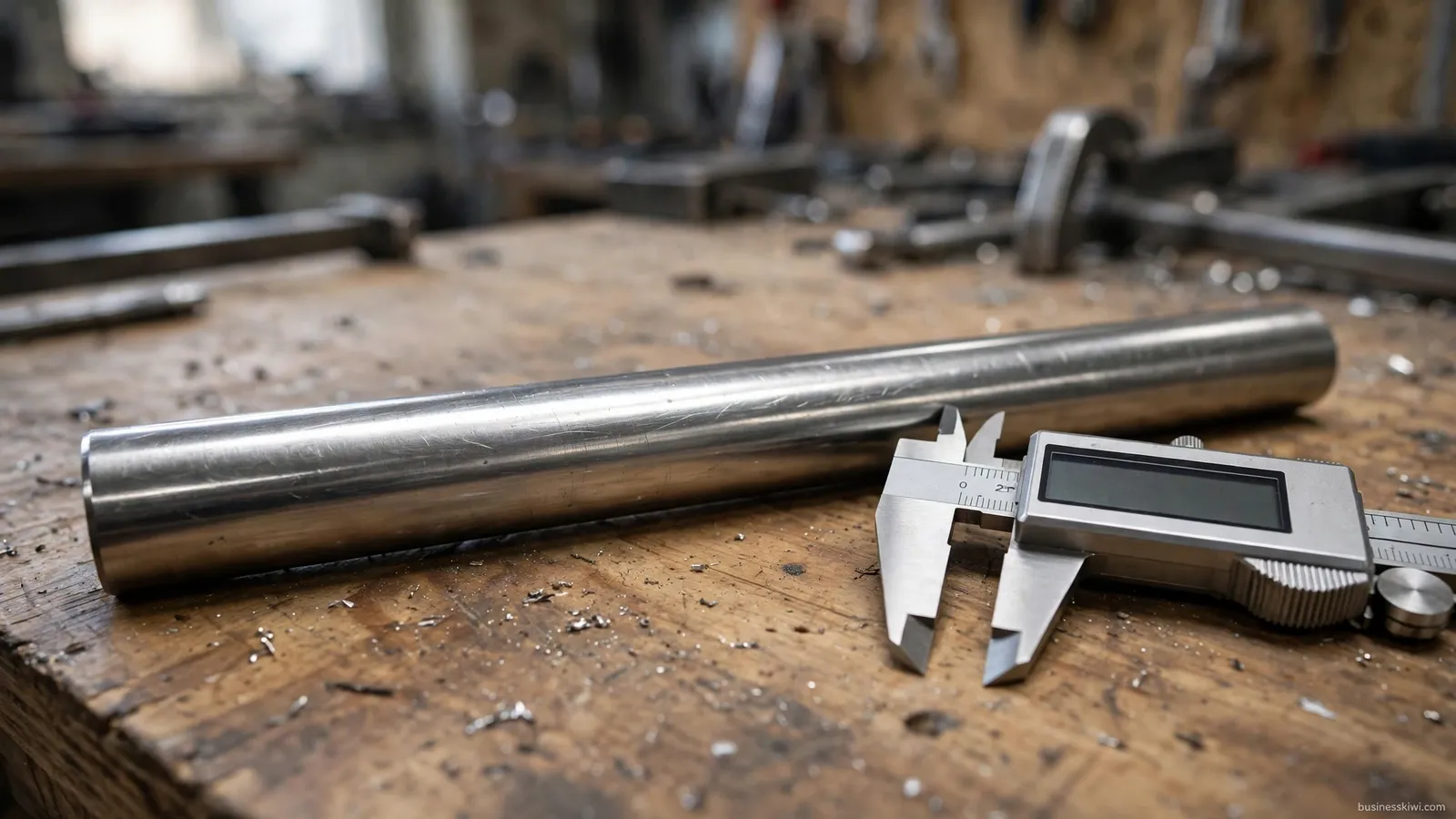
Finish decides how the bar looks, how accurate it is, and how much work is left for you. Hot rolled bar is the base product. It carries mill scale, its diameter tolerance is the loosest, and it suits fabrication, welding and any job where the surface will be cleaned, machined or painted anyway.
Cold drawn bar, often sold as bright bar, has been pulled through a die after rolling. The surface is smooth and the size is close. Vulcan lists cold drawn stainless at h9 tolerance. Steel & Tube’s tolerance table shows what h9 means in practice: for bar between 18mm and 30mm, the diameter can run up to 0.052mm under nominal size. Centreless ground bar is the precision option, at h8, and it is the usual choice for shafts that run in bearings. Large stainless diameters come peeled, where the surface skin is machined off, at a tolerance grade called K12.
For most workshop and farm jobs, the finish question is simple. If the part will be machined all over, hot rolled is fine. If the diameter itself is the finished size, or the bar must slide, seal or spin, buy cold drawn or ground bar and pay the extra.
How round bar is priced
None of the big NZ stockholders publishes a public price list for round bar. The product guides from Vulcan, Steel & Tube and New Plymouth Steel Supplies list grades, sizes and weights, but no dollars. You get a price by asking for a quote, and the quote is normally built from the weight of steel in the length, the grade, the finish and any cutting.
That means the details you supply decide the price you get. A quote request that gets a fast, accurate answer names the grade in full, so 316L rather than just stainless. It names the diameter and the finish, so 20mm cold drawn rather than just 20mm. It states the length you need and whether you want full lengths or cut pieces. It also asks whether the price includes delivery, because a 6 metre length travels as oversize freight.
Cutting is part of the picture. Vulcan offers a precision cutting service on stainless bar, with a standard cutting tolerance of minus 0 and plus 3mm. Buying cut pieces costs more per metre than a full length, but it can be the cheaper job overall once you count your own cutting time and waste. If you only need 400mm of 316 for a boat fitting, ask for a cut piece first. One metre increments are a standard unit of supply in the bigger stainless diameters, so short lengths are a normal order, not a special favour.
Choosing bar for common jobs
For marine work, buy 316 or 316L. Salt air and spray attack 304 over time, and Steel & Tube lists 316 for exterior work in severe marine atmospheres for exactly that reason. The same applies to pool areas, coastal balustrades and any fitting that sits in salt water.
For food areas, 304 is the standard choice. Steel & Tube lists it for food processing, handling and serving equipment, and for brewing and dairy plant. It cleans down well and resists the mild acids in food work. Where the washdown uses strong chlorides, or the gear sits in a coastal food plant, step up to 316.
For workshop and farm repairs, mild steel Grade 300 round covers most of the list: pins, linkages, spacers, gate hardware and machinery repairs. It is cheap, it welds with standard gear, and every stockholder carries it. Protect it afterwards with paint, or choose stainless where the part lives in effluent, fertiliser or weather and rust would seize it. Fertiliser sheds and dairy sheds are hard on plain steel, and a stainless pin often outlasts several mild steel ones.
For turned parts and shafts, choose by finish as much as by grade. Bright bar or cold drawn bar gives you an accurate, smooth starting point. If the part will be hardened, ask the stockholder about engineering rounds rather than forcing merchant bar to do a job it was not made for.
Cutting and handling
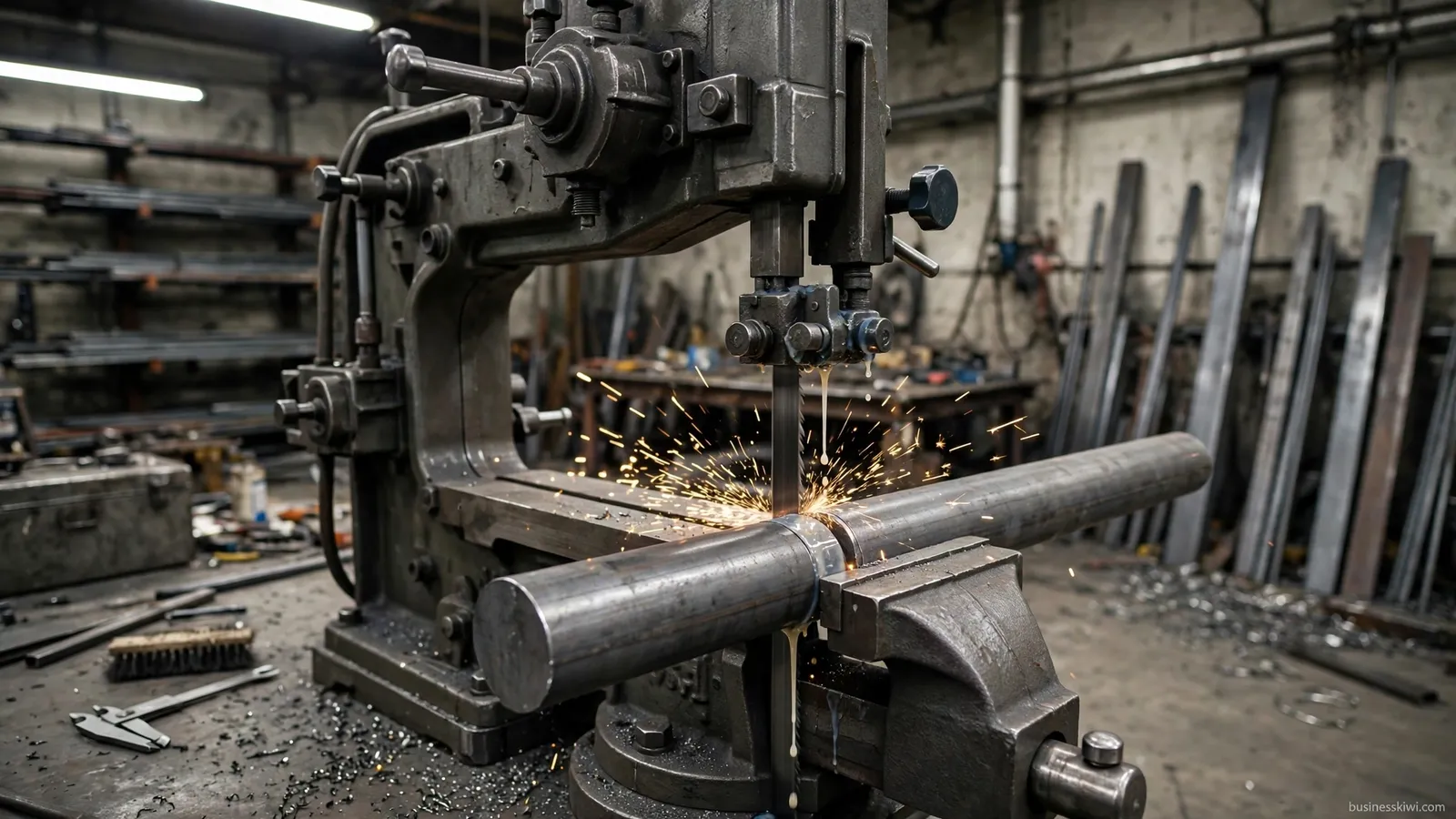
Round bar is dense, and even small diameters get heavy in full lengths. Plan the lift before the bar arrives. A 6 metre length of 50mm mild steel weighs about 92 kilograms, and long bars flex and roll. Store them on a rack or on bearers off the ground, never loose on a floor where they can roll onto a foot.
Cutting options are the usual workshop set: a bandsaw for clean, square cuts, a cold saw or an abrasive cut-off saw for smaller work, and an angle grinder for rough cuts on site. Stainless work-hardens, so keep the blade moving and do not let it rub. If you would rather not cut at all, order cut pieces. Vulcan’s standard cutting tolerance on stainless is minus 0 and plus 3mm, which is tight enough for most fabrication. If your job needs better than that, say so when you order, because precision cutting is offered as a separate service.
One safety point matters with stainless. Keep stainless bar and stainless work separate from mild steel grinding dust and shared wire brushes. Iron contamination on the surface can bloom as rust spots later, even though the bar itself is sound.
Related guides: our plastic sheet guide covers sheet and plate materials, our fence posts guide covers posts for farm fencing, and our fence pailings guide covers the pailings that go on them. For more trade and materials guides, browse the Business & Industry section.
Frequently asked questions
What is the difference between 304 and 316 stainless rod?
The difference is molybdenum. Grade 304 has none, and grade 316 carries about 2.2 percent, based on Steel & Tube’s typical analysis. That addition lifts 316’s resistance to salt and chemical attack, which is why 316 is the marine grade. Grade 304 remains the standard for food work and general use.
What sizes of steel round bar can I buy in NZ?
Mild steel rounds run from 6mm to 50mm or 80mm, depending on the stockholder. Stainless runs wider: Vulcan lists 304 from 3mm to 300mm and 316 from 4mm to 400mm. Stainless up to 30mm comes in 4 metre or 6 metre lengths, and larger diameters come in 1 metre increments.
How heavy is a 6 metre length of 20mm round bar?
About 14.8 kilograms in mild steel. The published mass for 20mm round is 2.46 kilograms per metre, and six metres at that rate gives 14.76 kilograms. In stainless the same length is a little heavier, at about 15 kilograms, because stainless is slightly denser.
Is round bar priced per metre or per length?
Either, depending on the stockholder and the size. Quotes are built from the weight of steel in what you order, plus grade, finish and cutting. Small stainless diameters are sold in 4 metre or 6 metre lengths, and big diameters are sold by the metre. Always check whether delivery is included.
Can I get round bar cut to length before delivery?
Yes. Stockholders offer cutting services. Vulcan’s standard cutting tolerance on stainless bar is minus 0 and plus 3mm, and precision cutting is available on request. Cut pieces cost more per metre than full lengths, but they save your time and waste.
Does stainless steel round bar rust?
It resists rust rather than never rusting. Steel & Tube makes the point that stainless means less staining, not no staining in every environment. The chromium oxide film protects the surface while it stays clean and exposed to air. Salt deposits, iron contamination and trapped grime can all mark it, and 316 handles those conditions better than 304.
What is bright bar, and when do I need it?
Bright bar is cold finished bar, drawn or ground after rolling, so it arrives smooth and close to its stated size. You need it when the diameter is the finished size, for shafts, pins and turned parts. If the part will be fully machined or welded into a fabrication, cheaper hot rolled bar does the same job.
The bottom line
Round bar buying in New Zealand comes down to three choices: the material, the size and the finish. Pick 304 for food and general work, 316 anywhere near the sea, and Grade 300 mild steel rounds for everyday workshop and farm repairs. Check the weight before you order, because diameter drives handling, freight and price. Then ask for the quote in full terms: grade, diameter, finish, length, cuts and delivery. A quote written that way can be compared fairly, and the bar that arrives will be the bar you meant to buy.
Sources
-
Vulcan, Stainless Product Guide, Round Bar data sheet (NZ): grades, sizes, finishes, units of supply and cutting tolerance. https://brand.vulcan.co/asset/05d26aea-cfa0-45e2-9e71-9af73cc34445/NZ-Stainless-Round-Bar-Data-Sheet.pdf
-
Vulcan, Steel NZ Product Guide, Merchant Bar: Grade 300 PLUS rounds and mass per metre. https://vulcan.co/wp-content/uploads/2025/03/VUL_Steel_NZ_Merchant_Bar.pdf
-
New Plymouth Steel Supplies, Round & Square catalogue: Grade 300 and SS400 rounds, diameters, lengths and mass per metre. https://steel.npss.co.nz/sites/default/files/downloads/main-catalogue/rounds-squares.pdf
-
Steel & Tube, Stainless Steel Users Guide (pocket guide): what stainless steel is, grade applications for 304, 304L, 316 and 316L, typical analysis, bar weights and bar tolerances. https://steelandtube.co.nz/sites/default/files/catalogues/S&T_Stainless_Pocket_Guide_bm2_0.pdf
-
Fletcher Easysteel, Pipe & Pipe Fittings Book (Steel Book): products available list covering merchant bar engineering rounds, special steels including bright bar, and reinforcing steel as a separate family. https://www.easysteel.co.nz/assets/FBES_01_Book-Easysteel-Pipe-Fitting-Book_V04.03.0518_WEB.pdf
This article is general information about steel round bar and how it is sold in New Zealand. It is not engineering advice. If a bar will carry a load, hold pressure or form part of a structure, get the grade and size confirmed by a qualified engineer before you order.