Fence Posts NZ: Types, Treatment Classes, Sizes and Prices

A fence is only ever as good as its posts. Wire, netting and rails all hang off them, they carry the strain at every corner and end, and the buried third of each post sits in damp soil for its whole working life. Choosing the right post in New Zealand means matching three things: the material, the treatment or protection it carries, and the size the job needs.
Treated radiata pine dominates the market. A 2021 study by Scion for Forest Growers Research put the treated wooden post market at roughly 13 to 14 million posts a year, with steel, concrete, recycled plastic and hybrid posts a much smaller share. It found CCA treated pine is typically the cheapest post you can buy, and that the alternatives earn their place where CCA is not wanted, or where a property such as not conducting electricity matters more than price.
This guide works through each post type sold in New Zealand, explains the H treatment classes in plain terms, lists the sizes suppliers publish, and gives prices only where a manufacturer or supplier publishes them on its own pages.
The main types compared
Treated pine and the H classes
Radiata pine is the raw material behind almost every wooden post in the country. The Wood Processors and Manufacturers Association (WPMA) design guide notes that radiata makes up about 90 percent of New Zealand’s sawn timber, its natural durability is low, and it treats readily. Untreated radiata buried in soil rots quickly, so the treatment is not a coating or an optional extra. It is the whole reason the post survives.
Treatment in New Zealand is specified by hazard class under NZS 3640, the standard for chemical preservation of round and sawn timber. The classes run from H1 to H6 and describe the biological hazard and the service conditions, as the WPMA guide sets out in its durability table:
- H1.1 and H1.2 cover dry interior uses such as framing, protected from weather and ground contact.
- H2 is a termite class used in Australia, not in New Zealand.
- H3.1 and H3.2 are for exterior use above ground. H3.2 is the stronger of the two and covers situations where water can be trapped, but both classes are explicitly not in contact with the ground.
- H4 is the first ground contact class: in the ground or in water, permanently wet, exposed to decay fungi and borer. The WPMA table lists posts, fencing, bridge decks and landscaping as typical H4 uses.
- H5 covers the same in-ground conditions where a 50 year durability is required for building purposes, such as piles, poles, foundations and line poles.
- H6 is for marine work, timber in estuarine ground or immersed in seawater, where marine borers are the hazard.
BRANZ’s summary of the treatment table adapted from NZS 3602 puts the same thing in specifier’s language: fence posts require H4, fence rails and palings are H3.2 because they sit above ground, and structural poles and piles in the ground are H5.
For ordinary farm and garden fencing, H4 is therefore the number to check. A post sold as H3.2, however good the timber, is an above-ground product and does not meet the ground contact class. Goldpine’s own treatment page describes H4 as treated for outside, in-ground use, H5 for in-ground use in damp conditions such as structural piles, foundations and waterlogged areas, and H6 for marine use, all treated to NZS 3640.
Two practical points follow. First, every piece of treated timber must be branded with the treatment plant number, the preservative code and the hazard class, so the class is verifiable on the post itself rather than taken on trust. Second, treatment is a whole-piece process: BRANZ advises site-treating all cut ends of copper-based treated timber and not placing cut ends in the ground. If you dock a post to length, the fresh cut is the weak point. BRANZ also warns against burning CCA offcuts in barbecues or domestic fireplaces.
On guarantees, Goldpine offers a 50 year treatment guarantee against insect and fungal attack on the posts and poles it produces, and PermaPine states a 50 year treatment warranty on its SelfLok pole fencing. Those are manufacturers’ guarantees with conditions, not a promise that every post in every soil lasts half a century, but they show the service life the treatment system is designed around. At end of life, the Scion study notes CCA posts go to a lined landfill, with disposal estimated at about $75 per cubic metre, one practical reason some buyers look at the alternatives below.
Steel Y posts (waratah standards)
The steel Y post, also sold as a star picket or waratah standard, is a rolled steel section with a pointed foot and a column of pre-punched holes the wires tie or clip through. Living Rural’s Summit Steel & Wire range runs from 0.40m to 2.6m with seven holes per post, in two coatings: black bitumen, the most common finish, or galvanised. On that supplier’s page, a 1.65m post is $13.50 including GST, the 1.8m is $14.65 and the 2.6m is $19.95.
Y posts earn their keep as intermediate posts. They drive fast, they suit rocky and stony ground where digging or ramming timber is miserable work, they carry electric fence wires with the right clips, and they can be pulled and reused. What they are not is a strainer. The section is too light to anchor a strained fence end or corner, so a Y post line still starts and finishes on a proper strainer assembly in timber, plastic or concrete.
Recycled plastic posts
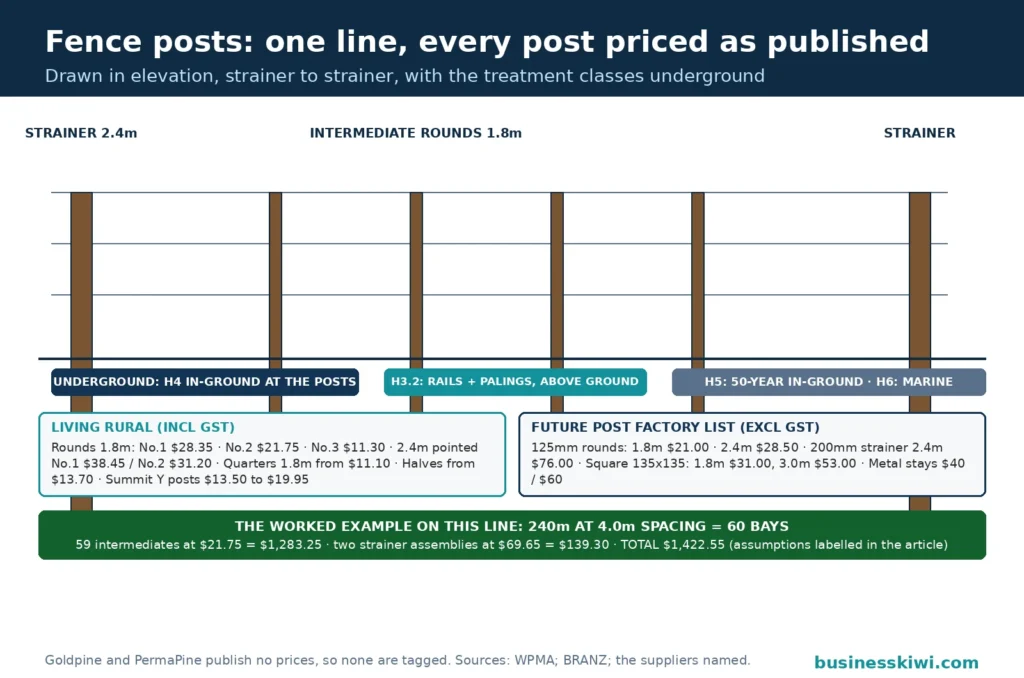
Future Post, which manufactures in Waiuku and Blenheim, makes solid posts from 100 percent recycled waste plastic, mostly plastic types 2, 4 and 5, with carbon black added as the UV inhibitor that also gives every post its black colour. The company’s factory direct price list (all prices plus GST, freight extra) has a 125mm x 1.8m full round at $21.00, the 125mm x 2.4m at $28.50, and the 200mm x 2.4m strainer size at $76.00.
The properties are quite different from timber. The posts do not rot, do not absorb water, and are non-conductive, so electric fence wires can be stapled straight to the post with no insulator. Future Post states the posts are BioGro certified for organic farms and orchards after independent leaching tests, which matters because CCA treated posts are not accepted in certified organic systems. Horses and goats do not chew them, a point the company makes strongly for equine fencing, where crib-biting wrecks timber posts and rails.
On life expectancy, Future Post says its posts should last more than 50 years and backs them with a 10 year manufacturer’s warranty. Treat that as the manufacturer’s own claim, stated as such. Installation follows timber practice: the posts can be driven, nailed, stapled, screwed, cut, drilled and bolted, and the company recommends the same post spacing as for timber, with pre-spiking or ripped rows in hard ground.
Concrete posts
Concrete is the one material where this guide gives no sizes and no prices, and the reason is worth stating plainly. No New Zealand manufacturer was found publishing a concrete fence post range with sizes and prices on its own pages, so nothing is quoted. What the primary sources support is the material’s market position. The Scion study lists concrete among the non-wood posts produced for New Zealand and Australian fencing, found concrete costs more than CCA treated posts at equivalent strength rather than equivalent diameter, and noted concrete is acceptable where CCA is not, including organic properties. Concrete strainers have a long history in some districts, but anyone pricing a concrete job in 2026 is likely working from a local precast yard’s quote rather than a published list.
Strainers, angles and stays
Every wire fence is a tension structure, and the tension has to land somewhere. The strainer assembly at each end, corner and gateway does that work: a heavier, longer post, set deeper and braced so the pull of the wires goes into the ground instead of dragging the post over.
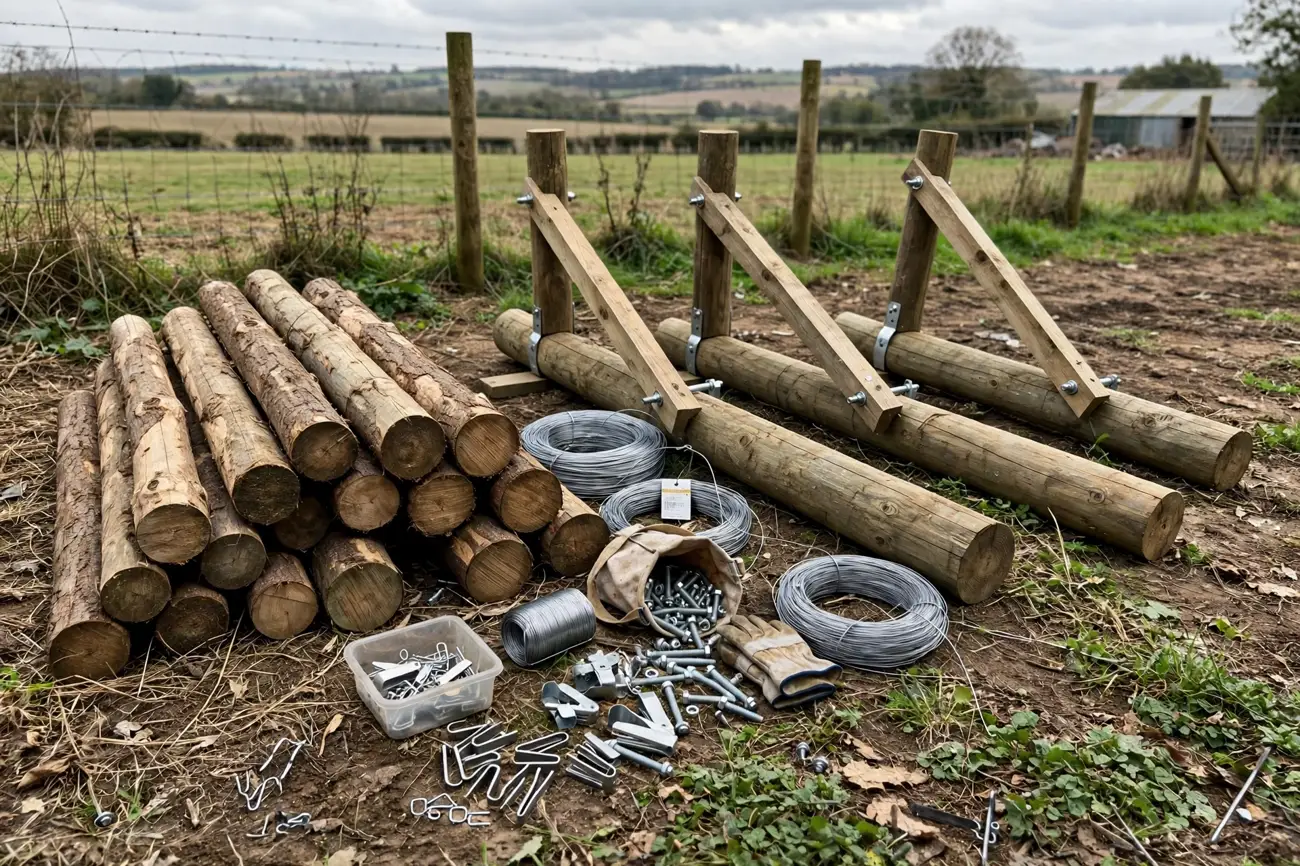
The NZ Fencing Competitions specification for its power fencing doubles event shows the conventional build. Competitors erect 35 metres of five wire fence between a 2.4m stayed strainer assembly at one end and a 2.4m blocked strainer assembly at the other, with 1.8m quarter round intermediates, a finished height of 1200mm and wires strained to 100kg of tension. A stayed assembly braces the strainer with a diagonal stay post bearing on a stay block at ground level. A blocked assembly uses a horizontal rail between the strainer and the next post, with a diagonal wire brace, so the brace works in the plane of the fence.
The components are sized accordingly. A 2.4m strainer gives about 1.2m above ground for a standard fence and the rest buried, and the stay needs to be a genuine post, not an offcut. Future Post sells metal stays for its system, a 2m horizontal stay for a box stay at $40.00 plus GST and a 3m angle stay at $60.00 plus GST, and for its 200mm plastic strainers it recommends box or horizontal stay assemblies, or a tie-back, wherever the strain is high, such as nine wire fences and long vineyard rows. The lesson generalises: the higher the wire count and the longer the strain, the more the end assembly matters relative to the post itself.
Sizing and spacing in practice
Post length follows fence height plus burial depth. The competition fence is the standard illustration: 1.8m intermediates produce a 1200mm high fence, so about 600mm of each post is in the ground, and strainers step up to 2.4m for the extra depth and leverage. Longer posts in the roundwood ranges, up to 3.6m in the Living Rural listings, serve deer fencing, trellis work and deep or soft ground rather than standard stock fences.
Grades need a word of explanation, because roundwood is not sold by diameter the way sawn timber is. Suppliers grade rounds as No.1, No.2 and No.3, with No.1 the heaviest and dearest and No.3 the lightest. Living Rural’s listings show the pattern at 1.8m: a No.1 round is $28.35 including GST, a No.2 is $21.75 and a No.3 is $11.30. Quarter rounds sit below rounds on price, because a quarter is one split section of a larger log. Living Rural notes its quarters come from older, larger diameter wood, and that a No.1 quarter falls between a No.1 and a No.2 round for strength while costing less than a No.2 round; its No.2 quarter at 1.8m is $11.10. Half rounds, flat on one face, suit post and rail work and electric lines, priced between quarters and rounds.
Spacing is not a fixed legal number for farm fences, and it is worth separating that fact from building work. Ordinary farm and lifestyle fencing is not set by the Building Code; spacing is a practice decision driven by wire type, stock pressure, battens and terrain. The competition specification spaces its posts evenly across 35m, about 5.8m bays, with battens doing the close work between posts. Electric fences run wider again, with droppers or tread-ins between a few permanent posts. Future Post’s guidance is that its plastic posts use exactly the same spacing as timber on the same job, varying with terrain and fencing material. Closer spacing costs more posts and buys a stiffer fence; wider spacing saves money and leans harder on wire tension and battens.
Installation basics
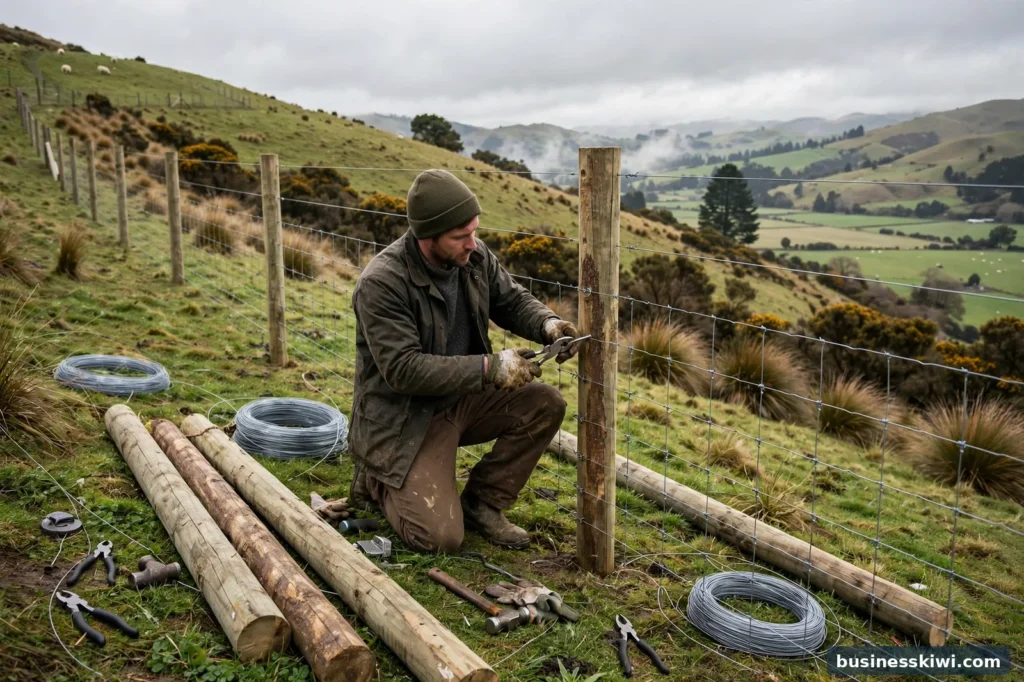
Timber and plastic posts are usually driven with a post rammer where ground allows, and dug where it does not. Future Post’s installation guidelines, written for plastic but broadly applicable, make the points experienced fencers make: pre-spike or rip rows in hard ground, get the post straight on the first few hits because correction gets harder with every blow, use shorter hits and support a tall post partway down while it starts, and ram the soil back firmly around the base in loose ground. Posts can also be concreted in.
For dug and set residential work, PermaPine’s SelfLok instructions describe the method: dig the hole about 25 percent wider than the post, secure the post with concrete or well-compacted earth, and run a string line and spirit level so each post lands plumb and in line before the rails lock in. Two handling points apply to treated pine specifically. Site-treat any cut end and keep cut ends out of the ground, per the BRANZ advice above, and store posts off the ground and out of standing water before use.
Farm, lifestyle block and residential use
On a working farm, the default build is H4 pine rounds for intermediates, heavier strainers at ends and corners, and quarters or halves where the fence is lighter, internal or electrified. How hard a fence gets tested depends on the stocking rate and the class of stock behind it, which is why boundary and pressure fences get the No.1 posts and close spacing while subdivision lines run lighter. Y posts fill in on hill country and rocky faces, and around yards, races and the hay feeder, gates and strain points take the heaviest posts on the property.
Lifestyle blocks sit in the middle. Distances are shorter, looks matter more, and horses change the specification: Future Post’s equine range and PermaPine’s SelfLok post and rail both aim at this market, one on the no-chew, no-paint argument and the other on a uniform machined pole look with rails that lock in without nails. SelfLok posts are 200mm diameter in the Signature range and 180mm in the Homestead range, in lengths from 0.9m to 2.4m with one to four rails.
Residential fencing uses the smaller end of the same ranges: 1.8m posts for a standard paling or panel fence, the palings and panels themselves at H3.2 because they are above ground, and the posts at H4 because they are not. Short posts also turn up edging garden beds and carrying rails above pebble landscaping, where plastic and machined pine avoid the painted-timber upkeep cycle.
Retaining work sits outside this guide. Timber that holds back soil is doing structural work, the treatment tables put in-ground structural poles and retaining at H5 rather than fence post H4, and anything beyond a low garden edge is engineered, consented work.
Prices published by New Zealand suppliers
Prices below are exactly as published on each supplier’s own pages when read for this guide. Living Rural prices include GST. Future Post prices are factory direct and exclude GST and freight. Goldpine and PermaPine do not publish post prices on the product pages read, so none are given for their ranges.
- Treated pine round, 1.8m: No.3 $11.30, No.2 $21.75, No.1 $28.35 (Living Rural).
- Treated pine round, 2.4m pointed: No.2 $31.20, No.1 $38.45 (Living Rural).
- Quarter round, 1.8m: No.2 $11.10, No.1 $16.95 (Living Rural).
- Half round, 1.8m: No.2 $13.70, No.1 $17.10 (Living Rural).
- Steel Y post, black bitumen, seven holes: 1.65m $13.50, 1.8m $14.65, 2.6m $19.95 (Living Rural, Summit Steel & Wire).
- Recycled plastic round, pointed: 125mm x 1.8m $21.00, 125mm x 2.4m $28.50, 200mm x 2.4m $76.00 (Future Post, plus GST).
- Recycled plastic square post, 135mm x 135mm: 1.8m $31.00, 3.0m $53.00 (Future Post, plus GST).
Read across, the Scion finding holds: CCA pine is the cheapest way to put a post in the ground, Y posts undercut timber at intermediate sizes but cannot strain a fence, and recycled plastic sits close to quality timber at 1.8m while asking a clear premium at strainer sizes.
Buying checklist, with a worked example
Before ordering, work through the following:
- Treatment class for the job. H4 minimum for anything buried. H3.2 is above ground only. Check the brand mark on delivered posts shows the class.
- Post role. Strainers and gate posts first, intermediates second. The strainer specification drives the fence’s life more than the intermediate grade does.
- Size and grade. Length from fence height plus burial (1.8m for a 1.2m fence, 2.4m for strainers). Grade from stock pressure: No.1 for boundaries and pressure points, No.2 as the general default, No.3 and quarters for light internal and electric lines.
- Quantity maths. Count bays, not posts. Posts equal bays minus one, plus a strainer assembly at each end and at every corner, gateway and direction change.
- Delivery and handling. Posts are heavy and awkward; rounds come in bundles and plastic posts in crates (Future Post sells rounds 34 to a crate, with part-crate fees on smaller quantities). Arrange forks for delivery day and a flat, dry storage spot off the ground.
Worked example. Assumptions, stated openly: a single straight, flat 240m internal fence, no gates or corners, wire fence 1.2m high, intermediates spaced at 4.0m, posts priced from the Living Rural listings above, GST inclusive, wire, battens, staples and labour excluded.
- Bays: 240m divided by 4.0m spacing gives 60 bays.
- Intermediate posts: 60 bays need 59 intermediates. At No.2 rounds, 1.8m flat, $21.75 each, that is 59 x $21.75 = $1,283.25.
- Strainer assemblies: one at each end, 2 in total. Each assembly is costed here as one 2.4m No.1 pointed round as the strainer ($38.45) plus one 2.4m No.2 pointed round as the stay ($31.20), so $69.65 per assembly and $139.30 for both.
- Total for posts and stays: $1,283.25 + $139.30 = $1,422.55.
Change the spacing and the count moves fast: the same run at 5m spacing needs 47 intermediates, and at 3m it needs 79. Spacing is the biggest cost decision on a fence line after the strainer specification.
Frequently asked questions
What treatment class should a fence post be in New Zealand?
H4. It is the ground contact class under NZS 3640 for timber in the ground or in water in non-critical applications, and both the WPMA durability table and the BRANZ treatment table list fence posts at H4. Check the brand mark on the post itself, which must show the hazard class.
Can I use H3.2 timber for fence posts?
Not for the buried part of the job. H3.2 is an exterior above-ground class, and the standards are explicit that it is not in contact with the ground. H3.2 is the correct class for the fence rails, palings and panels above ground; the posts that carry them need H4.
How long will a treated pine fence post last?
The treatment system is built for decades of ground contact. Goldpine guarantees its posts and poles against insect and fungal attack for 50 years, PermaPine states a 50 year treatment warranty on its pole fencing, and the H5 class is defined around a 50 year durability requirement for building work. Soil, drainage and damage all move the real figure, and no honest source gives one guaranteed lifespan for an H4 post in every soil type.
How far apart should fence posts be spaced?
There is no single code number for farm fences. Spacing follows the fence type, wire, stock pressure and terrain. The NZ Fencing Competitions specification spaces posts evenly at about 5.8m across a 35m battened fence, electric fences run wider with droppers, and heavy pressure fences run closer. The worked example above uses 4.0m as a stated assumption for an internal wire fence.
Are steel Y posts a full substitute for wooden posts?
As intermediates, largely yes, and they are often the better tool in rocky ground or for electric fencing. As strainers, no. A fence still needs a proper strainer assembly at each end and corner, in timber, plastic or concrete, to take the wire tension.
Do plastic posts need insulators for electric fencing?
No. Future Post’s posts are non-conductive, so a hot wire can be stapled directly to the post. The company still notes insulators or brackets can be used where a particular fencing system requires them.
Why are there no concrete post prices in this guide?
Because no New Zealand manufacturer was found publishing a concrete fence post range with prices on its own website, and this guide only quotes prices a supplier publishes itself. Scion’s industry study found concrete posts cost more than CCA pine at equivalent strength; for current pricing, a local precast yard quote is the realistic route.
Sources
- BRANZ Build, “Timber treatment” (buildmagazine.org.nz)
- Wood Processors and Manufacturers Association, NZ Wood Design Guides, Chapter 1.2: Trees, Timber, Species & Properties (nzwooddesignguides.wpma.org.nz)
- Goldpine, Poles treatment page and Superpost page (goldpine.co.nz)
- PermaPine, Roundwood page and SelfLok Pole Fencing brochure (permapine.co.nz)
- Future Post, Product Price List, FAQ page and Equine Use installation guidelines (futurepost.co.nz)
- Living Rural, Round Post, Quarter Round Post, Half Round Post and Summit Steel & Wire Waratah / Y Post product pages (livingrural.nz)
- NZ Fencing Competitions, Power Fencing Competition specification (nzfencingcompetitions.co.nz)
- Scion for Forest Growers Research, SWP-T127: Technoeconomic analysis of posts from specialty wood species and radiata pine, June 2021 (fgr.nz)
This article is general information about fence post types, treatment classes and published prices in New Zealand. Prices were read from suppliers’ own pages in October 2026 and will change; confirm current pricing, treatment certification and suitability with your supplier or fencing contractor before buying, and get professional advice for structural or retaining work.