Hay Feeders NZ: Types, Prices and What Actually Reduces Waste
Feeding hay or baleage off the ground looks simple until you watch a mob work over a bale dropped straight onto wet pasture. Animals pull mouthfuls out, drag them underfoot, lie on the rest and refuse what is muddy. A hay feeder exists to stop most of that. It holds the bale in one place, keeps it out of the dirt and makes stock eat through a barrier instead of standing in their dinner.
The range sold in New Zealand runs from a plain galvanised ring costing a few hundred dollars through to tractor-mounted and trailed bale feeders that load themselves and feed out along a windrow. This guide works through the main types, what each suits, the capacities and prices suppliers actually publish on their own pages, and what the evidence says about waste. Every price here comes from a manufacturer’s or supplier’s own New Zealand page read in full; where a supplier publishes no price, that is stated rather than filled in from a listing site.
Why feed from a feeder at all
Beef + Lamb New Zealand’s winter grazing guidance is plain about the principle. Its factsheet on managing winter forage crops during grazing tells farmers that if they are offering supplements such as hay, silage or baleage alongside a crop, they should use feeders where possible to reduce the amount of waste. The same factsheet pushes farmers to offer fresh, untrampled feed where practical. A bale on bare ground gets trampled within hours; a bale held in a feeder stays cleaner for longer, and stock take only what they can pull through the bars.
There is also a paddock argument. Feed dropped in the same gateway corner all winter concentrates hooves, manure and mud in one spot. A feeder you can shift spreads that pressure, and a machine that feeds out along a line spreads it further.
Ring feeders
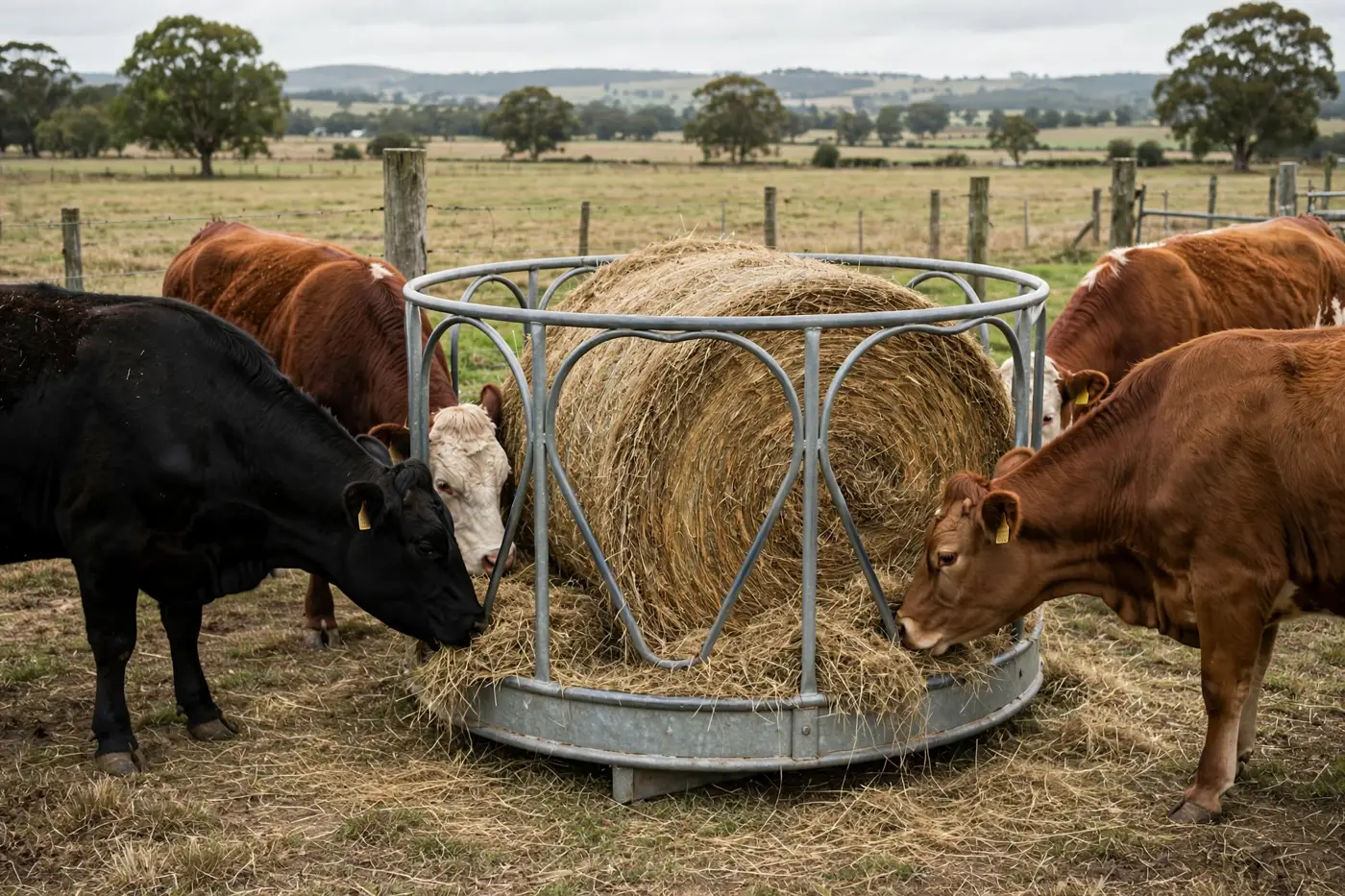
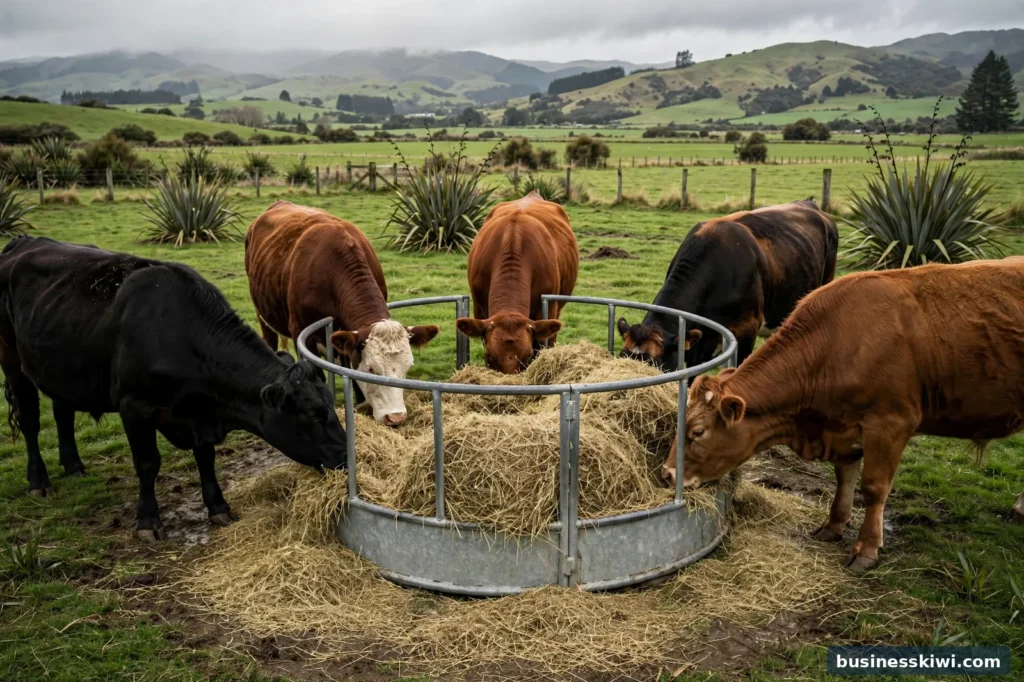
The ring feeder is the simplest design here and the cheapest way into feeder feeding. A circular steel frame sits over a single round bale and stock eat through the uprights. There is nothing to maintain. You place a bale with the tractor, drop the ring over it, and walk away.
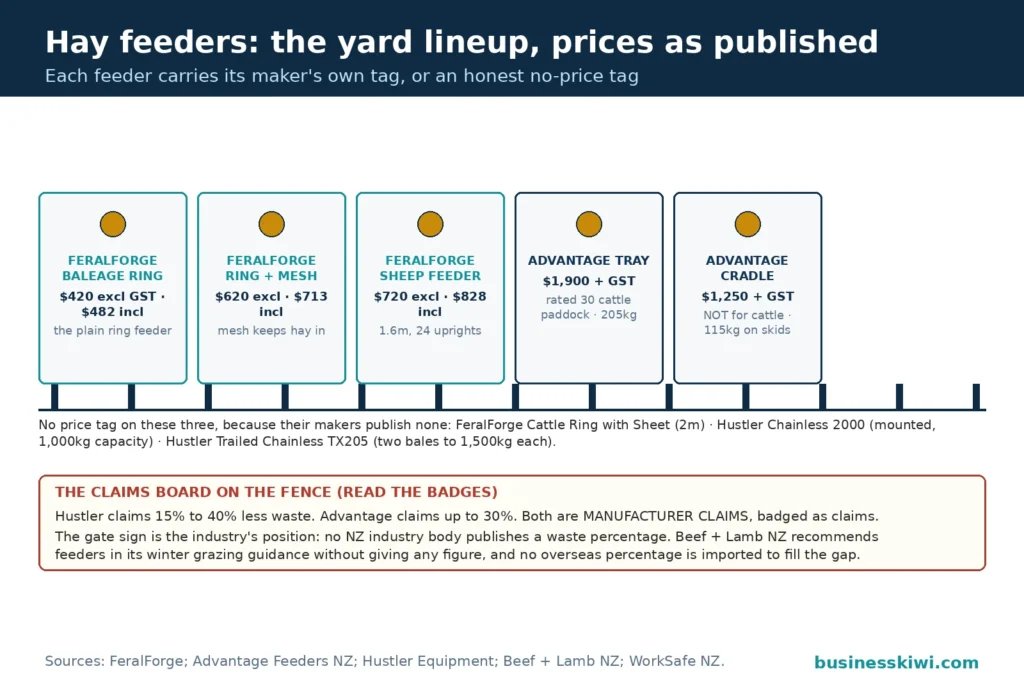
FeralForge, a New Zealand fabricator selling direct, publishes its prices. Its plain Baleage Ring is $420 excluding GST ($482 including GST). A version with 75mm by 75mm galvanised mesh welded around the base is $620 excluding GST ($713 including GST), the mesh there to stop hay being pulled out and dropped at the animals’ feet. Its Cattle Ring with Sheet is a 2 metre diameter ring with a 0.8mm galvanised sheet base 550mm high; no price is published for that model, so none is given here.
FeralForge builds its rings from C350 grade galvanised pipe to AS/NZS 1163:2016, with five uprights where it says four leaves too big a gap, sleeve-welded joins and no open pipe ends for mud to fill. Its Sheep Bale Feeder shows how much the design changes with the animal: 1.6 metres across, 1 metre high, 24 uprights and a 300mm mesh band at the bottom, priced at $720 excluding GST ($828 including GST). The close spacing is the point: sheep can reach the bale and eat, but cannot climb in and trample it.
The trade-offs are the same for any static ring. The bale stays in one place, so the ground around the ring takes all the traffic and will pug up in a wet winter unless you shift the ring to fresh ground. Stock also eat a ring bale from the outside in. Hustler Equipment’s feeding guidance lists unfinished bales inside ring feeders as a known source of waste, because once the outside is eaten down and the ground deteriorates, animals cannot reach the middle. A ring is a sound, cheap tool. It is not a set-and-forget one.
Tray and cradle feeders
Tray and cradle feeders hold the bale up off the ground in a basket or tray. The bale stays drier, what falls lands in a tray instead of the mud, and the better designs let you set the bale height for different classes of stock.
Advantage Feeders, based in Rolleston, sells two hay feeders on its own New Zealand site and publishes prices for both. The Tray Hay Feeder is $1,900 plus GST. It takes one round bale of 4 feet by 6 feet, and the company rates it to feed 30 cattle or calves in a paddock, 20 cattle in a feedlot, 60 deer or 15 horses. The frame is hot-dipped galvanised square hollow section with reinforced stainless steel trays and floor, with drainage holes in the floor so feed is not sitting in water. The basket has seven height settings, so one unit can be set at sheep height or cattle height. It weighs 205kg, arrives flat-packed, and the price includes freight to the nearest Advantage Feeders depot. A fitted roof that sheds rain off the bale is a separate $450 plus GST.
Bulls are the exception to its general suitability: the standard 300mm bar gaps create an entrapment risk, so bulls need the company’s THF Bull Kit fitted first.
The Cradle Hay Feeder is $1,250 plus GST and works differently. Its roll-in loading system means you roll the bale in by hand, so no loader or extra machinery is needed to fill it. It takes the same 4 feet by 6 feet round bale, and the company’s New Zealand catalogue rates it to feed 150 sheep or deer. It is explicitly not suitable for cattle, and is aimed at sheep, lambs, goats, deer and horses. The narrower 200mm bar gaps are stated to reduce waste, the low bale height suits smaller stock, and corner cover plates are fitted to prevent injury. At 115kg, on skids with towing loops, it is built to be dragged between feeding positions. Both Advantage hay feeders carry a two-year warranty, extendable to five years at no extra cost, plus a 30-day money-back guarantee.
Tractor-mounted bale feeders
A mounted bale feeder turns the job from containing a bale into feeding one out. It hangs on the tractor’s three-point linkage or a front loader, picks the bale up itself, and teases it out along the ground, or into a trough or bunk, as you drive.
Hustler Equipment, the Hastings manufacturer, is the best-known New Zealand maker in this class. Its Chainless 2000 is a mounted, self-loading feeder handling one bale at a time with a weight capacity of 1,000kg. It takes round bales from 4 feet by 4 feet up to 6 feet by 4 feet, and square bales as well. The unit weighs 480kg and needs a tractor or loader of 60 horsepower or more with two double-acting hydraulic services. Instead of a feed chain, two low-speed rotors tease the bale apart, which Hustler says handles tight and frozen bales and drops feed outside the wheel tracks. An optional side chute deflects feed into a trough or bunk. Hustler backs it with a five-year warranty, but publishes no price: pricing is by enquiry through dealers, so no figure is given here.
The step up from a ring is control: because the machine meters the bale out, you can feed part of a bale, keep the rest for tomorrow, and choose where the feed lands.
Trailed bale feeders
Trailed feeders are the same idea at larger scale, on their own wheels. Hustler’s trailed Chainless models, the TX205 and TH205, carry two bales per load and are self-loading, with a rated bale weight of up to 1,500kg per bale. They handle round bales up to 5 feet by 6 feet and square bales of all sizes, with an optional platform extension for squares over 6 feet long. The TX205 weighs 1,180kg and has 443mm of ground clearance, wide flotation tyres and mudguards fitted as standard for New Zealand.
Feed control is the feature Hustler emphasises for mixed operations: the rate adjusts from thick for cattle to thin for sheep, so one machine can ration different classes of stock. The loading system uses a single hydraulic ram, can be reversed partway if the operator decides against loading a bale, and lets wrap be removed above the feed cradle rather than on the ground. The trailed machines carry the same five-year warranty, and the TH205’s puckboard platform carries a separate ten-year warranty. Specifications are published in full, but no price is.
For a farm feeding several bales a day through winter, the case for a trailed machine is labour and trips: two bales per load, loaded without leaving the seat, fed out where you want them. The price gap over a ring reflects that, with pricing by dealer quote.
Hay racks and nets
At the small end, hay racks and slow-feeding hay nets serve horses and small numbers of other stock rather than mobs. A rack keeps a small quantity of hay off the ground in a yard or stable, and a net slows an animal down by making it pull hay through small holes, stretching a feed out and keeping more of it off the floor. They suit individual animals and small groups, not paddock feeding for a herd. No New Zealand manufacturer page read in full for this article publishes a hay net range with prices, so no figures are given here. If you buy nets or racks, check for sharp edges, a mesh size the animal cannot catch a hoof or head in, and a fixing that holds the net up as it empties.
The main types compared
What the evidence says about hay waste
This is where hay feeder marketing runs well ahead of published New Zealand evidence. No NZ industry body source read in full for this article publishes a percentage figure for hay waste with or without a feeder. Beef + Lamb New Zealand’s position, in its winter forage crops factsheet, is qualitative: use feeders where possible to reduce the amount of waste when offering hay, silage or baleage. It puts no number on the reduction, and no other permitted NZ industry source read for this article publishes one either. Any percentage attached to hay feeders in New Zealand comes from a manufacturer or a seller, not an industry trial.
Manufacturer claims exist; label them as exactly that. Hustler’s own savings calculator states that typical savings from its Chainless feeders are 15 to 40 percent compared with an existing feeding system, and lists the mechanisms it says cause waste: a bale not teased apart enough for stock to eat easily, animals lying or trampling on fodder, unfinished bales inside ring feeders when poor ground conditions stop animals reaching the remainder, and stock rejecting feed contaminated with dirt or mud. Advantage Feeders promotes savings of up to 30 percent on hay wastage for its tray feeder. Both are claims by the companies selling the machines, on their own pages, and neither is an independent New Zealand measurement.
Overseas studies put numbers on round bale feeding losses, sometimes large ones, but they come from North American conditions and winters that are not New Zealand’s, and they are not used here. The honest summary is narrower: a feeder keeps hay off the ground and behind a barrier, which plainly reduces trampling and soiling, the national beef and sheep industry body recommends feeders on exactly that basis, and nobody in New Zealand has published a verified figure for how much you will save. Treat any precise percentage as a sales claim.
Placement and ground damage
Where you feed matters almost as much as what you feed from. A static feeder concentrates everything in one circle: hooves, manure, spilled hay and the tractor track that delivers the bale. Beef + Lamb New Zealand’s winter guidance makes two points that apply directly. If baleage is being used, place it in the paddock before grazing starts if possible, which avoids driving heavy machinery over ground that is already wet and stocked. And reduce the time heavy machinery spends on a paddock once it is wet, because that traffic is a major source of soil damage.
In practice, choose the feeder site before the weather chooses it for you. Feed on the freest-draining ground you have, away from waterways and wet hollows, and shift static feeders to fresh positions rather than topping up the same ring all winter. Feeders built to move make this easier: the Advantage cradle runs on skids with towing loops, and Hustler fits wide flotation tyres so its trailed machines spread their load instead of cutting a track. Feeding out along a line distributes the feed, the traffic and the manure over a wider area than feeding at a single point. Pugged ground around a feeder is pasture out of production for the season.
Safety around feeders and bales
A round bale is a heavy, round object that wants to roll, and every feeder type involves moving one. WorkSafe New Zealand’s farm vehicle guidance covers the tractor side of the job: keep the load within what the tractor is designed for, use counterbalance weights, and remember a load on the front loader changes the vehicle’s centre of gravity. It also covers basics that get people hurt every year: wearing a seatbelt where a rollover protective structure is fitted, making sure that structure is sound and free of rust, and never climbing on or off a moving tractor. Self-loading feeders help here: the operator stays in the seat while the machine picks the bale up, instead of working around a suspended load.
Feeder design itself carries safety points the manufacturers state on their own pages. Advantage Feeders builds its hay feeders with no exposed nuts or threads and with corner cover plates, and its bull warning is the clearest example of an entrapment risk named by a maker: a bull can get caught in standard 300mm bar gaps, so bulls need the specific kit or a different feeder. Bar spacing is a safety specification, not just a feeding one. Check it against the class of stock you run, including young stock, and look for fully welded joins, no open pipe ends, and nothing protruding at animal head height.
Prices published by New Zealand suppliers
Prices below are as published on each supplier’s own New Zealand pages, read in full for this article, and shown the way the supplier shows them.
- FeralForge Baleage Ring: $420 excluding GST ($482 including GST)
- FeralForge Baleage Ring with Mesh: $620 excluding GST ($713 including GST)
- FeralForge Sheep Bale Feeder: $720 excluding GST ($828 including GST)
- FeralForge Cattle Ring with Sheet: no price published on the manufacturer’s page
- Advantage Feeders Tray Hay Feeder: $1,900 plus GST, including freight to the nearest depot
- Advantage Feeders Cradle Hay Feeder: $1,250 plus GST
- Advantage Feeders Hay Feeder Roof (fits both models above): $450 plus GST
- Hustler Equipment Chainless mounted and trailed bale feeders: no prices published; sold through dealers on application
Buying checklist
- Match the feeder to the animal first. Bar gaps and height decide whether stock can eat safely, and one maker here states plainly that its cradle feeder is not suitable for cattle and its tray feeder is not suitable for bulls without a kit.
- Check the capacity rating in animals, not just bales. The tray feeder above is rated at 30 cattle or calves in a paddock; a bigger mob needs a second feeder or a feeding-out machine, because too many animals at one feeder means the shy feeders miss out. How many animals need to eat at once comes back to mob size and your stocking rate, so do that sum before you order.
- Confirm bale size compatibility. Feeders are rated by foot dimensions: 4 feet by 6 feet for the tray and cradle feeders above, up to 6 feet by 4 feet round on the mounted Hustler. Square bales narrow your options to the machines built for them.
- Look at materials and finish. Hot-dipped galvanised steel after fabrication is the standard worth paying for in gear that lives outside in winter; the rings above are built to a named Australian and New Zealand pipe standard, and the tray and cradle feeders use galvanised frames with stainless floors.
- Think about how the bale gets in. A cradle rolls in by hand and needs no machine at the feeder. A ring needs a tractor to place the bale. A mounted or trailed feeder loads itself but ties up a suitable tractor and hydraulics at every feed.
- Plan for ground conditions, not just feeding. On heavy winter ground, favour feeders that shift easily or machines on flotation tyres, and choose feeding positions before the paddocks get wet.
- Read the warranty before the price. Advantage Feeders offers two years extendable to five at no extra cost, Hustler offers five years with ten years on one platform component, and FeralForge publishes no warranty term on its bale feeders page.
- Check freight and assembly. One supplier above includes freight to a depot in the price and ships flat-packed for on-farm assembly, needing the tools the maker specifies.
Frequently asked questions
What is the cheapest type of hay feeder?
A plain ring feeder. FeralForge’s New Zealand-made Baleage Ring is $420 excluding GST on the manufacturer’s own page, the lowest published price among the suppliers read in full for this article. The bale stays in one place, though, so expect to shift the ring to fresh ground through the season.
Can one hay feeder suit both cattle and sheep?
Some can, with conditions. Advantage Feeders’ tray feeder has seven basket height settings covering sheep and cattle heights, and Hustler’s trailed feeders adjust feed rate from thick for cattle to thin for sheep. But suitability is model-specific: the same company’s cradle feeder is stated to be unsuitable for cattle, and its tray feeder needs a kit before bulls can use it.
How many animals can feed from one feeder?
Advantage Feeders rates its tray feeder at 30 cattle or calves in a paddock, 20 in a feedlot, 60 deer or 15 horses, and its cradle feeder at 150 sheep or deer in its New Zealand catalogue. If your mob exceeds the rating, animals at the bottom of the pecking order miss out, and a second feeder is the fix.
Do hay feeders actually reduce hay waste?
They reduce the obvious causes: trampling, animals lying on feed, and hay dragged into mud. Beef + Lamb New Zealand recommends using feeders where possible to reduce waste when feeding hay, silage or baleage. What no NZ industry source publishes is a verified percentage saving. The percentages in circulation, including Hustler’s 15 to 40 percent and Advantage Feeders’ up to 30 percent, are manufacturer claims, treated as such here.
Will a hay feeder handle square bales as well as round bales?
The static feeders in this article, rings, the tray and the cradle, are round bale designs. Square bale feeding is a feature of the tractor machines: Hustler’s mounted Chainless 2000 and its trailed models are rated for round and square bales, with long squares needing an optional platform extension on the trailed range.
How do I stop the ground around the feeder turning to mud?
Start before winter: choose free-draining ground away from waterways and wet hollows, and place bales in the paddock before grazing starts where you can, as Beef + Lamb New Zealand advises, keeping machinery off wet, stocked ground. Then shift static feeders to fresh positions rather than feeding in one spot all season.
What warranty should I expect on a hay feeder?
Published terms vary by maker. Advantage Feeders offers two years extendable to five at no extra cost, with a 30-day money-back guarantee. Hustler offers five years on its bale feeders. FeralForge publishes no warranty term on its bale feeders page, worth asking about before buying rather than after.
Sources
- Advantage Feeders NZ, Tray Hay Feeder product page, advantagefeeders.co.nz
- Advantage Feeders NZ, Cradle Hay Feeder product page, advantagefeeders.co.nz
- Advantage Feeders NZ, New Zealand Product Catalogue, advantagefeeders.co.nz
- FeralForge, Bale Feeders page, feralforge.co.nz
- Hustler Equipment, Chainless 2000 bale feeders page, hustlerequipment.com
- Hustler Equipment, Trailed Chainless bale feeders page, hustlerequipment.com
- Beef + Lamb New Zealand, Winter forage crops: management during grazing factsheet, beeflambnz.com
- WorkSafe New Zealand, Use the right farm vehicle guide, worksafe.govt.nz
This article is general information about hay feeder types, published specifications and prices in New Zealand. Prices and specifications were those published on the suppliers’ own pages when this article was researched and can change without notice. It is not advice for your farm: feeding systems, stock classes and ground conditions differ, so confirm suitability, capacity and current pricing with the supplier before buying, and follow the manufacturer’s operating and safety instructions for any feeding machinery.