Round Bale Feeders in NZ: Rings, Cradles and Tractor Feeders, Bale Weights and Cutting Feed Waste
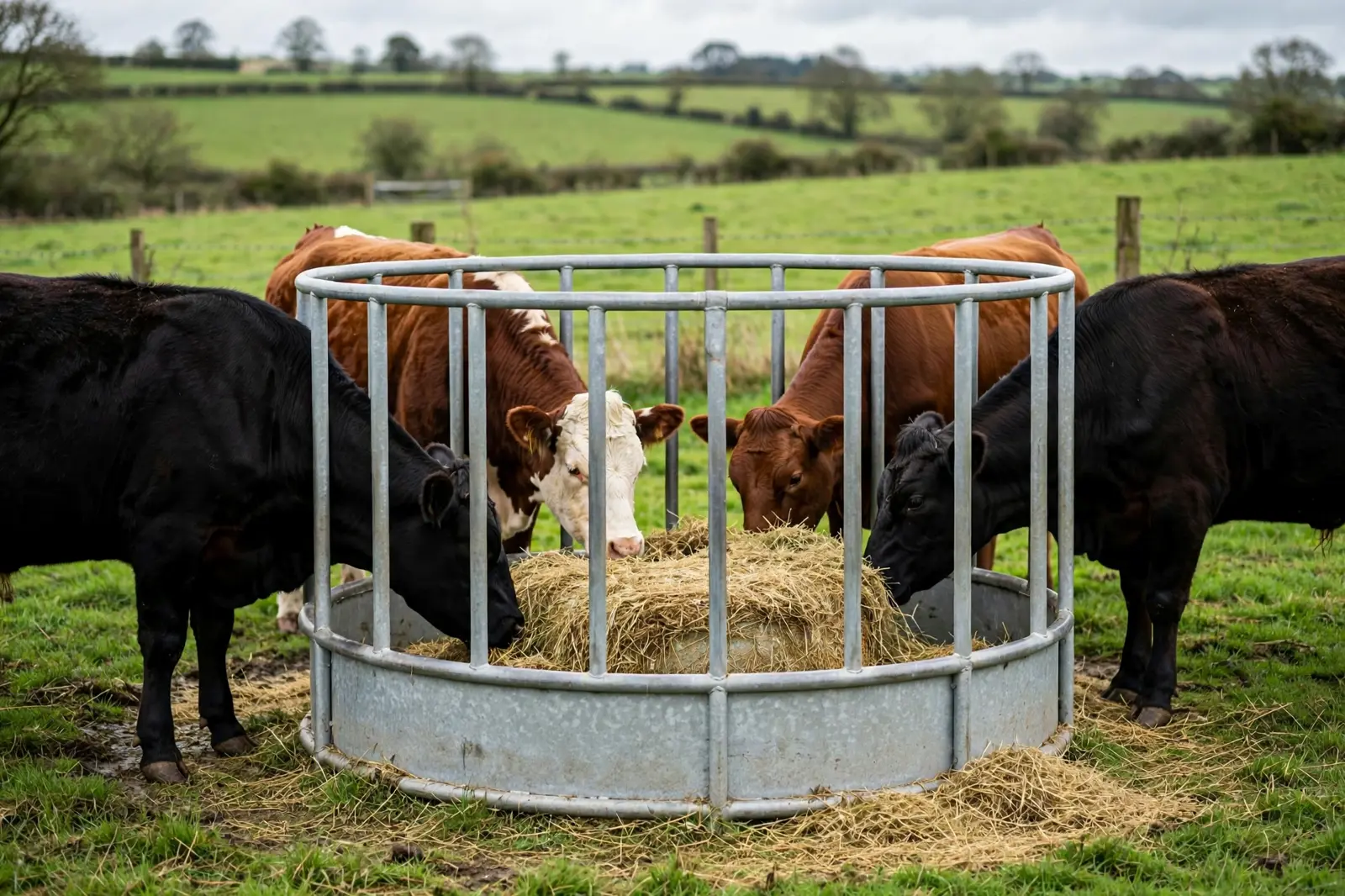
A round bale looks simple to feed out. Roll it into a paddock, pull the wrap off, and let the stock get on with it. Anyone who has wintered cattle or sheep on baleage knows it is not that tidy in practice. The outside of the bale gets trampled into the mud, the middle is dragged around the paddock, and a share of what you paid the contractor to bale never passes through an animal at all.
That is the problem a round bale feeder is meant to solve. Feeders range from a plain steel ring costing a few hundred dollars to tractor-mounted and trailed machines costing many thousands, and the right choice depends on your bale size, stock class, country and how much feed you put out in a season. This guide works through the main types sold in New Zealand, the bale sizes and weights they are built for, the safety points that come with moving heavy bales on a tractor, and what the research bodies say about feed waste. Prices are given only where a New Zealand manufacturer publishes them for its own models, and each is named with the model it belongs to.
What a round bale feeder does, and why feeding off the ground matters
In its simplest form, a round bale feeder is a barrier between the bale and the ground. It holds the bale in one place, limits how far stock can drag it apart, and gives animals defined feeding positions around it instead of an open scrum. Mechanised feeders go further: they pick the bale up, carry it where it is needed, and unroll or tease it out in a controlled row so the operator decides how much feed goes where.
The reason this matters is utilisation, the share of the bale that is actually eaten. DairyNZ puts wastage for silage and baleage at more than 20 percent when feeding out, and hay at 20 percent or more. On a typical bale fed without much control, a fifth or more of the dry matter you grew, cut and baled is lost to trampling, soiling, weather and simple refusal. DairyNZ also notes that wastage varies with the feed, the feeding method, the infrastructure and how the job is managed, which is another way of saying the feeder and the way you use it are part of the equation, not an afterthought.
The baseline: feeding on the ground with no feeder
Plenty of New Zealand farms still feed round bales on the ground, either rolled out with a tractor or simply dropped in the paddock with the wrap removed. It costs nothing in equipment, it is fast, and on dry, free-draining country with hungry stock it can work acceptably for short periods.
The weaknesses show up quickly in winter conditions. Stock pull the bale apart, walk through it, lie on it and dung on it. Feed that has been trampled or soiled is often refused, and once a bale is spread across a wet patch there is no getting it back. Hustler Equipment, which makes tractor feeders in New Zealand, lists the main causes of bale wastage on its own site as bales that are not teased apart enough for stock to eat easily, animals lying on or trampling fodder, unfinished bales left inside ring feeders on poor ground where animals cannot reach what is left, and stock rejecting feed contaminated with dirt or mud. Ground feeding exposes the bale to most of those at once.
There is also a pasture cost. A bale fed in one spot concentrates hoof traffic and dung in a small area, and the pugging damage can take a paddock out of the round for weeks. Feeding on the ground is reasonable for dry stock on hard country for a few days. As a whole-winter system on softer soils, it is usually the most expensive option once the wasted feed is counted.
Ring feeders: the simple circle of steel
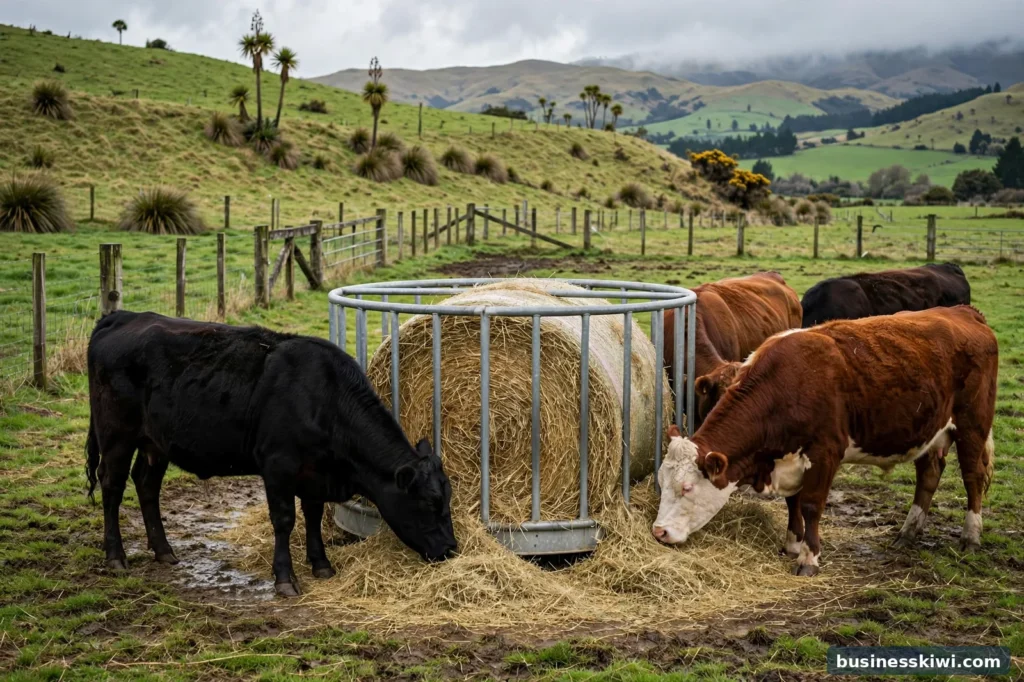
A ring feeder is a circular steel frame, usually in two or three sections that bolt or pin together, placed over or around the bale. Stock put their heads through the rails to eat, and the ring stops them pulling the bale apart or walking through it. It is the cheapest true feeder type and the one most small farms start with.
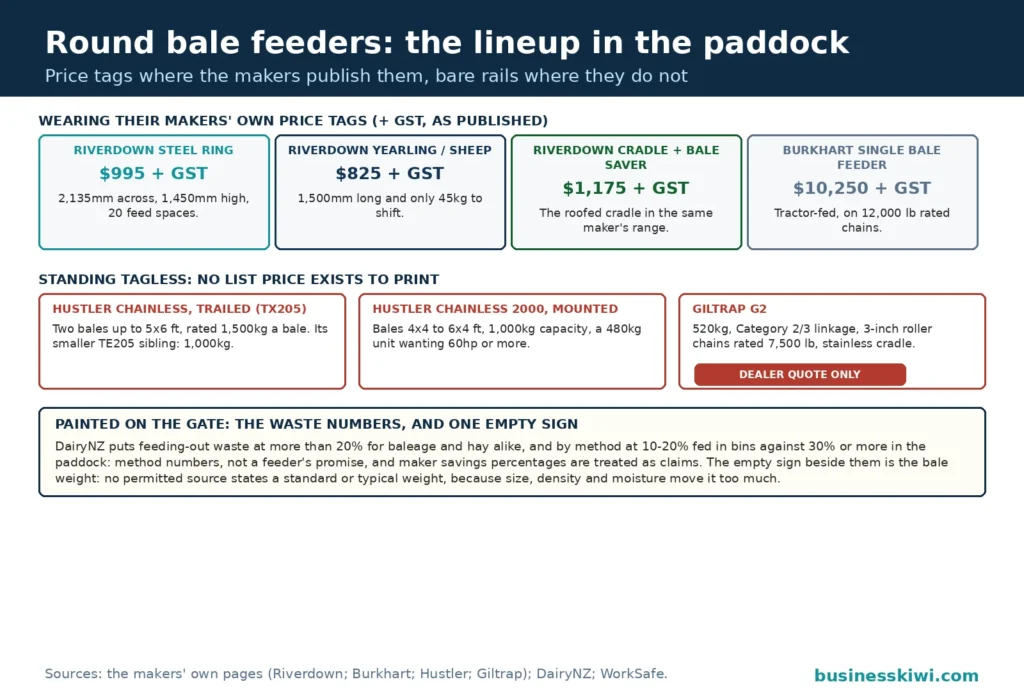
Riverdown Steel, a Rolleston manufacturer, sells a Round Bale Feeder that shows the typical format: 2,135 mm in diameter, 1,450 mm high, with 20 feed spaces around the ring and a welded base, supplied in two halves that bolt together. Its published price is $995 plus GST. A ring of that diameter comfortably takes the standard round bales baled in New Zealand, and twenty feed spaces means twenty animals can eat at once without shouldering each other off, provided the bale in the middle is within reach from all sides.
Smaller versions exist for young and small stock. Riverdown’s Yearling/Sheep Round Bale Feeder is 1,500 mm long, weighs 45 kg, comes flat packed for bolting together, and is priced at $825 plus GST. The light weight matters: a feeder one person can shift by hand gets moved before the ground under it is destroyed, and a feeder sized to the animal means sheep and calves reach the bale without climbing into it.
Ring feeders have limits worth knowing. The bale still sits on the ground, so its base is exposed to moisture and mud. As the bale is eaten down, the remaining core can end up out of easy reach in the centre, particularly on soft ground, which is the unfinished-bale problem manufacturers describe. And a ring must be moved to a fresh spot regularly or the ground around it becomes a mud bath. None of that makes rings a poor buy. For hay feeding to a small mob on reasonable country, they are hard to beat per dollar spent.
Cradle and tray feeders: the bale lifted off the soil
A cradle feeder holds the bale in a frame above ground level, so the bale rests in a V or U shaped cradle rather than on the dirt. Loose feed falls into a tray or onto a bed under the bale instead of into mud, and stock feed through the frame from the sides. Because the bale is off the ground, the last of it stays as clean as the first.
Roofed versions add weather protection. Riverdown’s Cradle with Bale Saver is a 1,500 mm square cradle with a roof over the bale, a chain fastening to stop the roof lifting in wind, and a published price of $1,175 plus GST. The maker lists weather protection for the bale and reduced wastage as the points of the design, which makes sense for hay in particular: hay under a roof stays dry between feeds instead of soaking up every shower.
Cradles also appear as the business end of tractor feeders, where the cradle holds and rotates the bale while chains or rotors strip feed off it. The Giltrap G2, a New Zealand-made tractor-mounted feeder, uses a stainless steel cradle and bed, and the company says the full width bed retains loose fodder that would otherwise be dropped and lost. Whether the cradle sits on legs in a paddock or on the back of a tractor, the principle is the same: support the bale, catch what falls, and keep both out of the mud.
Mechanised feeders: tractor-mounted and trailed machines
At the top of the range, the feeder is a machine. Mounted feeders attach to a tractor’s three-point linkage or a front loader, spear the bale, lift it, and unroll it in a row as the tractor drives. Trailed feeders do the same job behind the tractor and can carry a second bale, which cuts trips back to the stack.
Two drive systems dominate. Chain feeders rotate the bale on slats carried by heavy roller chains; rotor feeders use teasing rotors and no chains. Giltrap’s G2 is a mounted chain feeder: it weighs 520 kg, runs on Category 2 or 3 linkage, drives the bale with 3 inch roller chains rated at 7,500 lb, loads from either end and feeds out in either direction, with the rate controlled from the tractor seat. Burkhart Farm Equipment in Taranaki builds a single bale feeder around 12,000 lb roller chains, feeds both ways, and publishes a price of $10,250 plus GST. Hustler’s Chainless 2000 takes the rotor approach: self-loading, one bale at a time, rated for round bales from 4 by 4 feet to 6 by 4 feet up to 1,000 kg, 480 kg in weight itself, and rated by Hustler for tractors and loaders of 60 hp and up.
Trailed machines stretch capacity further. Hustler’s trailed Chainless TX205 is self-loading, carries two bales, handles round bales up to 5 by 6 feet at up to 1,500 kg per bale, and lays feed out in windrows so stock eat along a line rather than crowding a single point. Feeding along a row spreads animals out, reduces the bullying that keeps timid stock off a ring, and puts the trampling load on a strip of paddock instead of a circle hammered day after day.
These machines earn their keep where bale numbers are high: hundreds of bales a winter, feeding out in the dark, or country where carrying a bale on a loader is slow and hard on gear. For a lifestyle block feeding a dozen bales a year they are difficult to justify, and a ring or cradle does the same job at a fraction of the cost.
Round bale sizes and what a bale actually weighs
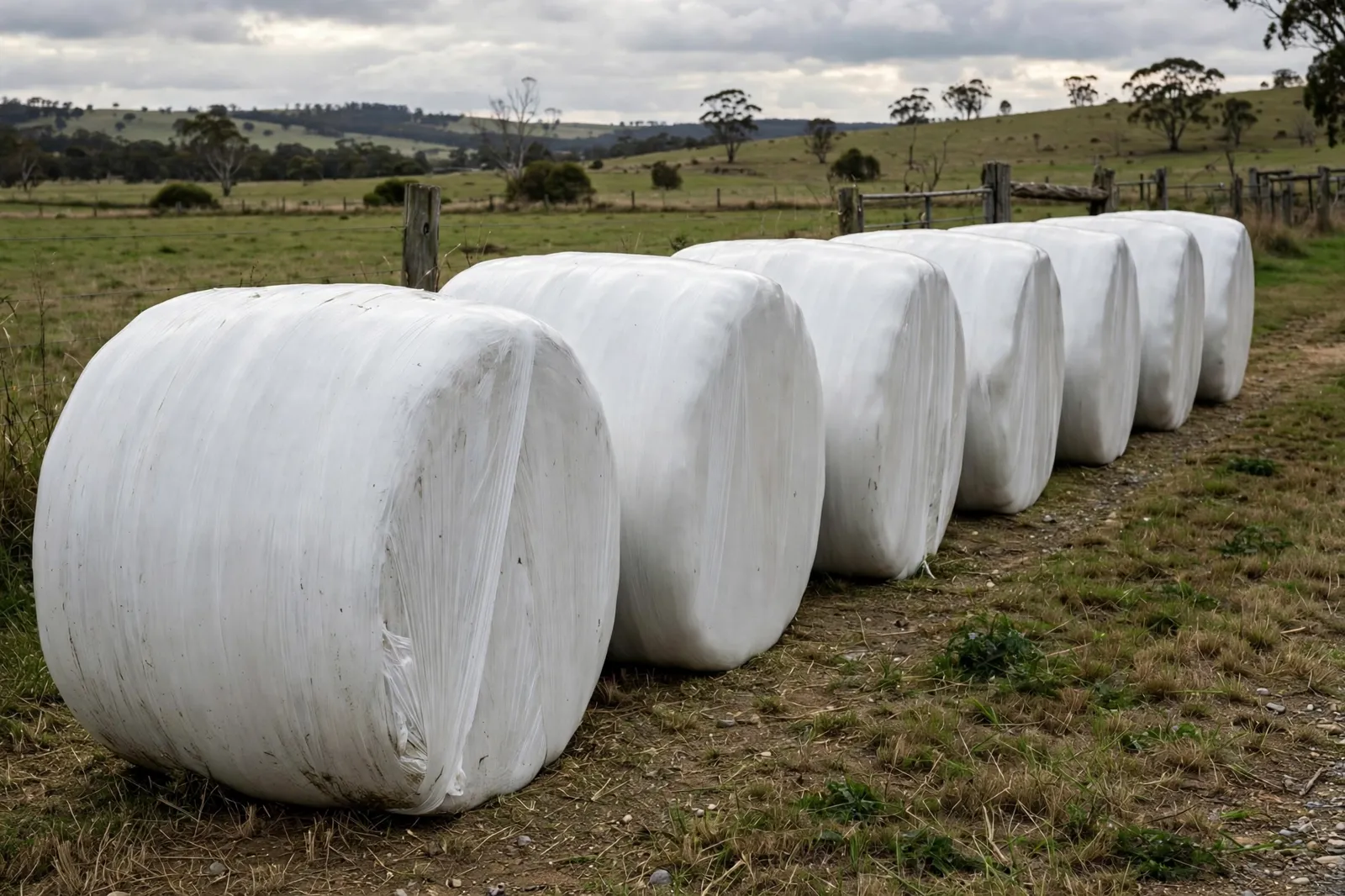
Round bales are described by diameter and width, and New Zealand balers produce them in a handful of common sizes. The feeder specifications quoted in this guide bracket the range well: mounted feeders are commonly rated for round bales from 4 by 4 feet up to 6 by 4 feet, and larger trailed machines handle bales up to 5 by 6 feet. Measure your bales before you buy a feeder. A ring or cradle sized for a 4 foot bale will not take a 6 foot bale, and a feeder built for the biggest bales is awkward with small ones.
Weight is where buyers get caught, because there is no standard weight for a round bale. Two bales of identical dimensions can differ greatly in weight. A dry hay bale is mostly fibre and air; a baleage bale of the same size is wet feed, and water is heavy. How tightly the baler packed the bale matters as well. That is why manufacturers rate feeders by the maximum bale weight they can handle rather than by an average, and the ratings are the most useful guide to what heavy bales actually weigh: 1,000 kg per bale on Hustler’s mounted Chainless 2000 and trailed TE205, rising to 1,500 kg per bale on the trailed TX205.
Work to the heaviest bale you will ever feed, not the typical one. A feeder, loader or linkage that is adequate for dry hay bales in December may be overloaded by wet baleage in July, and overloading is a safety issue as much as a mechanical one, as the next sections cover.
Matching a feeder to your stock and herd size
Start with feeding space. Cattle feeding from a ring need a position each if they are to eat in one sitting rather than in shifts dominated by the strongest animals. The 20 feed spaces on Riverdown’s round bale feeder give a simple benchmark: a mob much larger than the space count will feed in relays, and the animals at the back of the hierarchy get what is left, later, in worse condition. Two rings, or a mechanised feeder laying out a long row, suits bigger mobs better than one ring and hope.
Stock class matters as much as numbers. Sheep, calves and yearlings need smaller feeders with rails they can reach through without climbing, and lighter gear they cannot be crushed against in a push. Horned cattle need wider, smoother openings than polled cattle. DairyNZ’s wastage figures are a reminder that animal behaviour is part of feed efficiency: feed that dominant animals guard and timid animals cannot reach is feed wasted just as surely as feed in the mud.
Then match the system to the workload. Count your bales for the season honestly. A ring feeder asks for labour at every bale: move the ring, fetch the bale, cut the wrap, watch the ground. A mounted feeder turns feeding out into a tractor job measured in minutes per bale. Somewhere between a few dozen and a few hundred bales a winter, the labour and wastage savings start paying for the machine, but the crossover depends on your labour cost and bale value, and no manufacturer figure can tell you where it sits on your farm.
Placement, mud and looking after the ground
Where you put a feeder matters almost as much as which one you buy. Ground under a static feeder takes concentrated traffic from stock and tractor, so put rings and cradles on the firmest, best-drained spot available, ideally on a rise rather than in a hollow, and move them before the area turns. A feeder light enough to move gets moved; one that needs a tractor and twenty minutes tends to stay until the mud forces the issue.
Season changes the numbers. DairyNZ’s supplement guidance shows feeding method and conditions driving wastage hard: some feeds lose 10 to 20 percent fed from bins but 30 percent or more fed in the paddock, and its feeding-out wastage figures for baleage and hay sit above 20 percent before conditions are even considered. Wet ground multiplies all of it. Feed dropped in mud is refused, bales sitting in water rot from below, and pugged feeding areas cost pasture growth long after winter ends.
Mechanised feeders are designed with this in mind. Trailed machines run wide flotation tyres to spread their weight, and Hustler fits mudguards as standard for New Zealand and shapes its discharge so hay drops clear of the wheel tracks rather than being driven into the mud by the machine that delivered it. Feeding along a different line each day, and shifting static feeders at the first sign of the ground cutting up, are the habits that keep wastage near the bottom of DairyNZ’s ranges instead of the top.
Tractor handling and safety
Every round bale feeder system starts with moving a heavy, awkward load on a tractor, and this is where the serious risk sits. WorkSafe New Zealand’s farm vehicle guidance is direct about the basics: keep the load within what the tractor is designed for, use counterbalance weights when they are needed, and take particular care carrying a load on the front loader, because a raised load changes the vehicle’s centre of gravity. A round bale on raised loader forks is a large weight carried high and ahead of the front axle, which is close to the worst case for stability.
On slopes, WorkSafe’s advice is to take care, avoid driving diagonally, not turn down a slope, and turn uphill when working across one. Bale feeding happens on winter-softened hillsides, so plan the route before you lift the bale: travel with the load low and choose the gentlest line. Feeder design helps at the margins: Giltrap points to the low end fences on its cradle that hold a bale securely on steep hills, and Hustler fits a high rear fence to its mounted feeder to stop bales screwing off the back on hilly terrain, but neither replaces route planning.
WorkSafe also covers the habits that prevent the common accidents: wear the seatbelt where a roll-over protective structure is fitted and keep the structure sound, never get on or off a moving tractor, use only operators who are trained and familiar with the machine, and remember that as the person running the farm you carry duties under the Health and Safety at Work Act for the vehicles, training and gear your workers use. Spears deserve respect too. Forged spears that pierce a bale rather than pushing it, as Hustler describes its tynes, load the bale more securely, but a raised spear is still a hazard to anyone on foot, so keep people clear of the load path and never carry a bale near workers or children.
Waste, hygiene and animal health in practice
Beyond the percentages, waste has a hygiene side. Feed that has been rained on in an open feeder, mixed with mud, or left as a residue of old bale under a new one is feed that stock eat reluctantly and that can carry spoilage through the mob. Rotating feeder positions and cleaning out old residue when you shift a ring or cradle are basic hygiene, and they line up with DairyNZ’s point that wastage depends on management as much as on the feed itself.
Wrap and netting are part of the job. Self-loading feeders let the operator remove wrap and net above the cradle rather than on the ground, which keeps plastic out of the feed row. However you feed, cut wrap and net off completely and take it with you: plastic in a feed row ends up in stock, in the soil, or in waterways, and none of those outcomes is acceptable.
Animal safety around the feeder itself is mostly about condition and fit. Check rails and welds for breaks and sharp edges, especially on older rings dragged around by the loader. Make sure the feeder cannot tip onto stock if a bale lands unevenly, and size it to the animals using it. A feeder that is sound, stable and matched to the stock class is quiet farm infrastructure; one that is bent, sharp or wrong-sized is an injury waiting for a busy day.
What round bale feeders cost
Prices for new feeders sold in New Zealand are set model by model, and only some manufacturers publish them. Where prices are published, they are: Riverdown Steel lists its two-piece Round Bale Feeder at $995 plus GST, its Yearling/Sheep Round Bale Feeder at $825 plus GST, and its roofed Cradle with Bale Saver at $1,175 plus GST. Burkhart publishes $10,250 plus GST for its single bale tractor feeder. Hustler and Giltrap sell their mounted and trailed machines through dealers and do not publish prices on their product pages, so for those machines the price is a dealer quote for the model, the options and the freight to your district.
That spread, from a few hundred dollars to five figures, tracks what you are actually buying. A ring feeder is steel, welds and galvanising: its cost drivers are steel weight, the number of sections and the finish. A cradle adds the frame to hold a bale off the ground, and a roof adds more steel again. A tractor feeder adds hydraulics, chains or rotors rated for tonnes of pulling force, bearings, a loading system and the engineering to carry a tonne or more safely at linkage height. Freight is a real cost on bulky steel, and flat-packed designs exist partly to keep it down. Second-hand prices vary too widely by age and condition to quote responsibly; inspect chains, bearings, welds and hydraulics on any used machine as carefully as the asking price.
Frequently asked questions
What size round bale fits in a standard ring feeder?
Ring feeders are built around the common round bale sizes. The Riverdown Round Bale Feeder, for example, is 2,135 mm in diameter, which suits the standard bales produced by New Zealand balers. Measure your bale diameter before ordering, and leave working room: a bale that only just fits cannot be dropped in cleanly and will jam against the rails.
How much does a round bale weigh?
There is no single answer, which is why feeder makers rate their machines by maximum bale weight. A dry hay bale weighs far less than a wet baleage bale of the same size, and baler density adds further variation. Published ratings give the practical range: Hustler rates its mounted Chainless 2000 at up to 1,000 kg per bale and its trailed TX205 at up to 1,500 kg per bale. Size your gear for the heaviest bales you feed, not the average.
How many cattle can one ring feeder serve?
Count the feed spaces. A feeder with 20 feed spaces lets about 20 animals eat at once. A mob larger than that feeds in shifts, with subordinate animals getting later and poorer access, so bigger mobs are usually better served by a second ring or by a machine that feeds out along a row.
Can I feed baleage in a ring feeder, or are they only for hay?
Both hay and baleage are fed in rings and cradles. Baleage brings two extra considerations: it is much heavier, which matters when you are moving the bale and the feeder, and it deteriorates once the wrap is opened, so it needs to be eaten promptly. DairyNZ puts baleage feeding-out wastage at more than 20 percent, so containment matters at least as much as it does for hay.
Do feeders really cut feed waste?
The mechanisms are well established even where exact savings vary by farm: containment stops trampling and soiling, feeding off the ground keeps the bale out of mud, and controlled feeding lets you offer what stock will eat rather than a whole bale to spoil. DairyNZ’s published wastage figures, above 20 percent for baleage and hay fed out, are the baseline a good feeder works against. Treat any single savings percentage from a manufacturer as a claim, not a measurement.
What size tractor do I need for a mounted bale feeder?
It depends on the machine and the bale. Hustler rates its mounted Chainless 2000 for tractors and loaders of 60 hp and up, and the feeder itself weighs 480 kg before a bale of up to 1,000 kg goes on it. WorkSafe’s guidance is the real test: the tractor must be within its designed load limits with the bale carried, with counterbalance fitted if the manufacturer requires it.
Which is better for a small herd, a ring feeder or a tractor feeder?
For a small herd and a modest bale count, a ring or cradle feeder is usually the sensible buy: low purchase price, no hydraulics, nothing to maintain beyond the steel. A tractor feeder makes sense when bale numbers, labour time or winter ground conditions turn feeding out into the job that eats your day. The crossover is about bale count and labour, not herd size alone.
Sources
- DairyNZ, Supplements overview (dairynz.co.nz): energy, nitrogen and feeding-out wastage figures for silage and baleage, hay, straw and other supplements, and the effect of feeding method on wastage.
- WorkSafe New Zealand, Use the right farm vehicle, including the Safe use of tractors guidance (worksafe.govt.nz): load limits, front loader centre of gravity, slope driving, roll-over protection, operator training and PCBU duties.
- Hustler Equipment, Trailed Chainless Bale Feeders (hustlerequipment.com): TX205 and TE205 capacities, bale sizes, bale weights, self-loading and windrow feeding.
- Hustler Equipment, Chainless 2000 Round and Square Bale Feeder (hustlerequipment.com): mounted feeder specifications, bale size range, 1,000 kg weight capacity, 60 hp rating, and the manufacturer’s list of feed wastage causes.
- Giltrap, G2 Round Bale Feeder (giltrapag.co.nz): mounted chain feeder specifications, chain rating, stainless steel cradle and dual-direction feeding.
- Riverdown Steel, Round Bale Feeder; Yearling/Sheep Round Bale Feeder; Cradle with Bale Saver (riverdownsteel.co.nz): dimensions, feed spaces and published prices for each model.
- Burkhart Farm Equipment, Burkhart Single Bale Feeder (burkhartfarmequipment.com): chain feeder specifications and published price.
This article is general information about round bale feeder types, bale sizes and feeding practice in New Zealand. Feeder specifications, capacities and prices are those published by the named manufacturers at the time of writing and can change; confirm the current specification and price with the manufacturer or dealer before buying, and follow the tractor and feeder manufacturers’ operating instructions and WorkSafe guidance when handling bales.