Pebbles NZ: Types, Sizes, Prices and How Much to Buy
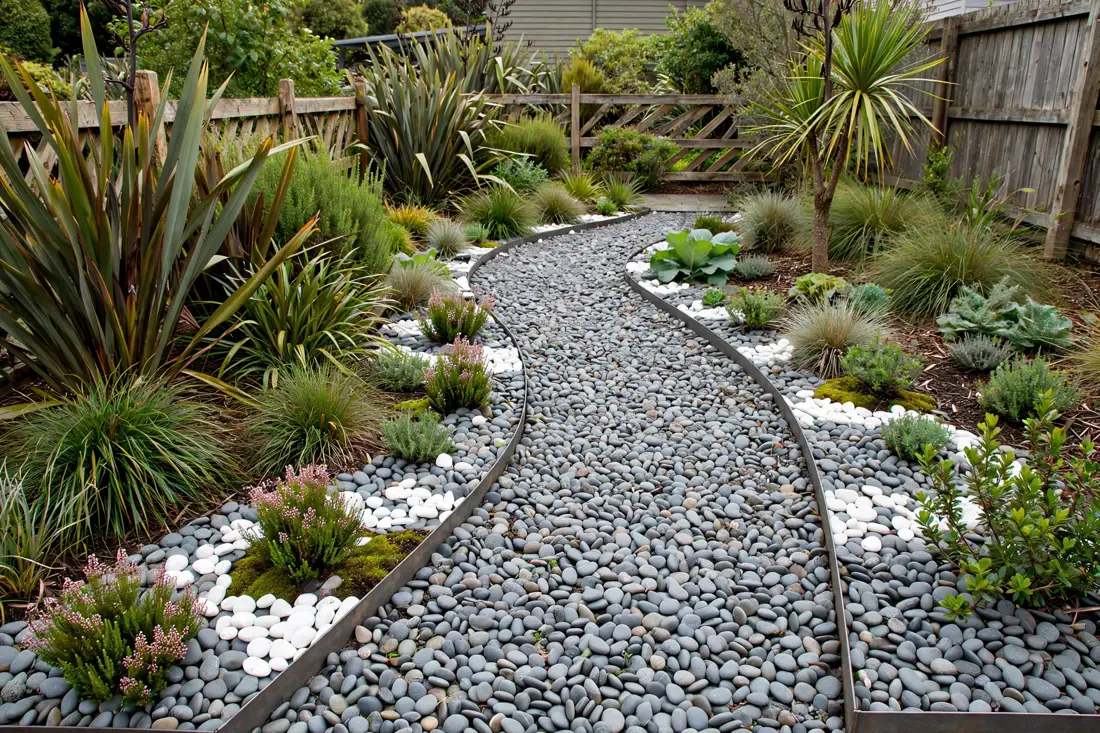
Decorative pebbles are one of the simplest ways to finish a NZ garden. They tidy up beds, give paths a clean edge and cut down the weeding, and they do it the day they are laid rather than a season later. The catch is that pebbles are sold in a confusing mix of bag weights, bag volumes, grades and bulk formats, and prices vary a lot between a plain river stone and a premium white marble. Order too little and you make a second trip with thin coverage that shows the weed mat through. Order far too much and you have paid to move stone you do not need, twice.
This guide works through what is actually sold in New Zealand, the sizes it comes in, what it costs bagged and in bulk, and the maths for working out how much to buy, with two worked examples. Prices are from NZ suppliers’ own product pages, checked on 8 October 2026, and they will change over time. Use them to compare formats rather than as a quote.
The types of decorative pebbles sold in NZ
River pebbles are the default NZ choice. They are smooth, rounded stones screened from river gravel, in natural grey and mixed earthy tones. Cubag, an Auckland and Hamilton landscape supplier, sells a small grade at roughly 13mm and a medium grade screened through a 20 to 40mm sieve, both in 25kg bags at $17.99. Central Landscape Supplies in Auckland sells a 10 to 20mm river pebble sourced from local rivers, in 20 litre bags or in bulk from a quarter of a cubic metre. Daltons bagged riverstone, sold through Bunnings, comes in 15 litre bags at $11.89 across three grades: fine at 15 to 20mm, coarse at 20 to 40mm and a large grade at 20 to 65mm. River pebbles are the workhorse option: paths, mulch cover on beds, around pools and in pots.
White pebbles are the premium look, bright against dark foliage or concrete. The stone itself varies. Some are marble, some are quartz, and some are paler river stone. Bunnings lists Tuscan Path Snow White Stone at 20 to 25mm in a 20kg bag for $23.50, Snow White Quartz Pebbles at 10 to 15mm in a 10kg bag for $25.98, and larger Snow White Marble Pebbles at 100 to 150mm in a 20kg bag for $21.98. Cubag’s Alpstone White Pearl, a white pebble with quartz flashes sold at 10 to 20mm in its bulk format, is $38.99 for a 20kg bag, well over double the price per kilo of plain river pebble. White stone shows leaf litter and algae more than grey stone does, so it suits courtyards and feature areas better than beds under trees.
Schist is the distinctly South Island option. Urban Paving in Christchurch lists Shotover schist among its decorative stones, a natural blend of white, grey and green tones used on paths, in gardens and around water features, and in the exposed aggregate of its own pavers. Schist tends to be flatter than river pebble, so it sits differently underfoot and gives a more layered, rustic finish.
Crushed decorative stone is angular rather than rounded, which makes it lock together instead of rolling. The best known NZ example is white chip, a screened limestone chip quarried in the central North Island. Cubag sells it at 6 to 16mm in 25kg bags at $18.99 and describes it as the country’s most popular decorative landscaping stone, used on paths, courtyards, driveways and beds. Urban Paving’s Canterbury range is built on crushed chip: Amuri limestone chip at 12 to 20mm, Blackstone chip at 15mm and 50mm, Greystone chip at 13mm and Teddington chip from Banks Peninsula at 20mm and 40mm. TCB Landscape sells crushed marble and crushed granite in bulk bags, including white granite at 20mm.
Around those four main types sit a few regional and specialty stones. Cubag’s range includes Cardrona pebble with green, white and grey colouring, Ohau stones in warm golden tones, black tusk pebble at 20 to 30mm and 30 to 50mm, and gabion rocks at 100 to 300mm for wire basket walls. Urban Paving sells Westland flat stones from the West Coast in small (25 to 70mm), medium (70 to 130mm) and large (130 to 200mm) grades. Crushed shell, sold by Cubag in 20kg bags at $29.99, is a pale, light option for paths and coastal style gardens. Scoria, the red volcanic stone common around Auckland, appears in bagged ranges too, with Daltons coarse scoria at 15 to 20mm in a 15 litre bag at $9.79 at Bunnings.
Sizes: what the grades actually mean
Pebble sizes are sieve grades. A product sold as 20 to 40mm has been screened so most stones pass a 40mm screen and are held on a 20mm one. Individual stones vary, and natural river products include a small share of split or undersize stone. Cubag notes that up to 5 to 10 percent of its medium river stones may be split faced, and suggests turning those stones crack side down.
The grades on NZ shelves run like this:
- Fine grades, about 4 to 16mm: mini pebbles, pea style stones and white chip. Good for pots, between pavers and fine textured paths. Small stones travel: they stick in shoe tread and migrate onto lawns.
- Medium grades, about 15 to 40mm: the standard for beds and general ground cover. Big enough to stay put, small enough to spread evenly and cover membrane well.
- Coarse grades, about 40 to 65mm: bold texture for feature areas and around larger plants. Coverage gets lumpier, so allow extra depth or the ground shows between stones.
- Large stone, 70mm and up: flat stones, marble boulders and gabion rock. Sold as individual features or by the bulk bag rather than as ground cover.
Match the grade to the job before you think about colour. A 10 to 20mm pebble on a bed behaves very differently from a 50mm stone, even at the same depth.
What pebbles cost in bags
Bagged pebbles are sold two ways in NZ: by weight, usually 10kg, 15kg, 20kg or 25kg bags, and by volume, usually 15 litre or 20 litre bags. That split is why shelf prices are hard to compare at a glance. All prices below were checked on suppliers’ own pages on 8 October 2026.
At the plain end, volume bags are the cheapest way in. Daltons 15 litre bags at Bunnings are $9.00 for Pebble Fine Decor (5 to 12mm) and Pebble Coarse Decor (15 to 40mm), and $11.89 for the three riverstone grades. Weight bags of river pebble sit a step up: Cubag’s 25kg bags of small and medium river stone are $17.99, which is about 72 cents a kilo.
Coloured and polished stones cost more per kilo. At Bunnings, Tuscan Path white pebbles at 30 to 50mm are $16.50 for 15kg, black polished pebbles are $21.98 to $23.90 for 15kg depending on grade, and the small 10kg bags of quartz and high polish stone run to $22.98 and $25.98. Cubag’s 20kg coloured bags run from $21.99 for Ohau stones and Cardrona pebble, through $34.99 for black tusk pebble, to $46.99 for its red desert pebble at 30 to 50mm. As a rough rule from these ranges, plain NZ river stone costs between about 60 cents and $1.20 a kilo bagged, and imported or polished feature stone costs $1.50 to $2.60 a kilo. The stone is the same shape; you are paying for colour, polish and freight.
How much to buy: the coverage maths
Every quantity question reduces to one formula:
Area (square metres) × depth (metres) = volume (cubic metres)
A depth of 50mm is 0.05 metres, so each square metre at 50mm deep takes 0.05 cubic metres, or 50 litres. At 40mm it is 40 litres per square metre. Once you have the volume, convert it into the format you are buying:
- Litre bags: divide the litres needed by the bag volume. A 15 litre bag into 300 litres is 20 bags.
- Weight bags and bulk bags: use the supplier’s own conversion where one is published. TCB Landscape states that its one tonne bulk bags are filled with 0.75 cubic metres, so a project needing 0.75 cubic metres is one of those bags, and it will weigh about a tonne when it arrives.
- Coverage figures: Urban Paving publishes that 1 cubic metre of pebbles covers approximately 30 square metres in its Stonelock stabilisation system, which works out to an average depth of about 33mm (1 divided by 30). Treat published coverage as a cross check on your volume figure, not a substitute for it.
On depth, the practical rule is to lay at least two to three stones deep so the membrane never peeks through. For a 20 to 40mm stone that points to roughly 50mm. In a stabilisation grid, Urban Paving’s coverage figure equates to about 33mm, because the grid holds the stones in place. Deeper is not always better: very deep loose pebble is hard to walk on and wastes money.
Worked example one: a garden path in litre bags
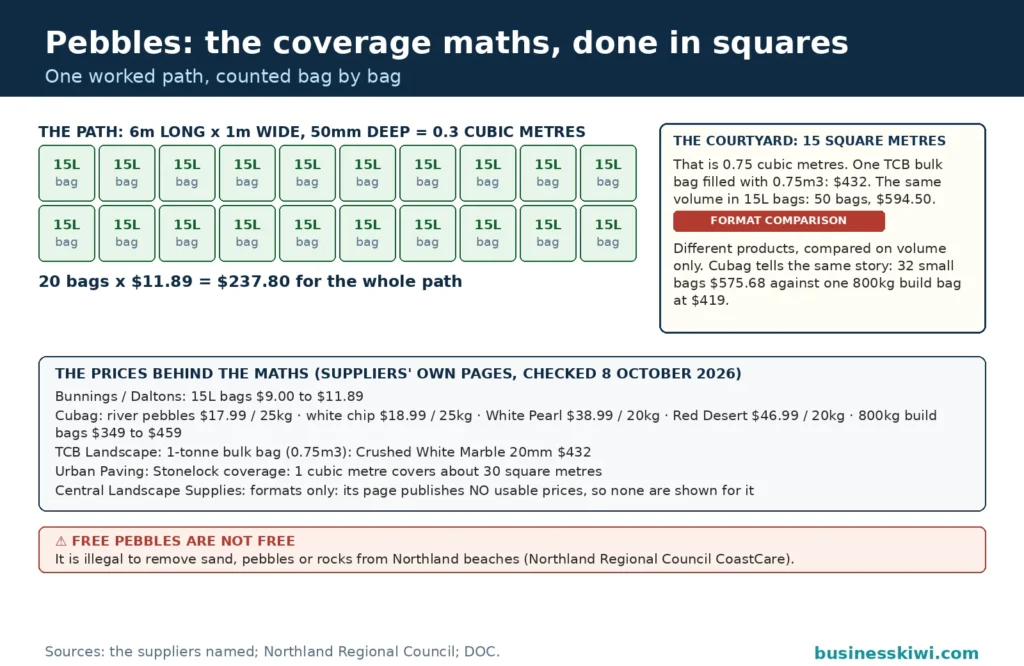
You are pebbling a path 6 metres long and 1 metre wide with a 20 to 40mm riverstone at 50mm deep.
- Area: 6 × 1 = 6 square metres.
- Volume: 6 × 0.05 = 0.3 cubic metres, which is 300 litres.
- Bags: Daltons Coarse Riverstone comes in 15 litre bags, so 300 ÷ 15 = 20 bags.
- Cost: 20 × $11.89 = $237.80 at Bunnings, checked 8 October 2026.
Cross check against Urban Paving’s figure: at about 33mm, 1 cubic metre covers 30 square metres, so at 50mm it covers about 20 square metres. Six square metres at 50mm therefore needs 6 ÷ 20 = 0.3 cubic metres. The two methods agree.
Worked example two: a courtyard bed in a bulk bag
You are covering a bed and courtyard area of 5 metres by 3 metres with white marble at 50mm deep.
- Area: 5 × 3 = 15 square metres.
- Volume: 15 × 0.05 = 0.75 cubic metres.
- Bulk format: TCB Landscape’s one tonne bag of Crushed White Marble at 20mm is filled with 0.75 cubic metres and costs $432, so one bag matches the volume exactly, with nothing left over for top ups.
- Bagged comparison: 0.75 cubic metres is 750 litres. In Daltons 15 litre bags that is 750 ÷ 15 = 50 bags, and 50 × $11.89 = $594.50.
The products differ, a crushed white marble against a plain riverstone, so this is a format comparison rather than a like for like quote. Even so, the bagged route costs $162.50 more here, and you would carry fifty bags instead of having one bag craned or tipped where you need it. The bulk bag also lands a tonne of stone in one spot, so plan where it goes before it arrives.
Bagged or bulk: which works out cheaper
Bulk wins on price per unit almost every time, and the gap widens with quantity. Cubag sells its small river pebbles at $17.99 for a 25kg bag. Buying 800kg that way takes 32 bags and costs 32 × $17.99 = $575.68. The same 800kg in one of Cubag’s build bags is $419, a saving of $156.68. The pattern repeats across the range: medium river stones are $379 in an 800kg bulk bag, white chip is $459 in an 800kg build bag against $18.99 a 25kg bag, and the 1 cubic metre bulk bags of Ohau stone and Cardrona pebble are $1,099 each.
Bags still make sense in plenty of situations:
- Small jobs and top ups, where a bulk bag would leave you storing most of a tonne of stone.
- Sites with no access for a delivery truck or hiab, where bags can be barrowed or carried through a house or up steps. Cubag notes its 1 cubic metre bulk bags need hiab delivery and can be craned over fences, which solves some access problems but not all.
- Premium stone in small areas, where the total quantity is a few bags either way.
Landscape yards split the difference. Central Landscape Supplies sells its river pebble in 20 litre bags or in bulk from 0.25 cubic metres, in quarter metre steps, and Urban Paving sells decorative stone in 20 litre bags, by the scoop (a third of a cubic metre) or by the cubic metre. Yard prices are usually quoted per yard or on enquiry rather than published online, Central’s product page lists formats without prices, so ring with your volume figure in hand and ask for the price at that quantity. Delivery is the swing factor: a bulk price that looks sharp can lose its edge once a delivery fee lands, while Cubag includes free delivery in its Auckland and Hamilton metro zones on its bagged and bulk range.
Laying pebbles properly
Good pebble work is mostly preparation. The stones themselves take an hour; the base decides whether the job still looks good in three years.
- Clear and level the area. Strip turf and weeds, and level the soil so water does not pool. On a slope, expect loose stone to creep downhill over time unless it is held by edging or a stabilisation grid.
- Put down a base where traffic demands it. For decorative beds, membrane straight over levelled soil is the usual approach. For driveways and parking areas, Cubag’s white chip guidance is to prepare a compacted GAP20 or GAP40 base first so the chip stays stable under vehicle weight.
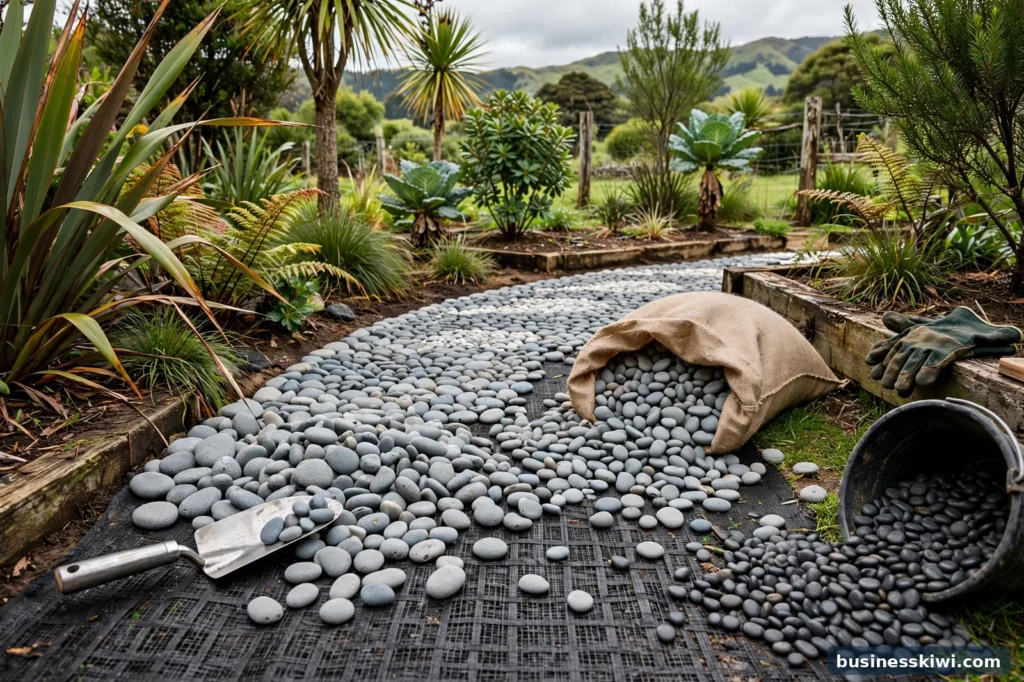
- Lay weed membrane. Cubag recommends placing its river stones on top of weedmat to help with weed suppression, and sells black weedmat at $20 for a 10 metre roll and $35 for a 25 metre roll, with galvanised pins at 50 cents each to hold it flat. Urban Paving describes its weedmat as a lightweight nonwoven fabric that lets air and water through and is UV stabilised for three to five years. Pin the mat, overlap joins, and cut crosses for plants rather than holes, so the flaps tuck back around the stems.
- Add edging. Pebbles migrate. Timber, steel or stone edging keeps them off the lawn and out of the mower’s path. Urban Paving’s range includes lawn borders and mowing strips for exactly this job.
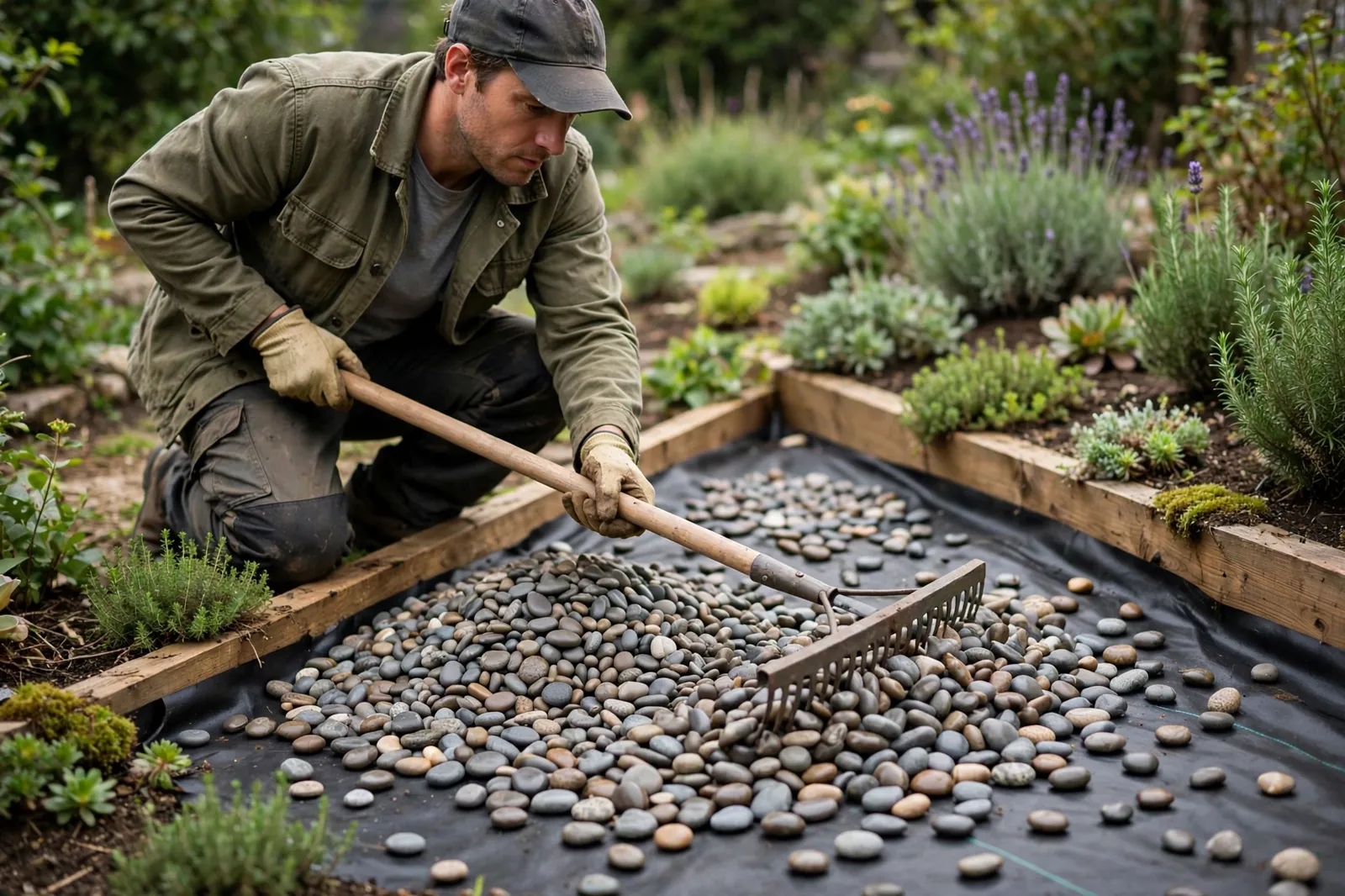
- Spread the stone to depth. Tip barrow loads at intervals rather than one heap, rake level, and check the depth with a ruler in a few spots. Aim for an even two to three stones deep with no membrane showing.
- Hose it down. New river stone arrives dusty. Cubag advises hosing laid stones down a couple of times to wash off the fine layer of quarry dust so the true colour shows. Stone also looks darker when wet, which is worth knowing before you judge the colour dry in the bag.
Where pebbles earn their keep
Paths. Fine to medium grades over membrane, with edging both sides. Small grades like Cubag’s 13mm river pebble are comfortable underfoot and, Cubag notes, stand up to being walked and driven over without cracking or splitting.
Mulching beds. Pebble mulch holds moisture, keeps soil temperature steadier and does not blow away or break down like bark, which is why heavy river stone suits windy sites. It feeds nothing to the soil, so beds still need compost underneath or feeding through the planting holes.
Around pavers. Fine grades fill the gaps in permeable paving and stabilisation grids. Urban Paving’s Stonelock honeycomb sheets each cover 0.92 square metres and hold pebbles in a stable, free draining surface as an alternative to concrete or asphalt.
Water features and pots. Smooth river stone is the classic finish around ponds and in water features, and a layer on top of potting mix in planters keeps the mix in place and looks finished. Black and white polished stones are sold largely for this contrast work.
One caution from Cubag’s white chip page: limestone chip changes soil conditions around acid loving plants such as rhododendrons and camellias over time, and Cubag suggests using bark mulch near those plants instead. If your bed is full of camellias, choose river pebble or bark, not white chip.
Can you collect your own pebbles?
It is tempting to fill a bucket at the beach or a riverbed, but beach and river stone is generally not free for the taking. Northland Regional Council’s CoastCare code puts it plainly: it is illegal to remove sand, pebbles or rocks from Northland’s beaches, because those materials are the building blocks of the coastline and take thousands of years to build up. Other councils take the same protective approach to their coasts, and the rules depend on where you are and who manages the land.
Protected places are stricter again. On Kapiti Island, a nature reserve administered by the Department of Conservation, the visitor guidelines include a simple instruction: do not take anything from the island. Conservation land, reserves and marine reserves sit at that end of the scale, where removing natural material is not permitted. Riverbeds add another layer, since gravel in rivers is managed as a resource and taking meaningful quantities is a consent matter for the regional council, not a weekend job.
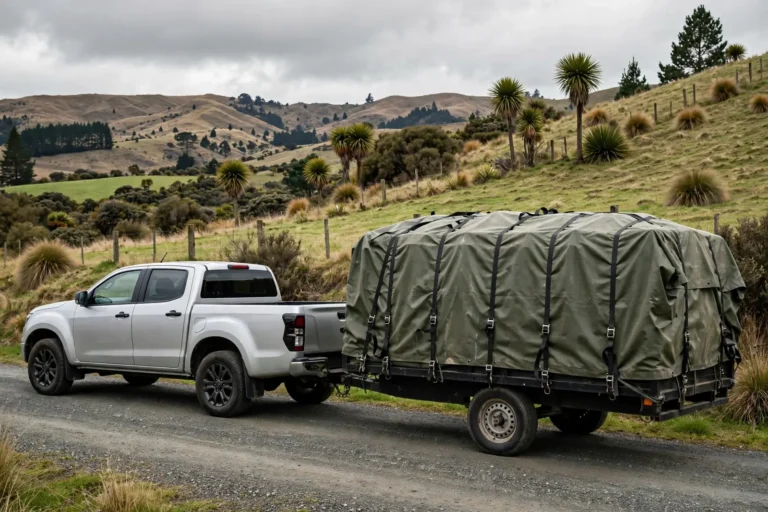
The practical position is this. Rules vary by place, so check with your local council before collecting anything, and assume that beaches, reserves and conservation land are off limits. A trailer load of river pebbles from a landscape yard costs a few hundred dollars, which is cheap beside a council infringement and a lot less work than carrying stone up a beach in buckets.
Frequently asked questions
How many bags of pebbles do I need for 10 square metres?
At 50mm deep, 10 square metres needs 10 × 0.05 = 0.5 cubic metres, which is 500 litres. In 15 litre bags that is 500 ÷ 15 = 33.3, so 34 bags. In weight terms that volume is roughly two thirds of a tonne for most river stone, but bag weights and stone density vary, so order by volume where you can and confirm with the supplier.
How deep should pebbles be laid?
Deep enough that no membrane shows: roughly two to three stones deep. For a 20 to 40mm grade that is about 50mm. Pebbles held in a stabilisation grid sit shallower, around 33mm on Urban Paving’s published coverage figure. Much deeper than 60mm of loose stone becomes awkward to walk on.
Do I really need weed membrane under pebbles?
Suppliers recommend it, and it does two jobs: it suppresses weeds coming up from the soil, and it stops the stone slowly sinking into the ground and disappearing. Weeds will still seed into dust that settles on top of the membrane over the years, but they pull out easily. Use a permeable mat that lets water through, and pin it properly.
What is the difference between pebbles and chip?
Pebbles are rounded stone, usually river worn or tumbled, and they roll underfoot a little. Chip is crushed stone with angular faces, so it locks together, stays put on paths and driveways, and feels sharper under bare feet. White chip is crushed limestone; most pebbles sold in NZ are river stone, marble or quartz.
Are white pebbles hard to keep white?
They show dirt, leaves and algae more than grey stone. Cubag’s maintenance advice for white chip is simple: a leaf blower is the best way to keep the stones clean. White stone also changes with water, bright white when dry and cream white when wet, so expect the colour to shift after rain.
Can I put pebbles over an existing driveway?
A thin scatter over a driveway will just move. Decorative chip on vehicle areas needs a compacted base underneath, and Cubag advises preparing a compacted GAP20 or GAP40 base before laying white chip where vehicles will drive. For a full driveway resurface, get the base right first or talk to a landscaper.
Why does the same pebble look different in my garden?
Two reasons. New stone carries quarry dust that dulls it until it is hosed or rained on, and wet stone looks noticeably darker and richer than dry stone. Judge the colour after a wash down, and expect split faced stones in natural river products, which suppliers suggest turning crack side down.
Is bulk always cheaper than bags?
Per kilo or per litre, yes, usually by a wide margin once you are buying several hundred kilos. The exceptions are small jobs, sites a truck cannot reach, and cases where delivery fees eat the saving. Run your volume figure through both formats before you order, using the supplier’s own bag and bulk prices.
This article is general information about buying and laying decorative pebbles in New Zealand. Prices were checked on suppliers’ own websites on 8 October 2026 and will change; confirm current prices, stock and delivery costs with the supplier before ordering. Rules on collecting stone vary by place and land status, so check with your local council or the Department of Conservation for the area you are in.
Sources
- Bunnings New Zealand, Pebbles product range, bunnings.co.nz
- Cubag, River Pebbles Small 25kg Bag, cubag.co.nz
- Cubag, River Stones Medium 25kg Bag, cubag.co.nz
- Cubag, White Chip 25kg Bag, cubag.co.nz
- Cubag, Alpstone White Pearl 20kg Bag, cubag.co.nz
- Cubag, Alpstone Red Desert Pebble 30-50mm 20kg Bag, cubag.co.nz
- Cubag, River Rocks and Decorative Stones range, cubag.co.nz
- Central Landscape Supplies, River Pebble 10-20mm, centrallandscapes.co.nz
- Urban Paving, Landscape Supplies Brochure, urbanpaving.co.nz
- TCB Landscape, Decorative Pebbles Bulk Bags, tcblandscape.com
- Northland Regional Council, CoastCare Code leaflet, nrc.govt.nz
- Department of Conservation, Kapiti Island Visitor Guidelines, doc.govt.nz