Partnership Resident Visa NZ: Requirements, Evidence and How to Apply

If your partner is a New Zealand citizen or resident and the two of you have built a life together, the Partner of a New Zealander Resident Visa is the visa that lets you settle here permanently. It is also one of the most evidence-heavy applications Immigration New Zealand (INZ) processes. There is no points test and no job offer requirement. Everything turns on one test: at least 12 months of living together in a genuine and stable partnership by the time you apply.
This guide covers who the visa is for, what INZ tests, the evidence that carries weight, and what happens after you lodge.
Quick answer
- The Partner of a New Zealander Resident Visa lets the partner of a NZ citizen or resident live in New Zealand indefinitely, with the right to work and study.
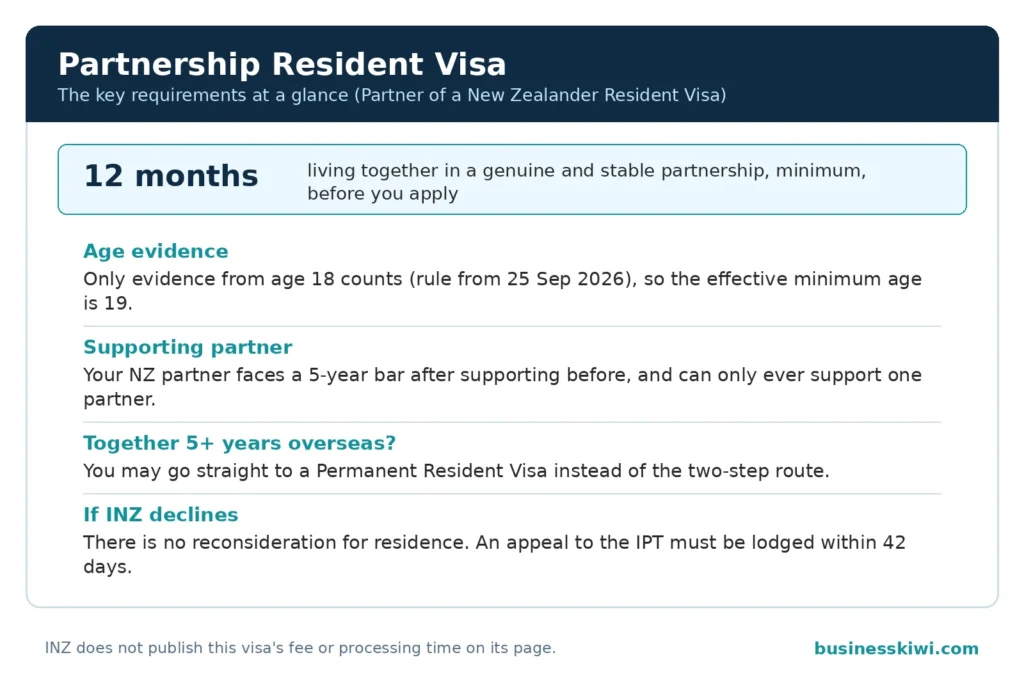
- You must have been living together in a genuine and stable partnership for at least 12 months at the time you apply, and only the period after you both turned 18 counts.
- Your partner must be eligible to support you. Limits apply if they have supported partners before, and they must complete the Partnership Support Form for Residence.
- You need a chest X-ray and medical examination, plus police certificates. Your partner faces a character check too, including their own police certificates.
- INZ does not publish the fee or current processing time on the visa page itself. Both are shown in INZ’s online fees and decision times tool, so check there before lodging.
- After 2 years on the resident visa, you can usually apply for a Permanent Resident Visa and drop the travel conditions attached to residence.
Who this visa is for
This visa is for the partner of a New Zealand citizen or a New Zealand resident. Partnership, in INZ’s definition, means two people living together in a legal marriage, a civil union, or a de facto relationship. You do not need to be married: a de facto couple who share a home and a life together are assessed on the same basis as a married couple, and a marriage certificate by itself proves very little.
If your partner holds New Zealand residence because they are an Australian citizen or Australian permanent resident, an extra condition applies: they must actually live in New Zealand, shown with documents such as utility bills, employment records, tax records and tenancy agreements in their name.
Dependent children can be included in the same application, on specific criteria: aged 24 or younger, single, no children of their own if they are 18 or older, and financially dependent on an adult if they are 21 to 24. For those aged 15 or younger, INZ asks for evidence they can legally leave their home country, such as custody documents or the other parent’s agreement to the move.
If you and your partner have not yet reached 12 months of living together, this visa is not yet open to you. Couples in that position usually look at the temporary partnership visas first, such as the Partner of a New Zealander Work Visa, live together in New Zealand, and apply for residence once the 12 months is complete.
The requirements in detail
The partnership test
INZ’s test has two halves. The first is living together: sharing the same home as a couple. INZ is explicit about what does not count: keeping separate homes and visiting each other, sharing accommodation on holiday, or living in the same house as flatmates. You and your partner must also not be close relatives, and you must have met before the application is made.
The second half is genuineness and stability: the officer must be satisfied the relationship is credible, genuine and stable. Marriage alone is not sufficient evidence of that, and the responsibility for proving the relationship sits with you, not with INZ. Both of you must also be planning to live in New Zealand for the same period of time.
The 12 months, and the age rule that changes how it counts
For residence, you must have at least 12 months of living together behind you when you apply, and the evidence must cover the 12 months immediately before the application.
Since 25 September 2026, INZ recognises partnership evidence only from when both people were aged 18 or over. Anything from before you both turned 18 is disregarded, however genuine it was. Because the 12-month clock starts only once you are both adults, in practice a couple cannot qualify until both partners are at least 19. If part of your shared life happened while one of you was 17, plan around the later start date rather than discovering the gap after you lodge.
Your partner’s eligibility to support you
Your partner is not a bystander in this application: they must be an eligible supporting partner, and INZ’s limits here catch some couples out.
Your partner must not have acted as a partner in a successful resident visa application within the past 5 years, and must not have acted as a partner in more than 1 successful resident visa application in total. “Acted as a partner” is wider than sponsoring a previous spouse. It also covers having applied for residence supported by a partner, or having included a partner in a successful residence application of their own, or been included in one (Permanent Resident Visa and Second or Subsequent Resident Visa applications are excluded).
Your partner must also not be liable for deportation, or have that liability suspended. And they must prove their own status, with a New Zealand passport, birth certificate or certificate of citizenship, or their New Zealand residence visa. Australian citizens and permanent residents provide their Australian passport and Australian permanent resident or resident return visa instead, plus evidence they live in New Zealand.
Your partner’s character
The supporting partner faces a character assessment of their own. INZ requires them to meet its good character requirements, or to be granted a character waiver. That means police certificates from any country they have spent 12 months or more in during the last 10 years, counting from when they turned 17 (the 12 months can be several shorter stays added together). The certificates must show any criminal record they have ever had in those countries, not just recent history. A New Zealand police certificate is the exception: your partner does not supply one, because INZ arranges it directly.
Some convictions mean a partner does not meet the character requirements, and INZ will then consider whether a character waiver is justified. If your partner has any conviction history, get advice on this early, before you pay a fee.
Your health and character
As the applicant, you must be in good health and of good character. Health is evidenced by a chest X-ray and a medical examination provided with the application.
For character, if you are 17 or older you need police certificates less than 6 months old when you apply, from every country you are a citizen of and every country where you have spent 12 months or more in the last 10 years (again, shorter stays can add up to 12 months). They must show any criminal record you have had at any time in those countries. One exception saves effort: certificates supplied with an earlier application and issued within the last 24 months do not need to be provided again, although INZ can ask for a fresh one while processing. A certificate not in English needs an English translation, including one that records no convictions. Our guide to getting a police check explains how certificates are obtained and what they show. Anyone with a criminal conviction, or who is considered a security risk, may be declined, so address character issues upfront rather than leaving them for INZ to find.
The evidence
Partnership applications stand or fall on evidence, which INZ organises into two groups of documents.
Evidence of living together
This is the foundation. INZ lists examples such as:
- joint ownership of a home, or a joint home loan, for the property you live in
- a joint rental agreement, or rental receipts
- joint utility accounts, such as power or phone bills
- mail addressed to you jointly, or to each of you individually, at the same address.
That last item is more useful than it looks: items showing your shared address, dated every few months, let the officer see both names at the same address at the start, middle and end of the 12 months. Individual items count, provided together they cover the full period.
Evidence the relationship is genuine and stable
The second group shows the texture of the relationship: that other people recognise it, that you make decisions and plans together, that you spend leisure time together and, if you have children, that you parent together. Its examples include:
- marriage or civil union certificates, if you have them
- birth certificates for children you share
- a joint bank account that is actually used, not just opened
- joint ownership of assets, joint credit cards, hire purchase agreements and other shared financial arrangements
- cards, letters or emails addressed to you as a couple
- chat records and other communication between you
- social media posts and photographs of you together
- letters of support from people who know you as a couple.
That last category is where friends, family, employers and community members can genuinely help: recognition by others is one of the things INZ is testing. Our separate guide to partnership visa support letters covers who should write them and what makes them persuasive.
How INZ weighs it all up
Officers weigh how long you have been together, how committed you are to a life together, any children and their care arrangements, and whether other people recognise the relationship. They also look at the practical side: how your household runs, whether you share household tasks and financial responsibilities and support each other financially, and whether you own or share property.
Use INZ’s partnership timeline and evidence checklist: complete it, include it with the application, and it will show any gaps in the 12 months before an officer finds them.
If you have spent time apart
Periods apart do not automatically sink an application, but they must be explained: why, for how long, and how you kept in touch. INZ then judges whether the reasons were genuine and compelling. A work posting with daily messages and visits paints a very different picture from an unexplained six-month silence, so put the explanation and the contact evidence in the file from the start.
Paper versus online evidence
How you apply changes what form your evidence takes. Online applications accept scanned images, so originals are not needed. Paper residence applications are stricter: documents must be originals or certified copies, although electronically issued documents are treated as originals.
The supporting partner’s form and obligations
Your partner formalises their support by completing the Partnership Support Form for Residence, which goes in with your application as evidence of their support. Anything not in English needs a translation.
Behind the form sit the eligibility rules already covered: your partner is vouching for the relationship, accepting the character check, and confirming their history does not breach the supporting-partner limits. A partner who recently supported a previous partner to residence, or who has an undisclosed character issue, can sink an otherwise strong application, so work through those questions honestly before lodging.

How to apply
Working from the documents INZ requires, the application runs in this order:
- Check the timing. Confirm you have 12 months of living together after you both turned 18, covered by evidence, before you lodge. Applying early wastes the fee.
- Gather identity and status documents. Your passport or certificate of identity and photograph (1 photo online, 2 on paper), plus your partner’s proof of citizenship or residence (and, for Australian-based partners, proof they live in New Zealand).
- Book the medical and order police certificates. Arrange your chest X-ray and medical examination, and request police certificates for both of you from every country that requires one. Certificates take time, and yours must be under 6 months old when you apply, so sequence this carefully.
- Build the evidence file. Complete INZ’s partnership timeline and evidence checklist, then assemble the 12 months of living-together evidence and the genuine and stable evidence, including support letters.
- Your partner completes the Partnership Support Form for Residence.
- Lodge online or on paper and pay the fee. Include translations of anything not in English; paper needs originals or certified copies, online takes scanned images.
- Respond to INZ during processing. INZ may ask for more documents, verify what you have provided, interview you both, or visit you, before deciding.
Fees and processing times
INZ does not state this visa’s fee or decision timeframe on the visa page itself. Both are published through INZ’s online fees and decision times tool, which shows the fee for your country of residence and how you apply, and INZ also publishes current wait times on its website. Fees and timeframes change, so check the tool on the day you plan to lodge rather than relying on figures quoted elsewhere.
Budget beyond the application fee: medicals and X-rays are paid to the provider, police certificates carry charges in some countries, and documents in other languages need paid translations. None of those costs is set by INZ.
On timing, partnership residence is assessed carefully rather than quickly. INZ may request more documents, verify your evidence, and interview or visit some couples. A complete file, organised against the checklist, is the main thing in your control that keeps the application moving.
What you get when approved
The visa lets you stay in New Zealand indefinitely, and live, work and study here with no conditions on where you work or what you study.
Residence does come with one important condition, and it is about travel. A resident visa lets you leave and return only until a set date, shown on your visa as the expiry date travel. If you are outside New Zealand after that date, your resident visa expires and you cannot return on it. You can apply to extend that date, or remove the issue altogether with a Permanent Resident Visa, covered next.
There is also a generous exception for couples based overseas. If your partner is a New Zealand citizen, you have lived together for at least 5 years, and your partner has lived outside New Zealand for at least 5 years (spending less than 3 months a year here in that period), INZ may grant you a Permanent Resident Visa straight away instead of a resident visa.
The Permanent Resident Visa next step
After holding your resident visa for at least 2 years in a row, you can apply for a Permanent Resident Visa. It has no conditions: you can live here permanently and travel in and out indefinitely, as long as the visa sits in a valid passport.
INZ requires a current resident visa (or one expired 90 days ago or less), that you have met its conditions, that you are of good character, and that you show commitment to New Zealand in one of five recognised ways. The most commonly used is the time commitment: at least 184 days in New Zealand in each of the last 2 years, which INZ checks against your travel records. The 2 years runs from when you first arrived in New Zealand as a resident, or from when your visa was issued if you were already here.
If you do not meet the PRV tests yet, the alternative is to extend your expiry date travel so you can keep coming and going as a resident in the meantime.

If INZ has concerns or declines
Concerns do not usually arrive as a straight decline. During assessment INZ may find information that could affect its decision: potentially prejudicial information, or PPI. Its glossary gives partnership concerns as an example. Before deciding, INZ sends a PPI letter setting out the information and inviting a response. That letter is your chance to explain, correct the record, or add evidence aimed at the specific concern, and it deserves to be treated as the most important document in the process.
If the application is declined anyway, the options depend on the visa type. Reconsideration (asking INZ to look again) is the route for temporary visa decisions, generally requiring you to be in New Zealand lawfully and to ask within 14 days. Residence is different: there is no reconsideration right, but applicants declined residence can usually appeal to the Immigration and Protection Tribunal within 42 days of the decision date. The Tribunal examines whether the decision was correct against the immigration instructions in force. Those 42 days pass quickly, and appeals are technical, so take advice as soon as a decline arrives.
FAQs
Do we have to be married to apply?
No. INZ’s definition covers a legal marriage, a civil union and a de facto relationship, all assessed the same way. Marriage does not reduce what you must prove: INZ states marriage alone is not sufficient evidence, and married couples need the same evidence as everyone else.
We have lived together for 10 months. Can we apply now and top up the rest during processing?
No. The 12 months must be complete at application, with evidence covering the 12 months before it. Couples short of the mark generally use a temporary partnership visa to live together here and apply for residence once they qualify.
Does the time we lived together as teenagers count?
No. Since 25 September 2026, INZ only recognises partnership evidence from when both of you were 18 or over, and both of you must be at least 18 when you apply. The 12 months can only start once you are both adults.
My partner supported a previous partner who got residence. Can they support me?
It depends on timing and history: your partner cannot have acted as a partner in a successful resident visa application within the past 5 years, and cannot have done so in more than 1 in total. If their last involvement was over 5 years ago and the only one, they may be eligible. This is a common failure point, so check it before lodging.
Can our children be included in the application?
Yes, if they meet the dependent child criteria: 24 or younger, single, no children of their own if 18 or older, and financially dependent if 21 to 24. Those 15 or younger also need evidence they can legally leave their home country, such as custody documents or the other parent’s agreement.
How much does it cost, and how long will it take?
INZ publishes the current fee and decision timeframes in its online fees and decision times tool rather than on the visa page, and both change over time. Check the tool before you apply, and budget separately for medicals, police certificates and translations. Partnership applications are assessed thoroughly, and INZ may verify evidence or interview you, which affects individual timeframes.
We lived in different countries for part of the year because of work. Will that fail the application?
Not necessarily, but it has to be explained and evidenced. INZ asks why you were apart, for how long, and how you kept in touch, and it assesses whether the reasons were genuine and compelling. Include the explanation, travel records and communication evidence upfront.
For more visa and residence guides, browse the Visa & Immigration hub.
Sources
- Immigration New Zealand, “Partner of a New Zealander Resident Visa”, immigration.govt.nz: who can apply, eligible partner rules, partner status and character requirements, health and character requirements, dependent children, documents needed, and the possibility of a Permanent Resident Visa for long-term couples living overseas.
- Immigration New Zealand, “Partnership and how to prove it”, immigration.govt.nz: the definition of partnership, minimum requirements, living together, evidence of a genuine and stable relationship, how partnership is assessed, and time spent apart.
- Immigration New Zealand, “Partnership visas”, immigration.govt.nz, published 5 August 2025: partnership defined in immigration instructions, the credible, genuine and stable test, marriage not being sufficient, verification, interviews and visits.
- Immigration New Zealand, “New age and evidence requirements for some partnership-based visas”, immigration.govt.nz, published 25 September 2026: the requirement that both partners be 18 or over and that evidence count only from age 18.
- Immigration New Zealand, “Becoming a permanent resident of New Zealand”, immigration.govt.nz: resident visa travel conditions, the expiry date travel, and extending travel conditions.
- Immigration New Zealand, “Permanent Resident Visa”, immigration.govt.nz: holding a resident visa for 2 years, commitment to New Zealand, and character requirements.
- Immigration New Zealand, Glossary, immigration.govt.nz: definition of potentially prejudicial information (PPI) and the PPI letter.
- Immigration New Zealand, “If your visa is declined” and “Appealing against a decision to refuse a visa”, immigration.govt.nz: reconsideration of temporary visa decisions, and appeals against residence decisions to the Immigration and Protection Tribunal within 42 days.
- Immigration New Zealand, “Getting immigration advice”, immigration.govt.nz, and Immigration Advisers Authority, iaa.govt.nz: who may give immigration advice.
Disclaimer
This article is general information about the Partner of a New Zealander Resident Visa, drawn from Immigration New Zealand’s published material at the time of writing. It is not immigration advice, and it does not assess your individual circumstances. Immigration instructions change, and partnership applications turn heavily on personal facts and evidence. In New Zealand, immigration advice may only be given by a licensed immigration adviser or by a person who is exempt from licensing, such as a lawyer holding a current New Zealand practising certificate. If you need advice on your situation, use a licensed adviser listed on the Immigration Advisers Authority register, or an exempt professional, before you apply.