Flight Attendant Jobs in NZ: Requirements, Recruitment, Training and Pay

Flight attendant work looks glamorous from the departure lounge. From the other side of the cabin door it is a safety job first and a hospitality job second, with early starts, rostered weekends and a recruitment process that can take months. If you are thinking about applying, it helps to know exactly what New Zealand airlines ask for, how their selection processes run, and what the pay realistically looks like.
Three employers account for most cabin crew jobs based in New Zealand. Air New Zealand flies domestic and international services with its own crew. Jetstar bases crew in New Zealand for its trans-Tasman and domestic flying. Jetconnect, a Qantas subsidiary, employs New Zealand based crew who fly in Qantas uniform on Qantas services. Each airline publishes its own requirements on its own careers pages, and the details differ more than many applicants expect.
Quick answer
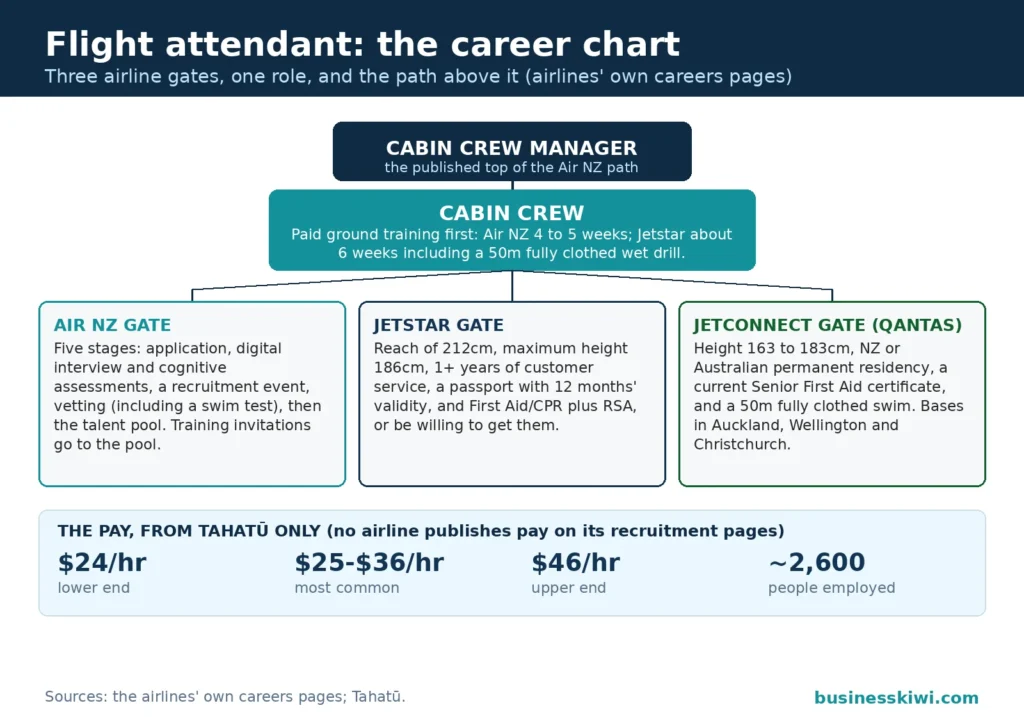
You do not need aviation experience to become a flight attendant in New Zealand, and there is no university degree requirement. The airlines that recruit here generally ask for a minimum age of 18, the legal right to live and work in New Zealand or permanent residency, a valid passport, customer service experience, a first aid certificate (or a willingness to get one), and the ability to swim. Recruitment runs in intakes rather than continuously, so applications open and close as each airline needs crew. Successful applicants complete paid ground training of roughly four to six weeks before they fly. Tahatū, the government’s careers service, puts typical flight attendant pay at $25 to $36 an hour before tax, with a wider range of $24 to $46 an hour. The airlines themselves do not publish salary figures on their recruitment pages.
What the job actually involves
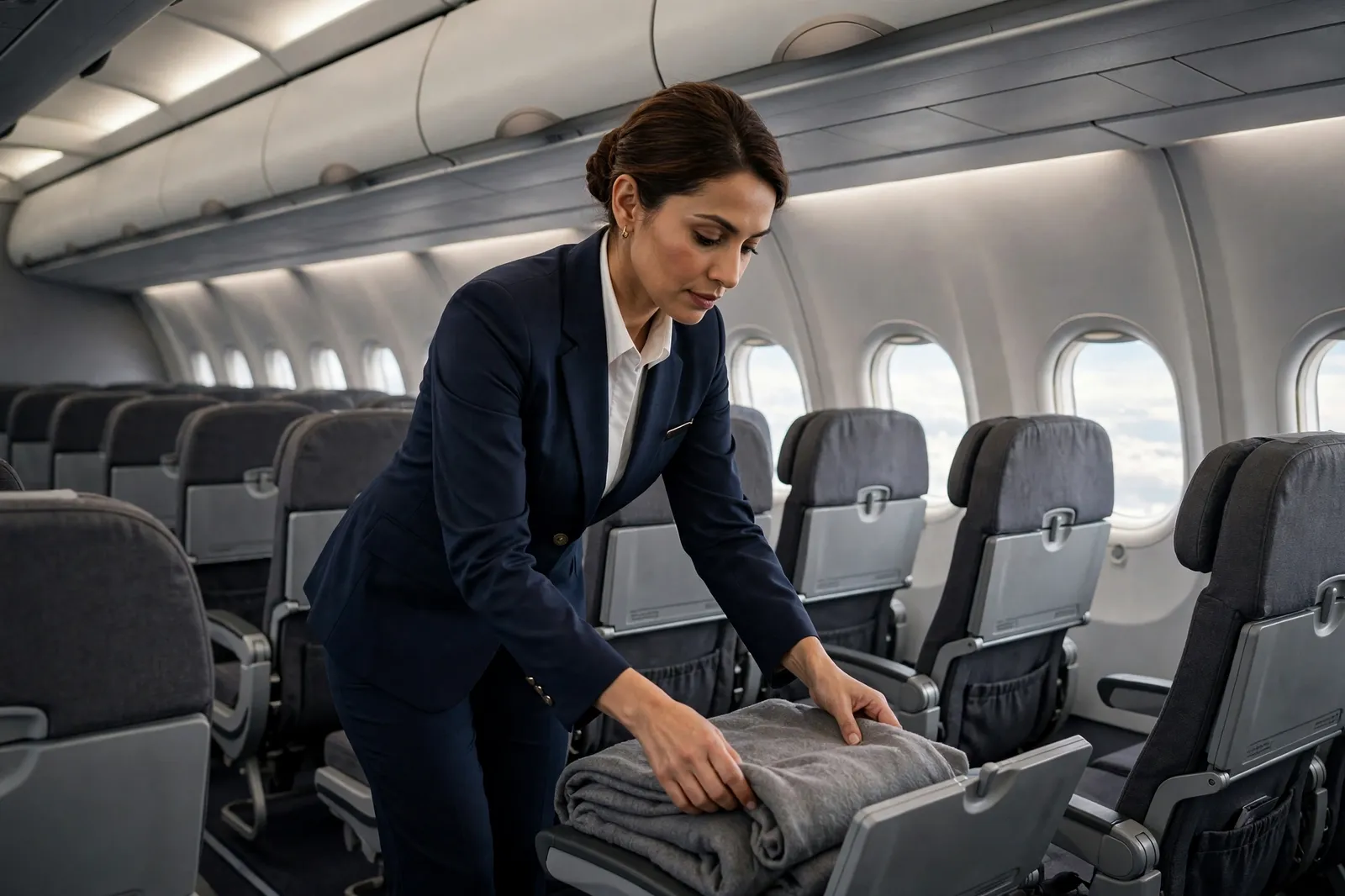
Tahatū describes flight attendants as the people who keep passengers safe and comfortable during a flight. The work includes explaining safety procedures, serving food and drink, and responding to emergency incidents. That short description understates how much of the role is about safety. Crew are trained to evacuate an aircraft, fight an onboard fire, give first aid and manage disruptive passengers, and they are assessed on those skills before they are allowed to fly.
Air New Zealand’s cabin crew pages describe its attendants as responsible for the welfare, comfort, enjoyment and safety of customers from the moment they step on board until they reach their destination. On Air New Zealand’s regional Q300 turboprop services, the flight attendant works sole charge, meaning one crew member carries the whole cabin role alone. On larger jets, crew work in teams under an onboard leader.
The service side is real too. Jetstar’s cabin crew pages describe crew greeting passengers, running safety briefings, keeping people fed and hydrated, and staying calm under pressure. Jetconnect, in its Qantas careers material, puts customer service, safety and passenger wellbeing at the heart of the role on everything from a short hop across the Tasman to long haul sectors.
A working week rarely looks like a working week. Cabin crew rosters cover early mornings, late nights, weekends and public holidays, and international flying involves nights away from home. Anyone weighing this career against a desk job should be honest with themselves about that pattern, because it is permanent, not a phase you pass after training.
Who employs flight attendants in New Zealand
Air New Zealand is the largest local employer of cabin crew. Its cabin crew pages cover three fleets. The ATR turboprop fleet flies domestic main trunk and regional routes, which the airline describes as running from Invercargill to Auckland and everywhere in between. The jet fleet covers domestic jet services and short haul international flying, and the Q300 fleet covers regional routes with a sole charge flight attendant. The airline also recruits for short haul and long haul teams, and its career path runs from flight attendant to onboard leader, and then to cabin crew manager, a role responsible for a team of roughly 100 people.
Jetstar recruits cabin crew for its New Zealand bases when it needs them, and its advertising states which base an intake is for. A recent Jetstar Auckland listing offered permanent full time roles based in Auckland, with successful applicants expected to live and work from that base. Jetstar’s cabin crew pages note that applicants need no aviation experience, and that crew bases exist across Australia and New Zealand.
Jetconnect is less well known by name, because its crew wear the Qantas uniform and fly Qantas aircraft. Jetconnect is wholly owned by Qantas, has its head office in Auckland, and employs more than 650 people across New Zealand. Its Qantas careers pages describe short haul crew bases in Auckland, Wellington and Christchurch flying trans-Tasman routes, and a long haul base in Auckland.
None of these airlines recruits continuously. Each opens applications for a set intake, fills a training course, and closes again. That pattern shapes everything about how you should approach applying, and it is covered in more detail below.
Entry requirements: what the airlines publish
The requirements below come from each airline’s own careers pages and listings. Read them as the published position of each airline, not as a single industry standard, because the differences matter when you are deciding where you fit.
The requirements most airlines share
Across the New Zealand based employers, the same themes keep appearing:
- A minimum age of 18.
- The right to live and work in New Zealand without restriction, or New Zealand or Australian permanent residency, depending on the airline.
- A current passport with a minimum period of validity, so you can enter every port the airline flies to.
- Recent customer service experience in a face to face role.
- A first aid certificate, held already or obtained during the process.
- The ability to swim, tested practically.
- Fitness and health good enough to pass a pre-employment medical.
- A willingness to work a shift roster with flexible hours.
Jetstar’s published requirements
Jetstar’s Auckland cabin crew listing set out a specific list. Applicants needed to be at least 18 years old, hold a passport with at least 12 months validity, and be able to work in New Zealand without restriction or sponsorship. Jetstar asked for customer service stars with more than a year of experience, and its careers pages describe the same one year benchmark. Candidates had to be willing to obtain a First Aid and CPR certificate and a Responsible Service of Alcohol (RSA) certificate, or hold them already.
Jetstar is precise about reach. Its cabin crew must be able to reach up to 212cm, which it checks at the start of its assessment centre, and its Auckland listing added a maximum height of 186cm. Crew also need to be fit and healthy and able to swim and tread water. The Auckland roles were permanent and full time, and anyone relocating had to do so before training started, at their own expense.
Jetconnect (Qantas) published requirements
Jetconnect’s expression of interest for New Zealand based flight attendants, published on Qantas careers pages, lists its essentials clearly. Applicants must be at least 18, and stand between 163cm and 183cm tall. They need New Zealand or Australian permanent residency, plus a passport that gives unrestricted access to all Qantas ports of call with at least 12 months validity.
Jetconnect asks for a current Senior First Aid Certificate that still has 12 months of validity at the time of application, which is a stricter position than Jetstar’s willingness to accept candidates who will obtain one. A Responsible Service of Alcohol Statement of Attainment is also required, although Jetconnect allows that one to be completed by the end of the recruitment process. On fitness, Jetconnect gives a concrete example: crew should be able to swim 50 metres fully clothed. Recent face to face customer service experience is expected, food and beverage service experience is an advantage, and so is the ability to speak additional languages. No previous airline or cabin crew experience is necessary, and full training is provided.
Air New Zealand’s position
Air New Zealand’s cabin crew pages put the emphasis on the person rather than a checklist. The airline says a flight attendant must be a people person with enthusiasm and a passion for flying, and that applicants should already have core skills before the airline trains them. Its applications are assessed against the requirements of the flight attendant position, and the detailed criteria sit in each job listing when an intake opens.
What Air New Zealand does publish openly is its vetting stage, which tells you a great deal about what the job demands. Candidates who reach vetting complete a swim test, plus security, medical and reference checks. If you cannot swim, or you know a medical issue could be a problem, that is the stage where it will surface, so it is better to think about it before you apply.
Published requirements compared
Air New Zealand is not in this table because its cabin crew pages describe its process and vetting rather than publishing a comparable list of numeric criteria. Its listings carry the specifics when recruitment opens.
The recruitment process, step by step
Air New Zealand
Air New Zealand publishes a five stage process on its cabin crew pages. First comes the application, where the airline assesses your skills and experience against the requirements of the role. Second is a digital interview, answering pre-set questions in short video clips, alongside online cognitive ability assessments. Third, successful applicants are invited to a recruitment event, where they hear more about the role and meet cabin crew managers and other applicants.
Fourth is vetting: the swim test, security checks, a medical, and reference checks. Fifth, if you meet every requirement, you are placed in a candidate talent pool. That last detail catches people out. An offer from Air New Zealand does not necessarily mean a start date. It means you wait in the pool until a place on a paid cabin crew training course becomes available, and only then are you invited to join.
Jetstar
Jetstar describes its own journey on its cabin crew careers pages. You apply with an up to date resume and a cover letter, and the airline confirms receipt by email. If you progress, you complete an online chat interview within a few days of being invited. The next stage is an in person assessment centre, which Jetstar describes as an interactive day where you learn about the role and meet potential teammates. Attendance is mandatory, and Jetstar says it may hold only one or two assessment days per intake, so treat the date as fixed once you have it.
After the assessment centre comes an online reference check, for which Jetstar asks for two referees who are colleagues you have worked with, including a previous direct manager. An offer follows by phone, and it is conditional on a security clearance and a medical examination. Jetstar covers the cost of the security clearance, but asks candidates to cover the cost of their own pre-employment medical. The reach test, the ability to reach 212cm, is demonstrated at the start of the assessment centre.
Jetconnect
Jetconnect has used expressions of interest for its New Zealand short haul roles, inviting people to register before a full intake opens. That model rewards patience and preparation: the certificate requirements, such as a Senior First Aid Certificate with a year of validity remaining, are much easier to satisfy if you arrange them while you wait rather than after an intake is announced.
Making your application count
Because all three airlines screen on customer service experience, your CV and cover letter do the heavy lifting early on. Point to specific work with unhappy customers, difficult situations you calmed down, and moments where safety rules mattered more than keeping someone happy. Generic claims about loving travel carry little weight, and every applicant makes them. If you are polishing an application, our cover letter guide covers how to structure one for a specific role rather than sending the same letter everywhere.
Training: ground school before you fly
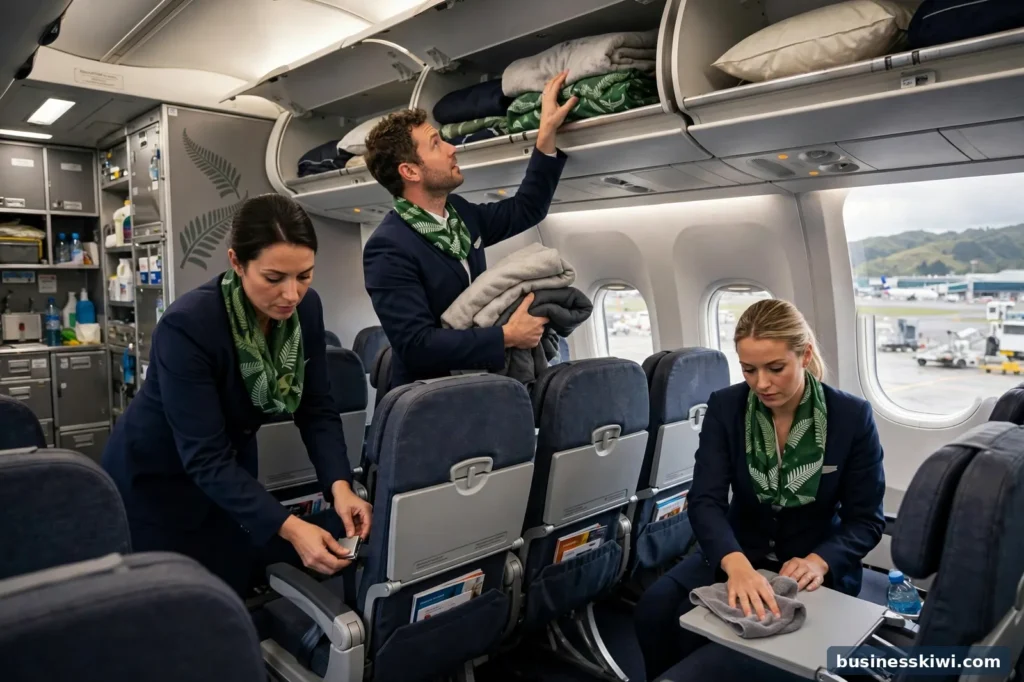
Nobody walks onto an aircraft as crew without passing ground training, and all three airlines train new crew themselves. You do not need to buy a private cabin crew course first, and none of the airlines’ pages ask for one.
Air New Zealand describes an intensive training course of four to five weeks on the ground, after which you qualify as a flight attendant and earn your wings. Its recruitment process confirms the training course is paid. Jetstar’s ground school runs for around six weeks and is also paid, according to its Auckland listing. Jetstar’s careers pages explain that trainees cover theory and practical work including customer service skills, emergency procedures and aircraft knowledge, and they must pass their exams to graduate. The practical side is physical: learning to operate the aircraft door, using the slide descent and fire equipment, and completing a wet drill that involves swimming 50 metres in full clothing while wearing a life jacket.
Jetconnect simply states that full training is provided, without publishing a duration on its expression of interest page. Tahatū, for its part, puts the overall training time for the occupation at under a year, which fits with a ground school of several weeks followed by supervised flying and ongoing checks once you start.
Training is also a genuine selection stage. Failing exams or practical assessments can end the process even after a job offer, which is why the airlines describe it as intensive. Treat those weeks as full time study, not as an induction you can coast through.
Pay: what is actually published
This is the section where honesty matters most, because it is the one where unofficial websites invent the most numbers. Neither Air New Zealand, Jetstar nor Jetconnect publishes a salary or hourly rate for cabin crew on the recruitment pages read for this guide. Jetstar tells successful candidates their salary when it phones with an offer. Anyone quoting you an exact Air New Zealand cabin crew salary from a blog or salary site is working from estimates, not from the airline.
The solid published source is Tahatū, the New Zealand government’s careers service, which tracks pay for the flight attendant occupation across the country. Tahatū puts pay before tax at $24 an hour at the lower end, with the most common range sitting between $25 and $36 an hour, and $46 an hour at the upper end. Tahatū also records around 2,600 people employed as flight attendants in New Zealand, with employment change rated as steady.
Two extra points are worth knowing. First, hourly pay is only part of the picture in this occupation, because rosters, allowances and seniority all move the total around, and the mix differs by airline and by whether you fly domestic, trans-Tasman or long haul. Second, languages can pay. Jetstar’s careers pages say a second language may give an applicant an advantage that is reflected in their remuneration, and Jetconnect likewise treats additional languages as an advantage.
Is this job right for you
Cabin crew work suits people who like structure and variety at the same time: the procedures are rigid, but no two days, crews or passenger lists are the same. It does not suit anyone who needs predictable hours, weekends at home, or control over their calendar. It is also about as far from home based work as a job gets, since your workplace is an aircraft and your roster is set by an airline. If flexibility about where you live and work matters more to you than travel, our guide to remote jobs in NZ covers the opposite end of the spectrum.
Practical readiness helps as much as enthusiasm. Before an intake opens, you can sort out a passport with plenty of validity left, gain or renew a first aid certificate, build a year or more of face to face customer service experience, and get comfortable in the water. Those four steps line up with what the airlines actually publish, and they cost you nothing in credibility if an intake takes a while to appear.
Frequently asked questions
Do I need experience as cabin crew, or a qualification, to apply?
No. Air New Zealand, Jetstar and Jetconnect all state that no previous airline or cabin crew experience is necessary, and each provides its own training. What they ask for instead is customer service experience: Jetstar publishes a benchmark of more than a year, Jetconnect asks for recent experience in a face to face role, and Air New Zealand assesses applications against the requirements of the position in each listing.
Is there a height requirement for flight attendants in NZ?
It depends on the airline. Jetstar requires crew to reach up to 212cm, and its Auckland listing set a maximum height of 186cm. Jetconnect publishes a height range of 163cm to 183cm. Air New Zealand does not publish a height or reach figure on its cabin crew pages, so check its current listing when an intake opens.
How much do flight attendants earn in New Zealand?
The airlines do not publish pay on their recruitment pages. Tahatū, the government careers service, puts flight attendant pay before tax at $24 an hour at the lower end, most commonly $25 to $36 an hour, and up to $46 an hour at the upper end. Your total income will also depend on your roster, allowances and seniority.
Do I need to be able to swim?
Yes. Air New Zealand includes a swim test in its vetting stage. Jetstar requires crew to be able to swim and tread water, and its ground school includes a wet drill swimming 50 metres in full clothing while wearing a life jacket. Jetconnect gives the same 50 metre fully clothed swim as its example of the fitness level expected.
When can I apply?
When an airline opens an intake. Cabin crew recruitment in New Zealand runs in rounds tied to training courses, not as a standing vacancy, and Air New Zealand holds successful applicants in a talent pool until a training place is free. Check the airlines’ careers pages regularly, register for their job alerts or expressions of interest, and have your documents and certificates ready so a short application window does not catch you out.
Sources
Air New Zealand, Cabin Crew careers page, careers.airnewzealand.co.nz
Jetstar, Cabin Crew careers page, careers.jetstar.com
Jetstar, Jetstar Cabin Crew Auckland job listing, careers.jetstar.com
Jetconnect (Qantas Group), Jetconnect Cabin Crew Expression of Interest, careers.qantas.com
Tahatū, Flight Attendant occupation profile, tahatu.govt.nz
Disclaimer
This guide is general information about flight attendant recruitment in New Zealand, based on the airlines’ own careers pages and Tahatū occupation data read in October 2026. Requirements, pay and recruitment processes change between intakes, and the figures here are not a promise of employment or earnings. Always check the current listing on the airline’s own careers page before you apply, and treat that listing as the final word.
For more career guides and job market explainers, see our Jobs and Education hub.