Study ECE Online in NZ: Qualifications, Providers, Fees and Practicum

Early childhood education is one of the few fields where you can start a degree from your kitchen table and still end up as a registered teacher. Online and field-based programmes in Aotearoa New Zealand are built for people already working with young children, or who want to, and they combine distance coursework with regular time in a licensed early childhood service. That second part catches many people out. Studying ECE online does not mean studying entirely from home, and the qualification you choose decides whether you finish as a certificated teacher or in a support role.
This guide covers the qualification ladder, the main distance providers and what their programme pages say about delivery, entry and fees, the practicum commitments, and registration after graduation.
Quick answer
To become a qualified, certificated early childhood teacher you need an approved initial teacher education (ITE) qualification at Level 7 or above, such as a Bachelor of Teaching (ECE), or a Graduate Diploma in Teaching (ECE) if you already hold a degree. Level 4 certificates and Level 5 diplomas prepare you for educator and support roles and can count towards degree study, but they do not lead to registration on their own. Every teaching degree includes supervised time in licensed services each week plus block practicums, even when coursework is online. Domestic fees for the degrees covered here sit roughly between $6,000 and $7,500 per year of full-time study.
Who online ECE study suits
Field-based ECE programmes were designed around people already inside the sector. If you work as an unqualified educator, reliever, nanny or home-based educator, a field-based degree lets you keep earning while your workplace doubles as your training ground, provided your service and a fully certificated teacher agree to support your placement hours.
Career changers use the same pathway for a different reason. Someone leaving retail, hospitality or an office job can begin with a Level 4 certificate to test whether the work fits, then stair-case into a diploma and a degree, crediting earlier study as they go. Parents returning to work often pick part-time options, because providers such as Te Rito Maioha reduce the weekly centre commitment for part-time students. There is also a shorter route for graduates of other disciplines: a Level 7 graduate diploma in teaching compresses the professional training into just over a year of full-time study.
What online study does not suit is anyone hoping to avoid childcare settings until the very end. The centre-based hours begin in your first semester, not your final year.
The qualification ladder
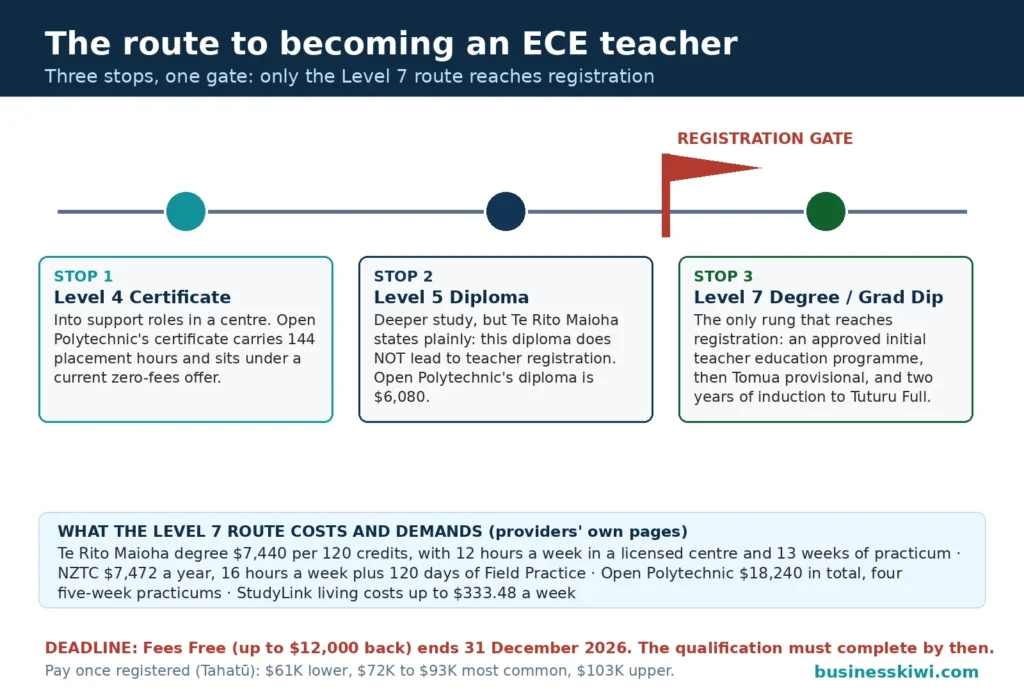
NZQA organises qualifications on the New Zealand Qualifications and Credentials Framework, which runs from Level 1 to Level 10. Certificates sit at Levels 1 to 6, diplomas mainly at Levels 5 and 6, and bachelor’s degrees and graduate diplomas at Level 7. In ECE, those levels map onto distinct jobs.
At Level 4, the New Zealand Certificate in Early Childhood Education and Care prepares people to provide practice-based education and care in a particular setting. Open Polytechnic describes it as the minimum qualification requirement for licensed home-based educators, and graduates work in roles such as ECE educator, support worker, reliever or home-based educator. It is a support qualification, not a teaching one.
At Level 5, the New Zealand Diploma in Early Childhood Education and Care deepens practice for people already working with infants, toddlers and young children. Te Rito Maioha is blunt about its limits: its Level 5 diploma does not qualify students for teacher registration or a practising certificate. What it can do is credit towards degree study, since Te Rito Maioha states that all five of its diploma courses may be credited towards the first year of its Bachelor of Teaching (ECE).
Level 7 is where registration begins. A Bachelor of Teaching (ECE) is a three-year, 360-credit initial teacher education degree. A Graduate Diploma in Teaching (ECE) is a 120-credit Level 7 qualification for people who already hold a bachelor’s degree. Graduates of approved ITE programmes can apply to the Teaching Council of Aotearoa New Zealand for registration and a practising certificate. The Ministry of Education’s funding system draws the same line: education and care services receive higher funding rates tied to the proportion of certificated teacher hours they use, so a Level 7 teaching qualification changes both your role and your employer’s funding position.

Providers and what they offer
Three providers dominate distance ECE study in New Zealand, and each structures the blend of online learning and centre time differently. The details below come from the providers’ own programme pages.
Te Rito Maioha Early Childhood New Zealand
Te Rito Maioha delivers its Bachelor of Teaching (ECE) through a blend of online learning and field-based learning, and students can be based anywhere in New Zealand. It also offers the Level 5 Diploma in Early Childhood Education and Care and, for existing graduates, a one-year Graduate Diploma of Teaching (ECE). Its bicultural focus is explicit: the degree builds skill in te reo me ōna tikanga Māori, and each year includes a two-day noho marae. In-person help is available at 11 regional education centres.
Open Polytechnic
Open Polytechnic positions itself as New Zealand’s specialist distance-learning provider for early childhood training. Its education listing includes the NZ Certificate in Early Childhood Education and Care (Level 4), the NZ Diploma in Early Childhood Education and Care (Level 5), the Bachelor of Teaching (Early Childhood Education) at Level 7 with 360 credits, and a Graduate Diploma in Teaching (Early Childhood Education) at Level 7 with 120 credits. Courses and assessment run online, and intakes run through the year rather than only in February.
New Zealand Tertiary College (NZTC)
NZTC delivers its Bachelor of Teaching (Early Childhood Education) through what it calls centre-based learning. Course material, discussion and assessment run through its NZTC Online platform, while students learn in their workplace at a licensed centre. The College describes the degree as an initial teacher education programme whose graduates are eligible to apply for teacher registration. NZTC also offers a Graduate Diploma in Teaching (ECE) and an NZ Diploma in Early Childhood Education and Care (Level 5), and notes that diploma graduates may apply to enter the second year of the Bachelor of Teaching (ECE).
The practicum reality: online does not mean at home
Every provider in this guide attaches real hours in real centres to its online programmes, and the pattern matters more than the marketing label.
Te Rito Maioha expects Bachelor of Teaching students to work or volunteer two days a week at an ECE centre in their community. Its entry criteria quantify that as at least 12 hours a week under a registered teacher holding a full practising certificate, or at least 6 hours a week if you study part-time. On top of the weekly commitment, the degree includes 13 weeks of practicum placement. Its Level 5 diploma has the same shape in miniature: about 12 hours a week in your home centre if you study full-time, plus a four-week teaching practicum in a different centre.
NZTC sets the weekly bar higher for its degree. Alongside Field Practice, its students must do paid or voluntary work experience in a licensed early childhood centre for a minimum of 16 hours per week throughout the programme, and they complete 120 days of full-time Field Practice across the degree, at least 40 days in each stage.
Open Polytechnic structures its degree around assessed practicum blocks rather than a fixed weekly quota, although it strongly recommends being in paid or voluntary employment in an early childhood setting throughout. Degree students complete four five-week practicums in approved licensed centres, one in each of the first two years and two in the final year, working at least 35 hours a week during each block. Its Level 4 certificate is lighter again: a supervised placement of 3 hours a week over 16 weeks for each of its three courses, totalling 144 placement hours.
The practical consequence is simple. Before you enrol, you need a licensed service willing to host you, and for the field-based degrees you need that arrangement in place at application, not after the first assignment lands.
Entry requirements
Academic entry to a teaching degree generally starts with University Entrance, or an equivalent the provider accepts. All three providers make room for adults without it. Open Polytechnic will consider applicants over 20 whose previous education, work or life experience suggests a reasonable likelihood of success. NZTC offers special admission for applicants over 20 at the College’s discretion, while those under 20 need University Entrance or an equivalent such as an International Baccalaureate diploma. Te Rito Maioha accepts University Entrance or skills gained through sufficient work, voluntary experience or other learning.
Because these are teaching qualifications, selection goes well past grades. Te Rito Maioha requires two written confidential referee reports, which cannot come from family or friends, and applicants must complete and pass a children’s worker safety check and police vetting under the Children’s Act 2014. NZTC asks for at least one written professional reference, a personal interview, a New Zealand Police vetting report, and assessments of literacy and numeracy, te reo Māori competency, and English language proficiency against the Teaching Council’s requirements. Open Polytechnic’s application asks for employment history, evidence of qualifications, any criminal convictions or traffic infringements, a short written piece on why you want to teach, two referees, verified identification and consent for police vetting, plus a written literacy and numeracy test.
Language standards are set by the Teaching Council rather than by individual providers. Where English or te reo Māori is not your first language, Open Polytechnic states the benchmark as an IELTS (Academic) score of 7.0 with no band below 7.0, or an equivalent, in line with Teaching Council guidelines. Lower-level qualifications set lower bars: Te Rito Maioha’s Level 5 diploma asks for NCEA Level 3 including 10 literacy credits at Level 2 and 10 numeracy credits at Level 1, or equivalent experience, and Open Polytechnic’s Level 4 certificate is aimed at people holding NCEA Level 2 or an equivalent.

Fees: what providers publish
Fees below are the domestic figures published on the providers’ own pages. They change annually, and part-time students pay pro rata by course or credit in most cases, so treat them as a starting point for budgeting rather than a fixed quote.
What the headline fee covers differs. Te Rito Maioha states that its fees cover all tuition costs, student guides, readings and the noho marae, with part-time rates of $1,860 per 30-credit course and $930 per 15-credit course. Open Polytechnic is more cautious: its qualification cost is an approximate figure built from the required courses, excluding annual administration fees, textbooks, course materials and external exam fees, and course fees may rise annually. NZTC lists extra charges for international students on its degree page, and a credit recognition and transfer assessment fee of $95 for any student seeking credit for prior study. Where a provider does not publish a fee for a programme, as with some graduate diplomas, the fee is confirmed during application and enrolment, so ask for it in writing before you commit.
Funding your study: Fees Free and StudyLink
Government help has shifted ground recently, so check the current settings before you rely on older advice. Fees Free for the first year of study finished at the end of 2024. From 1 January 2025 it was replaced by Fees Free for the final year: eligible first-time learners can claim back fees for the final year of their first qualification, up to $12,000, once they complete it. You pay your fees when you enrol, and you apply through myIR after finishing. If you have a student loan, the entitlement is transferred onto your loan balance rather than paid to you in cash. Timing is now critical, because the Fees Free website states that the final year must have started on or after 1 January 2025 and the qualification must be completed by 31 December 2026, when Fees Free ends.
For the years Fees Free does not cover, StudyLink is the main channel. Its student loan can pay compulsory course fees, up to $1,000 for course-related costs such as books or a computer, and, for full-time students, living costs of up to $333.48 a week at the rate published on its student loan page. A one-off establishment fee of $60 is added to the loan balance. Residency rules apply: most applicants qualify as New Zealand citizens, or as residents who have lived here for at least three years while holding a residence class visa for at least three years. StudyLink also offers the Student Allowance, a weekly payment towards living costs that does not need to be repaid, generally aimed at full-time students and income tested. Open Polytechnic makes the division of labour clear on its own site: applying for a loan is the student’s job through StudyLink, not the provider’s.
From graduation to registration
Finishing your degree is not the last step. It is the point where the Teaching Council takes over.
Graduates of an approved New Zealand ITE programme apply to the Teaching Council for teacher registration and their first practising certificate, called Tōmua, the Provisional Practising Certificate. The Council’s application requirements include having completed the approved programme within the last five years, a proof of identity check required for people working with children under the Children’s Act, a satisfactory New Zealand Police vet, and declarations covering your commitment to the Code of Professional Responsibility, your health, and your commitment to develop and practise te reo me ngā tikanga Māori through your career.
Tōmua is issued or renewed for three years and is designed to be held for a maximum of five. During that period, beginning teachers complete a two-year programme of induction and mentoring provided by their employer, guided by a fully certificated mentor, before moving to Tūturu, the Full (Category One) Practising Certificate. If you are not starting work straight away, you can apply for registration only and seek the practising certificate later.
Pay and pay parity context
Pay is where the Level 7 distinction stops being abstract. Tahatū, the government’s career information service, lists early childhood teacher pay before tax at around $61,000 at the lower end, most commonly between $72,000 and $93,000, and up to about $103,000 at the upper end. It records roughly 27,000 people employed in the occupation, with employment change rated as steady, and training of three to four years.
Those upper figures belong to qualified and certificated teachers, not to support roles, and the mechanism behind them is pay parity. Under the Ministry of Education’s ECE funding rules, education and care services can access base, parity, extended parity and full parity funding rates. To receive the higher rates, a service must attest, through its funding return, that it pays all of its employed certificated teachers at least the minimum amounts on the corresponding salary scale, from Step 1 of the base scale through to Steps 1 to 11 plus management steps under full parity. The Ministry gives the rationale plainly: certificated teachers in education and care services should be recognised in line with their kindergarten counterparts. Our guide to ECE pay parity and teacher salaries works through what that means for salary steps in more detail. The practical point for students is that registration is what places you on those attested scales at all.
Free short courses are not qualifications
A quick search will turn up plenty of free early childhood courses online, and some are genuinely useful for professional development or for testing your interest. They sit in a different category from everything above. A free short course, or even a micro-credential, does not make you a qualified teacher, does not count towards teacher registration, and will not lift a service’s certificated teacher hours for funding. If you are starting from zero and want a taste of the field before committing money, our roundup of free online courses in NZ explains what free study can and cannot do. For paid work in a licensed service, employers will look for the NZQCF qualifications described in this guide.
Frequently asked questions
Can I study an ECE teaching degree completely from home?
No. The coursework can be fully online, but every initial teacher education degree in this guide requires regular hours in a licensed early childhood service plus block practicums. NZTC, for example, requires at least 16 hours a week of work experience in a licensed centre alongside 120 days of Field Practice, and Open Polytechnic requires four five-week practicums. You will need a centre placement arranged, usually before or at enrolment.
Which qualification do I need to become a registered ECE teacher?
You need an approved initial teacher education qualification at Level 7 or higher, such as a Bachelor of Teaching (ECE), or a Graduate Diploma in Teaching (ECE) if you already hold a bachelor’s degree. On graduation you apply to the Teaching Council for registration and a Tōmua Provisional Practising Certificate. Level 4 and Level 5 qualifications do not lead to registration.
How much does it cost to study ECE online?
Published domestic fees for the degrees covered here range from about $6,080 for Open Polytechnic’s 120-credit graduate diploma to $7,440 or $7,472 per full-time year at Te Rito Maioha and NZTC, with Open Polytechnic listing $18,240 as the total for its three-year degree. Fees change annually, and some providers charge extra for items such as textbooks or administration, so confirm the full cost with the provider before enrolling.
Can I keep working in my centre while I study?
Yes, and field-based programmes assume that you will. Weekly placement hours can often be completed in your own workplace, supervised by a registered teacher with a full practising certificate. Part-time study usually reduces the required weekly hours, for example to at least 6 hours a week at Te Rito Maioha. Block practicums are the exception: some must be completed in a different centre from your usual one.
Does Fees Free cover my ECE qualification?
Possibly, but only the final year, and only if you are an eligible first-time learner. First-year Fees Free ended in 2024. The final-year scheme pays back up to $12,000 after you complete your first eligible qualification, and under the current settings your final year must have started on or after 1 January 2025 and the qualification completed by 31 December 2026, when Fees Free ends. Check your eligibility on the Fees Free website and with Inland Revenue.
Sources
Te Rito Maioha Early Childhood New Zealand, Bachelor of Teaching (ECE), ecnz.ac.nz
Te Rito Maioha Early Childhood New Zealand, Diploma in Early Childhood Education and Care, ecnz.ac.nz
Open Polytechnic, Education and Teaching Courses, openpolytechnic.ac.nz
Open Polytechnic, Bachelor of Teaching (Early Childhood Education), openpolytechnic.ac.nz
Open Polytechnic, NZ Certificate in Early Childhood Education and Care (Level 4), openpolytechnic.ac.nz
New Zealand Tertiary College, Bachelor of Teaching (Early Childhood Education), nztertiarycollege.ac.nz
Teaching Council of Aotearoa New Zealand, Apply for a Tōmua Provisional Practising Certificate, teachingcouncil.nz
Ministry of Education, ECE Funding Handbook: Attestation of Certificated Teachers’ Salaries, education.govt.nz
NZQA, About the New Zealand Qualifications and Credentials Framework, nzqa.govt.nz
Fees Free, What’s New for Fees Free in 2025, feesfree.govt.nz
StudyLink, Student Loan, studylink.govt.nz
Tahatū, Early Childhood Teacher occupation profile, tahatu.govt.nz
Disclaimer
This article is general information only, based on provider and government pages read in October 2026. Fees, entry requirements, practicum arrangements and funding settings change, sometimes within a single enrolment year, and none of the information here is a recommendation of any provider or programme. Always confirm the current details, including the total cost of your qualification and any placement you must arrange, directly with the provider and on the relevant government website before you enrol.
For more guides on studying and building a career in New Zealand, see our Jobs and Education hub.