Private Tutor in NZ: Costs, Choosing One and Becoming a Tutor

Most families who look for a private tutor are not chasing top grades. Something smaller has usually happened first. A child who used to race through maths homework now guesses at it. A Year 11 student realises in August that the NCEA externals are closer than they thought. A parent hears at interview night that their daughter reads well below where she should be for her age, and the school is doing what it can, but class time is shared among twenty-something other children.
Private tutoring is the paid, one-to-one or small-group teaching that sits outside school hours and targets exactly that kind of gap. This guide explains how tutoring works in New Zealand, what it costs at providers that publish their prices, how to choose a tutor and check them properly, and what is involved if you are thinking of becoming a tutor yourself.
Quick answer
A private tutor works with a student individually or in a small group, usually for an hour a week per subject, on the same curriculum the student meets at school. Families use tutors to rebuild foundations in reading, writing and maths, to keep a capable student stretched, or to prepare for NCEA assessments. Centre-based providers that publish national pricing currently charge in the range shown in the pricing table below, while independent tutors set their own rates and many publish no rate at all. There is no government register of private tutors, so the checking falls to you: ask about qualifications, references and police vetting, and agree goals and costs in writing before you start. If you want to tutor, you can work for a centre or set up on your own, in which case Inland Revenue treats you as self-employed.

What private tutoring actually is
Tutoring differs from school teaching in one basic way: the programme is built around one student’s gaps rather than a whole class’s timetable. A tutor diagnoses where a student has lost the thread, which might be a single misunderstood concept from two years ago, and rebuilds from there at the student’s pace.
The main formats in New Zealand are:
- Independent one-to-one tutoring. A tutor works with your child alone, at your home, at theirs, at a library or online. This is the most individual option and usually the most flexible on timing, but everything depends on the one person you hire.
- Tutoring centres. Businesses with physical centres assess your child, build a personalised programme and deliver set weekly lessons, often mixing direct teaching with computer-based practice. NumberWorks’nWords, which teaches maths and English to students aged 5 to 16, describes lessons built around an individual plan after an initial assessment, with one-to-one teaching from a tutor alongside computer exercises, books and pen-and-paper work.
- Online tutoring. The lesson happens live by video with a real tutor. Kip McGrath, for example, runs its online sessions through interactive software with a whiteboard and message board, using the same materials as its centres, and says a student needs a computer, webcam, headset and a reliable internet connection.
- Small-group and subject-specialist tutoring. Some tutors teach a handful of students together, and at secondary level many specialise in a single subject such as calculus, physics or essay writing for English.
Adults use tutors too, for literacy and numeracy, for te reo Māori, for music and languages, and for entrance or professional exams. The buying and checking process in this guide applies in much the same way.
When tutoring tends to help, and when to pause
Tutoring works best when the problem is specific. A student who missed fractions in Year 7 will struggle with algebra in Year 9 no matter how hard they try, because each new topic assumes the old one. A tutor can find and fill that hole in a way a busy classroom teacher often cannot. It also suits students whose confidence has dipped, because progress in a low-pressure setting tends to carry back into class.
Common triggers include a school report or teacher comment flagging that a child is working below the expected level for their year, a move between schools or countries that has left curriculum gaps, a specific goal such as University Entrance or a scholarship exam, and a student with a learning difference who benefits from teaching paced and presented differently.
There are times to talk to the school before spending money. Schools hold the fullest picture of your child’s learning, and a teacher may be able to tell you whether the issue is understanding, effort, attendance or something happening outside the classroom. If the school is already providing extra support, ask how tutoring would fit alongside it rather than duplicate it. Tutoring is also a poor fix for a problem that is really about workload or wellbeing: an exhausted Year 13 student taking five subjects may need a timetable conversation, not a sixth commitment.
Set a review point when you start. Three months of weekly lessons is usually long enough to see whether marks, confidence or homework habits are shifting, and a good tutor will welcome being measured against goals you agreed together.
Tutoring in the primary and intermediate years
At primary level, tutoring is mostly about the building blocks: reading fluency and comprehension, writing, spelling, and number knowledge. The two big centre providers in New Zealand both concentrate on English and maths at these ages. Kip McGrath tutors children from age 6 and covers English, reading, spelling, comprehension and maths, with most children attending one session a week and each session devoted to a single subject. NumberWorks’nWords covers ages 5 to 16 and likewise builds each student’s programme around the school curriculum, starting from a free assessment that identifies where the student is working.
Two practical points matter at this age. First, sessions are usually short and structured, because a tired seven-year-old learns little in the last twenty minutes of a long lesson. Second, parents should expect to hear what is being worked on. Both centre models above describe regular feedback to parents, and an independent tutor should offer the same. If months pass and nobody can explain what your child is practising or why, that is a problem with the arrangement, not with your child.
Tutoring for NCEA students
Secondary tutoring is usually bought for a reason with a date attached: internal assessments during the year, end-of-year external exams, or the literacy and numeracy co-requisite that now gates every NCEA certificate.
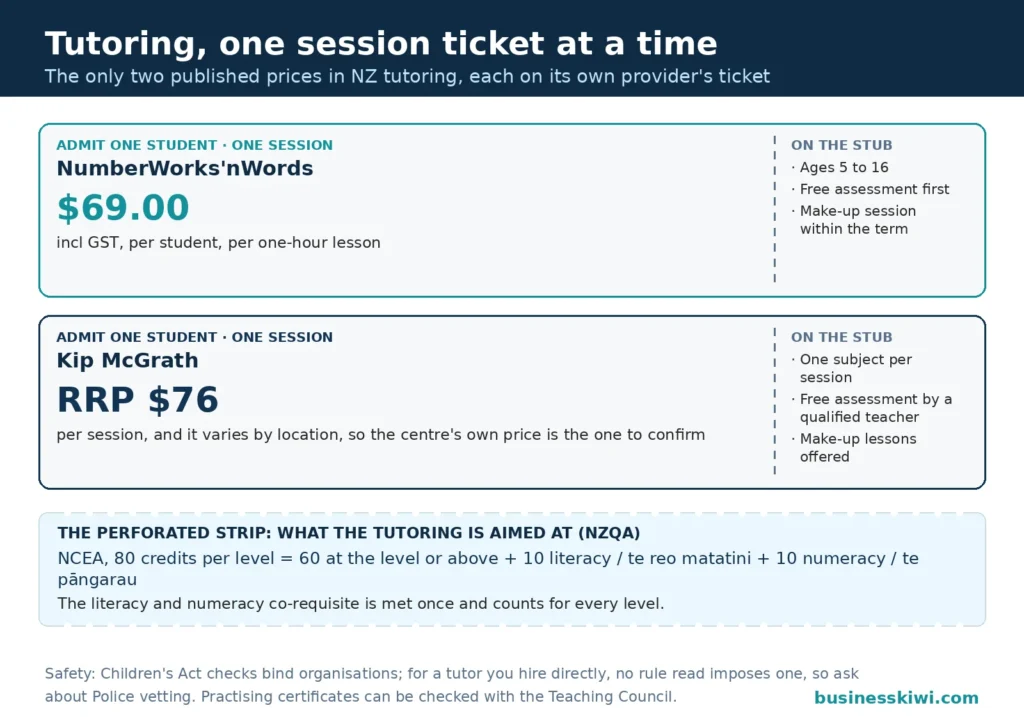
It helps to understand the shape of the qualification your tutor is working within. NZQA, which administers NCEA, explains that there are three levels of certificate, and that each level requires 80 credits: 60 credits at that level or above, plus 10 literacy (or te reo matatini) credits and 10 numeracy (or te pāngarau) credits. That 20-credit literacy and numeracy requirement is known as the co-requisite. A student only has to meet it once, and once met it counts towards all three levels. Credits can be accumulated over more than one year, and students can study standards at different levels at the same time. NZQA grades achievement standards as Not Achieved, Achieved, Merit or Excellence, though some standards are Achieved or Not Achieved only, and certificates and individual courses can be endorsed to recognise strong performance. University Entrance is a separate award on top of NCEA Level 3, not part of the certificate itself.
Assessment comes in two forms, and good NCEA tutoring addresses both. Internal assessments are set and marked by the school during the year. External assessments are set by NZQA and marked by NZQA panels, and they include the end-of-year exams, the Common Assessment Activities used for the co-requisite, and portfolios of work submitted for marking. Our separate guide to NZQA exams covers how the exam season itself runs.
For parents, the practical questions to put to an NCEA tutor are these. Which standards is my child entered for, and which ones are you targeting? How much of the work is internal assessment support versus exam technique? A tutor who teaches the underlying subject knowledge and helps a student plan and draft their own work is doing the job properly. A tutor whose help blurs into producing work the student hands in as their own is creating a serious problem, because schools and NZQA treat submitted work as the student’s own. Walk away from any arrangement that crosses that line.

Choosing a tutor: the questions that matter
Because anyone can advertise tutoring services, the quality check is yours to run. These questions sort most of it out:
- What is your background in this subject and year level? Registered teachers, senior university students and subject specialists can all tutor well, but the fit differs. For a struggling Year 4 reader you want someone who understands early literacy, not necessarily a physicist. If a tutor says they are a registered teacher, you can verify that: the Ministry of Education notes that a teacher’s current practising certificate can be checked with the Teaching Council of Aotearoa New Zealand.
- How will you work out where to start? A credible answer involves some form of assessment, conversation with you about school feedback, or a trial period with clear goals. Beware instant diagnoses and guaranteed grade promises.
- What will you report back, and how often? Written notes after lessons, periodic progress updates and honest advice to stop when tutoring is no longer needed are all good signs.
- What are the terms? Lesson length, where lessons happen, what a missed lesson costs, how much notice either side gives to cancel, and how payment works. Get this in writing, even if it is just an email.
- Can you provide references? Other families, or a school the tutor has worked with, are a reasonable ask for someone who will spend time alone with your child.
Centres handle much of this for you, with their own hiring, programmes and terms, and that structure is a large part of what their fees pay for. Independent tutors can be excellent and more adaptable, but you are the one building the structure around them.
Safety checks, police vetting and sensible precautions
This is the part of hiring a tutor that parents most often skip, usually out of politeness. Do not skip it.
New Zealand has a formal safety-checking system for people who work with children in organisations. The Ministry of Education’s guidance on the Children’s Act 2014 explains that a safety check is a process of gathering and assessing information about a person, and that it includes confirming their identity, interviewing them, checking referees, obtaining a Police vet, and assessing the overall risk of the person working with children. The Ministry distinguishes core children’s workers, who work alone with children or carry primary responsibility for them, from non-core workers, who have regular or overnight contact with children without a parent or guardian present. Schools, kura and their contracted providers must safety check their children’s workers before they start and renew the checks every three years, and people with certain serious convictions are barred from core children’s worker roles unless they hold an exemption.
A private arrangement between a family and an independent tutor sits outside that organisational system, which is exactly why your own questions matter. Before lessons begin:
- Ask the tutor directly whether they have been Police vetted, by whom and when, and whether they are willing to be vetted. The New Zealand Police Vetting Service processes vets for approved organisations, and a tutoring company that employs or contracts tutors should be able to tell you plainly what checking it does.
- Ask a centre the same question about its staff, and how it handles the result.
- Check references yourself rather than accepting written testimonials at face value.
- Agree the practical boundaries: where lessons happen, whether a parent or another adult is in the house or nearby, and how the tutor communicates with your child between lessons. For online lessons, agree which platform is used and keep communication on it.
- Tell your child, in age-appropriate terms, that they can always tell you if anything about the lessons makes them uncomfortable, and that you will act on it.
None of this implies suspicion of any individual tutor. It is the same standard the education system applies to its own workforce, and reputable tutors expect to be asked.
How much tutoring costs, and how pricing works
There is no official price list for tutoring, and independent tutors rarely publish rates, so the clearest evidence comes from providers that state their prices openly. Two national centre networks do:
Those figures buy you a place in a structured programme at a centre or online, not an hour of a tutor’s exclusive attention: centre lessons combine direct teaching with supervised practice, and other students are learning nearby. One-to-one tutoring from an independent tutor is a different product, and its price depends on the tutor’s experience, the subject and level, your region and whether lessons are in person or online. Because there is no primary published source for independent rates, treat any single “average price” you see quoted on the internet with caution, and judge quotes against what is actually included.
Whatever the model, check these points before you commit:
- Assessment and enrolment costs. Both providers in the table offer a free initial assessment. If a provider charges for assessment or enrolment, ask what it covers.
- What a lesson actually is. Length, group size, and whether the time is all teaching or partly independent practice.
- Payment method and timing. Kip McGrath, for instance, takes payment by direct debit or credit card. Ask whether you pay per lesson, per term, or by ongoing direct debit, and what happens financially if you stop mid-term.
- Missed lessons. NumberWorks’nWords describes rescheduling a make-up session within the same term if you let them know your child is sick, and Kip McGrath likewise says makeup lessons are available. Independent tutors set their own cancellation policies, so agree yours upfront.
- Sibling and multi-subject terms. Centres teach one subject per session, so two subjects means two sessions a week, which doubles the cost shown in the table. Ask about any family arrangements rather than assuming.
Online or in person?
Both work, and the better choice usually comes down to the student rather than the technology.
Many families land on a mix: in-person lessons while foundations and habits are being built, then online sessions once the student is older and self-managing. If you trial online tutoring, sit in on part of the first lesson. A good online tutor will expect that.
Becoming a tutor yourself
Tutoring attracts three groups: registered teachers earning extra income or moving out of the classroom, university students and graduates with strong subject knowledge, and specialists from other fields, such as engineers who tutor maths or writers who tutor English. There are three main ways in.
Working for a centre. Centre networks hire tutors to deliver their programmes. Kip McGrath states that its tutors are qualified teachers, which tells you the bar that particular network sets. Centres suit new tutors because the programme, materials, students and payment systems are already in place, and the work is steady during school terms.
Working independently. You find your own students, set your own programme and handle your own administration. Word of mouth does most of the marketing once you have results to point to. Expect to be asked the safety and reference questions in this guide, and treat them as a chance to look professional rather than as an insult.
Contracting to organisations. Schools and other organisations that engage tutors to work with children operate under the Children’s Act safety-checking system described above, so expect identity checks, referee checks and a Police vet as a condition of that work.
On the money side, working for yourself makes you self-employed in Inland Revenue’s eyes. IRD explains that a self-employed person uses their individual IRD number, pays tax on their net profit by filing an individual income tax return, and can claim the expenses of running the business. You will need to keep your business records, including invoices and receipts, and IRD requires records to be kept for seven years. If your turnover from tutoring goes over $60,000 in any 12-month period, you must register for GST. None of that is complicated, but it is unforgiving of a shoebox approach: set aside money for tax as you earn, because tutoring income has no employer deducting PAYE along the way.
Finally, treat the professional side seriously from the first student. Have written terms covering fees, cancellations and lesson times. Be clear with families about what you can and cannot do, including the line around assessment work: you can teach, question, give feedback and help a student plan, but the work a student submits must be their own. Tutors who hold that line, communicate clearly with parents and can show progress against agreed goals are the ones who stay booked.
Frequently asked questions
Does my child need a tutor, or will the school sort it out?
Start with the school. Ask the teacher where your child sits against expectations for their year level and what support the school is providing. Tutoring earns its cost when there is a specific gap to close, a qualification goal to prepare for, or a confidence problem that one-to-one attention can turn around. If none of those is present, the money may do more good elsewhere.
How many lessons a week does a student need?
One session a week per subject is the standard pattern at the big centre providers, and it suits most students because it leaves room for school, homework and a life. More frequent lessons make sense in short bursts, such as the run-up to external exams, but watch total workload. Two subjects at a centre means two separate sessions, so budget and timetable for that from the start.
Should a tutor be a registered teacher?
Not necessarily. Registration tells you a teacher has met the Teaching Council’s standards and holds a current practising certificate, which you can check, and it matters most for younger children and students with learning differences. For senior NCEA subjects, deep subject knowledge and familiarity with the standards being assessed can matter as much. Either way, ask about background and references rather than relying on a label.
Can a tutor help with the NCEA literacy and numeracy co-requisite?
Yes, and it is a sensible use of tutoring, because the co-requisite must be achieved before any NCEA certificate is awarded. NZQA describes a 20-credit requirement, 10 credits in literacy or te reo matatini and 10 in numeracy or te pāngarau, which a student needs to meet only once for all levels. A tutor can build the underlying reading, writing and maths skills and prepare the student for the assessments, including the Common Assessment Activities, but the student must sit and pass the assessments themselves.
How long before we see results?
Foundations take time. Confidence and homework habits often improve within a few weeks, while measurable shifts in school results usually take a term of consistent weekly lessons, which is why an agreed review point matters. If a tutor cannot show you what has been covered and what has improved at that review, reconsider the arrangement.
Sources
NZQA, NCEA levels and certificates, nzqa.govt.nz
NZQA, NCEA for parents and whānau, nzqa.govt.nz
Ministry of Education, Children’s Act 2014 guide: safety checking in schools and early learning services, education.govt.nz
Ministry of Education, Safety checking for core children’s workers, education.govt.nz
NumberWorks’nWords, Frequently asked questions, numberworksnwords.com
Kip McGrath Education Centres, Pricing, kipmcgrath.co.nz
Kip McGrath Education Centres, Online tutoring, kipmcgrath.co.nz
Inland Revenue, Self-employed, ird.govt.nz
Disclaimer
This article is general information about private tutoring in New Zealand. It is not education, legal or tax advice for your particular situation. Prices shown are those published by the providers named, as at October 2026, and can change; confirm current pricing and terms with any provider before enrolling. For advice about your child’s learning, talk to their school, and for tax questions about working as a tutor, check Inland Revenue’s guidance or talk to an accountant.
For more guides on work, study and qualifications, see the Jobs & Education hub.