Commercial Cleaning in Auckland: Costs, Contracts and What to Check
Buying cleaning for an Auckland workplace looks simple until the first quotes arrive. One company prices by the hour, another wants a fixed monthly fee, a third will not name a figure until someone has walked the site. The scopes differ too, so the cheapest number may cover the least work. This guide is for the buyer, not the seller, and no provider is recommended here.
Quick answer
Most Auckland commercial cleaning is sold as an hourly rate for a set number of cleaners, or as a fixed price for an agreed scope, often after a site visit. Routine work covers offices, bathrooms, kitchens, waste and floors. Periodic jobs such as carpet extraction, window cleaning and machine floor care sit outside the routine scope unless written in. Before you sign, get the scope in writing, give the same brief to two or three providers, ask whether the figure is a quote or an estimate, and check insurance, vetting, chemical handling and exit terms.
What a regular clean covers
A commercial clean is not one standard product. Providers build it from a site list, so two quotes for the same building can mean different things. The detail below reflects how providers describe their own work on their websites, checked on 7 October 2026.
In work areas, a normal visit usually means wiping cleared desks and meeting tables, dusting ledges, sills and partitions, cleaning glass and high-touch points such as door handles and switches, emptying bins and vacuuming carpet. CleaningPro lists tasks of that kind on its own page, alongside restroom and kitchen work. Jani-King describes a similar core: workstations, meeting rooms, reception, kitchens, bathrooms, floors and shared spaces.
Bathrooms need their own line. Expect toilets and fixtures cleaned and disinfected, mirrors wiped, bins emptied and dispensers checked and refilled if that is part of your arrangement. Kitchens usually include benches, sinks, appliance exteriors, microwave interiors and a mopped floor. Who handles dishes, and whether the fridge is ever emptied, varies: put both in writing if they matter. Emptying bins to a central point is routine. Taking waste to an outside store, separating recycling and removing larger items may or may not be included. Consumables vary too: some contracts include restocking from supplies you hold, others include supplying the products, inside the fee or on top of it.
Periodic work needs different equipment, time or access gear, so providers treat it as separate. CleaningPro notes that specialist carpet extraction, high-access windows, machine floor care, builders cleaning and restoration work need separate assessment. Paramount Services lists carpet cleaning, window cleaning and hard floor work such as machine scrubbing, stripping, sealing and polishing alongside its regular programmes, and Jani-King lists a similar set. A low monthly figure may simply be routine-only. If foyer windows, a six-monthly carpet clean or an annual floor treatment matter, ask for them as named items with their own frequency and price. Sites such as medical centres, schools and food premises add their own requirements: attach any hygiene or audit rules to the brief.
How often, and when?
Frequency drives price more than almost anything else. A small office might need one visit a week, a busy site with public bathrooms might need daily attention, and one-off cleans cover a move, a renovation or the end of a lease.
Most Auckland commercial cleaning happens outside core hours, early morning, evening or weekend. Jani-King states on its site that schedules can be built around an operation, including early morning, evening and weekend cleaning. After-hours work lets cleaners move freely, but it creates the security and lone work questions covered later. Daytime cleaning, common in larger buildings with a day cleaner, means wet floors and equipment in use while people are present. Ask how a provider handles that overlap.
How pricing works
Four pricing shapes cover most of the market.
Most larger operators do not publish a rate card. They quote after seeing the site. Crewcare, Jani-King and Paramount Services all invite businesses to request a quote on their own websites, and Crewcare and Jani-King describe a site visit first.
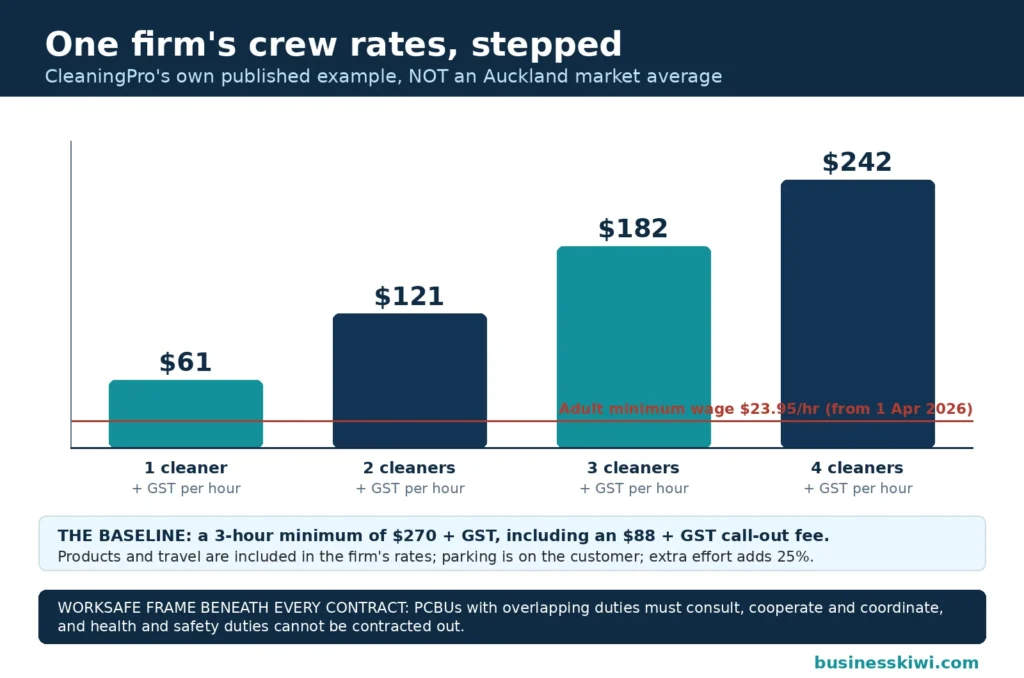
One Auckland provider does publish figures. CleaningPro lists on its own page $61 plus GST per hour for one cleaner, $121 plus GST for two, $182 plus GST for three and $242 plus GST for four, read on 7 October 2026. Its page states a three-hour minimum of $270 plus GST, including an $88 plus GST call-out fee per visit, says the price includes products and travel, states an extra 25 percent for properties requiring extra effort, and makes parking the customer responsibility. Use those figures only as an example of how one firm builds an hourly offer. They are not a market average. An hourly arrangement leaves you carrying the time risk, since a thorough clean takes longer than a rushed one.
Floor area is the starting point, but headcount and use matter as much. A 400 square metre office with 12 staff is a different job from the same area with 60 staff, a busy kitchen and public toilets. Frequency multiplies everything, and a first clean of a neglected site is rarely priced like a maintenance visit. After-hours access, parking and travel add time, as do consumables and equipment if the provider supplies them.
Consumer Protection, part of the Ministry of Business, Innovation and Employment, draws a clear line here. On its quotes and estimates page, it describes a quote as an offer to do a job for a specified price, which the provider cannot exceed once accepted unless you agree to extra work or the scope changes. An estimate is a best guess, and the final price can move, although it should generally sit within 10 to 15 percent of the estimate. Ask in writing which one you have been given, whether it includes GST, and whether there is a preparation fee: a provider who charges one must tell you beforehand. Consumer Protection also advises getting quotes from at least three businesses where you can, and comparing experience, reliability and quality, not price alone.
Why very cheap cleaning deserves a question
Cleaning is labour, and the legal floor under that labour explains why a sustainable price has a bottom limit. Employment New Zealand publishes the current minimum wage rates, effective from 1 April 2026: the adult rate is $23.95 per hour before tax, and the starting-out and training rates are both $19.16 per hour before tax, each applying only in limited situations. Employment New Zealand states that an employee aged 16 or over must be paid at least the minimum wage, and that employer superannuation contributions such as KiwiSaver must be paid on top of it, not counted inside it.
Employment New Zealand explains that an employee works under an employment agreement and is covered by employment law, while a contractor is self-employed, works under a contract for services, invoices for the work and is generally not covered by most employment laws, although health and safety law applies to both. Cleaning uses both models. Crewcare, for example, describes its cleaners on its own site as local franchise owner-operators. Neither model is automatically better. What matters is that the arrangement behind your price is lawful and stable, because underpaid labour tends to show up later as missed visits and rushed work. If a price leaves little room above the legal pay floor once travel, products, equipment, supervision and insurance are allowed for, ask how the service is staffed.
What to check in the contract
Many Auckland arrangements start on a handshake and a one-page proposal. Problems begin when the scope was never written down, a price rise arrives without warning, or you try to leave and find the exit terms unclear. Ask for the following in writing first.
A scope schedule. A room-by-room task list, with a frequency against each task. Daily, weekly, monthly and periodic work should sit in separate groups. Your inspections will be measured against this document.
Standards and inspections. How will quality be checked, how often, and by whom? Crewcare describes a digital platform it calls Carenote, which it says lets clients log issues and track jobs. Paramount Services refers to reporting, quality checks and a customer portal on its office cleaning page. Agree what happens when a clean is missed: a return visit, a credit, or a fix within an agreed time.
Term and exit. Is the agreement month to month, or fixed for a year or longer? How much notice ends it, and what happens if failures continue? Concierge Cleaners states in its own frequently asked questions that it can work with or without a contract, and that on-demand services are common. Some buyers like that flexibility. Others prefer a fixed term with a break right for repeated failure.
Price reviews. When can the price change, by how much, and with what notice? A clause tied to a stated review date is easier to budget for than an open right to increase fees. If nothing about your site has changed, you should be able to ask why the price has.
Insurance. Ask the provider to confirm in writing that it holds public liability insurance, and what it covers in plain terms. Do not assume your own policy covers damage caused by a contractor in your building. If your landlord or insurer requires a particular level of cover from contractors on site, name it in the brief and get the response in writing. This guide states no standard limit, because none is published by the official sources used here.
People, replacements and subcontracting. Who cleans your site if the regular cleaner is away? Is there a supervisor you can contact? Can the provider hand your site to someone else without asking? The agreement should name who is responsible for quality and complaints.
Health and safety: duties you cannot hand over
Engaging a cleaner does not transfer your health and safety responsibilities. WorkSafe New Zealand guidance on PCBUs working together explains the position under the Health and Safety at Work Act 2015. A PCBU is a person conducting a business or undertaking. Where PCBUs share a workplace or a contracting chain, duties can overlap, and WorkSafe states that they must consult, cooperate and coordinate, so far as is reasonably practicable, and that duties cannot be contracted out. It lists service and cleaning contracts among the arrangements covered, and expects health and safety to be built into contract management: scoping, checking competence, exchanging information, planning, monitoring and review.
Each PCBU holds a primary duty of care to ensure, so far as is reasonably practicable, that workers and other people are not put at risk by its work. In a cleaning arrangement that duty is shared. The company controls its workers, products and methods. You control the workplace: layout, occupants, emergency arrangements, and hazards your operation creates. Before cleaning starts, agree who manages each risk, flag fragile surfaces, restricted areas and machinery that must not be touched, and share your emergency plan. WorkSafe guidance treats notification as a shared duty where a notifiable event occurs, and recommends agreeing in advance who will notify WorkSafe.
Chemicals and safety data sheets
Cleaning chemicals are the risk most specific to this work. WorkSafe guidance on hazardous substances says businesses must know what substances they have and how much, keep an inventory, and hold a safety data sheet from the supplier for each hazardous substance in the workplace. A safety data sheet sets out the properties of a substance, how it affects health and safety, and how its risks should be managed. The same guidance covers labelling, safe storage, training, and planning for spills and emergencies.
WorkSafe illustrates the point in its contracting guidance with a cleaning example in which a venue told a contractor to use agents stored on site, without passing on usage instructions, and a worker was burned. Both businesses shared the duty. What should have happened, the guidance says, was checking training before awarding the contract, asking about protective equipment and first aid, providing safety data sheets ahead of time, and checking containers were labelled. If cleaners use your products, supply the safety data sheets and dilution instructions first. If they bring their own, ask what will be stored on site. Unlabelled spray bottles are an easy problem to rule out.
Slips, working alone and working at height
WorkSafe guidance on slips, trips and falls identifies floors made slippery by cleaning processes as one way workers are injured, along with trailing cables, clutter, damaged flooring and poor lighting. After-hours cleaning reduces the number of people crossing wet floors, but not the risk for cleaners or early starters. Ask how wet areas are signed and how cables are run.
Evening cleaning often means one person alone in a locked building. WorkSafe describes remote or isolated work as work done without direct assistance from others because of location, timing or the nature of the task, and notes that delays in getting help can make accidents more serious. Its safety alert points to supports such as scheduled welfare checks, reliable communication devices, a way of raising an alarm, first aid supplies and emergency procedures. Ask how a lone cleaner checks in and out, and what happens if they do not.
Height comes into cleaning through window work, high dusting and atrium glass. Do not assume it is covered by a general clean. If a task involves working where a fall could cause harm, it belongs in a separate, planned item, with the method agreed first. If a provider cannot explain the method, leave that task out.
Security, access and trust
Cleaners see papers on desks, stock in storerooms and the contents of bins, and they usually hold keys or swipe access. Treat access as a designed system. Agree how keys and cards are issued, recorded and returned, set alarm codes that belong to the cleaning team alone, name out-of-bounds areas, and set the procedure if a cleaner finds a door unlocked or something damaged.
On vetting, go by what a company says about its own practice, and ask directly. Concierge Cleaners states in its own frequently asked questions that all of its staff are background checked, including police checks. Other providers describe checks differently, and there is no single published standard across the market. Ask whether the people attending your site are police vetted, who carries out the check, and whether you will be told when the assigned cleaner changes. Record the answer in the agreement, especially for schools, medical sites and premises holding client files. Add a confidentiality line too: cleaners do not remove documents or photograph work areas.
Consumables, equipment and sustainability claims
Settle the supply list before the start date. A typical split is that the provider brings chemicals, cloths, mops, vacuums and machinery, while you supply or fund bathroom consumables. Crewcare states on its site that its franchisees bring all equipment and products needed. Other providers use your cupboard, vacuum or chemicals. All can work: the failure mode is discovering the split after the first visit.
Many companies describe environmentally responsible practices on their own websites. Jani-King states that it holds Toitū Enviromark Diamond certification and offers probiotic products it describes as eco-benign. Paramount Services describes its Paramount Care range as carrying Environmental Choice approval. Crewcare states a commitment to sustainable practices. Read those statements as each company describing its own offer. A certification name is worth more than a general claim to be green, because you can ask who issued it and what it covers. Ask which products will actually be used on your site. This guide makes no green claim of its own about any provider.
How to run a fair comparison
Write the brief once and send the same version to everyone. Include the address, floor area, a room list with bathroom and kitchen counts, tasks wanted on each visit, periodic work as separate items, frequency and time window, access arrangements, and who supplies consumables and equipment. CleaningPro lists similar information on its own page as what it needs before quoting.
Insist on a site visit before a final quote for anything beyond a very small office. Crewcare describes arranging a site visit before providing a detailed quote, and Jani-King says it visits the workplace before developing a programme and quote.
Compare like with like. Line the scopes up side by side before you look at totals. Check GST treatment, minimum charges, call-out fees, consumables, periodic work and price review terms. Consumer Protection advises asking why quotes vary a lot, since a gap can reflect experience, better materials, a more realistic view of the time needed, or a misunderstanding of the job. Ask the outlier to explain, ask for references from similar clients and call them, and consider a trial period rather than a long lock-in.
Red flags worth acting on
Cash-only payment, or resistance to invoices and a written agreement, should end the conversation. So should a refusal to confirm insurance in writing, or vagueness about who will attend and whether they have been vetted. A price far below every other quote, with no explanation of how the work is staffed or what is excluded, is not a bargain until that explanation exists. Pressure to sign on the spot, or a quote without a site visit for a complex building, are reasons to slow down. Later, repeated missed tasks and price rises notified only on an invoice tell you contract management is weak.
Frequently asked questions
How much does commercial cleaning cost in Auckland?
There is no single Auckland rate, because most providers quote after seeing the site. One provider, CleaningPro, publishes $61 plus GST per hour for one cleaner, with a three-hour minimum, on its own website, read on 7 October 2026. Treat that as one firm example, not a market average.
Should I choose an hourly rate or a fixed monthly price?
An hourly rate is transparent about time but leaves you exposed if visits run long. A fixed monthly price for a written scope makes budgeting easier and puts the time risk on the provider, but only works if the scope is detailed. Many buyers choose a fixed price with a room-by-room scope and agreed inspections.
Do I keep health and safety duties if I hire a cleaning company?
Yes. WorkSafe guidance states that PCBUs sharing a workplace or a contracting chain must consult, cooperate and coordinate, and that duties cannot be contracted out. You remain responsible for risks you control, including site information and emergency arrangements, while the cleaning company manages its workers, products and methods.
What should be in a cleaning contract?
At minimum: a scope schedule with frequencies, the price and whether it is a quote or an estimate, GST treatment, price review terms, term and notice period, insurance confirmation, inspections and the fix process for missed work, plus access, key and vetting arrangements.
Who supplies cleaning products and bathroom consumables?
It varies, and it should be settled in writing. Some providers, such as Crewcare, state that their operators bring all equipment and products needed. Bathroom consumables are often supplied or funded by the client and restocked by the cleaners. Ask each provider to state the split in its quote.
Sources
WorkSafe New Zealand, PCBUs working together: advice when contracting, worksafe.govt.nz
WorkSafe New Zealand, What the Hazardous Substances Regulations mean for you, worksafe.govt.nz
WorkSafe New Zealand, Slips, trips, and falls, worksafe.govt.nz
WorkSafe New Zealand, Remote and isolated work, worksafe.govt.nz
Employment New Zealand, Minimum wage rates and types, employment.govt.nz
Employment New Zealand, Employee or contractor?, employment.govt.nz
Consumer Protection, Ministry of Business, Innovation and Employment, Quotes and estimates, consumerprotection.govt.nz
CleaningPro, Commercial Cleaning Services Auckland, cleaningpro.co.nz
Crewcare, Commercial Cleaning Services NZ, crewcare.co.nz
Jani-King New Zealand, Commercial Cleaning Christchurch and Canterbury, janiking.co.nz
Paramount Services, Professional Commercial Office Cleaning Services New Zealand, paramountcleaning.co.nz
Concierge Cleaners, Commercial Cleaners Auckland, conciergecleaners.nz
Disclaimer
This article is general information about buying commercial cleaning services in Auckland. It is not legal, employment or health and safety advice, and it does not recommend any provider. Prices and terms change. Check current figures with the provider and the official sources listed above, and get professional advice for your own situation before signing.
See the Business and Industry guides on BusinessKiwi.