Business Cards in Tauranga: Printing Options, Specs and Prices

Order business cards in Tauranga and you will quickly notice something. The local print shops do not put their card prices on their websites, while the big online printers publish every price but print nowhere near Tauranga. Neither approach is wrong. They are simply two different ways of buying the same small rectangle of card, and knowing how each one works makes it much easier to end up with cards you are happy to hand over.
This guide walks through the channels available to a Tauranga business, the prices that are actually published (with the exact specifications they apply to), the specs worth understanding before you order, and the file setup and checking steps that prevent the classic wasted print run.
Quick answer
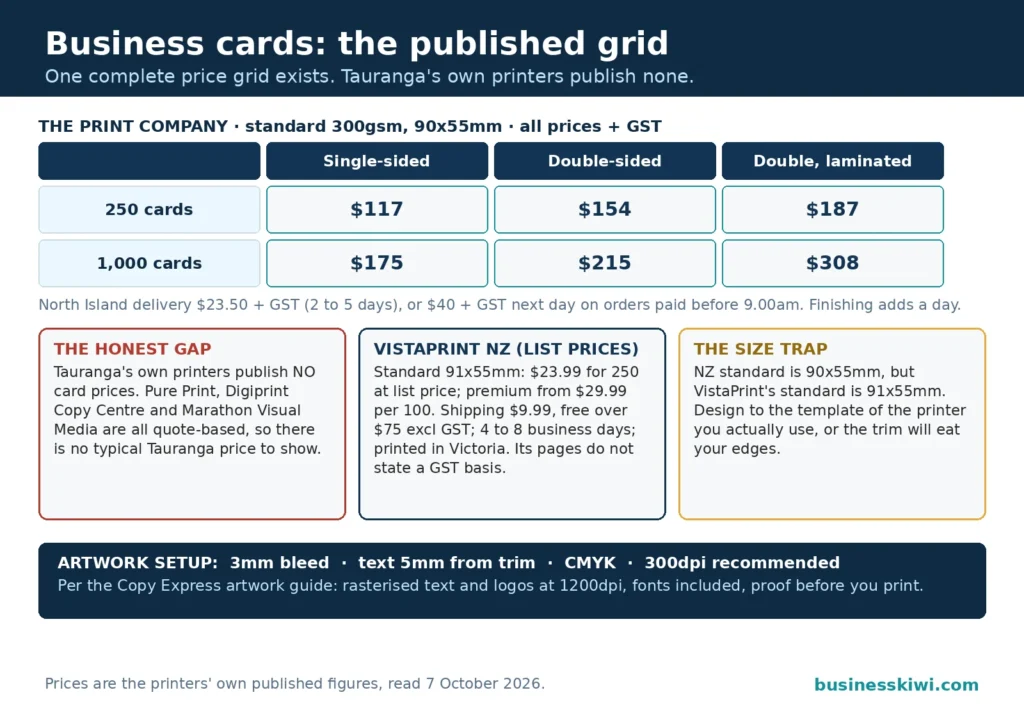
Tauranga’s local printers, including Pure Print in Judea and the Digiprint Copy Centre on Willow Street, price business cards by quote rather than from a published price list, so there is no single Tauranga price to quote here. Published prices come from online printers that deliver to Tauranga. The Print Company, an Auckland online printer, lists standard 300gsm cards at $117 plus GST for 250 single sided, falling to $175 plus GST for 1,000. VistaPrint NZ lists its standard cards at $23.99 for 250, with delivery on top and a 4 to 8 business day timeframe. The standard NZ card size is 90 x 55 mm, although VistaPrint’s standard is 91 x 55 mm, so always build your artwork to the template of the printer you actually order from.
The ways Tauranga businesses buy cards
Local Tauranga print shops
The walk-in option still suits a lot of Bay of Plenty businesses. Pure Print, at 4/35 Koromiko Street in Judea, describes itself as a Tauranga print, design and promotions company and takes work through a quote request rather than an online price list. The Digiprint Copy Centre at 14 Willow Street in central Tauranga is a copy and digital print shop, the kind of place you can walk into with a file on a USB stick. Marathon Visual Media is a larger Tauranga based commercial printer offering design, short run digital printing through to offset, large format work and mail processing, again on a quoted basis.
What you get from a local shop is not a published price. It is a conversation. You can look at physical stock samples, ask for a printed proof you can hold, and pick the finished cards up yourself instead of paying a courier. If your logo colour matters, or you want to feel the difference between a 300gsm and a 350gsm stock before committing, that face to face process is worth something real. The trade-off is that comparing quotes takes a phone call or an email to each shop, and turnaround depends on their current workload, which is one of the questions to settle when you ask for the quote.
Office supply chain print centres
Warehouse Stationery’s Print and Copy Centres are the chain store channel. The company’s own site confirms its print shops offer business card printing, and its business printing pages describe a design service where a designer prepares your artwork and sends it to a store for production. Many of its business print services can also be ordered online for delivery. Warehouse Stationery does not publish a business card price on the pages we read, so treat it as another quote or in-store enquiry rather than a listed price.
National online printers
Online printers publish their prices because the whole transaction happens on screen. You choose a template or upload finished artwork, pick the stock, sides and quantity, and the site gives you a total before you pay. The two examples used throughout this guide are The Print Company, based at 109 Dominion Road in Mt Eden, Auckland, which sells card printing online with North Island delivery options, and VistaPrint NZ, which prints New Zealand orders offshore. VistaPrint’s own shipping page explains that items printed in its Australian facility in Victoria are delivered by NZ Post, which is why its timeframes run longer than a local courier.
Neither channel is automatically better. The online price is knowable in advance and easy to compare. The local quote can flex around odd requests, unusual stocks and tight deadlines in a way a web form cannot.
Published prices, with the specs they belong to
Because every figure below comes from a printer’s own published page, each one is tied to a specific product. Change the stock, the sides or the finish and the price changes with it, which is exactly what the tables show.
The Print Company lists its prices plus GST. Its standard business card is 90 x 55 mm, printed full colour, on 300gsm stock, with square corners as standard and rounded corners on request. Its premium card uses a heavier 350gsm stock.
Delivery sits on top of those figures. The Print Company charges $23.50 plus GST for standard delivery to the North Island, which it puts at 2 to 5 days, and $40 plus GST per box for next day delivery, which it guarantees in the North Island when an order is placed and paid before 9.00am on a business day. Special finishing such as laminating adds one day to its turnaround.
VistaPrint NZ prices differently. Its standard business card measures 91 x 55 mm and is listed at $23.99 for 250 cards, which its site expresses as $0.10 per card. Quantities run from 100 to 1,500. Its premium line starts at $29.99 for 100 cards. Those headline prices move around with promotions, and delivery is extra: standard shipping costs $9.99 per order, free when the order exceeds $75 excluding GST, with delivery in 4 to 8 business days including production time. It is a genuinely cheaper entry point for a simple card, bought with a longer wait and less control over the details.
No equivalent published list exists for Tauranga’s local shops, and any article that gives you a single “typical Tauranga price” is guessing. Ask two or three local printers to quote the same specification, in writing, and you will have real numbers to compare against the online ones above.
What you are actually buying
Size
The Print Company states the standard specification plainly: 90 x 55 mm is the standard card size, with custom sizes available on request. VistaPrint’s standard is a touch larger at 91 x 55 mm. One millimetre sounds like nothing, but it matters when you design. Artwork built for one size and printed at another gets scaled or cropped, so download the template from the printer you are ordering from and design inside it.
Sides and colour
Single sided cards carry everything on the front. Double sided cards give you a back for a logo, a services list, a QR code or simply some breathing room in the design. Full colour printing is standard on both the products above; both are described by their printers as full colour (CMYK) work. Printing the second side is not double the price. On The Print Company’s standard stock, going double sided at 250 cards lifts the price from $117 to $154 plus GST.
Stock weight
Card stock is sold by weight in GSM, grams per square metre. Higher GSM generally means a stiffer, more substantial card, and the two published ranges here bracket the common ground: 300gsm for The Print Company’s standard card and 350gsm for its premium. Neither is flimsy, but the heavier stock feels noticeably more rigid in the hand, which is part of what the premium price buys. If you are buying locally, ask to handle samples. GSM numbers are abstract until you flex the actual card.
Finishes
Finishes are where cards stop being plain. The Print Company’s standard card comes with a choice of matte or gloss finish, and both its ranges offer lamination, a thin film applied over the print that protects the surface and changes how it feels. On its premium stock, rounded corners are a priced option: 250 single sided premium cards rise from $139 to $215 plus GST with rounded corners. VistaPrint offers standard or rounded corners too, and lists spot UV, foil and metallic finishes on the front side of its cards. Each finish adds cost and, at some printers, time, so decide which ones earn their place rather than ticking every box.
What drives the price
Quantity is the biggest lever, and the published figures show why. At The Print Company, 250 standard single sided cards cost $117 plus GST, about 47 cents a card. Ordering 1,000 costs $175 plus GST, about 18 cents a card. Four times the cards cost only half as much again, because the setup work is spread across the whole run. The same pattern holds at VistaPrint, where 250 standard cards work out to $0.10 each.
After quantity, the specification does the rest:
- A second printed side adds a moderate step, $37 plus GST on a 250 run of The Print Company’s standard cards.
- Lamination adds more. Double sided standard cards at 250 rise from $154 to $187 plus GST once laminated.
- Heavier stock carries a premium at every quantity. Compare $117 for 250 standard single sided cards with $139 for the 350gsm premium version.
- Shaped or special finishes, like rounded corners and foil, sit at the top of the range because they add processes.
- Design work is separate from printing. VistaPrint offers a design service starting at $12. Local printers quote design time as part of the job. A print-ready file you supply yourself avoids that cost entirely, provided it really is print ready.
- Speed and delivery are easy to overlook. Next day North Island delivery from The Print Company costs $40 plus GST against $23.50 for its standard service, and picking up from a Tauranga shop removes the courier charge altogether.
Design and file setup
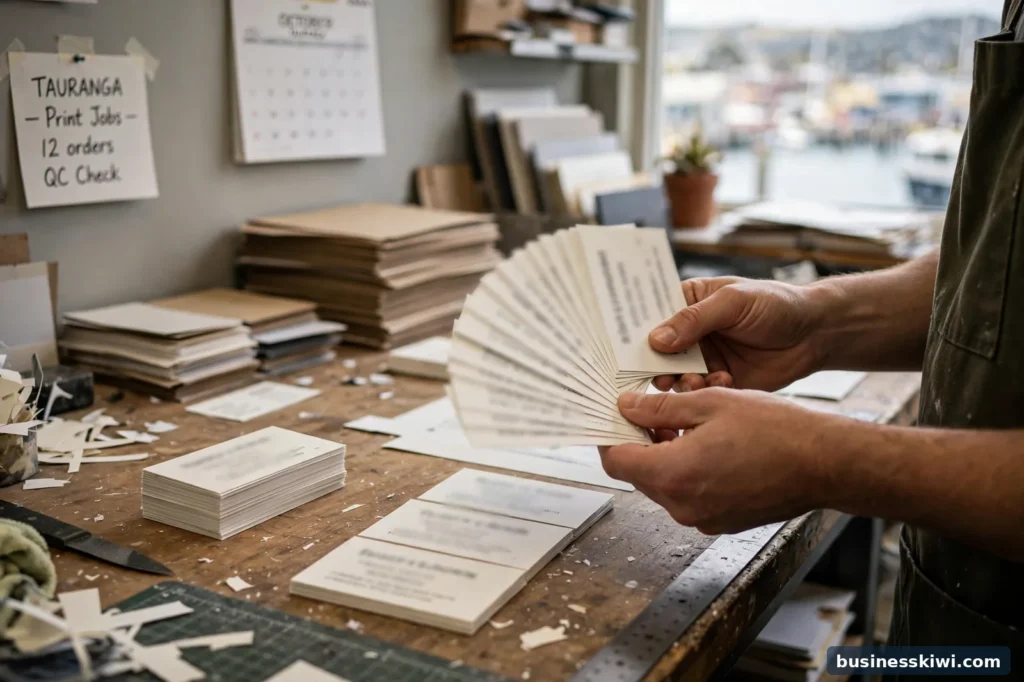
Most disappointing card orders fail before printing starts, in the artwork file. Printers publish artwork guides because the same handful of problems come back every week.
Print ready means the file arrives at the exact size, with everything the press needs and nothing it has to guess. Copy Express, a New Zealand printer, sets out the requirements in its published artwork guide, and they match what most printers ask for:
- Bleed. Any design that runs to the edge of the card must extend past it. Copy Express requires a minimum of 3mm of bleed, so a background colour or photo continues beyond the trim line and no white sliver appears if the cut shifts slightly.
- Safe margins. Keep text and important content at least 5mm inside the trim edge, per the same guide, so nothing important is clipped.
- Colour mode. Files must be in CMYK, the four colour process used in printing. Colours built on screen in RGB can shift when converted, and the guide warns that even some spot colours change noticeably in conversion. What looks right on your monitor is not a promise of what comes off the press.
- Resolution. Images should be at least 200 dpi, with 300 dpi recommended for best quality. Rasterised text or logos need far more, 1200 dpi in Copy Express’s guide, which is why a proper vector logo file beats a screenshot of your logo every time. VistaPrint’s own upload guidance likewise asks for at least 300 DPI.
- Fonts. Include or embed your fonts, as the guide’s checklist requires. A file that arrives with a missing font gets substituted, and the layout moves.
If you are designing in an online editor instead, the same thinking applies in simpler form. VistaPrint’s design guidance suggests no more than two fonts on a card and body copy no smaller than 10pt, and it lists a QR code among the elements you can add. If you do add a QR code, print one test copy and scan it with your phone before the full run goes ahead. A code that does not scan is just a square of decoration.
Proofs are the safety net. Copy Express provides PDF soft proofs showing layout and design, and offers a hard copy proof where colour accuracy is critical, since a screen proof cannot guarantee colour. Whichever channel you use, read the proof rather than glancing at it, and read it character by character. The next section explains why.

Ordering, step by step
- Settle the specification first. Size, stock, sides, finish and quantity. Every quote, local or online, is only comparable when each printer prices the same spec.
- Get the price in full. For local quotes, ask whether GST and any design time are included. Online, check the delivery charge and the estimated delivery date before paying, not after.
- Prepare or upload the artwork to that printer’s template and requirements, bleed and all.
- Check the proof like an auditor. Read your name, job title, phone number and email address one character at a time. Say the phone number out loud. The most expensive typo in printing is a wrong digit in a phone number, because the cards look perfect and are completely useless. Check the website address and any QR code too.
- Approve, then confirm the logistics. Pickup or courier, the expected day, and where the cards will be if you are out.
Minimum quantities differ by channel. VistaPrint sells from 100 cards. The Print Company’s published ranges start at 250. A local shop may run a smaller digital batch, which is a question for the quote.
If you are ordering cards because the business itself is new, get the details on the card right at the source: the name and structure you registered are what should appear in print. Our guide to setting up a limited company in NZ covers the registration steps if you are still at that stage.
Turnaround and Tauranga practicalities
Time is where the channels separate most clearly. A Tauranga pickup has no courier leg at all. Once the cards are printed, they are in your hand, which is why local printers and the chain print centres are the natural first call when a deadline is close. Ask about turnaround when you request the quote, because a small digital run and a laminated offset run live on different clocks.
Online orders need the calendar counted honestly. The Print Company will deliver to the North Island the next day if you order and pay before 9.00am on a business day, at $40 plus GST per box, and its standard service takes 2 to 5 days. Finishing work like laminating adds a day. VistaPrint quotes 4 to 8 business days for standard delivery to New Zealand, production included, and its cards are printed in Australia, so there is no speeding it up once ordered.
For events, work backwards from the date. If you need cards for a trade expo, a field day or a networking function, order at least a week earlier than the courier maths suggests. That buffer is what absorbs a proof correction or a reprint, and it costs nothing but forethought.
Alternatives worth knowing about
Paper is not the only option anymore. Digital business cards share your details through a link or a QR code that opens a contact page, and NFC cards carry a small chip that passes your details to a phone held against the card. Both update without a reprint when your number changes, which is their genuine advantage. Plenty of Tauranga businesses run a hybrid: a printed card for the hand-to-hand moment, with a QR code on the back pointing at the digital version. Neither option removes the need for printed cards at a market stall or a site visit, where the person in front of you may not want to scan anything.
Mistakes that waste a print run
- A wrong phone number or email. Printers print what the approved proof says. If the error is yours, the reprint is yours to pay for.
- A low resolution logo. A logo lifted from a website or a screenshot will print soft and fuzzy. Supply the original vector file, or at least a 300 dpi image.
- No bleed. Backgrounds that stop exactly at the trim line come back with a white edge on one side whenever the cut moves a fraction.
- Text hard against the edge. Keep important content inside the safe margin, 5mm from trim in the guide cited above.
- Ordering too few. The unit price falls so steeply with quantity that running out and reordering a small batch usually costs more in total than ordering properly once. Balance that against how soon your details might change. A new business with a likely new phone number or address is the exception, not the rule.
Frequently asked questions
How much do business cards cost in Tauranga?
There is no single Tauranga price, because local printers quote rather than publish. For published reference points, The Print Company lists standard 300gsm cards from $117 plus GST for 250 single sided, and VistaPrint NZ lists its standard card at $23.99 for 250 before delivery. Ask local printers to quote the identical specification so you can compare like with like.
What size are business cards in New Zealand?
The standard specification used by The Print Company is 90 x 55 mm. VistaPrint’s standard card is slightly larger at 91 x 55 mm. Design to the template of the printer you order from, since artwork built for one size will be scaled or cropped at the other.
How fast can I get business cards in Tauranga?
The fastest routes are local. A Tauranga printer can hand cards over the counter once printed, with no courier time, and turnaround is agreed in the quote. Online, The Print Company offers next day North Island delivery on orders paid before 9.00am on a business day, while VistaPrint quotes 4 to 8 business days including production.
What does print ready artwork mean?
It means a file supplied at the finished size with at least 3mm of bleed on anything that runs to the edge, text kept at least 5mm from the trim edge, colours in CMYK, images at 300 dpi and fonts embedded or included. Those are the requirements set out in Copy Express’s published artwork guide, and they are typical of what NZ printers ask for.
Is it worth paying for double sided cards?
On published prices the step is modest: $117 to $154 plus GST for 250 standard cards at The Print Company. The back of the card is useful space for a services list, a QR code or a logo treatment, and it stops the front getting crowded. If everything fits cleanly on one side, single sided is a perfectly good saving.
Sources
The Print Company, Standard Business Cards, theprintcompany.co.nz
The Print Company, Premium Business Cards, theprintcompany.co.nz
VistaPrint NZ, Standard Business Cards, vistaprint.co.nz
VistaPrint NZ, Shipping and Delivery Information, vistaprint.co.nz
Copy Express, Artwork Guidelines, order.copyexpress.co.nz
Pure Print, pureprint.co.nz
Digiprint Copy Centre, digiprint.net.nz
Marathon Visual Media, mvmltd.co.nz
Warehouse Stationery, Printing Services, warehousestationery.co.nz
Warehouse Stationery, Business Printing, warehousestationery.co.nz
Disclaimer
This article is general information about buying business card printing, not a recommendation of any printer. Prices were read on the printers’ own websites on 7 October 2026, are stated with each printer’s specification, and can change with promotions or repricing. Check the current price, GST treatment, delivery charge and timeframe before you order.
More guides for local businesses are in our Business and Industry section.