Limited Company in NZ: Setup, Directors’ Duties and Compliance

Forming a limited company is the point where a business stops being just you with a trading name and becomes a legal person in its own right. That separation brings real protection, but it also brings a register to maintain, duties that sit personally on directors, and deadlines that do not move because you were busy. This guide covers what a New Zealand limited company is, how it compares with sole trader and partnership structures, the steps and costs of setting one up, and the obligations that follow every year afterwards.
Quick answer
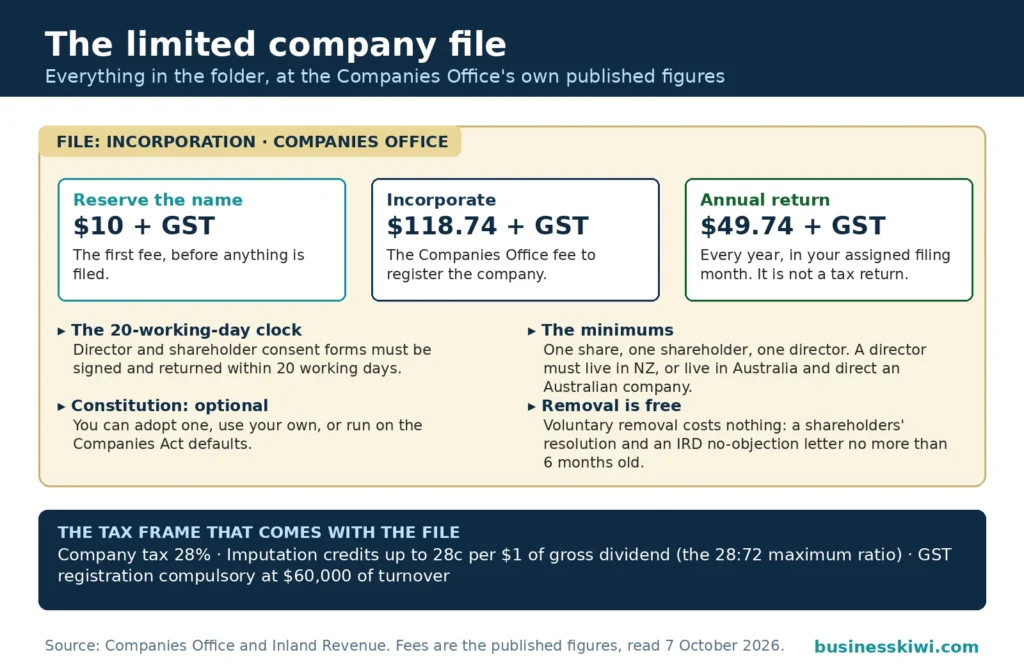
A limited company is a separate legal entity registered with the Companies Office under the Companies Act 1993. Shareholders own it through shares, directors run it, and the company itself holds the assets and owes the debts, so a shareholder’s loss is normally limited to what they put in. Setting one up is done online: reserve a name for $10 plus GST, then incorporate for $118.74 plus GST. Every company needs at least one share, one shareholder and one director, and at least one director must live in New Zealand, or live in Australia while also directing an Australian company. Companies pay tax at a flat 28 percent, file an annual return each year (currently $49.74 plus GST), and their directors carry legal duties, including acting in the company’s best interests and not trading recklessly.
What a limited company actually is
The Companies Office describes incorporation as creating a separate legal entity. In practical terms, the company can own property in its own name, sign contracts, borrow money, and sue or be sued, without those rights and obligations simply being yours personally. If the founder leaves, sells their shares or dies, the company carries on. It exists until it is removed from the Companies Register.
Ownership and management are split into two roles. Shareholders are the owners: they hold shares, and the proportion they hold sets their voting weight. Directors are appointed to manage the company’s business day to day. In a small New Zealand company one person often fills both roles and does all the work, but the law treats the hats as different, and the duties attach to the director hat.
Limited liability is the feature most people incorporate for. If the company fails, creditors can pursue the company’s assets, but a shareholder is generally not personally liable for company debts beyond any amount unpaid on their shares. The protection has limits worth understanding before you rely on it:
- It does not protect directors who breach their duties. A director who keeps trading when the company cannot pay its way can become personally liable, and the Companies Office is blunt that a director can face prosecution in serious cases.
- Banks and landlords routinely ask owner-directors for personal guarantees, which undo the limited liability for that particular debt.
- The company must actually be run as a separate entity. Mixing personal and company money in one account undermines both the legal separation and your credibility with Inland Revenue.
Who a company suits, and who it does not
A company tends to suit a business that carries genuine risk: signing leases, employing staff, holding stock, or doing work where a large claim is possible. It also suits businesses with more than one owner, because shares record cleanly who owns what, and businesses the owners may one day sell, since shares transfer without unwinding the whole operation. business.govt.nz puts the core point simply: having a company limits your risk because your business and personal finances are separate.
It is a poorer fit for a very small, low-risk sideline where the owner wants the simplest possible tax affairs. A company means its own financial reporting on top of your personal return, an annual return, statutory records, and usually an accountant’s bill a sole trader might avoid. Many people start as sole traders and incorporate later, once turnover, risk or a second owner justifies it.
Company, sole trader or partnership?
The three structures most New Zealand businesses use differ mainly in where legal responsibility lands.
The sole trader column is deliberately brief, because the detail sits in our guide to registering a sole trader business in NZ. business.govt.nz also offers a free Choose Business Structure tool that works through the comparison based on your answers.
Before you incorporate
A little preparation makes the online application a ten-minute job rather than a stalled one.
Choose and check the name. Your company name must end in “Limited” (or a permitted equivalent), must not be identical or almost identical to an existing company’s name, and some names are unacceptable under the Companies Act 1993 because they are misleading, offensive or protected by other legislation. Reserving the name protects it on the register, but a company name is not a trade mark. business.govt.nz’s ONECheck tool searches a proposed name across business names, trade marks, domains and social media in one place, and a trade mark check through IPONZ before you print signage is cheap insurance against rebranding later.
Decide the people and the shares. You need at least one director, one shareholder and one share. Many small companies issue a round number such as 100 shares so percentages are easy to express. Think about the allocation before you file: fixing a lopsided split later means transfers and paperwork. Every director and shareholder must sign a consent form, so have full legal names and residential addresses ready, and make sure each person can sign within the window described below.
Consider a constitution. A constitution is optional. If you do not adopt one, the Companies Act 1993 supplies the default rules governing the company, its board, directors and shareholders. The Companies Office notes you can incorporate with no constitution, buy one, or prepare and upload your own. A constitution earns its keep when several shareholders want custom rules, for example restrictions on selling shares to outsiders. Multi-owner companies often also take a separate shareholders’ agreement, which is not filed with the Companies Office and is worth discussing with a lawyer.

Setting up: the incorporation steps
Incorporation runs through the Companies Register online services, and you will need a RealMe login and a Companies Office online account first. The sequence is:
- Reserve the company name. Check availability, then reserve the name online. The fee is $10 plus GST.
- Gather the required information. That means the company’s contact details (registered office, address for service, address for communication, and an email address for official correspondence), the details of every director and shareholder, how many shares each shareholder will hold, and, if the company is controlled by an ultimate holding company, that entity’s details.
- Complete the online application. Work through the screens for directors, shareholders and tax registration. During this step you can also choose to register the company for an Inland Revenue number, GST and as an employer, which saves separate applications later.
- Choose your annual return filing month and pay. The Companies Office assigns a filing month at incorporation. Pay the incorporation fee of $118.74 plus GST and submit.
- Return the consent forms. The Companies Office emails an individual consent form to each director and shareholder. Each person must sign and return theirs within 20 working days, or their registration can be cancelled.
- Receive the certificate. Once all consent forms are in and the application approved, the Companies Office issues a Certificate of Incorporation and the company’s details become publicly searchable on the Companies Register.
Total Companies Office cost to get started is $128.74 plus GST. The one ongoing charge is the annual return, covered below.
Straight after incorporation
Four jobs want doing in the first week or two.
Tax registration. If you did not register for an IRD number during incorporation, apply for one now, because the company is a separate taxpayer and cannot use your personal number. Register for GST if the company’s turnover from its taxable activity was $60,000 or more in the last 12 months or is expected to reach $60,000 in the next 12 months; Inland Revenue is clear that registration is compulsory at that level, and you must also register if you add GST to your prices. Our GST registration guide walks through the registration choices. Register as an employer before the first pay run if you will employ anyone, including yourself on a salary.
A company bank account. Open an account in the company’s name and run all business income and spending through it. It is the single habit that keeps the separate-entity story credible.
Records from day one. The Companies Act 1993 requires the company to keep records, including minutes of meetings, financial records and a share register, with one set kept at the registered office. Setting up your bookkeeping properly at the start, rather than reconstructing a year of transactions later, is where most new companies save themselves real pain; our guide to client accounting software in NZ compares the main options businesses use for invoicing and accounts.
Keep the register current. Directors must update the public register details within the Companies Act timeframes whenever addresses, directors or shareholdings change.
How company tax works, in outline
Inland Revenue taxes companies at a flat 28 percent on their taxable income. The company files its own annual income tax return (an IR4), separate from the owners’ personal returns. Most companies also pay provisional tax in instalments during the year towards the expected bill, then square up once the IR4 is filed.
Getting money out has tax consequences of its own. The two standard routes are:
- A salary to a working shareholder. The company deducts PAYE like any employer, claims the salary as an expense, and the shareholder is taxed at their personal rates.
- Dividends. A dividend is paid from profits the company has already taxed. To stop the same profit being fully taxed twice, the company attaches imputation credits representing the tax already paid. Inland Revenue caps the credits at 28 cents for each $1 of gross dividend (a ratio written as 28:72), so they cannot exceed the tax paid on those profits. The shareholder declares the grossed-up dividend and claims the credits against their own tax.
Money a shareholder simply takes out informally is neither of these. It lands in the shareholder’s current account, which can create tax complications if it stays overdrawn, so get advice before you start drawing money rather than after.

Directors: who can be one, and what the job demands
Eligibility
A director must be a real person (a company cannot be a director), must consent in writing, and must certify they are not disqualified. Under the Companies Act 1993, a person cannot be a director if they:
- are under 18
- are an undischarged bankrupt
- are prohibited from directing or managing companies under any law, which includes people convicted of a dishonesty offence in the previous five years and people banned by the Registrar of Companies or the Financial Markets Authority, including bans imposed in Australia
- are subject to a property order under sections 30 or 31 of the Protection of Personal and Property Rights Act 1988
- are ruled out by the company’s own constitution.
On top of eligibility sits the residency rule: every company must always have at least one director who lives in New Zealand, or who lives in Australia and also directs an Australian-incorporated company. Losing your only qualifying director and doing nothing about it is itself a compliance failure that can end with the Registrar removing the company.
Directors’ duties
Duties cannot be delegated away. The Companies Office summarises the core of them, drawn from the Companies Act 1993, in plain terms:
- Act in good faith and in the company’s best interests. The duty is to the company, not to yourself or to one favoured shareholder. Where a personal interest could conflict, record it in the register of directors’ interests and manage the conflict openly.
- Use powers for a proper purpose and follow the rules. A director must not act, or agree to the company acting, in a way that breaches the Companies Act 1993, other legislation, or the constitution.
- Take reasonable care. Directors must stay engaged: understand how the company works, participate in decisions, and use company information carefully. Signing whatever is put in front of you is not exercising care.
- Mind the solvency line. Directors must not let the company trade in a way that creates a substantial risk of serious loss to creditors, the behaviour the Act treats as reckless trading. Nor may a director agree to the company taking on an obligation unless they reasonably believe the company can perform it when the time comes. Trading while insolvent can leave a director personally liable and exposed to prosecution.
Alongside the duties sit responsibilities that can be delegated to staff or advisers but remain the directors’ problem if not done: holding shareholder meetings (at least one a year for most companies), keeping the records described above, updating the register, completing the annual return, and filing financial statements if required.
Shareholders: rights and practicalities
Shareholders own the company but do not run it. The Companies Office lists the decisions that belong to shareholders through voting at meetings, including changing the company’s constitution, approving major transactions, and authorising dividends. Voting power follows the shares held, so a holder of 60 percent of the shares carries ordinary resolutions against a 40 percent holder, which is why the initial allocation matters. Shareholders also appoint and remove directors, their ultimate lever over management.
Shares are property: they can be sold or transferred, gifted, or left in a will, subject to any restrictions in the constitution or a shareholders’ agreement. Every change to who holds shares, or how many shares exist, must be recorded in the share register and reflected in the Companies Register and the next annual return. Selling shares does not change the company’s obligations; the entity continues, only its ownership changes.
The ongoing compliance calendar
Company compliance is mostly a short list of recurring tasks.
Closing or removing a company
When a company has genuinely finished, the tidy ending is to ask the Registrar to remove it from the register. Applying is free. Before you apply, the company needs to have stopped trading, settled its liabilities and dealt with any remaining assets, and you need two documents ready: a shareholders’ resolution authorising the request, where that is how the applicant is authorised (the Companies Office requires it signed by at least 75 percent of shareholders holding at least 75 percent of the voting shares), and a “no objection” letter from Inland Revenue confirming your final tax filings are in order, no more than six months old when you apply. The application is made online through your Companies Office account.
Removal can also happen to you. The Registrar can remove a company that has not met its obligations under the Companies Act 1993, for example by not filing annual returns, persisting with inaccurate information, or having no qualifying resident director. Companies also come off the register when a liquidation finishes or an amalgamation completes. Removal is not an escape hatch for debts, and winding up properly, with tax filings complete, is the safer path.
Common mistakes new companies make
- Treating the company account as a personal one. Every personal withdrawal muddies the separation you incorporated to create, and creates tax problems.
- Missing the annual return. Five minutes and $49.74 plus GST, once a year, in a filing month the Companies Office assigns you. Set a recurring reminder the day you incorporate.
- Appointing a director who is not really involved. Anyone who signs as a director carries the full duties, including personal liability risk, whether or not they ever look at the accounts. Only appoint people who understand that and will actually participate.
- Skipping the paperwork for decisions. Loans from shareholders, salary decisions and dividends should be minuted or resolved in writing. In a dispute or an Inland Revenue review, the paper trail is the difference between a structure and a story.
- Assuming limited liability covers everything. Personal guarantees, and debts run up while trading insolvent, reach past the company in ways that surprise first-time directors.
Frequently asked questions
How much does it cost to register a limited company in NZ?
The Companies Office charges $10 plus GST to reserve a name and $118.74 plus GST to incorporate, $128.74 plus GST in total. After that, the only Companies Office charge is the annual return fee, currently $49.74 plus GST each year. Applying to remove a company is free.
Can one person be the only director and only shareholder?
Yes. A New Zealand company needs a minimum of one director, one shareholder and one share, and one person can hold all of those positions. Provided that director lives in New Zealand (or in Australia while directing an Australian company), a single-person company is entirely legitimate.
Do I need a constitution for my company?
No. A constitution is optional, and without one the Companies Act 1993 provides the default rules. A constitution is worth considering where shareholders want different rules from the defaults, for example limits on who shares can be sold to.
What is the difference between an annual return and a tax return?
They go to different agencies and do different jobs. The annual return is filed with the Companies Office each year to confirm the company’s register details are correct and that it is still operating. The tax return (an IR4) is filed with Inland Revenue and reports the company’s income. Filing one does not satisfy the other.
Can a company be removed without the owners asking?
Yes. The Registrar can remove a company that fails its Companies Act obligations, such as not filing annual returns or having no resident director. A removed company ceases to exist, which is why the annual return matters even for a dormant company.
Sources
Companies Office, Incorporating a company, companies-register.companiesoffice.govt.nz
Companies Office, Before you set up a company, companies-register.companiesoffice.govt.nz
Companies Office, What it means to be a director, companies-register.companiesoffice.govt.nz
Companies Office, Applying to remove your company from the register, companies-register.companiesoffice.govt.nz
Companies Office, When the Registrar removes your company, companies-register.companiesoffice.govt.nz
Companies Office, Why annual returns matter, companies-register.companiesoffice.govt.nz
Companies Office, Managing share allocations, companies-register.companiesoffice.govt.nz
Companies Office, Consent and certificate of director (Form 9, section 152 Companies Act 1993), app.companiesoffice.govt.nz
Inland Revenue, Registering for GST, ird.govt.nz
Inland Revenue, Maximum imputation ratio, ird.govt.nz
Inland Revenue, Companies income tax return guide (IR4 guide), ird.govt.nz
Business.govt.nz, Starting a business, business.govt.nz
Disclaimer
This article is general information about New Zealand limited companies, based on official sources published by the Companies Office, Inland Revenue and business.govt.nz. It is not legal, tax or accounting advice, and company law, fees and tax settings change over time. For decisions about your own situation, check the current requirements with the Companies Office or Inland Revenue, or get advice from a lawyer or accountant.
For more guides on starting and running a business, see our Business and Industry hub.