Car Finance in Auckland: Costs, Channels and Borrower Rights

Most Auckland cars are bought with borrowed money, and the borrowing often takes about twenty minutes to arrange. That speed is the trap: the contract is signed the same day you first sit in the car, yet it can run for five years or more. This guide slows things down, explaining how car finance works in New Zealand, what each channel really costs, your legal rights, and how to compare offers without being misled by a weekly payment figure.
Nothing here is a recommendation. Lenders are named only where their own published figures are used as examples, and every rate and fee quoted was read on the lender’s own website on 7 October 2026. Figures change; treat them as illustrations of how pricing works, not quotes.
Quick answer
Car finance in Auckland comes through three channels: finance arranged by the dealer with a finance company, a car or personal loan from a bank, and a loan taken directly with a non-bank lender. Most dealer and finance company loans are secured against the car; bank car loans may be unsecured, leaving the car out of the contract. Before signing you up, the Credit Contracts and Consumer Finance Act (CCCFA) requires the lender to check the loan is affordable and suitable for you, and to give you a disclosure statement setting out the total amount you will repay. You also get a cooling-off period and hardship rights if your circumstances change. Compare offers on the total amount payable over the same term, never on the weekly payment.

How car finance works: secured and unsecured loans
The most important distinction is whether the car itself secures the loan.
With a secured loan, the contract gives the lender a security interest in the vehicle, registered on the Personal Property Securities Register (PPSR), the national register run by the Companies Office. UDC Finance, a vehicle finance specialist, charges $10.35 for the search and registration of its security interest. While that interest is registered, the car is the lender’s collateral: selling it without the lender’s agreement breaches the contract, and if you stop paying, the lender can repossess and sell it. Any shortfall after the sale is still yours to pay.
With an unsecured loan, no asset is tied to the debt; the lender relies on your promise to pay, assessed against your income and credit history. ASB’s car loan works this way: the bank states it no longer offers secured personal loans to new customers, so its car loan is unsecured, and once approved you can buy from a dealer or a private seller as a cash buyer. Miss payments and the lender cannot simply take the car, although the debt remains enforceable and defaults damage your credit record.
Dealer-arranged finance has a third party in the room: the salesperson completes the paperwork, but the lender is a finance company behind the dealership. UDC’s own dealer loan documents show what can be built into the amount you owe: the vehicle price plus the lender’s establishment fee, a dealer origination fee, PPSR fees, and the cost of insurance or service plans added to the deal. UDC’s paperwork itself warns that financing those fees costs more in interest than paying them separately.
The three channels side by side
Dealer-arranged finance
This is the default for many Auckland buyers because it happens where the car is. Networks such as MTF Finance work through approved dealers as well as their own local offices, and MTF says its approved dealers can organise a loan within an hour, subject to responsible lending inquiries and checks. The convenience is genuine, but speed is not the same as value: the car price, trade-in, finance and add-ons can blur into one negotiation.
A loan from a bank
Going to a bank first flips the order: arrange the money, then shop with a firm budget. ASB publishes a standard fixed rate of 13.90% per annum for its car loan, with no loan processing fee and no charge for extra repayments or early repayment. Terms run from six months to seven years. The structural point matters more than any single rate: a bank loan is priced mainly through the interest rate, whereas finance company loans tend to spread the cost across a rate plus a schedule of fees.
Direct with a non-bank lender
You can also approach a finance company yourself. The paperwork is similar: MTF, for example, asks for a passport or driver licence, proof of address and bank statements covering the last 90 days, and says applicants need to be New Zealand residents or visa holders over 18 with a regular income.
What lenders look at before they say yes
Lenders are not allowed to simply hand over the keys. Under the CCCFA’s lender responsibility principles, a lender must make reasonable inquiries so it is satisfied the loan is suitable for your needs and that you can make the repayments without suffering substantial hardship.
Your credit history matters because it is the record lenders read when deciding both approval and, with many finance companies, the rate you are offered. If you have not looked at yours recently, our guide to your credit score and the report behind it explains what lenders see and how to fix errors.
A deposit or trade-in helps twice over: it reduces the amount borrowed, which reduces interest, and it buffers you against owing more than the car is worth early in the term. If your credit history is patchy, mainstream banks may decline you and specialist lenders may charge considerably more for the extra risk, a separate topic covered in our guide to bad credit car finance. A past default does not shut every door, but it makes comparing total cost more important.

The real cost of a car loan
The interest rate is only the headline. The real cost is everything you pay back above what you borrowed, and three things drive it: the rate, the fees, and the length of the term.
Fees add up quietly
UDC’s standard fee schedule for consumer contracts, effective for applications from 1 April 2026, shows what a finance company’s charges can look like: a $249 establishment fee, charged only if the application is approved; the $10.35 PPSR fee; a maintenance fee of $2.00 per month; $25 to vary the contract; and an early settlement charge of a $7 administration fee plus a variable amount covering the lender’s funding loss when a fixed loan is broken early. Miss a payment and default interest applies at the contract rate plus 5% per annum on the overdue amount, a dishonour fee of $3.50 can be charged, and starting repossession action costs a $50 fee. By law, credit fees must be reasonable and tied to the lender’s actual costs; Consumer Protection notes lenders cannot use fees as a profit stream. Small fees still accumulate, and financed fees attract interest too, so check where they are all added up: the disclosure statement.
A worked example
ASB publishes its car loan rate as a fixed 13.90% per annum and charges no processing or early repayment fees, which makes it a clean example of what the term does to cost. These figures are calculated from that published rate on a $20,000 loan with no fees, as an illustration rather than an offer.
Stretching the same loan from three years to seven cuts the monthly payment by around $309 but adds roughly $6,800 in interest.
Weekly payments deserve suspicion. Quoted weekly, the five-year loan above is about $107 a week, which sounds modest. The total is still $27,860 for a $20,000 purchase. Judge every offer on the total amount payable in its disclosure statement.
Low deposits, balloon payments and add-ons
No-deposit offers remove the upfront hurdle but start the loan at its highest point, with fees often added to the balance. Because cars lose value fastest early on, a no-deposit loan can leave you owing more than the car is worth for a stretch of the term. If the car is written off or you need to sell, the gap is yours.
Balloon payments set regular repayments lower in exchange for one large final payment. The risk is plain: when the balloon falls due you need the cash, a refinance, or a sale of the car, and the car may be worth less than the balloon by then. Interest is charged on the full balance throughout, so the total cost is higher than the low payments suggest.
Add-on products are where contracts quietly grow. Payment protection insurance, mechanical breakdown insurance, extended warranties and repayment waivers are commonly offered with car finance. MTF, for instance, sells a Payment Waiver and mechanical breakdown cover and notes the cost can be included in your repayments, which means paying interest on the premium too. Consumer Protection advises checking what insurance a loan requires and whether supposedly free extras are genuinely free. Lenders must check that insurance sold with a loan is affordable and suitable for you, and they cannot unreasonably require you to buy credit-related insurance, warranties or waivers as a condition of the loan. Ask what each product costs, what it excludes, and whether you can take the loan without it.
Your rights before and just after you sign
Before you sign, the lender must give you a disclosure statement. For a car loan it must set out the amount owing, payment terms, the interest rate and how interest is calculated, all fees, any security interest, penalties for late payments, what happens if you cannot pay, your rights to change or cancel the contract, and, for vehicle finance, whether the car will be fitted with an immobiliser and how it works. Consumer Protection also advises checking that the cash price on the vehicle’s Consumer Information Notice (CIN), the card displayed on cars offered by traders, matches the price in the contract.
Take the contract home. Consumer Protection’s advice is blunt: if in doubt, leave the car at the yard and get independent advice. Pressure to sign on the spot is more than a sales tactic; Consumer Protection lists pressuring a borrower to sign immediately, or to borrow more than they can afford, as possible examples of oppressive conduct, which is unlawful.
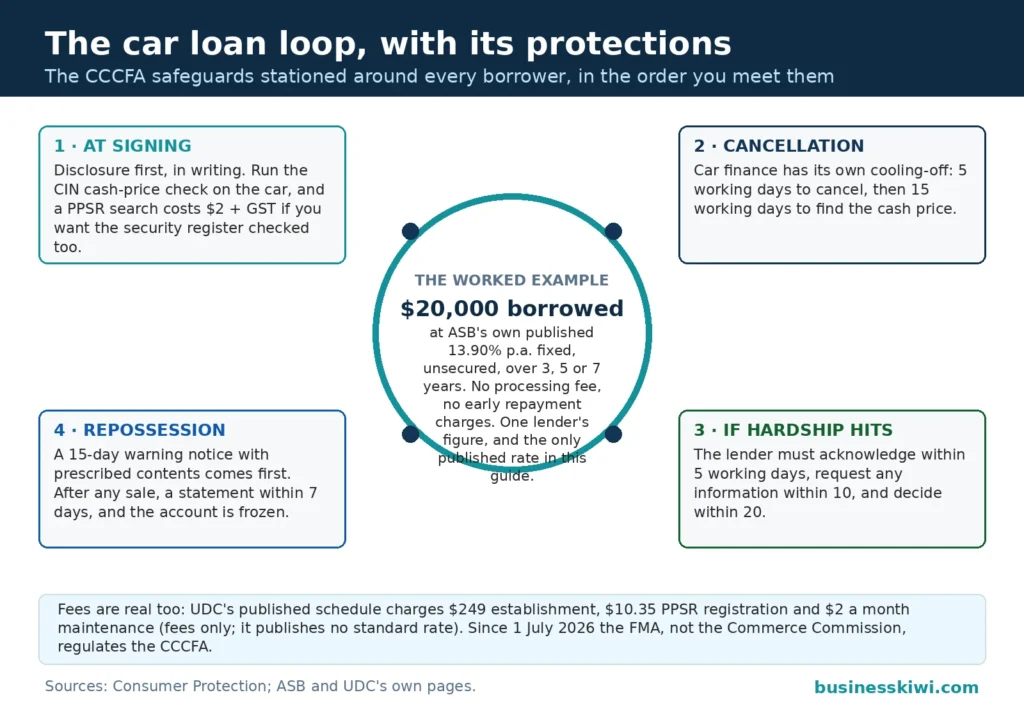
Changed your mind? You have a cooling-off period. Under the CCCFA you can cancel the credit contract in writing within five working days of disclosure, extended to seven working days if the documents were emailed to you and nine if posted. For a car purchase, if you cancel the finance but still want the car, you have 15 working days to come up with the cash price. If you have not taken the vehicle yet, you can cancel the sale as well. If you have driven it home, you can still cancel the credit contract, but you remain committed to buying the car and must find the balance within 15 working days.
If a lender fails to give you disclosure, or the statement is wrong or incomplete, you can cancel at any time; the lender cannot recover interest or fees for the period it failed to comply, and cannot enforce the contract in the meantime. During the loan you must receive balance updates at least every six months, and agreed changes must be in writing before they take effect.
Since 1 July 2026 the regulator watching all of this is the Financial Markets Authority (FMA), which took over responsibility for the CCCFA from the Commerce Commission under the Credit Contracts and Consumer Finance Amendment Act 2026. Lenders now sit under the FMA’s licensing regime and must belong to an approved dispute resolution scheme: complain to the lender first, then to the scheme named in your disclosure statement.
If repayments become a struggle
Contact the lender early, before you miss payments. Consumer Protection lists the changes you can ask for: spreading payments over a longer period to reduce each one, a payment holiday until a set date, or interest-only payments for a time. You can also return the vehicle voluntarily; you will still owe money, but the debt will not include penalty interest and repossession costs.
There is also a formal hardship process. If something you could not reasonably have foreseen, such as illness, injury, job loss or a relationship ending, makes repayments unmanageable, you can make a written hardship application asking for the term to be extended, payments postponed, or both. Consumer Protection sets out the timetable: the lender must acknowledge your application within five working days, request any further information within 10 working days, and decide within 20 working days. Timing matters: if you are two months or more behind, have missed four or more consecutive payments, or have been in default for two weeks or more after a repossession warning notice, you must bring payments up to date before you can apply.
Repossession: the rules a lender must follow
A lender can only take a vehicle if the contract gives it that right, the vehicle is identified as security in the contract, and you are in default. Before acting, the lender must send a repossession warning notice, and Consumer Protection states it must reach you at least 15 days before repossession. The notice has to identify you and the lender, the contract and the goods, how you breached the contract, how the breach can be fixed, and warn that the goods will be repossessed if it is not. The exception is where the lender reasonably believes the goods are at risk of being destroyed, damaged or removed, and that decision can be challenged.
Agents who attend must show their licence or certificate. They can take only the items listed as security in the contract, cannot take household necessities such as beds, a fridge or your passport, and must not damage your home or belongings.
Afterwards, the lender must send a post-repossession notice setting out your options: pay the overdue amount to get the car back, pay the full balance, or let the lender sell it. The notice includes the lender’s estimate of the car’s value. You can get your own independent valuation and introduce a buyer; if you do, the lender must sell to that buyer for at least the estimated value. The lender must take reasonable steps to get the best market price and cannot sell the car unreasonably cheaply. Within seven days of the sale it must tell you the sale price, the sale costs, your balance before the sale, and either the shortfall you still owe or any surplus payable to you. Once the vehicle is sold your account is frozen: no further interest or fees can be added.
Buying the car in Auckland: dealer, private or imported
Buying from a dealer, you have the Consumer Guarantees Act behind you: if the car is faulty, a dealer may have to repair, replace or refund. Registered motor vehicle traders must tell you if money is owing on a car, and the CIN on the windscreen states whether a security interest is registered against it.
Buying privately, usually with an unsecured loan arranged beforehand, is where protections thin out. There is no Consumer Guarantees Act remedy against a private seller, yet the loan still has to be repaid. Before paying, search the PPSR for the vehicle using its VIN, chassis and registration numbers. The register’s own help pages put the search fee at $2 plus GST, and a registered security interest means the car could be repossessed from you over the previous owner’s debt.
Importing a car yourself is the third route, and finance works differently because there is no local vehicle for a lender to secure until the car has arrived and been registered here. Imports are usually paid for with cash or an unsecured personal loan, and the purchase price is only part of the cost: shipping, border charges, and compliance and registration costs all sit on top.
Red flags to walk away from
- “Guaranteed approval” advertising. Every lender must make affordability inquiries before lending. A promise of approval regardless of circumstances does not sit with that duty.
- Pressure to sign today. You are entitled to take documents away and get advice. Urgency is a sales technique, not a legal deadline.
- A weekly payment with no total. Ask for the disclosure statement and the total amount payable. If the conversation keeps returning to the weekly figure, there is a reason.
- Extras you did not ask for. Insurance, warranties and service plans built into the amount financed, unexplained, cost you interest as well as premiums.
- A contract price that differs from the CIN. Consumer Protection specifically flags checking the cash price on the Consumer Information Notice against the loan contract.
Comparing offers like for like
Take the same car price, the same deposit and the same term to each lender, and compare disclosure statements rather than brochures. The total amount payable is the number that matters. Then check the differences a total can hide: whether the rate is fixed or variable, what early repayment costs (ASB charges nothing; UDC charges a $7 administration fee plus a variable funding loss amount), and what default interest and dishonour fees apply if a payment fails.
Frequently asked questions
Can I cancel car finance after I have signed?
Yes, within the cooling-off period: five working days after disclosure, or seven if the documents were emailed and nine if posted. If you still want the car, you then have 15 working days to pay the cash price another way. If the lender never gave you proper disclosure, you can cancel at any time.
What happens if I miss a car loan payment?
Expect default interest on the overdue amount and possibly a dishonour fee. Talk to the lender immediately, because hardship help depends on applying before you fall too far behind. Repossession can only follow a written warning notice given at least 15 days beforehand, and only if the car is security under your contract.
Is dealer finance more expensive than a bank loan?
Not automatically, but the cost sits in different places. ASB’s published car loan charges a fixed 13.90% per annum with no processing fee and no early repayment charge. UDC, a finance company whose loans are commonly arranged through dealers, pairs its rate with fees: $249 to establish the loan, $10.35 for the PPSR registration and $2.00 a month in maintenance fees. The only reliable comparison is the total amount payable on each disclosure statement, for the same amount borrowed over the same term.
Can I sell my car while it is still under finance?
If the loan is secured, the car is the lender’s security, registered against it on the PPSR, so selling it without the lender’s agreement breaches your contract. The usual path is to repay the loan from the sale proceeds, arranged with the lender. If the loan is unsecured, the car is not tied to the contract, but the debt remains yours until it is repaid.
Do I have to buy insurance with my car finance?
Your contract may require the vehicle itself to be insured, and the disclosure statement must set out what insurance is required. Separate credit-related products, such as payment protection insurance and repayment waivers, are optional extras in most cases. Lenders must check these products are affordable and suitable for you and cannot unreasonably require you to buy them. If a premium is added to the loan, you will pay interest on it, so price the cover separately before agreeing.
Sources
Consumer Protection, Getting a loan for your car, consumerprotection.govt.nz
Consumer Protection, What lenders must do, consumerprotection.govt.nz
Consumer Protection, Credit Contracts and Consumer Finance Act, consumerprotection.govt.nz
Consumer Protection, Credit contracts: Plain English definitions, consumerprotection.govt.nz
Consumer Protection, Repossession, consumerprotection.govt.nz
Financial Markets Authority, Credit Contracts and Consumer Finance Act (CCCFA), fma.govt.nz
Personal Property Securities Register, How the PPSR can help when you’re buying used goods, ppsr.companiesoffice.govt.nz
ASB Bank, Car loans, asb.co.nz
UDC Finance, Standard fees and charges applicable to Consumer Contracts, udc.co.nz
MTF Finance, Caravan and motorhome loans, mtf.co.nz
Disclaimer
This article is general information about how car finance works in New Zealand. It is not personalised financial advice, and it does not recommend any lender, dealer or product. Interest rates, fees and lender policies change, and the figures used as examples were read on lenders’ own websites on 7 October 2026. Consider your own circumstances before borrowing, read the disclosure statement for any loan you are offered, and if you want advice about your situation, talk to a licensed financial advice provider. Free, confidential budgeting help is available through MoneyTalks.
You can find more guides on borrowing, saving and everyday money decisions in our Finance section.