Culverts in NZ: Types, Sizes, Installation and Fish Passage Rules
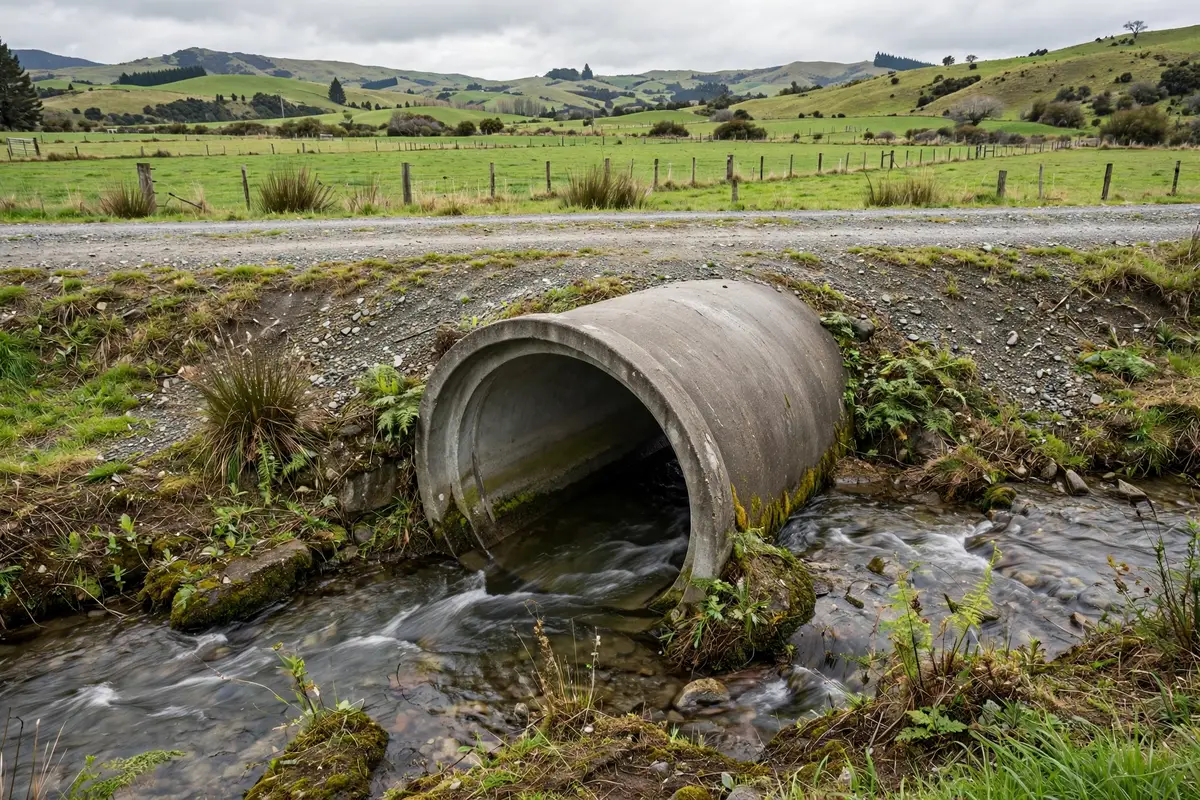
A culvert is easy to drive over and easy to forget. Under thousands of driveways, farm tracks and roads around New Zealand there is a pipe or a concrete box quietly carrying a stream, a drain or stormwater from one side to the other. Get it right and nobody thinks about it again. Get it wrong and the results show up as a flooded paddock, a washed-out crossing, an eroded stream bank, or a stream that fish can no longer swim up.
This guide explains what culverts are, the types and materials commonly used here, how sizing and installation work in outline, and the rules that can apply, particularly the national fish passage requirements.
Quick answer
A culvert is a closed structure, usually a pipe, box or arch, that carries water under a road, track, driveway or embankment. Concrete is the traditional material, HDPE plastic pipe is lighter and dominates smaller rural work, and corrugated steel suits some large and low-cover crossings. Size is described by internal diameter for pipes and by span and height for box and arch shapes. If the culvert sits in the bed of a river or stream, the National Environmental Standards for Freshwater (NES-F) set design conditions for fish passage: meet them and the work is a permitted activity; fail to meet them and a resource consent is needed. A driveway culvert crossing the road reserve also needs the local council’s approval as a vehicle crossing, quite separately from any waterway rules.
What a culvert actually is
The NES-F regulations define a culvert as a pipe, box structure, or covered or arched channel with an inlet and an outlet, sitting in, and connecting the water or bed of, the same river or connected area. In everyday use the word covers a wider set of jobs: any buried conduit that lets water pass underneath something people need to drive, walk or build over.
Where culverts get used
The most common private culvert in New Zealand is the driveway crossing: a short pipe under the entrance where a property meets the road, carrying the roadside drain beneath the driveway. Farm tracks and races use culverts where they cross drains and small streams. Councils and Waka Kotahi NZ Transport Agency use them at a much larger scale under local roads and state highways, ranging from a single pipe to large precast box structures. Rail corridors, forestry roads, subdivisions, industrial sites, stopbanks and flood schemes all rely on them too.
The main types and materials
Three materials account for most culverts installed in New Zealand, and each has a working niche.
Concrete pipe
Reinforced concrete pipe is the long-standing default for road culverts and permanent crossings. Hynds, the country’s largest concrete pipe maker, lists its farm grade culvert pipe in internal diameters from 225 mm up to 3050 mm, in nominal lengths of about 2.4 to 2.5 metres. Concrete is rigid, so it carries load largely through its own strength. It is heavy and needs machinery to place, and the joints and bedding still have to be right, but a well-installed concrete culvert is about as close to fit-and-forget as drainage gets.
HDPE plastic pipe
Twin-wall HDPE pipe has a ribbed outside for stiffness and a smooth inside for flow. P&F Global’s EUROFLO range, widely stocked in New Zealand, runs from 160 mm to 2100 mm outside diameter in 5.8 metre lengths, in stiffness classes the maker labels SN4 and SN8. Plastic pipe is a flexible structure: it depends on the soil around it for much of its strength, which is why makers emphasise bedding, backfill and compaction. The payoff is weight. Lengths can be handled with small gear, it does not rust, and it tolerates the acidic or salty soils that shorten the life of other materials.
Corrugated steel
Corrugated steel pipe is made from galvanised steel sheet formed into round pipe or into a flattened pipe-arch shape, described by span and rise rather than diameter. Steel is strong for its weight and can be fabricated in large sizes. Its weakness is corrosion over time, particularly in aggressive soils and where bed load grinds the invert, so service life depends heavily on coatings and site conditions. Waka Kotahi’s F/3 pipe culvert construction specification covers corrugated metal culvert pipes alongside other materials, including sizes down to 300 mm.
Box culverts and arches
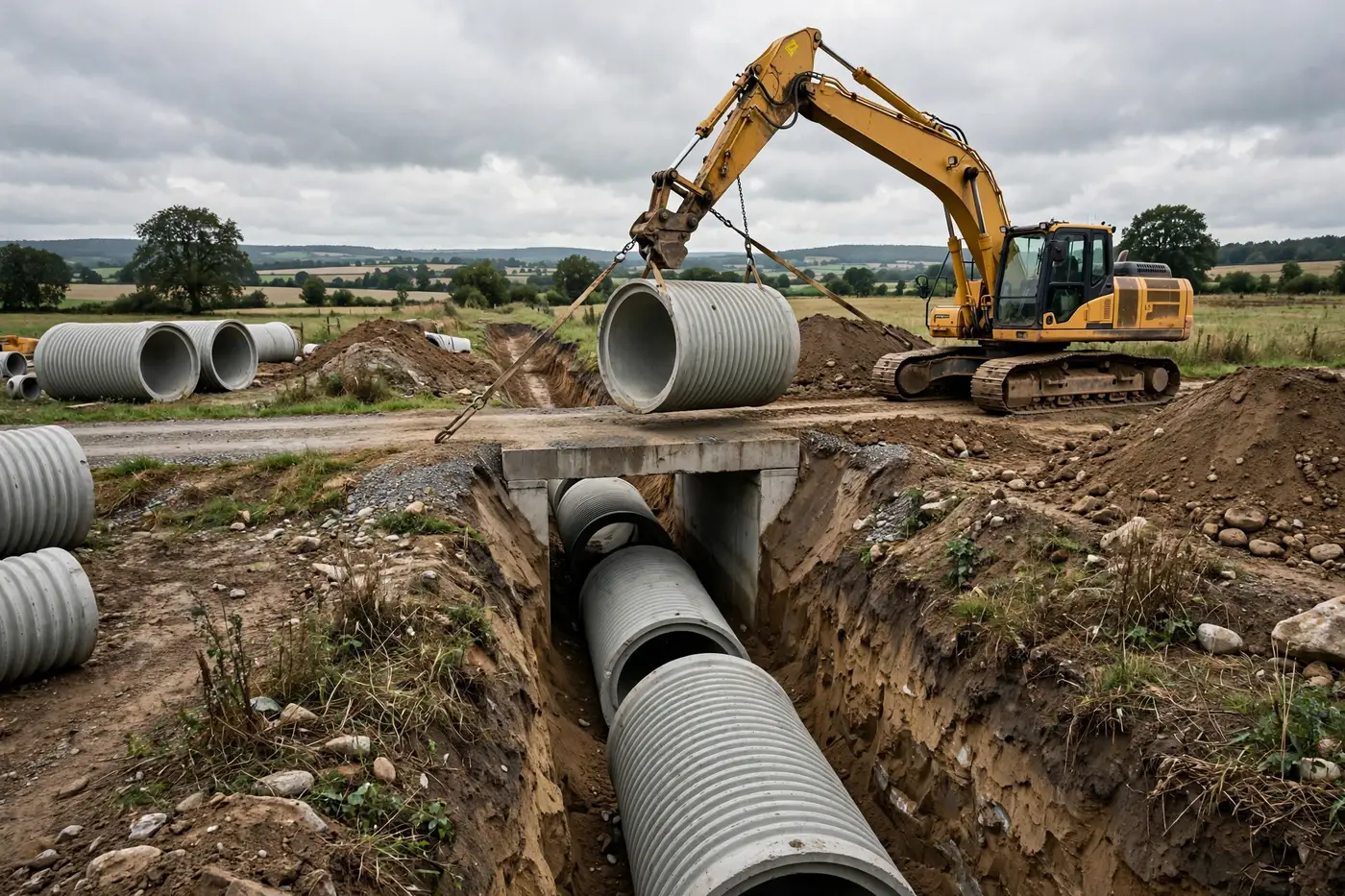
A box culvert is a rectangular concrete structure, usually precast in sections and craned into place, described by its internal span and height. Hynds describes a recent Northland project using six precast sections each 4.0 metres wide and 3.0 metres high, plus precast wingwalls. Boxes suit wide, shallow waterways because they spread the flow across a broad, low opening rather than squeezing it into a round pipe, and they work where there is not enough depth above the stream for a large pipe plus cover. Arch and open-bottom culverts go one step further and leave the natural stream bed in place between footings, which is why they are often the preferred answer where fish passage and habitat matter.
How size is described, and how the right size is chosen
Pipe culverts are sized by internal diameter in millimetres: a “600 culvert” has a 600 mm internal bore. Plastic ranges are sometimes sold by outside diameter, so check which measurement a supplier is quoting. Box and arch culverts are sized by span (the width of the opening) and height or rise.
Choosing the size is a water question before it is a product question. In outline, the designer works out how much water the catchment above the crossing can deliver in the design storm, taking account of the catchment area, its slope and surface, and local rainfall. That flow is then matched against what a culvert of a given size, material and gradient can pass, allowing for how deep water can pond at the inlet before it causes a problem upstream. P&F Global’s own guidance notes that a pipe’s flow capacity depends on its size, the roughness of the material, the gradient and how full the pipe is allowed to run.
Three other checks sit alongside the flow calculation. Cover depth: the thickness of material between the top of the culvert and the surface above it has to suit the culvert type and the traffic over it, and P&F Global’s brochure sets minimum cover that increases with pipe diameter under heavy truck loading. Loading: Waka Kotahi treats culverts or groups of culverts with a total waterway area greater than 3.4 square metres as major culverts designed under its Bridge Manual. Fish passage: in a stream, the opening often needs to be wider than the flow calculation alone suggests, for reasons covered below.
Undersizing is the expensive mistake. An undersized culvert acts as a dam in a flood, ponding water upstream, overtopping the crossing and sometimes washing the whole structure out. Oversizing costs money but rarely causes harm, and the fish passage rules push sizes up anyway.
Installation in outline
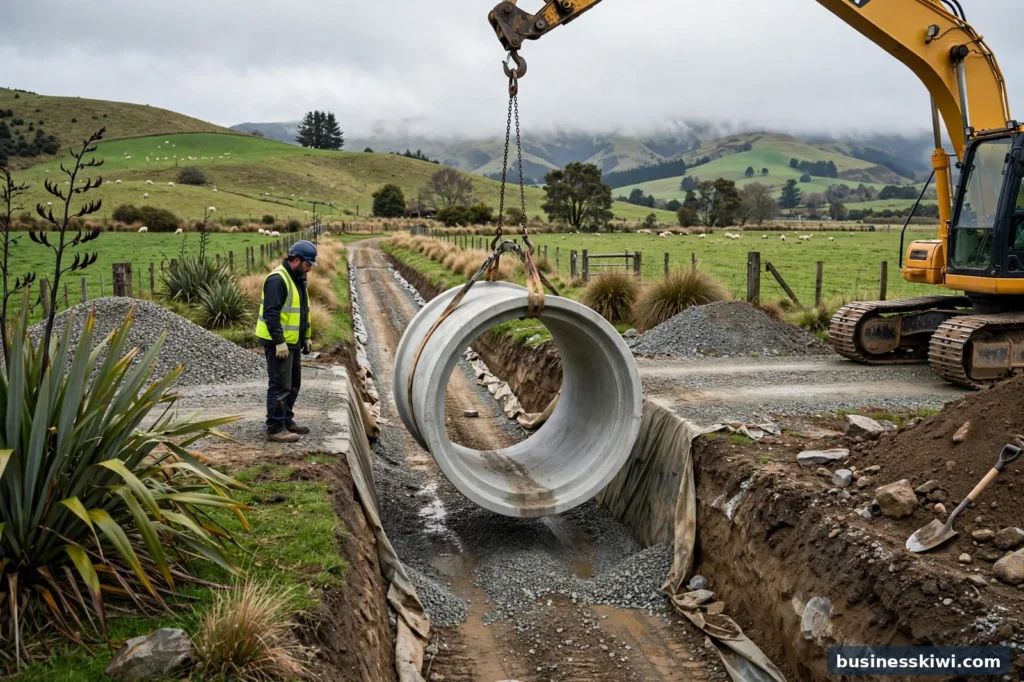
Details vary by material, but the sequence is broadly the same, and Waka Kotahi’s F/3 specification for pipe culvert construction covers the same ground for roading work: excavation, bedding, laying and jointing, headwalls and wingwalls, then backfilling and reinstatement.
Bedding. The culvert sits on a prepared, even bed, not on the rough trench floor. For plastic pipe, P&F Global specifies a sand bedding layer of 100 to 200 mm depending on diameter, levelled and spread but not compacted, so the pipe bears evenly along its length.
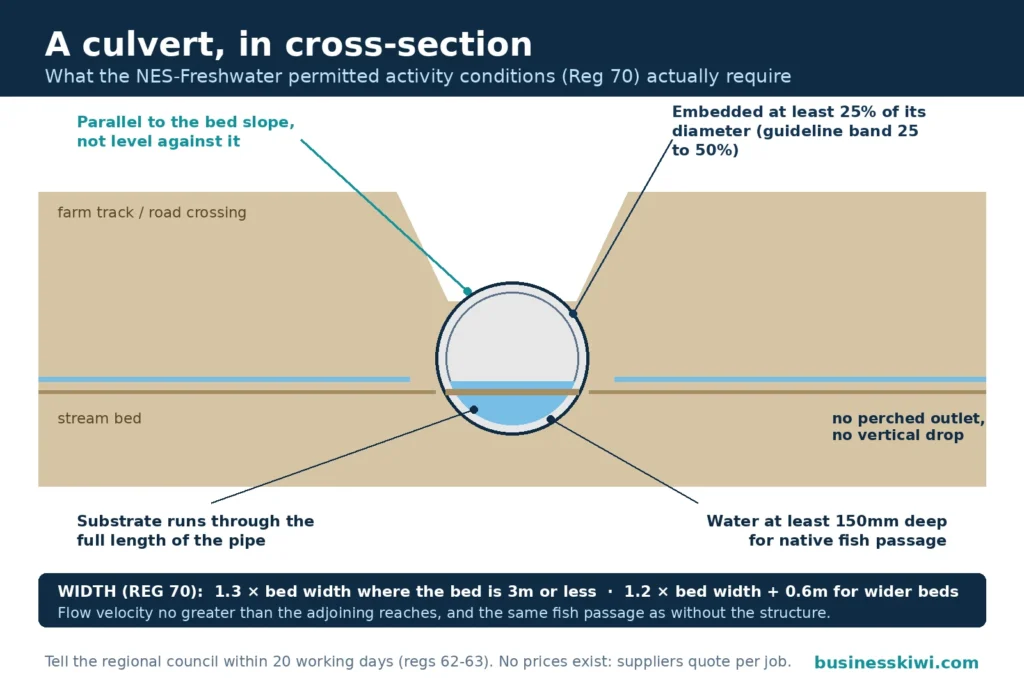
Alignment and grade. Units are laid to the line and slope of the channel they serve. In a waterway, the NES-F conditions require the culvert to be laid parallel to the slope of the bed, so installation starts from surveyed levels rather than guesswork.
Backfill and compaction. This is where flexible pipes are made or broken. Material is placed evenly on both sides in layers and compacted, so the soil becomes part of the structure. Hynds makes the same point from the other direction: free-draining granular backfill gives the best side support, while cohesive clay backfill provides less, pushing the design toward a stronger pipe class.
End treatments. Headwalls and wingwalls at the inlet and outlet hold the embankment back, guide water in and out, and stop the crossing edges from eroding. Aprons of concrete or rock at the outlet protect the bed where water leaves the culvert, and rock protection is commonly added where outlet velocities are high enough to dig a hole, a process known as scour.
Cover and finishing. Fill is brought up evenly over the culvert to at least the minimum cover for the material and loading, the crossing surface is formed, and the site is stabilised so the first storm does not carry loose soil into the new waterway.
Driveway culverts and vehicle crossings
If your culvert sits under a driveway entrance within the road reserve, the road controlling authority, usually your district or city council, has a say quite apart from waterway rules. Councils typically require approval before a vehicle crossing is built or altered, set a specification for how it is constructed, and place responsibility for providing and maintaining the crossing on the property owner.
Thames-Coromandel District Council’s vehicle crossing policy is a fair example of the pattern: the owner is responsible for providing and maintaining an appropriate crossing, and the stated purposes include keeping natural water flows along the road maintained and preventing flooding of both the property and the road. Where the crossing passes over the roadside drain, a culvert pipe forms part of it, and councils set minimums: Horowhenua District Council’s engineering standards call for a concrete culvert pipe of at least 300 mm diameter with headwalls under farm crossings.
One practical point follows from all this. A driveway culvert that is too small, blocked or badly graded does not just flood your entrance; it can push road stormwater onto your land or your neighbour’s, and the maintenance duty sits with you. And if the drain your driveway crosses is actually a stream, or connects to one, the waterway rules in the next section can apply as well. When in doubt, ask the council before the digger arrives.
Culverts in waterways: the consent position
Works in the bed of a river or lake sit under the Resource Management Act 1991, and the NES-F adds national fish passage rules on top of regional plan rules. The NES-F applies to placing, using, altering, extending or reconstructing a culvert in, on, over or under the bed of any river or connected area.
Under regulation 70 of the NES-F, that work is a permitted activity, meaning no resource consent is needed under the NES-F, if the finished culvert meets a set of design conditions aimed at fish passage. In summary: the culvert must provide the same passage for fish, up and down, as would exist without it; be laid parallel to the slope of the bed; keep the average speed of water through it no greater than in the reaches immediately upstream and downstream; meet a width formula based on the bed width (at least 1.3 times the bed width where the bed is 3 metres wide or less, and at least 1.2 times the bed width plus 0.6 metres for wider beds); be open-bottomed, or set down so at least a quarter of its diameter sits below bed level; keep natural bed material present through its full length, stable at the flows the stream runs at most of the time; and keep sediment and debris moving through rather than trapping them.
If a proposed culvert cannot meet those conditions, regulation 71 makes the work a discretionary activity, which means a resource consent is required. Any consent granted must carry conditions requiring the structure to be monitored and maintained so its fish passage performance does not decline over its life, with a plan for how that will be done.
Two further obligations apply even when everything is permitted. Regulations 62 and 63 require specified information about the structure to be given to the regional council within 20 working days after the work is finished: for a culvert, its location, dimensions, shape, material, slope and alignment, photographs of both ends, the drop height and any erosion at the outlet, and whether features such as baffles or spat ropes are fitted. Auckland Council runs a permitted activity notice process for exactly this. Regional plans can also impose their own rules on bed works, so NES-F compliance alone is not the whole story; your regional council is the place to confirm both.
Structures already in place before the NES-F took effect on 3 September 2020 are treated differently under the standards, but replacing an old culvert brings the new one under the current rules.
Designing for fish passage
Many of New Zealand’s native freshwater fish, including the whitebait species, eels and bullies, need to move between the sea and freshwater to complete their life cycles, and councils such as Northland Regional Council point out that a badly designed culvert can cut a stream’s fish population off from its habitat. The New Zealand Fish Passage Guidelines, produced by NIWA and the Department of Conservation, are the design reference the NES-F conditions are drawn from.
The guidelines’ approach can be summed up as making the culvert behave like the stream. Keep the natural channel’s alignment and gradient where possible. Make the opening generous, using the same width benchmarks as the NES-F, based on the stream’s bankfull width. Set the culvert down into the bed, or use an open-bottom structure, so natural substrate runs through it rather than a bare pipe floor; the guidelines put embedment at 25 to 50 percent of the culvert’s height. Keep water speeds no faster than in the stream either side, and keep enough depth at low flows: the guidelines nominate 150 mm as a minimum depth for native fish passage. Avoid any vertical drop at the outlet. A perched culvert, one whose outlet hangs above the downstream water level, is the single most common fish barrier in the country.
Fixing an existing barrier
Where an existing culvert blocks fish, the guidelines describe retrofit options short of full replacement. Spoiler baffles fitted to the culvert floor slow the water and create resting pockets, and are recommended for larger culverts over about 1.2 metres in diameter on gentle grades. Mussel spat ropes, the fibrous ropes used in mussel farming, can be run through smaller culverts, under 1.2 metres in diameter, pulled tight and flush along the base to give climbing species such as young eels and some whitebait a textured, low-velocity path; the guidelines call for at least two rope lines in a 0.5 metre culvert, and more in bigger pipes. A perched outlet can be reconnected with a rock ramp built downstream at a gentle slope, or by backwatering: raising the downstream water level with rock so the drop disappears. The Department of Conservation notes that ramps and baffles need checking after floods, since the same events that move fish also move rock and debris.
Maintenance and how culverts fail
A culvert’s enemies are blockage, scour and time. Debris is the everyday one: branches, slash, weed and rubbish lodge at the inlet, and a partly blocked culvert in a storm behaves like a much smaller one. Scour is the quiet one: fast water leaving the outlet digs a hole that can undermine the outlet and leave it perched, while water tracking along the outside of the pipe can hollow out the embankment until the crossing collapses. Corrugated steel rusts through at the invert, concrete joints can open if the bedding settles unevenly, and plastic pipe can deform if backfill was poorly compacted. The NES-F information rules, which ask for the length of any undercutting at the outlet, reflect how routine that failure is.
The maintenance rhythm is simple: look at both ends after big storms, clear debris before it mats down, watch for erosion at the outlet and for cracking or slumping over the line of the pipe, and deal with small scour holes while they are still small. On a consented structure, monitoring and maintenance are not just good practice but a consent condition.
When you need an engineer or the council
For a like-for-like replacement of a small driveway culvert in an open drain, a competent contractor and the council’s crossing specification will usually cover it. Step up to professional input when any of the following apply: the culvert is in a stream rather than a drain, so the NES-F conditions and regional plan rules are in play; the catchment is large, or the crossing carries a public road or heavy vehicles; downstream properties would flood if the culvert underperformed; or the structure is large enough to count as a major culvert in roading terms. An engineer sizes the structure and documents the design, and the regional council’s consents team can confirm whether your design is permitted or needs consent before you commit to buying pipe.
Frequently asked questions
Do I need a resource consent to put a culvert in a stream?
Not always. Under the NES-F, placing a culvert in the bed of a river is a permitted activity if the design meets the fish passage conditions in regulation 70, covering width, slope, embedment, water speed and bed material. If it cannot meet them, the work is a discretionary activity and needs a resource consent, and your regional plan may add requirements either way. You must still send the regional council specified information about the structure within 20 working days of finishing the work.
What size culvert do I need for my driveway?
There is no single answer, because size depends on how much water the drain or stream carries in a storm, not on the width of the driveway. Councils set minimums for crossings: Horowhenua District Council, for example, requires a concrete culvert pipe of at least 300 mm diameter with headwalls under farm crossings. Your council’s vehicle crossing specification is the starting point, and bigger is generally safer than just big enough.
Does the fish passage law apply to an old culvert?
The NES-F fish passage standards are aimed at structures placed, altered, extended or reconstructed after the standards came into force on 3 September 2020. An old culvert left as it is generally sits outside those conditions, but the moment you replace it, the replacement has to comply, and other rules, including the Freshwater Fisheries Regulations 1983 and regional plan provisions, can still bear on existing barriers.
How do I make an existing culvert passable for fish?
The usual fixes, set out in the New Zealand Fish Passage Guidelines, are to slow the water and remove any drop. Spoiler baffles suit culverts larger than about 1.2 metres in diameter, mussel spat ropes suit smaller ones and help climbing species, and a perched outlet can be reconnected with a rock ramp or by raising the downstream water level. Full replacement with a wider, embedded culvert or an open-bottom arch is the most durable answer where the existing pipe is near the end of its life anyway.
What happens if my culvert is too small?
In a heavy storm an undersized culvert ponds water upstream, which can flood land, yards or buildings, and once water overtops the crossing it can erode the embankment and wash the structure out entirely. Water also attacks the outside of the pipe and the outlet, so scour and undermining often arrive before the dramatic failure does. A crossing that regularly dams water back needs a bigger opening, not just a clean-out.
Sources
Ministry for the Environment, National Environmental Standards for Freshwater, environment.govt.nz
New Zealand Government, Resource Management (National Environmental Standards for Freshwater) Regulations 2020, legislation.govt.nz
Ministry for the Environment, Essential Freshwater: Fish passage factsheet, environment.govt.nz
Franklin, P. et al., New Zealand Fish Passage Guidelines, niwa.co.nz
Department of Conservation, Fixing barriers to fish passage, doc.govt.nz
NZ Transport Agency Waka Kotahi, Bridge Manual (SP/M/022), nzta.govt.nz
NZ Transport Agency Waka Kotahi, F/3 Specification for Pipe Culvert Construction, nzta.govt.nz
NZ Transport Agency Waka Kotahi, P46 Stormwater Management and Minor Stream Diversion Design Specification, nzta.govt.nz
Hynds Pipe Systems, Farm Grade Culvert Pipe, hynds.co.nz
Hynds Pipe Systems, Precast Concrete Box Culvert Installation at Te Arai, hynds.co.nz
P&F Global, EUROFLO Culvert Pipe FAQs and Technical Brochures, pandfglobal.com
Thames-Coromandel District Council, Vehicle Crossing Policies, tcdc.govt.nz
Horowhenua District Council, Engineering Standards: Vehicle Crossings, horowhenua.govt.nz
Auckland Council, Permitted Activity Notice for Fish Passage Structures, aucklandcouncil.govt.nz
Northland Regional Council, Are Your Culverts Fish-Friendly?, nrc.govt.nz
Disclaimer
This article is general information about culverts and the rules that commonly apply to them in New Zealand. It is not engineering, design or legal advice. Culvert sizing, structural design and consent requirements depend on the site, and rules vary between regions and change over time. Talk to your regional council, your local council’s roading team, or a qualified drainage or civil engineer before designing or installing a culvert.
More guides for businesses, farms and property owners are in our Business and Industry section.