Arborists in NZ: Services, Tree Rules, Costs and Hiring One
Quick answer
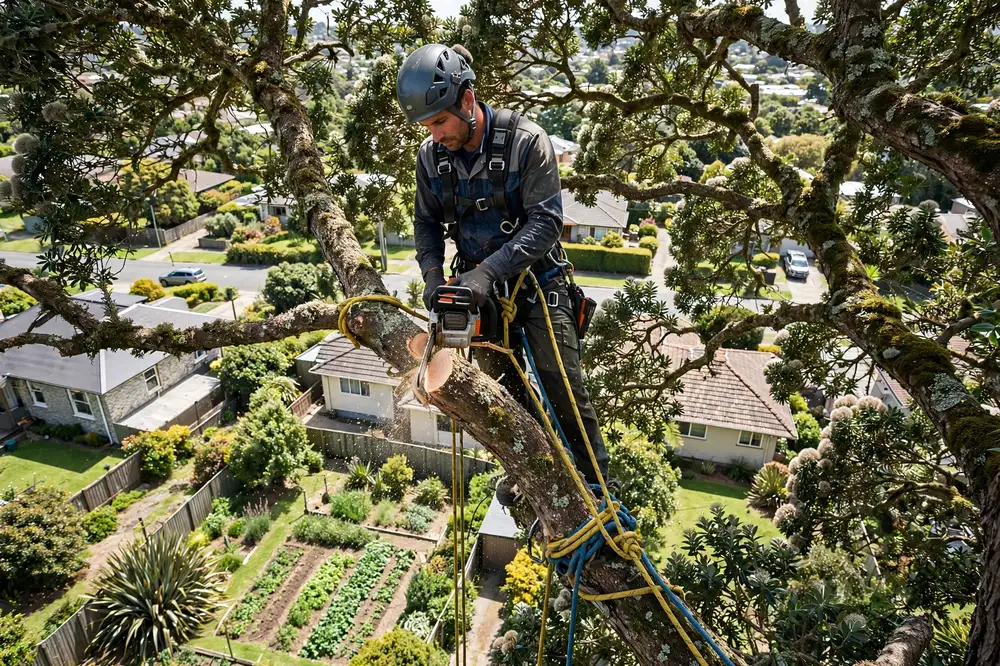
An arborist is a trained tree specialist who prunes, removes, plants and assesses individual trees, usually working at height with ropes or an elevated platform. In New Zealand, anyone can advertise tree work, so the checks that matter are qualifications (the New Zealand Certificate in Horticulture (Arboriculture) at Level 3, and Horticulture Services (Arboriculture) at Level 4), insurance, and membership of the industry body, NZ Arb. Some trees are protected under your council’s district plan and need a resource consent before they can be pruned or removed, and work near power lines is restricted to suitably qualified operators. Arborists almost never publish fixed prices. Expect a written quote after someone has seen the tree, because cost turns on size, access and what is underneath it.
What an arborist does, and how that differs from a gardener or tree lopper
Arboriculture is the care of individual trees, as opposed to forestry, which manages stands of trees as a crop. NZ Arb, the New Zealand Arboricultural Association, describes arborists as specialists in the care of individual trees who are trained and equipped to look after them properly. That training is the dividing line. A gardener or landscaper typically works at ground level on shrubs, hedges and planting. An arborist works on the tree itself, including up in the canopy, and is expected to understand tree biology well enough to know what a cut will do to the tree over the following years, not just how it looks on the day.
“Tree lopper” is the label to be wary of. Lopping, or topping, means cutting back large branches to stubs. NZ Arb is blunt about it: topping, removing an excessive amount of live wood, and using climbing spikes on a tree that is not being removed are improper practices that breach industry standards. A qualified arborist prunes to branch collars and laterals, keeps the tree’s structure sound, and will sometimes talk you out of work rather than do something that shortens the tree’s life. If the person quoting reaches for the word “lopping” as a selling point, keep looking.
The work is also genuinely dangerous, which shapes everything else in this guide. Pruning or removing large trees involves chainsaws at height, heavy timber under tension, and rigging loads over houses and fences. WorkSafe New Zealand publishes an Approved Code of Practice for safety and health in arboriculture precisely because the industry carries significant risk, and its rules assume trained, competent operators. That is the real difference you are paying for.
Services arborists provide
Pruning
Pruning is the core service, and a good arborist will ask what you want to achieve before recommending cuts. Work described by NZ Arb includes removing limbs that interfere with roofs, power lines or other structures, clearing branches that obstruct roads and footpaths, and taking out dead, weak or decayed wood that poses a risk. Thinning a canopy lets more light through without changing the tree’s outline much. Formative pruning on young trees builds a sound structure early, which is far cheaper than correcting a badly shaped mature tree later. Storm-damaged and diseased limbs also come off as part of pruning work.
Tree removal
Removal is treated as a last resort in the industry, but sometimes it is the only sensible call. NZ Arb lists the usual triggers: the tree is dead or dying, it has become an unacceptable risk, it is causing an obstruction that pruning cannot fix, it is crowding out better trees, or the site is being rebuilt and the tree cannot stay. In a typical suburban section there is rarely room to fell a tree whole, so the climber dismantles it in sections, lowering each piece on ropes. Where access allows, a crane or elevated work platform may do the job instead.
Stump grinding
Felling leaves the stump behind, and most firms treat grinding as a separate item rather than part of the removal price. A stump grinder chews the stump and surface roots down below ground level so the area can be regrassed, planted over or paved. Always confirm whether grinding is in your quote, and say if you plan to build or concrete over the spot, because that can change how deep the stump needs to go and whether roots need chasing out further.
Planting and plant health care
Plenty of arborists plant trees, and most will advise on species choice for a particular site, which matters more than it sounds: the wrong tree in the wrong place is how many expensive removals start, twenty years later. Ongoing plant health care covers fertilisation and soil improvement, soil aeration to help root growth, cabling or bracing for branches with weak attachments, and treatments for particular insect and disease problems. Some firms also install lightning protection on significant trees.
Reports, assessments and consulting
Consulting arborists assess trees and put their findings in writing. You might need one for a resource consent application (councils commonly require an arborist’s report for extensive work on or around protected trees), for a tree risk assessment near a house or school, for a dispute with a neighbour or an insurer, or to value and plan the management of trees on a commercial site. This is desk and inspection work rather than chainsaw work, and it is usually done by the most experienced people in the industry.
Emergency and storm work
After a storm, arborists clear limbs and whole trees that have come down on houses, cars, driveways and other trees. Storm work is the most hazardous work of all, because fallen trees are loaded with stored energy and can roll or spring without warning. NZ Arb keeps a list of approved contractors for exactly this situation. If a fallen tree is touching power lines, do not go near it: call your lines company first and let them make the site safe.
Protected trees: when you need council consent first
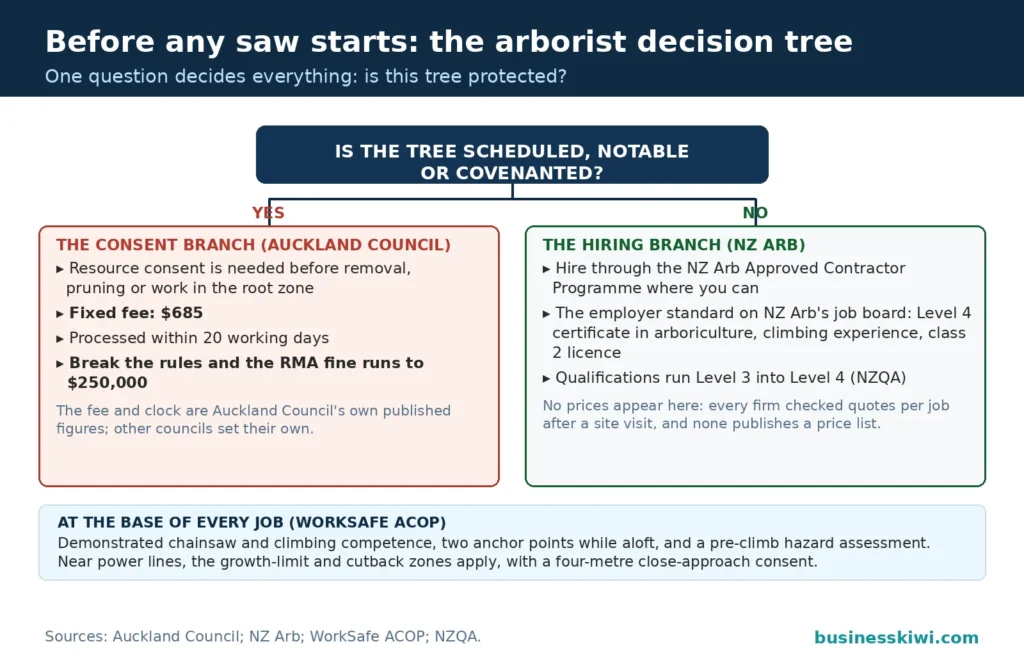
There is no blanket rule that you can do what you like with a tree because it grows on your land. Each council’s district plan sets its own tree rules, and they vary around the country, but the pattern Auckland Council publishes is a good guide to how protection usually works. A tree may be protected because it is listed in the plan as a notable or scheduled tree, because a condition on an earlier resource consent protects it, because a covenant or consent notice on the property title covers it, or because a general tree protection rule applies in a rural environment. No species gets automatic protection in Auckland, apart from vegetation rules that apply on the Hauraki Gulf islands.
If a tree is protected, Auckland Council requires a resource consent to remove it, prune it, or carry out construction work near it. That last point catches people out: digging, building decks, fences and retaining walls, or stockpiling material within the root zone can all need consent, and doing the work without one can attract a fine of up to $250,000 under the Resource Management Act. For extensive work, the council may require an arborist’s report covering the effects of the proposal on the tree and the protection methods to be used. Applications to prune or work within the protected root zone of a notable tree can be made without the usual fixed fee; for other tree work consents Auckland charges a fixed fee of $685 and says it processes applications within 20 working days.
Trees on public land are a separate case. Street and park trees belong to the council, which has its own arborists and contractors; you need the council’s approval before arranging any work on them. Wherever you live, the practical step is the same: before booking significant work, check your council’s district plan rules or ring and ask a planner. Any competent arborist should ask about protection status before quoting, and many will handle the consent paperwork as part of the job.
Trees near power lines
Power lines add a legal layer of their own. The Electricity (Hazards from Trees) Regulations 2003 place duties on tree owners to keep trees clear of lines, and lines companies administer a system of zones around conductors. As lines companies such as MainPower explain it, trees growing into the notice zone or cut-back zone need trimming soon, and a tree that reaches the growth limit zone triggers a formal legal notice requiring it to be trimmed by a qualified contractor within a set time. The regulations were strengthened in 2024, including a “clear to the sky” requirement for vegetation overhanging lines.
The safety rules are stricter than the trimming rules. WorkSafe’s arboriculture code states that all power lines are to be treated as live, and work on trees extending into the zone around lines is restricted to utility arborists who are specially trained and certificated for that work, or to other arborists who hold written consent and agreed safety conditions from the line owner. Lines companies likewise require their consent before people or machinery come within four metres of lines. The short version for homeowners: never trim a tree near lines yourself, and expect your arborist to involve the lines company if the canopy is anywhere near the conductors.
Safety: what the rules expect of tree workers
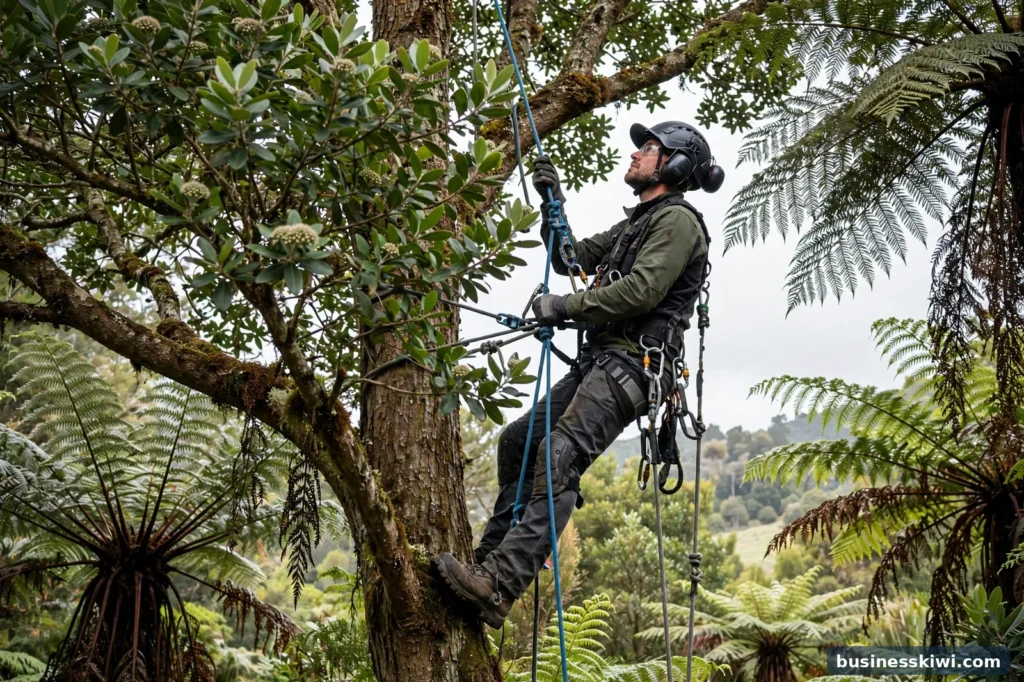
The current law sitting over all of this is the Health and Safety at Work Act 2015, which requires every business to manage risk so far as is reasonably practicable. WorkSafe’s Approved Code of Practice for Safety and Health in Arboriculture predates that Act and WorkSafe notes it has not been updated for it, but the regulator still publishes it as relevant guidance, and its competence rules show what professional practice looks like:
- Nobody should use a chainsaw for tree work unless they have demonstrated competence and practical knowledge in both chainsaw operation and tree climbing.
- Anyone using climbing systems, including knots, hitches and hardware, must be trained and competent in their use.
- A visual hazard assessment of the tree, including the root plate area, is carried out before any climbing or work in the tree.
- When making cuts up in the tree, the climber is attached by two anchor points, and the saw is kept secured and operated with two hands.
- Fall restraint is used whenever a climber is aloft.
For you as the client, the translation is simple. A professional crew arrives with helmets, eye and hearing protection, chainsaw protective clothing and a rescue plan, and will often have a second person on site who can climb to help if something goes wrong. If the quote in your hand comes from someone proposing to free-climb with a saw and no harness, the saving is not worth it.
Qualifications and training
Arboriculture is not a licensed trade in New Zealand, so qualifications are voluntary, which is exactly why they are worth checking. The standard pathway sits on the New Zealand Qualifications Framework: the New Zealand Certificate in Horticulture (Arboriculture) at Level 3, followed by the New Zealand Certificate in Horticulture Services (Arboriculture) at Level 4. Programmes are delivered by polytechnics and through workplace training while employed with a tree company. Level 4 is the benchmark employers advertise for: job listings on NZ Arb’s own jobs board routinely ask for a Level 4 certificate, several years of climbing experience and a class 2 truck licence, with utility arborist roles asking for additional certification for work near lines.
Two industry credentials sit on top of the certificates. NZ Arb runs an Approved Contractor Programme: a business listed under it has met, and must keep meeting, a minimum standard of professional knowledge, practical ability and client service. NZ Arb also recognises the Certified Arborist credential run by the International Society of Arboriculture, a voluntary qualification gained by examination and maintained through continuing education. Neither scheme guarantees a perfect job, but both give you something verifiable to ask about, which is more than a ute magnet can offer.
How much does an arborist cost?
There is no standard price list, and you should be suspicious of any website that quotes you a typical figure for “tree removal” without seeing the tree. Arborist firms publish their services and then quote the individual job, usually after a site visit, and many offer that visit and quote free of charge. The price is built from the tree itself: its height, trunk diameter, species and condition, how much canopy has to come out, and whether it can be felled, dismantled in sections, or needs a crane or platform. Access matters as much as size. A big tree in an open paddock can cost less to remove than a medium tree wedged between two houses, because everything from the second tree has to be lowered on ropes and carried out by hand.
Also pin down what the number includes. Chipping and carting away green waste, cutting firewood rounds, stump grinding and traffic management are frequently separate lines. NZ Arb suggests asking two questions that flush out most surprises: “Is this the total price?” and, if you might add work on the day, “What is your hourly rate?” Consent costs, where they apply, sit on top of the contractor’s price: Auckland Council’s fixed fee of $685 for a tree works resource consent is one published example. Get at least two written quotes for anything substantial. They will rarely match, and the differences usually tell you something about how each firm intends to do the job.
Hiring an arborist: a checklist
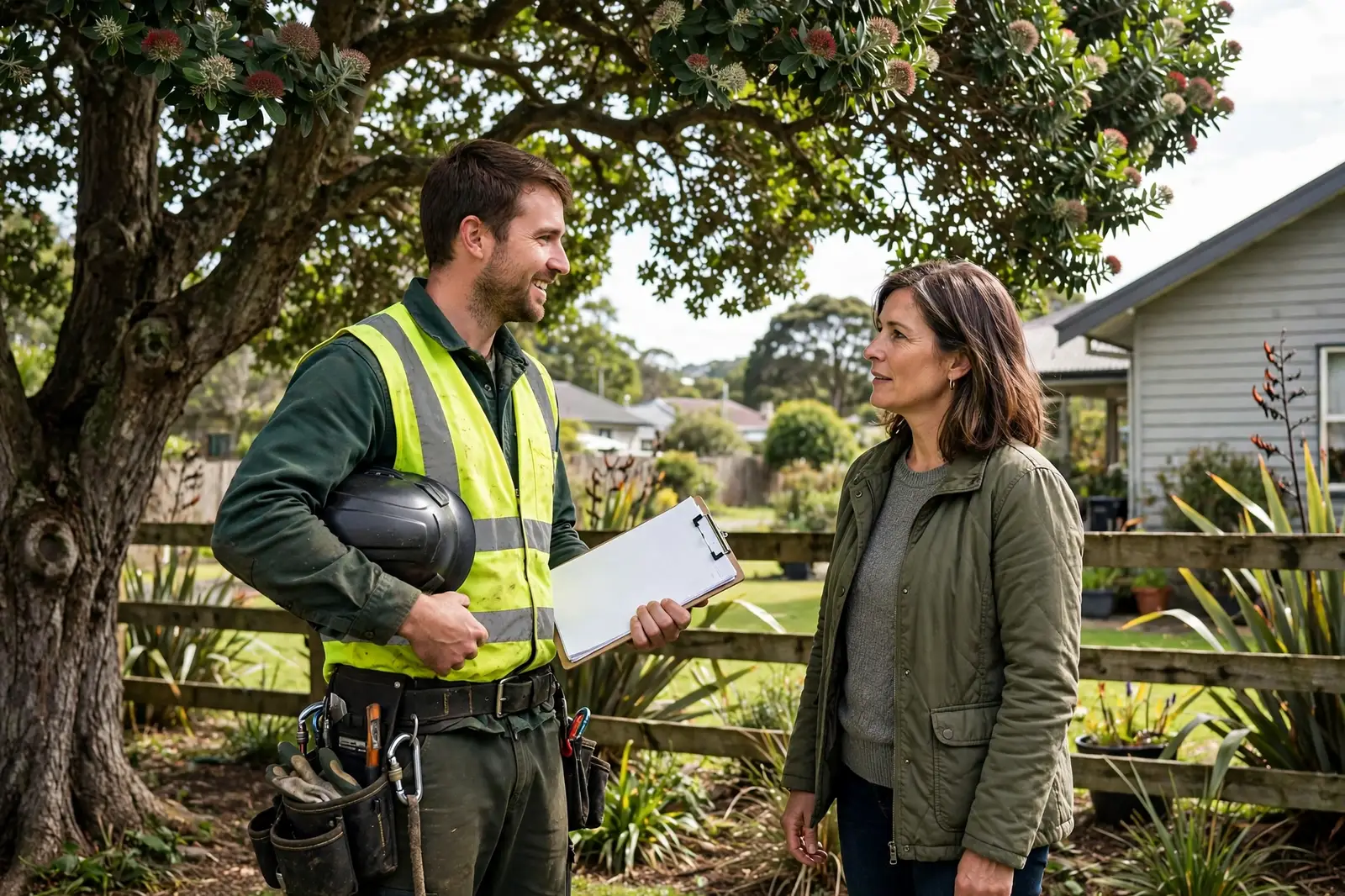
NZ Arb publishes consumer advice on choosing an arborist, and it boils down to verifying before you commit:
- Check the qualifications. Ask which NZQA certificates the crew hold, and whether the person climbing is the qualified one.
- Check professional standing. Membership of NZ Arb or the International Society of Arboriculture, listing under NZ Arb’s Approved Contractor Programme, or ISA Certified Arborist credentials all count in a firm’s favour.
- Ask for proof of insurance. NZ Arb advises that a reputable arborist carries public liability and property damage cover as well as professional indemnity insurance, and suggests ringing the insurer if you are not satisfied with the paperwork.
- Ask about permits and consents. For protected trees, confirm who is applying for the resource consent and whether an arborist’s report is needed.
- Get more than one estimate. NZ Arb notes you may have to pay for estimates, but for a large job the comparison is worth it. Do not automatically take the lowest bid; weigh price against the written specification, skill and professionalism.
- Get it in writing. A proper contract or written quote sets out when work starts and finishes, who is responsible for clean-up, the total price, payment terms, and the hourly rate for extras.
- Watch for red flags. Door-to-door operators offering bargains, pressure to decide on the spot, offers to top the tree, or a quote given without visiting the site.
Becoming an arborist
Most arborists start on the ground. Ground crew feed the chipper, run ropes, cut firewood and keep the drop zone clear while they learn how a site works, and many employers take on trainees or apprentices and put them through the Level 3 and Level 4 certificates while they work. From there the usual progression is to climbing arborist, then crew leader, and for some, consulting work assessing trees and writing reports, which draws on higher qualifications and long experience. Utility arboriculture, keeping vegetation clear of power lines for lines companies and their contractors, is a substantial branch of the industry with its own training requirements, and councils employ arborists directly to manage street and park trees.
The job suits people who like physical outdoor work and are comfortable at height. Employers ask for fitness, a driver licence (a class 2 truck licence is a real advantage), and a genuine commitment to safety procedures, because the work is unforgiving of shortcuts. Experienced arborists who want to work for themselves often move into contracting, or set up their own limited company and build a small crew around a truck, chipper and climbing kit. Pay varies with qualification level, region and whether the work is residential, council or utility work, so talk to employers and training providers about current rates rather than relying on advertised ranges.
Frequently asked questions
Do I need a qualification to call myself an arborist in NZ?
No. Arborist is not a protected title or a licensed trade here, which is why checking credentials matters. Look for the New Zealand Certificate in Horticulture (Arboriculture) at Level 3 or the Level 4 Horticulture Services certificate, NZ Arb membership or Approved Contractor status, and ISA Certified Arborist credentials.
Can I remove a tree on my own property without permission?
Often yes, but not always. If the tree is notable or scheduled in your council’s district plan, protected by a consent condition or a covenant on your title, or covered by a general protection rule, you will need a resource consent before removing or even pruning it. Check with your council first. The fine for unconsented work near a protected tree in Auckland can reach $250,000.
Will the quote include stump grinding and waste removal?
Not automatically. Stump grinding, chipping and carting green waste away are commonly separate items, so ask for the quote to itemise them. NZ Arb’s advice is to confirm in writing whether the price is the total price, who cleans up, and what extra work would cost per hour.
My tree is touching the power lines. What should I do?
Stay away from it and contact your lines company. Trees that reach the growth limit zone around lines must be trimmed, and work close to live lines is restricted to utility arborists or arborists working with the line owner’s written consent. Never attempt it yourself, even with the power apparently off.
What is the difference between pruning and topping?
Pruning removes selected branches back to suitable growth points, keeping the tree’s structure and health intact. Topping cuts large branches back to stubs, which NZ Arb classifies as an improper practice: it stresses the tree, invites decay, and triggers weak regrowth that becomes a hazard of its own. A reputable arborist will refuse to top a tree that is staying.
Sources
NZ Arboricultural Association, Why Hire An Arborist, nzarb.org.nz
NZ Arboricultural Association, About Us, nzarb.org.nz
NZ Arboricultural Association, Job listings, nzarb.org.nz
WorkSafe New Zealand, Safety and Health in Arboriculture: Approved Code of Practice, worksafe.govt.nz
WorkSafe New Zealand, Tree felling near powerlines in forestry operations, worksafe.govt.nz
Auckland Council, Protected trees on your property, aucklandcouncil.govt.nz
Auckland Council, Working on or around protected trees, aucklandcouncil.govt.nz
Auckland Council, Apply for a resource consent to work on or around protected trees, aucklandcouncil.govt.nz
MainPower New Zealand, Trees and vegetation near powerlines, mainpower.co.nz
Otago Polytechnic, New Zealand Certificate in Horticulture (Arboriculture) (Level 3) and New Zealand Certificate in Horticulture Services (Arboriculture) (Level 4), op.ac.nz
Stump Busters, Residential, Lifestyle and Commercial Stump Grinding, stumpbusters.co.nz
Tauranga Arborist, Frequently Asked Questions, taurangaarborist.co.nz
Disclaimer
This article is general information only and is not legal, safety or arboricultural advice for your particular tree. District plan rules, fees and consent requirements differ between councils and change over time, so check the current rules with your local council before arranging work. Tree work is hazardous: leave climbing, chainsaw work and anything near power lines to qualified professionals.
For more guides on trades, services and running a business, see our Business & Industry guides.