Engineering Courses NZ: Degrees, Diplomas and Certificates Compared

“Engineering courses” is not one thing in New Zealand. It covers short pre-trade certificates, a two-year national diploma, two different kinds of degree, and postgraduate study through to doctoral level. They differ in length, entry maths and the jobs they lead to, so choosing well starts with understanding the ladder.
The most useful framing comes from Engineering New Zealand, the professional body. Its accreditation pages describe three programmes of engineering education in this country: a four-year Bachelor of Engineering (Honours) for professional engineers, a three-year Bachelor of Engineering Technology for engineering technologists, and the two-year New Zealand Diploma in Engineering for engineering technicians. Certificates at levels 3 and 4 sit below them, and postgraduate study sits above. This guide works through each level, the disciplines, accreditation, entry, fees and funding, and how to match a course to the career you want.
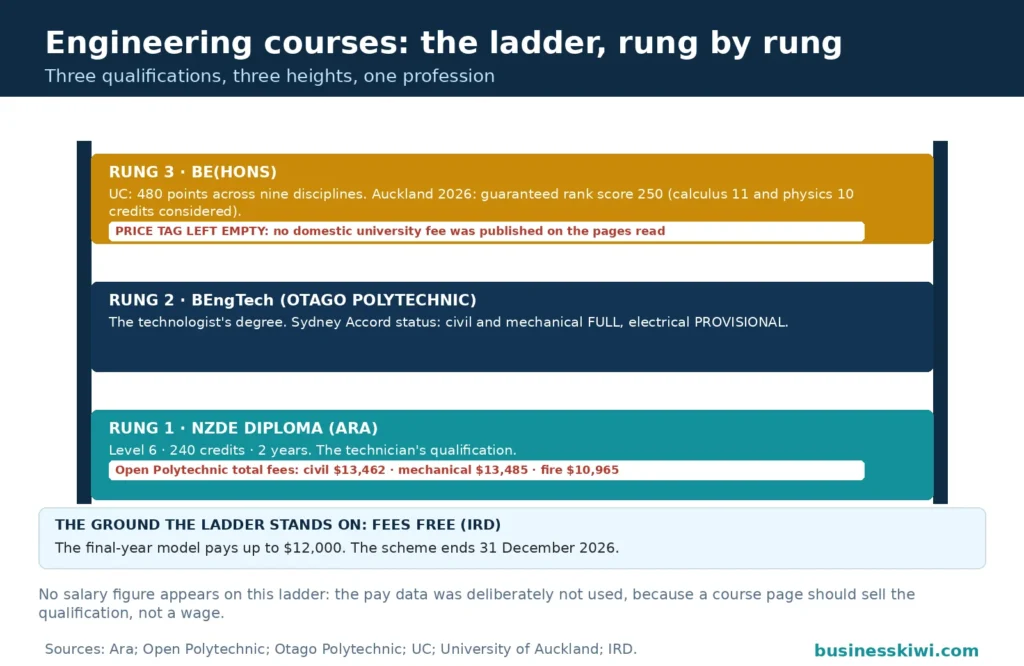
The qualifications ladder
Certificates at levels 3 and 4
Certificates are the entry point for people who want hands-on engineering skills without committing to a diploma or degree, and they are also a recognised way into further study. NZQA’s qualifications register lists current certificates such as the New Zealand Certificate in Electrical Pre-Trade (Level 3), a 120-credit qualification that 13 organisations can deliver, and the New Zealand Certificate in Engineering Fabrication (Trade) (Level 4), at 255 to 270 credits. These qualifications are practical and trade-focused, suited to school leavers unsure about degree-level maths, career changers, and anyone aiming at an apprenticeship or technician support role.
Certificates also work as a bridge. Ara accepts the New Zealand Certificate in Study and Employment Pathways (Level 4) Engineering Pathway as an entry route into its engineering diploma, and Open Polytechnic offers two free mathematics micro-credentials, Foundation Mathematics for Engineering at level 3 and Introductory Mathematics for Engineering at level 4, each worth 10 credits. They let a learner who left school without strong maths build toward diploma entry instead of being shut out of engineering altogether.
The New Zealand Diploma in Engineering (Level 6)
The New Zealand Diploma in Engineering (NZDE) is the national technician qualification. Ara’s programme page for the civil strand confirms the standard shape of the diploma: level 6, 240 credits, two years full-time, with part-time study available for up to five years. Open Polytechnic’s engineering page lists the same qualification at 240 credits in civil, mechanical and fire engineering strands.
The content is applied. Ara describes its civil diploma as covering design and drawing, materials, surveying, hydraulics, geotechnical engineering, structures and highways, designed by industry for the New Zealand engineering sector. Graduates are expected to reach the standard in Engineering New Zealand’s graduate profile for engineering technicians, which Ara notes is benchmarked internationally against the exemplar attributes for technician programmes recognised under the Dublin Accord. The diploma is not a dead end: Ara states that it provides a pathway into the Bachelor of Engineering Technology with established cross-crediting arrangements, so a diploma graduate can continue into degree study with credit for work already done.
The Bachelor of Engineering Technology (Level 7)
The Bachelor of Engineering Technology, or BEngTech, is the technologist degree. It takes three years full-time, and Open Polytechnic lists its civil strand at 360 credits and level 7. Otago Polytechnic describes core courses in areas such as engineering mathematics, mechanics, communication and management, followed by a major and a significant industry-based project in the third year. It offers majors in mechanical, civil and electrical engineering at its Dunedin campus, with part-time options and February or July intakes.
The emphasis is applied: solving practical problems with technology, running projects, and working between the design office and the site or workshop. Otago Polytechnic notes that technologists develop competence in practice after graduating and can progress toward the standard for registration as an Engineering Technology Practitioner, and toward Technical Membership of Engineering New Zealand. There is also room to specialise: its civil major offers structural, water and wastewater, transportation and geotechnical specialisations, and its electrical major offers power or mechatronics pathways.
The Bachelor of Engineering (Honours) (Level 8)
The Bachelor of Engineering (Honours), the BE(Hons), is the professional engineering degree: four years full-time and, in the University of Canterbury’s 2026 regulations, 480 points in total. It suits people aiming at complex design work, responsibility for significant engineering decisions, and chartered professional standing later in their careers.
Structure varies a little between universities but follows a pattern. Canterbury’s regulations describe an Engineering First Year of at least 120 points, after which admission to a second-year programme in a chosen discipline depends on a competitive grade point average that secures a place. Canterbury awards the degree in nine disciplines: Chemical and Process Engineering, Civil Engineering, Computer Engineering, Electrical and Electronic Engineering, Forest Engineering, Mechanical Engineering, Mechatronics Engineering, Natural Resources Engineering, and Software Engineering. Practical work is built in: Canterbury’s first-year schedule includes an engineering work experience course, and its progression rules require passes in introductory mathematics, physics or chemistry courses where students need them.
Postgraduate study
Above the BE(Hons), universities offer postgraduate certificates and diplomas, taught and research masters degrees, and PhDs, for graduates who want to specialise or move into research. Canterbury’s Master of Engineering page gives a typical picture of entry expectations: applicants normally need a BE(Hons) with first or second class honours, a BSc(Hons) in relevant subjects, or a Postgraduate Certificate in Engineering with a grade point average of 5 or more, and must have completed the non-academic requirements of their first degree, such as practical work days and a workshop training course. Postgraduate study is best treated as a second decision, made when your direction is clearer.
Engineering disciplines: what each one covers
Most providers use the same broad discipline names, but the detail sits on their own course pages, worth reading for the exact strand on offer.
Civil engineering covers the built infrastructure of daily life. Tahatū, the official careers site, describes civil engineers as overseeing the design, construction and maintenance of large structures such as buildings, dams, bridges, roads, sewerage systems and irrigation projects, and lists structural, transport, seismic, geotechnical, roading, dam, water and construction engineer among its related job titles. At diploma level, Ara’s civil strand adds surveying, hydraulics and highway engineering.
Mechanical engineering deals with machines, energy and moving systems. Otago Polytechnic’s mechanical major includes materials science, strength of materials, thermodynamics and heat transfer, fluid mechanics, mechanics of machines and design, with electives such as manufacturing processes and energy engineering.
Electrical and electronic engineering covers power systems, electrical machines, electronics and control. Otago Polytechnic’s electrical major includes electrical and electronic principles, power engineering and power distribution, sustainable energy and power electronics, with specialisations in power or mechatronics.
Software and computer engineering focus on computing systems and the software that runs on them. Canterbury lists Computer Engineering and Software Engineering as separate BE(Hons) disciplines, and its first-year schedule includes an introduction to programming for engineers.
Chemical and process engineering applies chemistry and physics to industrial processes, which is why chemistry features in its first-year requirements. Canterbury awards its BE(Hons) in Chemical and Process Engineering, while Auckland combines this area with materials as Chemical and Materials Engineering.
Structural engineering is concerned with how buildings and other structures carry loads and stay standing. Tahatū lists structural engineer within the civil engineering family, and Otago Polytechnic offers structural as a specialisation inside its civil major, a reminder that some disciplines are full degrees at one provider and specialisations within a broader degree at another.
Mechatronics blends mechanical, electrical and computing skills for automated systems and robotics. Canterbury offers it as a BE(Hons) discipline in its own right, while Otago Polytechnic delivers mechatronics as a specialisation within electrical engineering, including programmable logic controllers, instrumentation and control, automation and robotics.
Fire engineering appears at diploma level: Open Polytechnic offers the NZDE in a fire engineering strand by distance learning, a niche option for fire safety design work.
Accreditation and working overseas
Accreditation connects a New Zealand qualification to the wider world, and it is one of the first things to check on any course page. Engineering New Zealand accredits New Zealand tertiary engineering qualifications against internationally recognised benchmarks, through its Standards and Accreditation Board. Its accreditation page makes two practical points: graduating with an accredited qualification means the graduate can work overseas, because Engineering New Zealand is a signatory to international accords, and accredited graduates are automatically eligible for Engineering New Zealand membership.
The three accords line up with the three tiers of the ladder. Engineering New Zealand’s page on working overseas explains that it is a signatory to the Washington Accord, covering professional engineers with four-year degrees; the Sydney Accord, covering engineering technologists with three-year technology degrees; and the Dublin Accord, covering engineering technicians with two-year diplomas. Accreditation against these benchmarks can help graduates find work in other signatory countries, and can also assist elsewhere. Status matters at the level of the individual programme, not just the qualification type: Otago Polytechnic states that its civil and mechanical BEngTech specialisations are fully accredited under the Sydney Accord while its electrical specialisation holds provisional accreditation, so check the standing of the exact strand you plan to take.
Chartered status sits beyond graduation. Engineering New Zealand maintains international registers for its Chartered Members, including the International Professional Engineers and APEC Engineer registers for professional engineers, and equivalent registers for technologists and technicians. An accredited degree is the academic foundation for that pathway; the chartered titles come later, once competence in practice has been demonstrated. One nuance matters for the United Kingdom: its Engineering Council requires masters-level study for Chartered Engineer status for those who began study from 2016, so a BE(Hons) alone may not meet it, although a 2025 agreement treats New Zealand Chartered Members and Chartered Professional Engineers as having met that requirement.
Where you can study
Universities and polytechnics divide the ladder between them fairly consistently. Universities are the home of the BE(Hons) and postgraduate study. Polytechnics and institutes of technology are the main providers of the NZDE and the BEngTech, alongside certificates and foundation programmes, although some universities also offer engineering technology degrees.
Among the providers whose own pages inform this guide, Auckland and Canterbury both publish detailed BE(Hons) requirements, and Canterbury’s regulations give the clearest public picture of the degree’s structure and disciplines. Ara delivers the NZDE in Christchurch. Otago Polytechnic delivers the BEngTech in Dunedin with civil, mechanical and electrical majors. Open Polytechnic is the distance specialist, offering the NZDE in civil, mechanical and fire strands and a civil BEngTech for study from home. Other universities, including AUT, Waikato, Massey, Victoria and Otago, and other Te Pūkenga institutes such as Unitec, MIT and Wintec, also teach engineering, but their programmes are not described here because this guide only details programmes whose own course pages were read in full. Treat these as worked examples of each type, and apply the same checks to any other provider on your shortlist.

Entry requirements and pathways
What school leavers need
Degree entry is where the ladder bites hardest, because engineering degrees assume strong mathematics and physics. For its BE(Hons), the University of Auckland states that guaranteed entry requires University Entrance, the programme rank score, and the subject requirements. For 2026 entrance the guaranteed NCEA rank score is 250. Auckland also considers applicants with a minimum of 11 external Level 3 credits in Mathematics with Calculus, covering two of the three calculus standards (differentiation, integration, complex numbers), and a minimum of 10 external Level 3 credits in Physics, covering two of the three standards (wave, mechanical and electrical systems); applicants at that lower level are considered rather than guaranteed a place. Cambridge International students need a rank score of 300 or more with Mathematics and Physics at A Level for guaranteed entry, and IB students need 32 or more with Mathematics and Physics at Higher Level. Auckland notes that the IB’s Standard Level Mathematics “Applications and interpretation” is not accepted, because it does not provide enough calculus background.
Canterbury’s regulations show the same expectations from the course side: prerequisites for first-year engineering mathematics and physics refer to 14 credits at Level 3 in Mathematics, including the differentiation and integration standards, and 14 credits at Level 3 in Physics, with 18 credits strongly recommended in each. Canterbury also provides introductory mathematics, physics and chemistry courses for students whose school background needs topping up, although bridging adds time.
The BEngTech asks slightly less. Otago Polytechnic’s entry requirements call for NCEA Level 3 with three subjects at Level 3, including Physics and Calculus with a minimum of 14 credits each, plus the standard literacy and numeracy requirements, or equivalent qualifications. The NZDE asks less again: Ara requires NCEA Level 2 with a minimum of 48 credits at Level 2 across four subjects, including at least 12 credits in Mathematics, preferably in algebra, calculus or trigonometry, and lists English, mathematics, physics and calculus, algebra or trigonometry as recommended school subjects. The pattern is consistent: the higher the qualification level, the more calculus and physics you need before you start.
If you do not meet the entry requirements
Missing the school subjects is not the end of the road. Ara accepts the New Zealand Certificate in Study and Employment Pathways (Level 4) Engineering Pathway as an alternative entry route into the NZDE, offers alternative entry for people who can show equivalent skills from study, work or life experience, and notes that required courses may be reduced for relevant prior credits or workplace learning. Otago Polytechnic allows provisional entry, at the discretion of its Head of College, for applicants with equivalent experience who have a reasonable chance of succeeding. Auckland accepts tertiary transfers: its catalogue states that applicants need one semester of successful bachelor degree study, or one year of successful study in an acceptable sub-degree qualification, from a New Zealand tertiary institution, along with a sound background in calculus and physics. Combined with diploma-to-degree cross-crediting, the ladder is genuinely climbable one rung at a time.

Fees, Fees Free and StudyLink
Fees vary by provider, level and strand, and they change each year, so any figure here is a snapshot to check against the provider’s current page. One of the clearest published examples comes from Open Polytechnic, whose engineering page lists total fees for the New Zealand Diploma in Engineering of $13,462 for the civil strand, $13,485 for the mechanical strand and $10,965 for the fire strand, each for the full 240-credit qualification studied by distance. Ara’s NZDE page confirms its diploma may be eligible for StudyLink and Fees Free support. University degree fees are set by each university on its own programme pages; none are quoted here because the university pages read for this guide cover entry and structure rather than a single domestic fee figure.
Fees Free has changed shape, and the change matters for anyone starting study now. Inland Revenue’s Fees Free pages explain that Fees Free now covers the final year of tertiary study, or the final two years of work-based learning, up to a maximum of $12,000, paid only after the learner completes their first eligible qualification. Learners pay their fees when they enrol, then apply through myIR once they have finished and passed. The final year must start on or after 1 January 2025 and the qualification must be completed by 31 December 2026; Inland Revenue states that Fees Free ends on 31 December 2026 with no transitional arrangements, so check your own position rather than assuming the entitlement will be there at the end. The entitlement covers tuition fees, compulsory course costs and student services fees, applies to study at level 3 and above, and is available only once. If the learner has a student loan, the entitlement is paid onto the loan balance.
StudyLink is the other main support. Its pages describe a Student Loan that can help pay for compulsory course fees, course-related costs and living costs, and a Student Allowance that helps with living costs and does not have to be repaid. Eligibility depends on factors such as residency: citizens qualify, and other applicants generally need to have lived in New Zealand for at least three years while entitled to reside here indefinitely. Because entitlement is individual, check your own circumstances with StudyLink before you enrol, not after.
Studying online or part-time
Engineering has a reputation as a full-time, on-campus commitment, and for laboratory-heavy degrees much of it still is, but the lower and middle rungs are more flexible. Open Polytechnic delivers the NZDE by distance in civil, mechanical and fire strands. Ara offers its NZDE part-time over up to five years as well as full-time over two. Otago Polytechnic offers part-time BEngTech study, and its Capable NZ pathway provides a distance route, around 10 months full-time or 18 to 20 months part-time, for experienced practitioners seeking recognition of existing skills toward the degree. The BE(Hons) is the least flexible rung: it is designed as a four-year full-time degree, and Canterbury’s regulations note that part-time students must seek academic advice, because course sequencing matters.
Careers: what each level leads to
Each rung of the ladder points at a recognisably different job family. NZDE graduates work as engineering technicians: Ara lists graduate roles for its civil diploma as engineering technicians, designers, construction supervisors and sales engineers, supporting infrastructure work such as subdivisions, highways, irrigation and hydropower systems, and water and wastewater networks. BEngTech graduates work as engineering technologists, closer to design responsibility and project leadership; Otago Polytechnic lists career areas including research and development, technical support, quality and general management, and technical roles in local authorities and government. BE(Hons) graduates work as professional engineers, responsible for design and delivery at a larger scale. Tahatū puts one discipline in context: its civil engineer page records around 12,000 people employed in that occupation, with employment change described as steady. Pay varies widely by discipline, level and experience, and is covered separately in an engineer salary guide.
How to choose the right engineering course
Start with the job, not the institution. If you want to be a professional engineer signing off complex designs, the BE(Hons) is the required academic step. If you want applied, hands-on engineering work with design input and a faster route into employment, the BEngTech fits. If you want technician work or a lower-cost way to test whether engineering suits you, the NZDE or a certificate is the sensible start, with staircasing options that carry credit upward.
Then check accreditation for the exact programme and strand, because accord recognition is what makes the qualification portable if you later work overseas. Check entry requirements honestly against your school results or work history, and price the bridging options if you fall short. Compare delivery mode and location with your real life: a part-time distance diploma you finish is worth more than a full-time degree you abandon. Finally, run the money properly. Compare total fees on providers’ own pages, factor in the final-year shape of Fees Free and its 31 December 2026 end date, and confirm your StudyLink position early. Short free online courses can also help you top up maths and computing skills before you enrol. Readers whose interests lean toward running building projects rather than engineering design itself may also want to compare construction management courses, which approach the same industry from the project delivery side.
Frequently asked questions
What is the difference between the NZDE, the BEngTech and the BE(Hons)?
Engineering New Zealand describes them as three programmes aimed at three roles. The NZDE is a two-year level 6 diploma that prepares engineering technicians. The BEngTech is a three-year level 7 degree that prepares engineering technologists, with an applied, project-based focus. The BE(Hons) is a four-year level 8 degree that prepares professional engineers for complex design work and, later, chartered standing.
Do I need calculus and physics to study engineering?
For degrees, yes, in practice. Auckland’s BE(Hons) entry requirements centre on Level 3 Mathematics with Calculus and Physics, and Otago Polytechnic’s BEngTech requires 14 credits each in Level 3 Physics and Calculus. The NZDE is more forgiving: Ara asks for NCEA Level 2 including at least 12 mathematics credits, with calculus and physics recommended rather than required.
Can I start with a diploma and move into a degree later?
Yes. Ara states that the NZDE provides a pathway into the Bachelor of Engineering Technology with established cross-crediting arrangements, and Auckland accepts applicants who have completed a year of successful sub-degree study, provided they have a sound background in calculus and physics. Staircasing usually saves time compared with starting again, but the exact credit granted is set by the receiving provider.
Can I study engineering online or part-time?
Partly. Open Polytechnic offers the NZDE by distance in civil, mechanical and fire strands, and a civil BEngTech by distance. Ara offers its NZDE part-time over up to five years, and Otago Polytechnic offers part-time BEngTech study plus a distance Capable NZ route for experienced practitioners. The BE(Hons) is primarily full-time and on campus.
Does accreditation matter if I want to work overseas?
Yes. Engineering New Zealand is a signatory to the Washington, Sydney and Dublin Accords, which align the BE(Hons), BEngTech and NZDE respectively with international benchmarks. Graduating from an accredited programme makes it much easier for overseas employers and professional bodies to recognise your qualification, and accredited graduates are automatically eligible for Engineering New Zealand membership.
What does Fees Free cover for engineering students now?
Under the current settings described by Inland Revenue, Fees Free covers up to $12,000 of fees for the final year of a first eligible qualification at level 3 or above, paid after you complete it, provided the final year starts on or after 1 January 2025 and the qualification is completed by 31 December 2026. Inland Revenue states it ends on 31 December 2026 with no transitional arrangements.
I missed the school subjects I needed. Can I still study engineering?
Usually, yes, by a longer route. Options include pathway certificates such as the New Zealand Certificate in Study and Employment Pathways (Level 4) Engineering Pathway, which Ara accepts for NZDE entry, free mathematics micro-credentials at levels 3 and 4 from Open Polytechnic, introductory first-year courses at university, and alternative or provisional entry based on work experience at some providers.
This article is general information about engineering study options in New Zealand, based on the official sources listed below as at October 2026. Entry requirements, fees, accreditation status and funding settings change, sometimes yearly, so confirm the details that matter to you on the provider’s own course page and with StudyLink or Inland Revenue before enrolling. Nothing here is personalised education, careers or financial advice.
Sources
- Accredited engineering qualifications, Engineering New Zealand (engineeringnz.org)
- Working overseas, Engineering New Zealand (engineeringnz.org)
- New Zealand Diploma in Engineering (Level 6) (Civil) programme page, Ara Institute of Canterbury (ara.ac.nz)
- Bachelor of Engineering Technology programme information, Otago Polytechnic (op.ac.nz)
- Engineering courses page, Open Polytechnic (openpolytechnic.ac.nz)
- Bachelor of Engineering with Honours qualification regulations, University of Canterbury (canterbury.ac.nz)
- Master of Engineering programme page, University of Canterbury (canterbury.ac.nz)
- Bachelor of Engineering (Honours) programme and catalogue pages, University of Auckland (auckland.ac.nz)
- Fees Free pages, Inland Revenue (ird.govt.nz)
- Coming to New Zealand to study, StudyLink (studylink.govt.nz)
- Civil engineer occupation page, Tahatū (tahatu.govt.nz)
- Qualifications register listing for Ara Institute of Canterbury, NZQA (nzqa.govt.nz)