Oxford Area School (Te Kura o Te Poho Rakahua): Enrolment, Curriculum, NCEA Results and Costs

Most New Zealand children change schools at least twice, once after primary and again for secondary. In Oxford, a small farming town in North Canterbury, they do not have to. Oxford Area School takes children from their first day as five-year-olds through to the end of Year 13 on a single site, and many of its pupils arrive on buses that cross the Waimakariri River.
That one-school-for-everything model shapes everything else about it: class structures, the way older and younger students mix, subject choices and results. This guide works through what the official record shows: how enrolment works, what it costs, what the curriculum looks like in practice, and what the NCEA and retention figures actually say.
Oxford Area School at a glance
These details come from the school’s Education Counts directory profile, checked in October 2026. The directory classifies it as a composite school (Years 1 to 15), the formal category for area schools. In practice the school teaches Years 1 to 13, for students aged 5 to 18.
One school from age five to eighteen
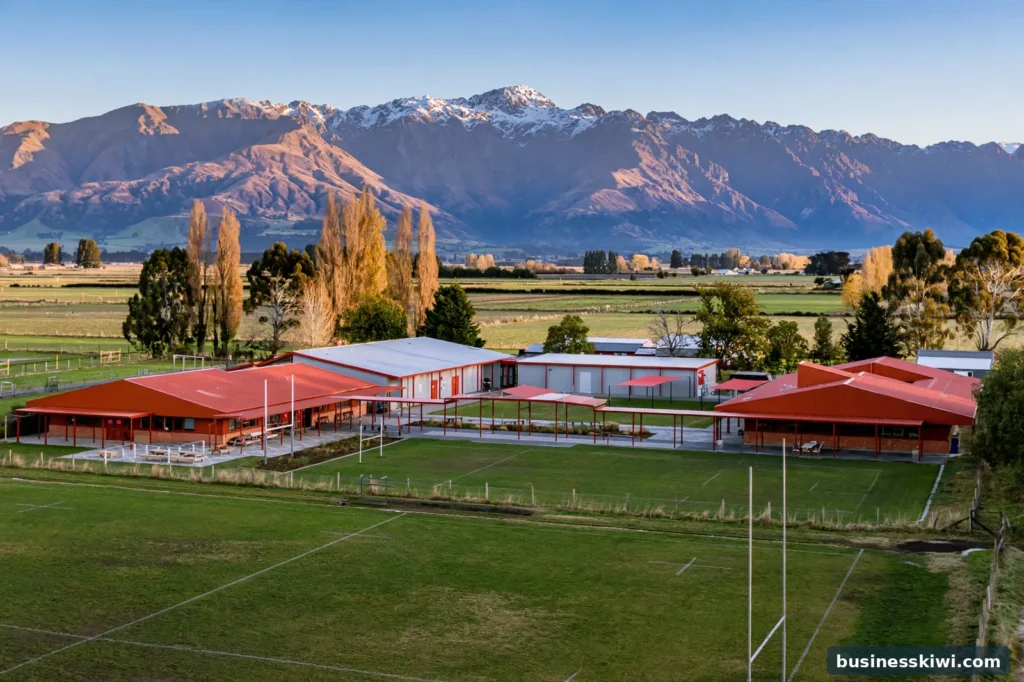
Area schools exist mainly in rural New Zealand, where a town is too small to support separate primary, intermediate and secondary schools. Oxford fits that pattern. The school describes itself as a cornerstone school in a growing community, and it holds the whole of a child’s compulsory schooling in one place, from the junior primary classes through to a senior school running to NCEA Level 3 and the end of Year 13.
For families, the practical effects cut both ways. Children keep the same teachers, friends and routines for years at a time, transitions that unsettle many students simply do not happen, and senior students are known to staff rather than new faces in a crowd of hundreds. The school leans into that structure: senior outdoor education students help run the junior outdoor programme, and older students are a visible presence in the younger school’s daily life.
The trade-off is scale. A senior school of this size cannot timetable the long subject lists of a big city secondary, and class groups at senior level are small. Some families read that as personal attention, and the school itself makes that pitch to international students, pointing to small senior classes and individual time with teachers. Others prefer a larger subject menu. Neither view is wrong, but it is the central judgement to make about any area school.
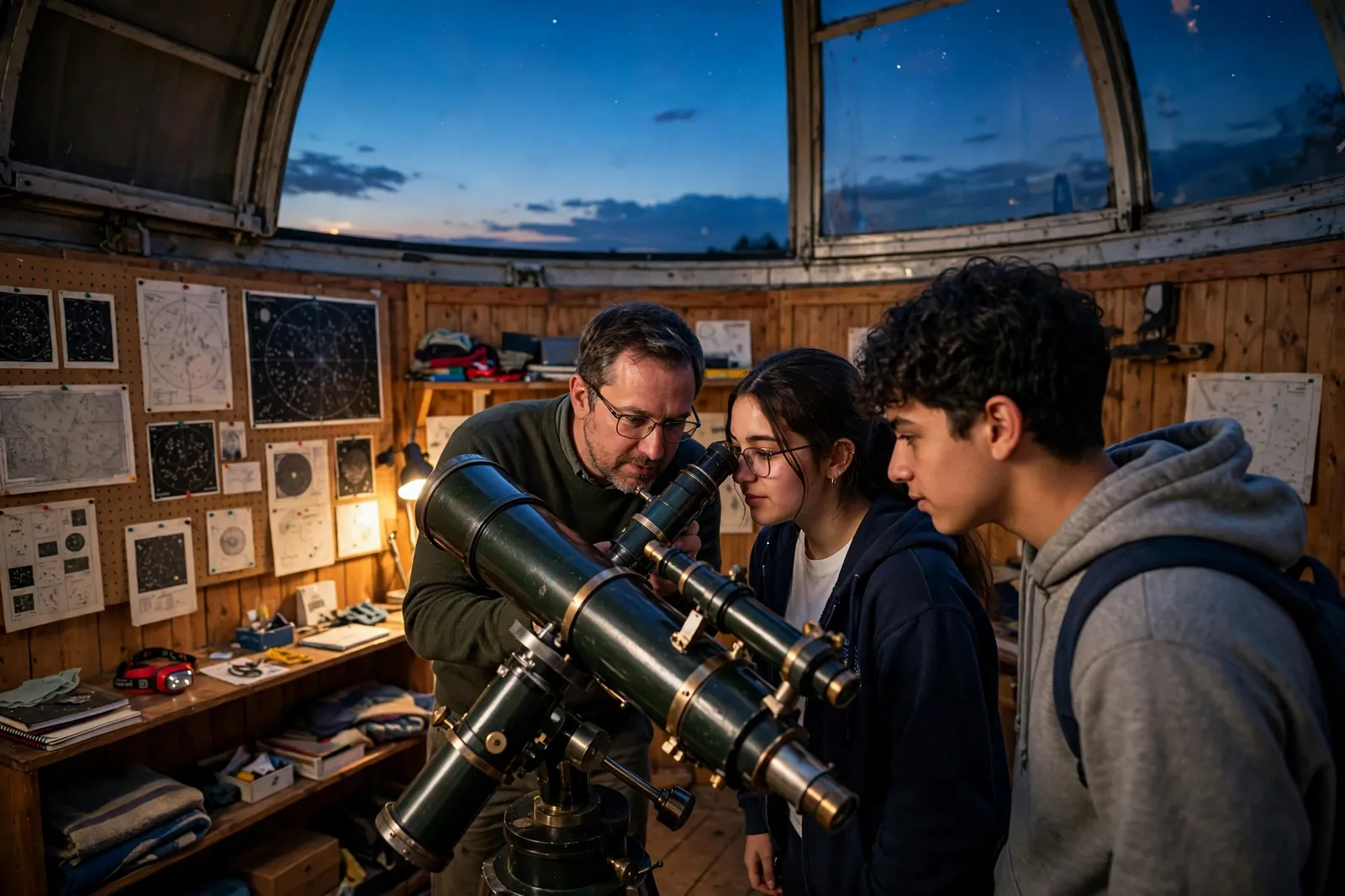
The site also holds a feature few schools anywhere can match: an observatory, which the school says supports the astronomy components of its science classes and gives students observation opportunities.
Roll and student community: what the official record does and does not say
Families often want two numbers first: how many students, and what the Equity Index (EQI) is. Here the honest answer is that the school’s Education Counts profile does not publish a current roll figure or an EQI figure, so no current official roll is stated in this article rather than guessed at from secondary sources.
What can be stated comes from the school’s own newsletter. In a Term 1 newsletter, the principal described a school community of 507 students across Years 1 to 13, including 10 international students, and noted that the roll had grown from 477 at the beginning of 2023. Treat that as the school’s own picture rather than a Ministry count: roughly 500 students, small by secondary standards and mid-sized as primary schools go.
The same newsletter describes a wide ethnic mix, listing Filipino, New Zealand European and Pākehā, Japanese, and Māori students among many others. Ministry leaver data gives a consistent picture from the other end of the school: of the 55 students who left in 2025, most identified as European or Pākehā, with nine Māori leavers (Ministry ethnicity data is multiple-response).
Geography matters to this school’s makeup. Students are drawn from both sides of the Waimakariri River, from Oxford itself and from farms and lifestyle blocks across the surrounding district.
Curriculum and learning
Oxford teaches the New Zealand Curriculum across all levels, and its own reporting shows where it has been putting effort. The school belongs to the Tipu Māia Kāhui Ako, its local community of learning, and its published 2024 analysis of variance (part of its audited annual report) sets out shared challenges in mathematics and writing, with a particular focus on Years 1 to 10. Junior and middle school classes use the Writers Toolbox programme and a structured spelling programme called CODE, alongside structured literacy work in Years 9 and 10.
The school’s own 2024 achievement reporting, covering students in Years 1 to 10, includes these results:
- Reading: 80 percent of Year 1 to 3 students were at or above the expected curriculum level. In Years 4 to 6 almost three-quarters were at or above, and 95 percent of that group made expected or accelerated progress during 2024. Years 7 and 8 sat just over three-quarters at or above.
- Writing: 96 percent of Year 1 to 3 students were at or above the expected level, with 61 percent of Years 7 and 8 at or above.
- Mathematics: in Years 4 to 6, 94 percent of students made expected or accelerated progress in 2024, and 52 percent made accelerated progress.
- The senior end of the middle school is the area the school itself flags for work. In Years 9 and 10, 43 percent were at or above the expected level in reading and 46 percent in writing. The school notes that many of its Year 9 students were new to the school that year, and that achievement lifts by Year 10: 52 percent at or above in reading and 58 percent in writing, against 34 and 35 percent in Year 9.
That kind of self-reporting is worth reading directly: it shows both the strengths and the gaps in the school’s own words rather than a marketing summary. The full document is published on the school’s website as part of its annual report.
Beyond the core subjects, three specialisms run through the school’s programme:
Outdoor education is the signature. The school describes a junior programme in which every student completes a water skills course, spends a week in a mountain environment with tramping, river rafting, ropes courses and confidence and teamwork activities, and has a snow experience with skiing or snowboarding. Senior students can specialise in outdoor education, travel around the South Island, and train to advanced levels.
Agriculture reflects the district. The school highlights its agriculture courses and events, including its Young Farmer contests, and the local agricultural and pastoral show held at the showgrounds next to the school each year, which whole families take part in.
The arts have dedicated space, including a purpose-designed dance and drama studio used for classes, productions and shows. Visual art options the school lists include photography, painting, design and visual communication, alongside kapa haka, music, and sports teams entered in local, regional and national competitions.
Senior students build their NCEA programmes with the help of their dean, choosing from the subjects the school offers.
NCEA results and how long students stay
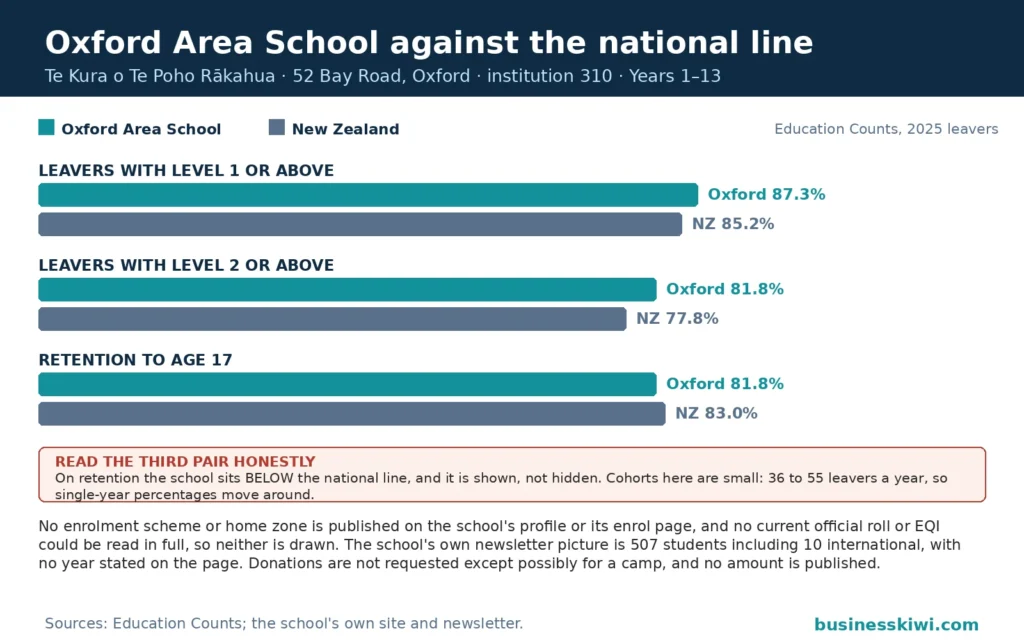
Education Counts publishes school leaver data drawn from the Ministry’s ENROL records and NZQA results. For Oxford Area School the cohorts are small, between 36 and 55 leavers a year across 2023 to 2025, so percentages move around more than they would at a large school.
NCEA Level 1 or above. In 2025, 87.3 percent of the school’s leavers (48 of 55) left with NCEA Level 1 or above. The figure was 97.2 percent in 2023 (35 of 36 leavers) and 90.5 percent in 2024 (38 of 42). For context, the 2025 national figure was 85.2 percent and Canterbury’s was 87.1 percent. Within the 2025 group, 88.9 percent of Māori leavers and 87.5 percent of European and Pākehā leavers achieved Level 1 or above, with female leavers at 85.2 percent and male leavers at 89.3 percent.
NCEA Level 2 or above. Level 2 is the benchmark most often used for readiness for work and further training. Oxford’s leavers achieved it at 81.8 percent in 2025 (45 of 55), following 80.6 percent in 2023 and 81.0 percent in 2024. That stability across three years is the more useful signal, and it sits above the 2025 national figure of 77.8 percent.
Staying at school. Retention data tracks whether leavers stayed until at least their seventeenth birthday. For Oxford that was 81.8 percent in 2025 (45 of 55 leavers), up from 72.2 percent in 2023 and just below the 2025 national figure of 83.0 percent. The 2024 figure was 88.1 percent.
At the other end of the school, Ministry data on new entrants shows that 96.4 percent of the children who started at Oxford in 2025 had attended early childhood education beforehand, in line with the national participation rate.
Enrolment: no published zone, and how to apply
Oxford Area School does not operate a published enrolment scheme on the evidence of its official pages. Neither its Education Counts profile nor its own enrolment page lists a home zone, an out-of-zone ballot process, or zone streets, and this article states that position rather than describing a zone that is not published. In practical terms, enrolment is handled directly with the school, and families moving into the district apply through the school office. If a scheme is adopted in future it would be published by the school and the Ministry, so check the enrolment page for the current position.
The school sets out its enrolment process in four broad steps: look through the information on its website, complete the online enrolment application form, provide supporting documents (including your child’s birth certificate and proof of address), and the school then confirms the enrolment and the starting arrangements.
New families are encouraged to contact the main office on 03 312 4197 to arrange a meeting with a member of the senior team or a dean, plus a tour of the school, before or alongside the paperwork.
Starting school at five: cohort entry
Oxford operates cohort entry for new entrants, which the Education Counts profile confirms. Instead of starting on or just after their fifth birthday, children start in groups at set intake points through each term. The school’s published 2026 dates provide three intakes a term: Term 1 on 29 January, 9 March and 2 April; Term 2 on 20 April, 2 June and 3 July; Term 3 on 20 July, 24 August and 25 September; and Term 4 on 12 October, 16 November and 11 December. The office confirms which intake your child joins when you enrol.
International students
The school also enrols a small number of international students and is a signatory to the Code of Practice for the pastoral care of international students. International students live in homestays in the village within walking distance of the school, or on lifestyle blocks and working farms along the school bus routes. International fees are published in the school’s own fee schedules; the 2027 short-term schedule is covered in the costs section below.
Term dates
The school’s published 2026 dates, taken from its official cohort entry calendar for the year, run as follows: Term 1 from 29 January to 2 April, Term 2 from 20 April to 3 July, Term 3 from 20 July to 25 September, and Term 4 from 12 October to 11 December. Teacher-only days and any local adjustments are announced through the school’s newsletters and calendar, so confirm the details for the year you need directly with the school.
What it costs
Oxford is a state school, so there is no tuition fee for domestic students. The main costs are the usual ones: uniform, stationery, a device for older students, and charges attached to particular subjects, trips and activities.
Donations. The school’s Education Counts profile records that donations should not be requested, except possibly for a school camp. That is the wording the Ministry uses for schools in its donations scheme, which means the school does not ask parents for a general annual donation, although a donation towards camp costs may still be requested. The school does not publish a donation amount, and none is quoted here.
Uniform. Uniform is compulsory for Years 1 to 12 and is gender-neutral, with all items able to be worn at any time of year. The core look is navy and red: a navy and red polo with the school logo, navy shorts, culottes, a skort or trousers, and a navy sweatshirt or polar fleece for younger students; Years 7 to 12 add options such as a blue fleck blouse or shirt and a navy and white pullover, with plain black shoes. Year 13 students do not wear the uniform and instead wear tidy, appropriate clothing that fits the school’s values. Years 1 to 6 uniform is sold through the Uniform Bay at The Warehouse in Rangiora, and Years 7 to 12 uniform through Mainland Uniforms on Wairakei Road in Christchurch or its online store. The school does not publish uniform prices on its own pages, so check the suppliers for current amounts. As a rough guide to scale, the school’s international fee information allows $50 to $500 for a uniform bought new or second-hand. Families with cultural reasons for an exception to the uniform rules can raise it with a deputy principal, and requests are considered case by case.
Stationery and devices. Stationery lists are supplied through Schoolpacks by Qizzle, the school’s chosen provider, and ordered online for each year level. Students in Years 9 to 13 work under a bring-your-own-device arrangement. The school’s guidance is that the device needs a physical keyboard, a screen comfortable to use for extended periods, enough battery for a full day of up to five hours of classes, access to the Google suite, and be easy to carry.
Subject and activity costs. Some subjects charge for materials, with hospitality and photography named in the school’s fee information. School trips vary in cost, and some sports and extracurricular activities carry a small fee.
International fees. Families enrolling an international student pay set fees, published in the school’s own schedules. Under the school’s 2027 short-term schedule, tuition is $560 net per week for stays under ten weeks, homestay is $360 per week, the administration fee is $550, and a suggested incidentals fund of $250 (one to five weeks) or $500 (five to ten weeks) covers additional costs, with any balance refunded at the end of the stay. International students must hold medical and travel insurance, which the school can arrange or an agent can. Long-term fees are published in a separate schedule on the school’s website.
Buses and getting to school
Because the school draws from a wide rural catchment, buses are a major part of its day. The school’s newsletter describes five school buses carrying 226 students daily, which is close to half the school community arriving and leaving by bus. Students travel from both sides of the Waimakariri River as well as from Oxford itself.
The school does not publish a route-by-route timetable on the pages used for this article, and bus arrangements in rural districts are usually handled through the school office and the local bus network, so new families should confirm their route, pick-up point and timing with the office when they enrol. If you are house-hunting with this school in mind, ask about bus routes early: the school’s own international programme highlights route access because its farm and lifestyle-block homestays sit on school bus routes.
ERO reviews and the school’s own reporting
The Education Review Office (ERO) is the government agency that reviews every state school on a cycle and publishes its findings. This article does not summarise an ERO report for Oxford Area School because no current ERO report for the school was read in full during its preparation, and ERO findings are never paraphrased second-hand here. The school’s Education Counts profile carries a link to its ERO report, which can be read in full via that link.
Alongside ERO, the school’s board publishes an audited annual report each year, including the analysis of variance drawn on above, which reports the school’s own achievement data and what it is working on next. Between the Education Counts data, the annual report and the ERO report, families have three official windows into how the school is performing.
Is Oxford Area School right for your family?
The case for the school is continuity and fit with its place. A child can start and finish in one community, the outdoor education and agriculture programmes use the foothills, rivers and farmland on the doorstep, and the published leaver data shows NCEA Level 2 attainment holding above the national figure across 2023 to 2025, with retention recovering to close to the national level.
The questions to test on a visit are the ones the data cannot answer for you. Ask how the senior subject lines are built and which subjects run in a given year, since small cohorts mean not every subject runs every year. Ask about the Year 9 and 10 achievement picture and what the school is doing about it, since its own reporting is candid that this is the area of focus. Ask about bus routes from your place. And if your child is starting school, ask how cohort entry will work for their birthday. The school invites this kind of visit: contact the office, meet a senior leader or dean, and tour the site before you decide.
Frequently asked questions
What year levels does Oxford Area School teach?
Oxford Area School teaches Years 1 to 13 on one site at 52 Bay Road, Oxford. The Ministry of Education’s Education Counts directory classifies it as a composite school (Year 1–15) with institution number 310. It is a state, co-educational school with no boarding facilities.
Does Oxford Area School have an enrolment zone?
No enrolment scheme or home zone is published for the school on its Education Counts profile or its own enrolment page. Enrolment is arranged directly with the school office. Schemes can be introduced over time, so check the school’s enrolment page for the current position.
How many students go to Oxford Area School?
The Education Counts profile does not publish a current roll figure for the school, so no official roll is stated here. In its own Term 1 newsletter, the school described a community of 507 students in Years 1 to 13, including 10 international students, up from 477 at the beginning of 2023.
How do I enrol my child at Oxford Area School?
Start with the information and online enrolment form on the school’s website. You will need supporting documents, including your child’s birth certificate and proof of address, and the school then confirms the enrolment. New families can also contact the main office on 03 312 4197 to arrange a meeting with a senior team member or dean and a tour of the school.
When does a new entrant start at Oxford Area School?
The school uses cohort entry, so five-year-olds start in groups at set dates rather than on their fifth birthday. Its published 2026 dates provide three intakes per term, at the start of term, mid-term and the end of term. The office will confirm your child’s intake date when you enrol.
What does it cost to send a child to Oxford Area School?
There is no tuition fee for domestic students at this state school, and the school’s Education Counts profile records that donations are not requested other than possibly for a school camp. The costs families do meet are uniform (Years 1 to 12; Year 13 students wear tidy mufti), stationery ordered through Schoolpacks, a device for Years 9 to 13 under the school’s BYOD arrangement, and any subject, trip or activity charges. The school does not publish uniform or stationery prices on its own pages, so check the named suppliers for current amounts.
What were Oxford Area School’s NCEA results in 2025?
In 2025, 87.3 percent of the school’s leavers (48 of 55) left with NCEA Level 1 or above, and 81.8 percent (45 of 55) left with NCEA Level 2 or above, above the national Level 2 figure of 77.8 percent. In the same year 81.8 percent of leavers had stayed at school until at least their seventeenth birthday. Cohorts are small, so single-year percentages should be read alongside the 2023 and 2024 figures published by Education Counts.
Does Oxford Area School run school buses?
Yes. The school’s newsletter describes five school buses carrying 226 students each day, serving a catchment that spans both sides of the Waimakariri River. Routes and pick-up points are confirmed through the school office when you enrol.
This article is general information about Oxford Area School based on official sources published by the Ministry of Education and the school, checked in October 2026. It is not affiliated with the school. Enrolment arrangements, dates, costs and programmes can change, so confirm current details with the school office or on the school’s website before making decisions.
Sources
- Ministry of Education, Education Counts, Oxford Area School: Profile and Contact Details, educationcounts.govt.nz
- Ministry of Education, Education Counts, Oxford Area School: NCEA Level 1, educationcounts.govt.nz
- Ministry of Education, Education Counts, Oxford Area School: NCEA Level 2, educationcounts.govt.nz
- Ministry of Education, Education Counts, Oxford Area School: Retention, educationcounts.govt.nz
- Ministry of Education, Education Counts, Oxford Area School: Early Childhood Education, educationcounts.govt.nz
- Oxford Area School, Homepage (Te Kura o Te Poho Rakahua), oxford.school.nz
- Oxford Area School, Enrol, oxford.school.nz
- Oxford Area School, International Programme, oxford.school.nz
- Oxford Area School, Term 1 Newsletter (Week 3), hail.to
- Oxford Area School, 2026 Cohort Entry Dates, oxford.school.nz
- Oxford Area School, International Student Fee Schedule 2027 (Short Term), oxford.school.nz
- Oxford Area School, Years 1–13 School Uniform, assets.hail-cdn.com
- Oxford Area School, Annual Report 2024: Analysis of Variance, oxford.school.nz