Back to School Stationery NZ: What You Need, What It Costs and How Lists Work

Every summer, usually just as the previous school year is winding down, a stationery list lands in the inbox or the school app. It is a page or two of exercise books with cryptic codes, pens, rulers, glue sticks and, for older students, a scientific calculator and possibly a device. For first-time parents it can look oddly specific. For families with three or four children at school, it can look expensive.
The good news is that the system is more flexible than the list suggests. You do not have to buy from the school or from the supplier named on the list. You do not have to buy everything brand new. And while stationery is one of the school costs parents genuinely are expected to meet, a surprising amount of what appears on school invoices, including textbooks, compulsory workbooks and curriculum materials, is not something a state school can charge you for at all.
This guide explains how stationery lists work in New Zealand, what tends to be on them at each stage of schooling, what the verified prices look like, and where the legal lines sit under the Ministry of Education rules. It is written for parents of school-age children, and it is also useful for school leavers setting up for their final years, when lists get shorter but the calculator and device decisions get bigger.
How stationery lists work
There is no single national stationery list. Each school, and often each class or syndicate within a school, sets its own requirements based on how its teachers run their programme. That is why two neighbouring primary schools can ask for quite different things, and why the list changes as your child moves up.
Most schools publish their lists by year level. A primary list might be split into new entrants, junior, middle and senior classes. An intermediate list usually covers Years 7 and 8 together. A secondary list is organised by subject rather than by class, because a Year 9 student takes eight or more subjects and each teacher wants a particular book or file for their subject.
Many schools partner with a stationery supplier to make ordering simpler. The two arrangements you will see most often are:
- Pre-packed boxes or packs. The school loads its lists with a supplier, and parents order the whole pack for their child’s year level or class. OfficeMax runs this through its MySchool service, where you search for your school and class and the full list of requirements is loaded ready to buy. Qizzle runs a similar service through Schoolpacks, where packs are customised to each class or year level and you simply select your school and year level. Some schools skip the supplier and assemble packs themselves using bulk buying, then sell them through the school office.
- Buy it yourself. Every school list can also be treated as a shopping list. You can buy the items from any retailer, use suitable items you already have at home, or mix the two approaches, ordering the exercise books in a pack and picking up pens and pencils wherever they are cheapest.
Schools are upfront about this more often than parents realise. One Christchurch primary school’s 2026 stationery document gives families three options in writing: order the pack online through the supplier, come into the office and use the school’s community computer to order with help, or purchase the requirements elsewhere. A Waihi secondary school tells students the opposite default, encouraging them to buy locally from named town shops. Either way, the list belongs to you, not to the supplier printed at the top of it.
Timing matters a little. Schools expect children to arrive on the first day with their stationery ready to use, and lists are written with that in mind. Ordering a pack in January is painless. Hunting for a specific exercise book in the first week of February, when back to school ranges have been picked over, is not.
What is actually on the list, stage by stage
The codes are the first hurdle. New Zealand exercise books are sold under standard codes that describe the ruling and size: 1A5, 1B5, 1E5, 1F4 and so on. The letter roughly indicates the ruling style, and teachers specify codes because a maths book with quad ruling is not interchangeable with a lined writing book. Suppliers know the codes well. OfficeMax MySchool publishes an exercise book conversion chart for parents who find a code out of stock and need the closest equivalent.
Beyond the codes, the shape of a list changes as children get older.
Junior primary (Years 0 to 3)
Junior lists are short and dominated by exercise books. A typical new entrant list asks for a handful of books across the year, a few HB pencils, and a book bag to carry reading books home. One published new entrant list, for example, specifies six exercise books in three different codes, four HB pencils, a library book bag and a separate reading or homework bag. Pencils, crayons and glue are often shared classroom supplies at this age, provided from a class set rather than bought individually, although this varies by school.
The Pareawa Banks Ave School list for its Kiwakiwa class in Christchurch shows how book-focused junior lists can be: the whole pack is ten exercise books and topic books, nothing else. Those books are the writing programme for the year, which is why teachers care about getting the right codes.
Senior primary (Years 4 to 6)
By the middle years the list grows pens and personal gear. Children usually graduate from pencils to pens once they earn a pen licence, add a ruler, scissors, felt pens or coloured pencils, a handwriting or topic book per subject area, and often a set of headphones for classroom devices. Homework books and book bags continue. This is also the stage where some schools introduce a bring your own device programme, covered in more detail below.
Intermediate (Years 7 and 8)
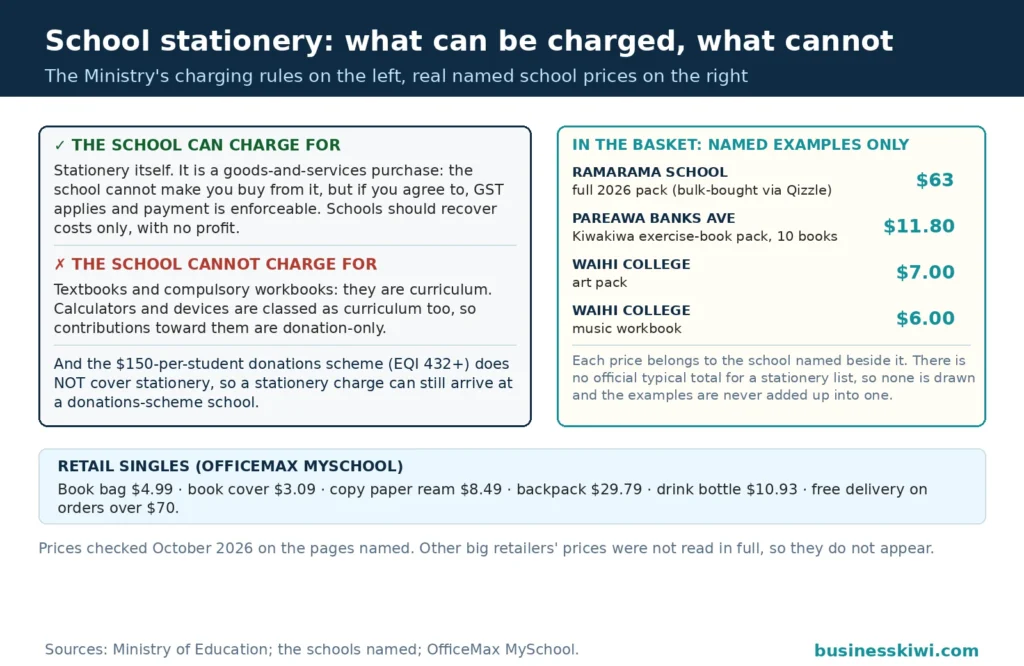
Intermediate lists look like a bridge between primary and secondary. There is still one main list rather than subject lists, but it adds a scientific calculator at many schools, more exercise books per student, a document wallet or clear files for the many loose sheets intermediate classes generate, and subject-specific extras for technology, food technology and languages. Some intermediates sell a single pack through the school. Ramarama School in Drury, for example, buys in bulk through Qizzle and sells one stationery pack for all students, priced at $63 for 2026, delivered to classrooms at the start of the year.
Secondary (Years 9 to 13)
Secondary lists are organised by subject, and the total page count can look alarming until you realise each student only buys for the subjects they actually take. Waihi College’s 2026 Year 9 list is a fair example. Most subjects start from a shared pencil case: blue or black pens, a red pen, pencils, eraser, sharpener, a 15cm ruler and highlighters. On top of that, each core subject adds a book or two. English wants pens and headphones. Mathematics wants two 1E8 maths books, a scientific calculator (described as essential), a 30cm ruler and HB pencils. Science wants a hard cover book. Option subjects add small extras, and a few items are sold only by the college itself: an art pack at $7.00 and a music workbook at $6.00.
Two patterns hold across secondary lists generally. First, the scientific calculator is the single most expensive standard item, and it is a once-in-several-years purchase, not an annual one. Second, senior lists shrink. By Years 12 and 13 many students work from refill pads and a laptop, and buy books per subject rather than a full list.
What it costs
Prices checked in October 2026 show how wide the spread is, depending on whether you are buying a school’s bulk pack, a supplier pack, or individual items.
A few honest observations from those figures. The exercise books themselves are cheap. Ten books for $11.80 means the paper your child writes on all year can cost less than the backpack it travels in. The money in a secondary list sits in the calculator, the device if your school runs one, and the accumulation of small extras across eight subjects. And a school that bulk-buys and sells one pack, like Ramarama at $63 for everything, is very hard to beat by shopping item by item, which is exactly why schools do it.
Delivery is worth factoring in if you order a pack online. OfficeMax MySchool offers free delivery on orders over $70, which a multi-child order clears easily and a single junior pack may not.
The rules: what schools can and cannot charge for
Stationery sits in a specific legal category, and understanding it clears up most arguments at the school office.
Education at a state school is free. Under the Education and Training Act 2020, state schools cannot charge domestic students a fee for enrolment, attendance, or delivery of the curriculum. The Ministry of Education’s guidance for parents lists what families should still expect to pay for: school uniforms, stationery, trips outside school hours, and extra-curricular activities such as sports.
Stationery is treated as a good or service, not as curriculum. That has three practical consequences:
- You choose where to buy it. A school can sell stationery, and many do, but it cannot compel you to buy from the school or from its partner supplier. The Ministry’s circular on payments by parents is explicit that schools cannot compel parents to buy items from the school.
- If you agree to buy from the school, you have to pay. A voluntary purchase becomes an ordinary debt once agreed. The school can charge GST on it and enforce payment, and unlike a donation, no tax credit applies to it.
- The school should not profit from it. Ministry guidance to schools notes that schools are not expected to make a profit from school stationery; they should recover only their costs.
Just as important is what sits on the other side of the line. Textbooks are curriculum, and schools cannot charge for them. Compulsory workbooks are curriculum too, and cannot be charged for. A workbook can only be charged for when it is genuinely optional and you have agreed to buy it. Course materials used in teaching, such as ingredients cooked in a food technology class, are curriculum and cannot be charged for, although if your child makes something to take home, like a letterbox in hard materials, the school can ask you to pay for that item if it told you the cost beforehand and you agreed.
So if a stationery invoice includes a compulsory workbook or textbook charge, that is worth a polite query. If it includes exercise books, pens and a calculator your child will own and use, that is the goods and services category working as intended.
The donations scheme, and why it does not cover stationery
Many parents assume the government donations scheme means schools cannot ask for money at all. It does not mean that, and stationery is the most common exception families meet.
Under the scheme, schools with an Equity Index of 432 or higher can opt in each year. In return for government funding of $150 per student per year, an opted-in school agrees not to ask parents for donations for anything connected with the curriculum, with one exception: overnight school camps. Schools outside the scheme can still ask for donations, but a donation is always voluntary. You can pay it in full, in part, or not at all, and the school cannot call it a fee, charge interest on it, or withhold reports, privileges or a place in a curriculum activity because it was not paid. Genuine donations to a school do qualify for a donations tax credit through Inland Revenue, and there is a four-year limit on claiming.
None of that touches stationery. The donations scheme covers donations, not purchases. Uniforms and stationery remain a cost to parents even at opted-in schools, as schools themselves spell out in their scheme information. If you buy a stationery pack from an opted-in school, you pay for it, because you agreed to buy goods, not because you were asked for a donation.
State-integrated schools are a separate case: their attendance dues are compulsory and enforceable, and private schools set their own fees. Neither changes the stationery rules above.
Devices, calculators and BYOD
The biggest back to school ticket item is often not on the stationery list at all. Many schools from the middle primary years up run bring your own device (BYOD) programmes. Ramarama School encourages students from Year 4 up to bring a device and says a Chromebook works best with its systems, with families signing a BYOD agreement and digital citizenship forms. Waihi College tells Year 9 families that for most students the most economical device is a Chromebook, while senior students in specialised courses may choose something more capable.
Here is the part most school device letters do not mention. In the Ministry of Education’s charging table, calculators and devices are classed as curriculum items. A school cannot require students to provide a calculator, and contributions towards devices such as tablets, laptops and Chromebooks fall in the donations category: a school that is not in the donations scheme may ask, but payment is voluntary, and a school in the scheme cannot ask at all. Schools get around the practical problem by strongly recommending a device and by providing school-owned devices for students who do not have their own, and in practice most families do supply one because classwork is designed around it. But if a device is genuinely out of reach, you are entitled to ask the school what it provides for students without one, and you cannot be charged a fee for access to the school network or use of school hardware as a curriculum cost.
The calculator sits in the same category, with a practical twist: schools list a scientific calculator as essential because students need one in their hands during maths and science, and almost every family buys one. It is also a genuine multi-year purchase. Buy the model the school names, usually a Casio fx-82 series or similar, once in Year 9, and it will typically serve through to Year 13.

Ways to keep the cost down
- Buy only what the list actually requires. Lists often mix required items with recommended ones, and supplier sites separate these out. On OfficeMax MySchool, school lists distinguish the items you must get from a “buy now or bring from home” list. Anything already in the pencil case at home comes off the bill.
- Reuse across years and siblings. Rulers, scissors, calculators, book bags, pencil cases and half-used exercise books carry over. The single biggest saving in a household is a calculator bought once and handed down twice.
- Compare the school pack price before shopping around. A school that bulk-buys can undercut retail, as the $63 all-in pack at Ramarama School shows. Equally, some supplier packs price in convenience, so a quick item-by-item comparison on the big-ticket lines is worth ten minutes.
- Watch the extras, not the books. Exercise books cost around a dollar each. The spending creeps in through branded extras added at the online checkout: premium pencil cases, covers for every book, a new backpack and drink bottle every year whether the old ones survive or not.
- Name everything. Schools ask for items to be named for a reason. A named calculator, jacket and lunchbox come home. An unnamed one funds the lost property bin and a replacement purchase.
- Cover books selectively. Some schools ask for books to be covered; others, like Ramarama, say covering is a personal choice. Covers at $3.09 each across ten books add up, so check whether your school actually requires them before adding a set to the cart.
- Buy the calculator once, and buy it right. Choose the exact model family the school specifies, keep the cover, and write the name on the case. Replacing a lost scientific calculator twice in a year costs more than most of the rest of the list combined.
If money is tight
Stationery is a real cost landing in the same month as uniforms, and schools know it. If the list is a stretch, talk to the school office early. Schools can often supply a pack and let you pay it off, point you to the cheapest channel they have negotiated, or quietly provide what a child needs so they start the year equipped like everyone else.
The Ministry of Education also points parents to Work and Income, which can help with some school costs, including its school and year start-up payment for families receiving certain support. And if a payment request from a school does not look right, if a voluntary donation is described as a fee, or a curriculum item appears as a charge, the Ministry’s advice is to raise it with the school first, then the school board, and then your regional Ministry office if it is still unresolved.
Frequently asked questions
Do I have to buy stationery from the school or its chosen supplier?
No. Stationery is classed as a good or service, and the Ministry of Education is clear that a school cannot compel you to buy items from the school. You can order the school’s pack, buy the same items from any shop, or use suitable items from home. If you do agree to buy from the school, that purchase is binding and the school can enforce payment.
What do the codes on the list, like 1B5 and 1A5, mean?
They are standard New Zealand exercise book codes describing the book’s size and ruling. Teachers specify them because different subjects need different rulings: quad-ruled books for maths, lined books for writing, larger unruled or topic books for junior classes. Match the code on your list when you buy, and if a code is out of stock, ask the supplier for the equivalent, as OfficeMax MySchool publishes an exercise book conversion chart for exactly that situation.
Can a school charge me for textbooks or workbooks?
Not for textbooks, and not for compulsory workbooks. Both are classed as curriculum, which state schools must provide free. A school can only charge for a workbook that is genuinely optional and that you have agreed to purchase. If a compulsory workbook appears as a charge on an invoice, query it with the school.
What does a full stationery pack cost?
It depends on the stage and the channel. As a guide from prices checked in October 2026, one full primary pack sold by Ramarama School after bulk buying cost $63 for 2026, while the exercise books alone for one Christchurch primary class came to $11.80. Secondary lists cost more in total because they span many subjects, and the calculator and any device sit on top. Treat any single figure with care: your child’s actual list is the only reliable quote.
Does the school donations scheme cover stationery?
No. The scheme replaces donations, not purchases. Schools that opt in receive $150 per student per year and stop asking for donations, except for overnight camps, but uniforms and stationery remain a parent cost at those schools too, because buying a pack is a purchase of goods, not a donation.
Can the school require my child to bring a laptop or Chromebook?
Schools can and do run BYOD programmes and strongly recommend a device, and many name a Chromebook as the most economical option. However, devices and calculators are classed as curriculum items in the Ministry of Education’s charging guidance, so a school cannot charge for them or treat a contribution towards one as compulsory. If your family cannot supply a device, ask the school what it provides, because students still have to be able to access the curriculum.
What happens if I cannot afford the stationery list?
Talk to the school office before term starts. Schools can usually arrange payment over time, steer you to their cheapest negotiated pack, or make sure your child has what they need. Work and Income can also help some families with school costs, including through its school and year start-up payment. What a school cannot do is leave a child unable to join in curriculum learning because a donation was not paid.
This article is general information about how school stationery lists, packs and charges work in New Zealand. It is not legal or financial advice. Stationery lists, pack prices and school arrangements change every year, so check your own school’s current list and talk to the school office about anything on an invoice you do not understand. Prices quoted were published by the schools and suppliers named and were checked in October 2026.
Sources
- Ministry of Education, School costs and donations, education.govt.nz
- Ministry of Education, Fees and charges at school, education.govt.nz
- Ministry of Education, What a school or kura can charge for, education.govt.nz
- Ministry of Education, The school donations scheme, education.govt.nz
- Ministry of Education, Education Circular 2021/03 (payments by parents), education.govt.nz
- Ministry of Education, What families and whānau need to know about school and kura donations, schoolwebsites.school.nz
- OfficeMax MySchool, Back to school supplies and stationery, myschool.co.nz
- Schoolpacks by Qizzle, Back to school stationery packs, schoolpacks.co.nz
- Ramarama School, Stationery, ramarama.school.nz
- Pareawa Banks Ave School, Stationery requirements 2026, assets.hail-cdn.com
- Waihi College, Stationery requirements for Year 9, 2026, waihicol.school.nz