NZ Investment Options: Comparing Term Deposits, Funds, Shares and Property

Ask a room of New Zealanders where their money is invested and you will hear the same handful of answers: a term deposit at the bank, KiwiSaver, a few shares bought through an app, maybe a rental property. None is automatically the right one. What separates a sensible choice from a poor one is rarely the product itself; it is how well the product matches the job the money has to do and how long it can stay invested, and how much of a fall in value you could sit through without panicking.
This article puts the main options available in New Zealand side by side and compares them on what actually differs: where the return comes from, the risk involved, fees, tax, access to your money, and effort. It stops short of recommending products. By the end you should have a framework for narrowing the field yourself.
First, three ideas that sit underneath every option
Before comparing products, it helps to understand three ideas that the Financial Markets Authority (FMA) and Sorted, the Commission for Financial Capability’s personal finance service, return to again and again.
The first is that return and risk travel together. Sorted puts it bluntly: the higher the return you chase, the more risk you must be prepared to accept, and higher-risk investments tend to be a rollercoaster in the short term even when they grow more over long periods. No option below offers high returns with no risk. If someone offers you exactly that, it is almost certainly a scam.
The second idea is liquidity: how quickly and cheaply you can turn an investment back into cash. A savings account is highly liquid; a rental house is not. Sorted notes that property takes time to sell and can be expensive to exit, while schemes such as KiwiSaver lock your money away for decades.
The third idea is diversification. Spreading money across different investment types, and across many companies, industries and countries, smooths out the ups and downs. Half your money in one share and half in one bond is balanced in proportion but not diversified at all, because everything rides on two names. Funds and exchange-traded funds exist largely to solve that problem cheaply.
The main options side by side
Each row is unpacked in the sections that follow.
Cash in the bank: savings accounts and term deposits
A savings account is the default parking spot for money, and Sorted describes savings accounts with New Zealand banks as one of the most common and least risky ways to hold money for the short term. Depositing money is effectively lending it to the bank, which pays interest for the use of it. The trade-off is plain: the rate is relatively low, so cash is a poor engine for long-term growth, and money left in it for decades can lose buying power to inflation even though the balance never falls.
A term deposit changes one term of that arrangement. You agree to leave the money with the bank for a fixed period, commonly six or twelve months, and in return the bank pays a higher rate than an ordinary savings account. The FMA describes cash investments as relatively safe because you are promised a fixed interest rate, while noting that interest-based returns tend to be low: a questionable sole strategy for retirement, decades away.
Practical points worth knowing:
- Early access usually costs you. Sorted notes that some term deposits cannot be broken during the term, and where breaking is allowed you generally receive a lower interest rate for the period invested.
- Rates move with wider interest rate settings, influenced by the Official Cash Rate set by the Reserve Bank of New Zealand. A rate advertised today says nothing about the rate offered when your term rolls over.
Bonds: lending to governments and companies
A bond is a loan you make to an issuer: the New Zealand Government, a council, a bank or a company. The issuer pays interest, called a coupon, at set intervals and promises to repay the bond’s face value at maturity. Sorted compares a bond to an IOU.
The FMA’s guidance highlights two features newcomers often miss. First, if you hold a bond to maturity and the issuer is still solvent, you generally get your face value back. Second, bonds can be sold early, but the price moves with the market: if general interest rates rise after you buy, your bond’s price tends to fall, and longer-dated bonds are hit harder. If the issuer gets into financial trouble, coupons and even your principal are at risk. Credit ratings are the shorthand for that risk: lower-rated borrowers must offer higher interest.
Government and corporate bonds trade on the NZX Debt Market (NZDX), and many investors hold bonds indirectly through managed funds and KiwiSaver funds. Buying bonds directly suits people who want predictable income and can assess an issuer’s strength. For everyone else, a bond fund does the same job with less homework.
Shares and exchange-traded funds
When you buy a share you buy a small slice of a company. If it prospers, you may receive part of its profit as a dividend, and the share price may rise, giving you a capital gain when you sell. Prices can and do fall, sometimes sharply. The FMA is blunt about the ranking: shares are riskier than bonds and cash, with no guaranteed return or capital gain, although they can deliver higher returns over the long term.
New Zealand shares trade on the NZX Main Board, mostly bought through an NZX participant broker or an online platform. Sorted notes that platforms have lowered the barriers to starting, so you no longer need a large lump sum. That convenience cuts both ways, though. Buying one or two companies because you like the brand is the opposite of diversification, and frequent trading racks up brokerage while exposing you to Sorted’s trap: jumping in and out and missing the few strong days that drive long-term returns.
Exchange-traded funds, or ETFs, bridge the gap between picking shares and buying a managed fund. An ETF holds a basket of assets, often everything in a market index, and trades on the exchange like a single share. The FMA describes ETFs as a simple and affordable way to invest in the sharemarket, as a lump sum or through a regular savings plan. One purchase spreads your money across dozens or hundreds of companies. The catch is that an ETF is only as calm as what it holds, so a sharemarket ETF falls when the sharemarket falls. Fees are usually lower than for actively managed funds, but brokerage may apply. Check whether the fund is taxed as a PIE, because that affects your after-tax return.
Managed funds
A managed fund pools money from many investors and buys a portfolio of shares, bonds, property, term deposits and cash. Sorted’s summary is that professional managers make the buying decisions, and that holding units in a fund spreads your savings so your eggs are not all in one basket.
Funds are labelled by their mix of assets, from defensive and conservative funds that lean on cash and bonds, through balanced funds, up to growth and aggressive funds dominated by shares and commercial property.
What you pay is a management fee, generally a percentage of your balance, plus in some cases performance or administration fees. The detail sits in the fund’s product disclosure statement, and Sorted stresses that fees deserve real attention. Before investing, check the fund’s risk indicator, asset mix and total fees.
KiwiSaver: a vehicle, not an asset class
KiwiSaver is not a type of investment in the way shares or bonds are. It is a wrapper: your contributions go into a managed fund investing in the same cash, bonds, shares and property described above. A conservative KiwiSaver fund and a growth KiwiSaver fund are entirely different animals, even though both carry the KiwiSaver name.
Two features define the vehicle. The first is restricted access: Sorted groups KiwiSaver with low-liquidity investments because money is generally locked up until you retire. In practice that means age 65 for most people, with limited exceptions such as a first home purchase or genuine financial hardship. Money you might need next year does not belong in KiwiSaver, whatever fund it sits in.
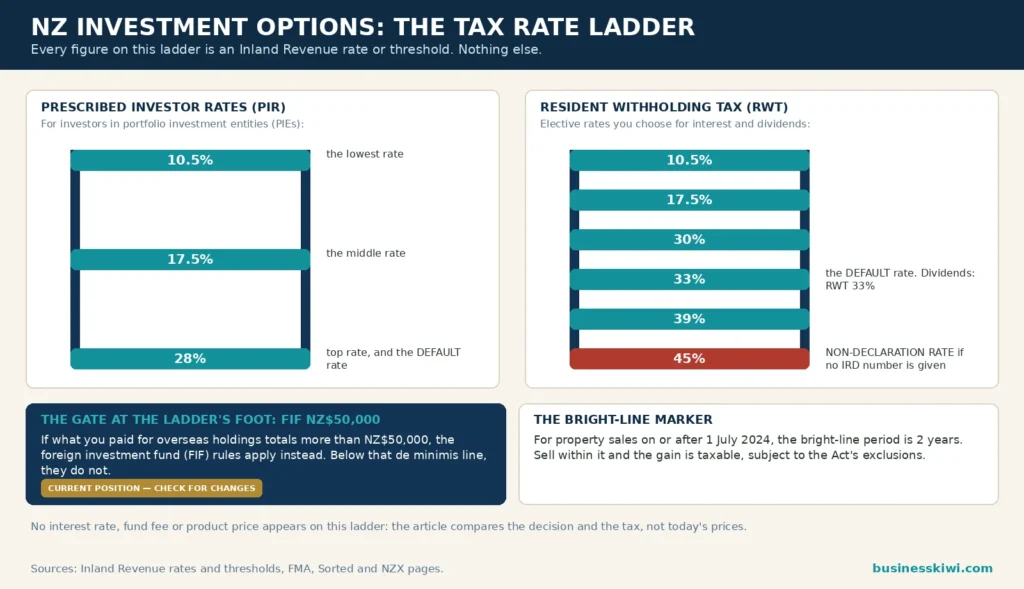
The second feature is tax efficiency, covered in the tax section below: most KiwiSaver schemes are PIEs, so earnings are taxed at your PIR of 10.5%, 17.5% or 28%. For someone on a 33% or 39% marginal rate, that cap is a real structural advantage.
This article does not compare KiwiSaver funds or providers. The point is narrower: if you are in KiwiSaver, you already own a managed fund, and further investing should take that existing mix into account rather than duplicating it by accident.
Residential property
Property is the investment New Zealanders talk about most. The FMA calls it one of the most popular types of investment in the country, and one of the biggest financial commitments most people make. Returns come from two sources, as Sorted explains: rent, and any increase in the property’s value over time.
Property’s strengths are tangibility and leverage. It is an asset you can see and touch, and a bank will lend you a large share of the purchase price, so your return is earned on an asset much bigger than your deposit. That leverage magnifies outcomes in both directions.
Set against that are some heavyweight drawbacks:
- Concentration. One property in one suburb is about as undiversified as an investment gets; a share investor can spread the same deposit across hundreds of companies and several countries.
- Illiquidity and exit costs. Sorted is direct: to get money out you sell the property or increase the mortgage, and selling brings valuation and agent fees. A sale can take months.
- Effort. Sorted notes that property usually involves more work than bank savings, shares or managed funds: finding properties, finding and managing tenants, arranging maintenance. A property manager will do that work for a percentage of the rent, another ongoing cost.
- Borrowing risk. Lenders can tighten terms, and interest rates can rise and squeeze the return. If the property is mortgaged with the same bank as your own home, Sorted warns the bank could in the worst case sell both if you fall behind on either loan.
None of that makes property a bad investment. It makes it a business-like one, with business-like demands on your time, cash reserves and risk tolerance. There are indirect routes too: Sorted points out that managed funds holding commercial property, directly or through listed property securities, offer exposure without hands-on management.
Peer-to-peer lending and other newer options
Peer-to-peer lending platforms match people who want to borrow with people willing to fund the loans. As an investor you are the lender, earning interest from borrowers you will never meet. The FMA’s summary is the one to remember: you may be offered a high interest rate, but that is because you are taking more risk. Borrowers can default, your money is committed for each loan’s term, and the platform itself could fail. Providers are licensed by the FMA in New Zealand, a minimum check, not a safety guarantee.
Two neighbours deserve a caution rather than a section. Equity crowdfunding means buying shares in start-up or growing businesses, and the FMA warns you could lose your entire investment, with no easy way to sell your stake. Cryptocurrencies are described by the FMA as high-risk, speculative products; its advice is to invest only what you can afford to lose. Neither suits money you cannot afford to see fall to zero.
The tax layer: same return, different outcome
Two investments can earn the same headline return and leave you with very different amounts after tax. New Zealand taxes investment income in several ways, and knowing which applies is part of comparing options honestly.
Interest and dividends: resident withholding tax. If you are a New Zealand tax resident, Inland Revenue states that resident withholding tax (RWT) is deducted from interest and dividends from New Zealand bank accounts and investments before you are paid. Individuals can elect an RWT rate of 10.5%, 17.5%, 30%, 33% or 39%, and the right one matches your total taxable income. Choose too low and you can expect an end-of-year tax bill. If you do not choose, tax is deducted at 33%, and if your payer does not have your IRD number at all, interest is taxed at a non-declaration rate of 45%. Dividends are paid with RWT deducted at 33%, although imputation credits from New Zealand companies, representing tax already paid, can offset that RWT.
Funds and KiwiSaver: PIE tax. Most managed funds and KiwiSaver schemes are portfolio investment entities, or PIEs. Instead of RWT, a PIE taxes your share of the fund’s income at your prescribed investor rate (PIR). Inland Revenue sets out three PIRs for resident individuals: 10.5%, 17.5% and 28%, based on your taxable income over the previous two years; if you do not provide one, the 28% default applies. The cap matters for higher earners: because PIE tax tops out at 28%, below the top personal income tax rates of 33% and 39%, holding investments inside a PIE can leave you better off after tax than holding similar assets directly. KiwiSaver withdrawals themselves are not taxed; the earnings inside the scheme are taxed along the way.
Capital gains: no general tax, but watch the intention test. New Zealand has no general capital gains tax, and gains on shares held as a long-term investment are generally not taxed. There are sharp edges, though. If you bought shares intending to resell them at a profit, the gain can be taxable as income; Inland Revenue’s guidance makes the same point for shares held on revenue account.
Overseas shares and funds: the FIF rules. If you invest directly in foreign companies or funds, the foreign investment fund (FIF) rules may apply. Inland Revenue provides a de minimis exemption: individuals whose attributing interests in FIFs cost less than NZ$50,000 in total do not need to calculate income under the FIF rules, and are taxed on dividends instead. Above that threshold, FIF income is calculated each year using an approved method, commonly the fair dividend rate method, whether or not you received any cash. An exemption also covers many ASX-listed Australian companies. The FIF rules are a common tax surprise for DIY investors on offshore platforms, so check the current rules if your overseas holdings approach NZ$50,000 in total cost.
Property: rent and the bright-line test. Rent from an investment property is ordinary taxable income, against which you can claim deductible expenses, subject to rules such as Inland Revenue’s interest limitation rules for residential rental property. On the sale side, the bright-line test taxes the profit when a residential property is sold within the bright-line period, unless an exclusion or rollover relief applies. For property sold on or after 1 July 2024, Inland Revenue states that the period is 2 years. A sale of your main home is generally excluded when the use criteria are met, and inherited property sits outside the test. Selling outside the period does not make a gain automatically tax-free: other property rules still apply if you bought intending to sell, or you have a pattern of buying and selling.
Risk, diversification and the scam filter
Risk is not a single thing. There is the risk that an investment’s value swings around, the risk that an issuer or borrower fails outright, the risk that inflation quietly outruns a cautious portfolio, and the risk that you need your money back at exactly the wrong moment. Each option carries a different blend, which is why comparing a single number misleads.
Diversification is the main tool for managing the blend. Sorted’s framing is useful: holding shares and bonds across many companies, industries and countries means some will do poorly while others do well, smoothing the ride. One rental property, one bank stock and a term deposit at the same bank are more concentrated than they look, because all three lean on the New Zealand economy.
Past performance deserves its own warning. Sorted is explicit that past results are not a reliable guide to the future, and that good investing is forward looking.
Then there is the risk that the investment is not an investment at all. The FMA sets out reality checks worth applying to any offer, especially one that arrives uninvited:
- High returns with low or no risk do not exist. The FMA’s position is that all investments carry risk and no returns are ever guaranteed; if someone tells you there is no risk, it is likely a scam.
- Legitimate offers come with written disclosure. Almost all legitimate investments offered in New Zealand must have a document such as a product disclosure statement. Little or no information in writing is a warning sign.
- Check the provider. Search the Financial Service Providers Register to confirm the business is registered in New Zealand, and check the FMA’s warnings and alerts list to see whether it has already been flagged.
- Unusual payment requests are a red flag: wire services, cryptocurrency, overseas accounts, or a New Zealand account in a different name from the company.
- Pressure is a tactic. Be suspicious of deadlines, secrecy and repeated contact, and talk the offer over with someone you trust before sending money. If you do not understand how it works, the FMA’s advice is simple: walk away.
Money sent offshore or into crypto assets is, in the FMA’s words, almost impossible to get back.

A decision framework: matching the option to the job
Work through these steps in order; each one rules options in or out.
Step 1. Name the goal and its date. A house deposit needed in eighteen months, a car in three years and retirement in thirty years are three different problems. Sorted’s buckets are a good starting grid: short term is roughly one to three years, medium term four to nine, long term ten or more.
Step 2. Match the timeframe to the risk you can take. Short timeframes cannot absorb a market fall, with no time to recover; that points to savings accounts, term deposits or defensive funds. Long timeframes can absorb falls, and usually need growth assets such as shares to outpace inflation. Medium timeframes sit between, where bonds and balanced funds earn their place.
Step 3. Test your risk capacity honestly. Capacity is not just temperament. It is whether a 20% fall in value would change your plans or your behaviour. If a fall would force or push you to sell, the investment is too risky for that goal regardless of its long-term record. Your KiwiSaver fund counts here: if it is already growth-heavy, adding more growth assets concentrates your position further.
Step 4. Decide how you will diversify. For most people this is where funds and ETFs win on practicality. Building a diversified portfolio of individual shares and bonds takes meaningful money, time and ongoing attention; a single diversified fund achieves the spread in one purchase.
Step 5. Count the full cost. Compare fund fees, brokerage on share and ETF trades, property management percentages, platform fees and tax drag. Costs are one of the few parts of investing you can know in advance, which is why Sorted pushes investors to weigh fees against likely returns. Fees erode compound interest year after year, so the longer the timeframe, the more a small fee difference matters.
Step 6. Invest regularly and review lightly. Contributing a fixed amount on a regular schedule, often called dollar-cost averaging, means you buy more when prices are low and less when they are high, and removes the temptation to time the market. Sorted describes the secret of compounding as time in the market, not timing the market. Review your mix once or twice a year and otherwise leave it alone.
Step 7. Know when to buy advice. If the sums are large, the tax position is complicated (FIF exposure is the classic example), or an inheritance or business sale is involved, personalised advice from a licensed financial adviser is money well spent. Check the adviser is licensed, and whether they advise on all products or only their own.
Frequently asked questions
What is the safest investment option in New Zealand?
Savings accounts and term deposits are generally regarded as the lowest-risk options, because the interest rate is fixed or known and capital is not exposed to market movements. Safe does not mean risk free, though: returns are low, and over long periods inflation can reduce what your money buys.
What is the difference between a managed fund and KiwiSaver?
KiwiSaver is a managed fund inside a retirement savings wrapper. The fund underneath invests in cash, bonds, shares and property. The differences are the wrapper’s rules: money is generally locked in until age 65, with limited exceptions such as a first home purchase, and earnings are taxed inside the scheme, usually at your PIR. An ordinary managed fund has no lock-in.
How much money do I need to start investing?
Less than most people expect. Sorted notes that online platforms have lowered the barriers to entry, so small regular amounts can now buy into funds and ETFs. Property is the exception: a deposit, legal costs and a maintenance buffer put the starting point in the tens of thousands of dollars. Start with whatever you can invest without touching your emergency savings.
Are my investments taxed in New Zealand?
Yes. Interest and dividends have resident withholding tax deducted before you are paid, at rates between 10.5% and 39%. Most managed funds and KiwiSaver schemes are PIEs, taxing earnings at your PIR of 10.5%, 17.5% or 28%. There is no general capital gains tax, but gains can be taxed if you bought intending to resell, overseas holdings can fall under the FIF rules past NZ$50,000 in total cost, and property sales within the bright-line period are taxed.
What is a PIE and why does the 28% cap matter?
A portfolio investment entity (PIE) is a fund that pays tax on behalf of its investors at each investor’s prescribed investor rate. Because the top PIR is 28%, while the top personal income tax rates are 33% and 39%, higher-income investors keep more of their return inside a PIE than holding the same assets directly at their marginal rate. KiwiSaver schemes and most New Zealand managed funds are PIEs.
Should I invest in property or shares?
They do different jobs. Shares, especially through funds and ETFs, offer diversification, daily liquidity and low effort, at the price of visible ups and downs in value. A rental property offers leverage and a tangible asset, but concentrates your money in one place, takes real work to run, and is slow and costly to sell. Your timeframe, risk capacity and tax position are a better basis for the decision than past price growth in either market.
What is peer-to-peer lending and is it safe?
Peer-to-peer platforms match borrowers with individual lenders, and you earn interest on the loans you fund. The FMA notes the rates can look high because the risk is higher: borrowers may default, your money is tied up for the loan term, and you rely on the platform to manage collections. It is licensed in New Zealand, but licensed does not mean safe, and it suits only a small slice of a diversified portfolio, if any.
How do I check whether an investment offer is a scam?
Apply the FMA’s reality checks. Look for a proper disclosure document, search for the provider on the Financial Service Providers Register, and check the FMA’s warnings and alerts list. Treat promises of high returns with little or no risk as a disqualifier. Be wary of unusual payment methods, offshore accounts and pressure to act quickly. If you cannot explain how it makes money, walk away.
Sources
- Financial Markets Authority, Types of investments: https://www.fma.govt.nz/consumer/investing/types-of-investments/
- Financial Markets Authority, Scam basics: https://www.fma.govt.nz/scams/scam-basics/
- Sorted, Types of investments: https://sorted.org.nz/guides/saving-and-investing/types-of-investments/
- Sorted, How to start investing: https://sorted.org.nz/a-z-guides/investing-basics
- Sorted, Property investment: https://sorted.org.nz/guides/saving-and-investing/investing-in-property/
- Inland Revenue, New Zealand resident individuals’ portfolio investment entity income: http://www.ird.govt.nz/income-tax/income-tax-for-individuals/types-of-individual-income/portfolio-investment-entity-income-for-individuals/nz-residents
- Inland Revenue, How your KiwiSaver income is taxed: http://www.ird.govt.nz/kiwisaver/kiwisaver-individuals/taxing-kiwisaver-income
- Inland Revenue, Using the right resident withholding tax (RWT) rate: http://www.ird.govt.nz/income-tax/withholding-taxes/resident-withholding-tax-rwt/using-the-right-rwt-tax-rate
- Inland Revenue, Foreign investment fund rules exemptions: http://www.ird.govt.nz/income-tax/income-tax-for-businesses-and-organisations/types-of-business-income/foreign-investment-funds-fifs/foreign-investment-fund-rules-exemptions
- Inland Revenue, The bright-line test: http://www.ird.govt.nz/property/buying-and-selling/when-you-need-to-pay/the-brightline-test
- NZX, Debt listing process and timetable (NZDX): https://www.nzx.com/services/listing-on-nzx-markets/debt/listing-process-timetable
This article is general information about investment options in New Zealand. It is not personalised financial advice and it does not take your own goals, timeframe or financial situation into account. Investment values can go down as well as up, past performance is not a reliable guide to future returns, and no return on any option described here is guaranteed. Tax rules and product terms change, so check the current position with Inland Revenue, the Financial Markets Authority or Sorted before acting, and consider advice from a licensed financial adviser for decisions involving significant sums.