Mortgage Broker or Bank: How Each Route to a New Zealand Home Loan Works

Every home loan starts with the same question, and it is not about interest rates. Before you can compare a single rate, you have to decide who you will deal with: the bank itself, or an intermediary who deals with banks for you.
In New Zealand both routes are well established. You can walk into a bank, or apply through its app, and be assessed against that one lender’s products and lending criteria. Or you can sit down with a mortgage adviser, often called a mortgage broker, who prepares one application and can put it in front of several lenders. Neither route changes the underlying reality that a lender still has to approve you, and the lender still carries legal duties about how it lends. What changes is who does the legwork, how much of the market you see, and how the person helping you gets paid.
The two routes at a glance
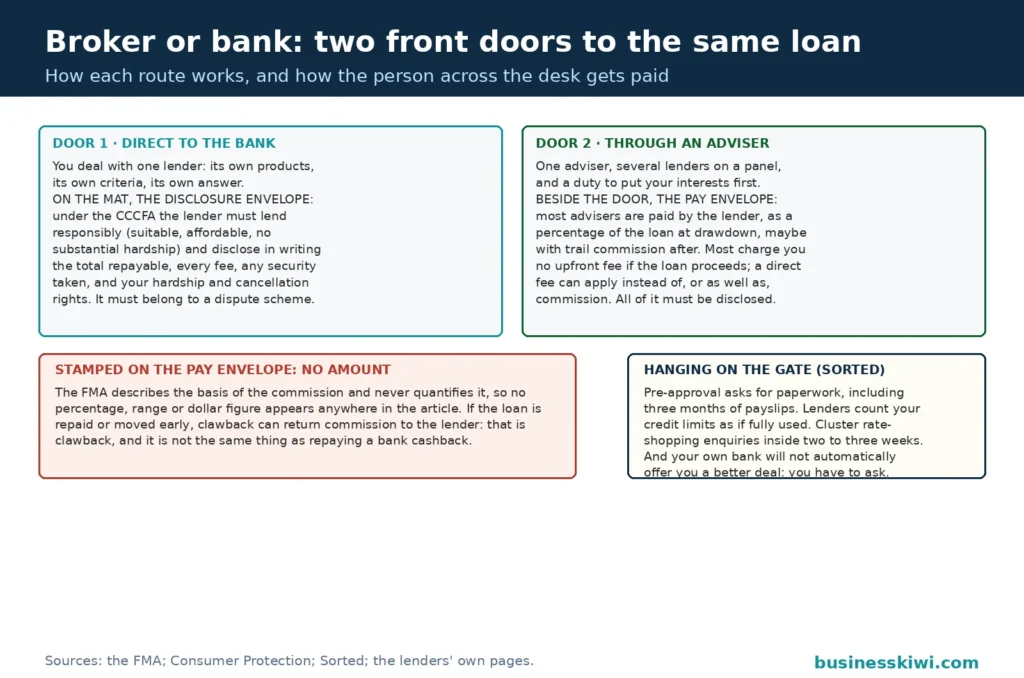
Going direct means you are the applicant and the bank is your only counterparty. You choose a bank, apply, and the bank assesses you against its own criteria. If it says no, that is the end of that application, and starting again somewhere else means starting the process again.
Using a mortgage adviser inserts a specialist between you and the lenders. The adviser takes your information once, advises you on loan structure and options, and submits your application to one or more lenders they work with. The Financial Markets Authority (FMA), which regulates financial advice in New Zealand, notes that advisers often provide advice from more than one lender, and that you are entitled to ask why a particular loan has been recommended to you.
One point is worth stating plainly at the start. A mortgage adviser does not lend you money and cannot approve your loan. The approval always sits with the lender, whichever route you take. The adviser route changes how your application is prepared, presented and compared. It does not change who makes the final credit decision.
Terminology matters a little here. “Mortgage broker” is the older, commonly used label. “Mortgage adviser” is the term the FMA and much of the industry now use, because the regulated activity is financial advice. In this article the two terms mean the same role.
Going direct: how applying through a bank works
The direct route is the one most people picture. You pick a bank, make contact, and work through its process.
Banks offer several ways in. ANZ, for example, lets existing customers apply through its mobile app, offers an online form for people new to the bank, and has mobile mortgage managers who will meet you at a time and place that suits. Westpac describes a similar pattern through its Home Loan Experts, who can meet face to face, come to you, or work over the phone, alongside applications through its digital banking for existing customers. The details differ between banks, but the shape is the same: an application channel, a conversation with a lending specialist, and an assessment.
That assessment is not a formality, and it is not optional. Under the Credit Contracts and Consumer Finance Act (CCCFA), lenders must follow responsible lending principles. Consumer Protection, the government consumer agency, explains that a lender has to check a loan is suitable for you and that you are likely to afford the repayments without substantial hardship. It must ask what the loan is for, make reasonable inquiries about your income and expenses, and help you understand what you are signing before you sign it. Those duties apply to the lender whether you arrive through the front door or through an adviser. An adviser can package your application well, but no one can package you around the affordability test.
What the bank can offer you is, by definition, its own shelf. Each bank has its own loan types, fixed and floating rates, and features such as offset or revolving credit facilities, and each attaches conditions to its headline pricing. ANZ’s home loan pages note, for instance, that its special interest rates can require a minimum level of equity and a transaction account with your salary credited to it. Rates and fees are subject to change, as every bank’s fine print will tell you.
The direct route does have one structural advantage that is easy to overlook: the ongoing relationship. Your loan, your everyday banking, your savings and your future applications sit in one place, and the bank’s own staff handle reviews, refixes and top-ups. Banks also run their own advice services. ANZ, for example, publishes a financial advice provider disclosure statement for its own advice service, and Westpac promotes free personalised advice from its home loan experts. A bank specialist knows their own products in depth. What they cannot do is recommend a competitor’s loan, even if it would suit you better. That is not a criticism of the individuals. It is the boundary of the role.
If you are declined by one bank, the direct route gives you no automatic second look. Lending criteria genuinely differ between banks, so a no from one is not a no from all, but discovering that for yourself means repeating the application process bank by bank.
Using a mortgage adviser: what they actually do
A mortgage adviser works on your application before any lender sees it. The practical work looks like this: they gather your financial information, work out what you can borrow, advise on how to structure the loan, prepare the application, submit it to a lender (or more than one), and handle the back-and-forth until approval and settlement.
The information required is much the same as a bank would ask for. Sorted, the personal finance service run by the Retirement Commission, describes the pre-approval stage of a home purchase and lists the documents a lender or mortgage broker will need: identification, proof of income, three months of payslips, and evidence of your deposit. Sorted also points out what lenders weigh up behind the scenes. They look at how much income you have left after commitments, they assess you as if your credit limits were fully used even when they are not, and they look at your credit history and how you have repaid other loans. A good application, to either route, is built around those realities.
Where an adviser earns their keep is in matching and structure. The FMA’s consumer guidance on mortgage advice suggests thinking before your first meeting about what matters to you: the lowest cost loan, the ability to make extra repayments, or a particular structure. An adviser can walk you through the options and features of different loans and explain the pros and cons of each, because not all banks and lenders are the same. If you are unhappy with an option, you can ask for an alternative. You do not have to take the first loan you are offered.
The relationship does not have to end at settlement. The FMA says an adviser should clarify how often they will be in touch to review your circumstances, and may check from time to time that the mortgage is still suitable for you, particularly when something in your life changes. Some advisers also talk about KiwiSaver or insurance, but they can only advise on those products if they have the necessary competence, and should tell you what their advice does and does not cover.
There is a limit worth knowing about. An adviser can only recommend lenders they actually work with. The FMA’s general guidance on getting advice makes a related point about commission-based advisers: because they are paid by product providers, you may be offered a limited choice of options. “More than one lender” is not the same as “every lender”. Asking which lenders an adviser works with, and which they do not, is a basic and reasonable question.

How mortgage advisers are paid: commission, fees and clawbacks
This is the part of the arrangement borrowers most often misunderstand, so it deserves a careful explanation based on what the regulator actually says.
The FMA states that most mortgage advisers work on commission. Typically, the lender pays the adviser when your loan is drawn down, for example when you settle on your house purchase. That payment is calculated as a percentage of the total loan amount. The adviser may also receive an ongoing periodic commission, sometimes called a trail commission, for as long as you hold the loan. The FMA does not publish a standard percentage, and there is no single industry rate that official guidance points to. Commission levels vary between lenders, which is precisely why the next sentence matters.
Because commissions vary, the FMA requires transparency rather than pretending the issue away. Advisers are obliged to disclose how they are paid, how much you will need to pay if anything, and the circumstances in which a fee arises. The FMA also acknowledges the tension directly: differing commissions could influence which loans an adviser recommends, and advisers must prioritise your interests over their own when advising you. The disclosure statement an adviser gives you is where the specifics for that adviser live. Read it before you proceed, not after.
What about paying the adviser yourself? Generally, the FMA says, most mortgage advisers do not charge you an upfront fee when you successfully get a mortgage, because the lender’s commission covers their pay. Sometimes, though, an adviser will charge a fee directly, instead of or as well as commission, and you should check this when you first meet. If there are situations in which a fee will be charged, the adviser must tell you upfront, as part of explaining the fees and commissions that could apply if you work with them.
The fee situation borrowers most often trip over is the clawback. Here is how the FMA describes it. If your loan ends, or is moved to another lender, within a certain period, the lender may recoup some or all of the commission it paid your adviser. In some cases the adviser may then charge you a fee to cover that clawed-back commission. The official guidance does not attach a fixed timeframe to this, so any specific period quoted to you comes from your own adviser’s disclosure, not from a universal rule. The FMA also draws a distinction that catches people out: a bank cashback repayment and a commission clawback are two different things. Cashback offers from banks often come with conditions tying you to the lender for a set period, and if you move early you may have to repay some or all of that cash incentive, potentially to the lender or the adviser. Cancel or move a loan early and, in the FMA’s words, you may face costs under both headings, not just one.
None of this makes commission a dirty word. It does mean the honest answer to “what does a mortgage adviser cost?” is: usually nothing upfront if your loan proceeds, paid for by the lender out of its own margins, with fee and clawback exceptions that your adviser is legally required to lay out before you commit.
The rules that protect you on both paths
Borrowers sometimes assume the adviser route is the lightly regulated one and the bank route is the safe one. The regulatory picture is more even-handed than that.
Financial advice in New Zealand is regulated by the FMA. Anyone providing financial advice must be licensed by the FMA as a Financial Advice Provider, or work under the licence of an approved provider, and must follow the Code of Professional Conduct for Financial Advice Services, which sets standards for conduct, client care, competence, knowledge and skill. The FMA monitors advisers, collects information about their dealings with customers, and takes enforcement action when needed. Banks that give advice operate inside the same licensing framework for that activity; ANZ’s website, for example, directs customers to its financial advice provider disclosure statement.
You can check who you are dealing with. The Companies Office maintains the Financial Service Providers Register (FSPR), which lists licensed Financial Advice Providers and the advisers who work for them. Searching an adviser’s name shows their registration and which provider they are engaged by. The FMA suggests doing this homework before you rely on anyone’s advice, and it is equally useful for confirming that the person in front of you is who they claim to be.
Disclosure is the second protection, and it runs in both directions. From an adviser, expect disclosure of their licence, the scope of what they can advise on, how they are paid, and how to complain. From the lender, expect the CCCFA disclosure: before you sign, the lender must give you key information in writing, including the total amount to repay including interest, all fees, any assets used as security, how to apply for hardship, and how to cancel. If that disclosure is wrong or missing, the consequences for the lender are real: Consumer Protection notes it cannot charge you interest or fees for the period in question and cannot enforce the contract until proper disclosure is provided.
Complaints follow a similar pattern on both paths. Consumer Protection advises complaining to the lender first if it has not followed the responsible lending principles, and then to the lender’s dispute resolution scheme if you cannot agree a solution. Lenders are required to belong to an approved independent dispute resolution scheme. Advisers likewise have to tell you which dispute resolution service they belong to. These schemes are free for consumers.
Where the routes genuinely differ
Strip away the marketing on both sides and the real differences come down to a handful of trade-offs.
Choice of lenders. A bank shows you one lender’s products. An adviser can usually show you several, with the caveat that their panel is not the whole market. If your situation is straightforward and your preferred bank’s offer is competitive, the extra choice may add little. If you have been declined once, or your income is irregular, an adviser’s knowledge of which lender’s criteria fit your profile can matter a great deal.
Whose criteria you are judged against. Every lender runs its own affordability and suitability assessment under the same responsible lending law, but the settings are their own. Sorted notes that lenders look at free income after commitments, your credit history, and existing debts, and that repayments on other debts, such as a student loan, reduce what you can borrow. One bank’s settings may treat your income or expenses differently from another’s. An adviser who submits applications routinely has a practical sense of those differences. Going direct, you learn them one application at a time.
Negotiation and pricing. The FMA makes the point that a home loan is long-term debt, so even a small difference in interest adds up over the years, and a lower rate from another lender could save you thousands. An adviser can put lenders’ offers side by side, which is a form of leverage in itself. Going direct, you can still negotiate, and banks do respond to credible competing offers, but you have to generate those offers yourself. Either way, the FMA advises wariness about short-term incentives: judge the long-term fundamentals of the loan, not just the cash dangled at the start.
Time and paperwork. Applying direct means doing your own document gathering, form filling and follow-up with each bank. An adviser takes one set of information and reuses it, a genuine saving of effort when time is short. Sorted’s refinance guidance makes a related point about shopping around: because lenders run credit checks when you apply, it suggests doing your rate shopping within a two to three week window so enquiries cluster together rather than scattering across your credit history.
Advice versus product knowledge. A bank specialist’s advice is deep but narrow: their own products, in detail. An adviser’s advice is broader across lenders but limited to the products and areas they are competent and licensed to advise on. Neither is automatically better. The question is whether your problem is “help me use this bank’s loan well” or “help me work out which lender and structure fit my life”.
The cost of switching later. Whichever route you choose, moving loans is not free. Sorted lists the costs that can arise when you refinance or switch lenders: break fees on fixed loans, repayment of cash incentives, exit or discharge fees, solicitor’s fees, new valuations and application fees. Add the possibility of an adviser clawback fee, and the cheapest loan on day one is not always the cheapest loan over the time you actually hold it.

Questions worth asking before you commit
Ask an adviser:
- Are you licensed, and which Financial Advice Provider do you work under? Can I see your disclosure statement?
- Which lenders do you work with, and which significant lenders do you not work with?
- How are you paid for this loan? What commission will you receive, and is there any situation where you would charge me a fee?
- If I repay or move this loan early, could a clawback fee apply, and in what circumstances?
- Why are you recommending this lender and this structure for me, and what alternatives did you consider?
- How often will you review my mortgage with me, and what happens if I want help later?
- Which dispute resolution scheme do you belong to, and how do I complain if something goes wrong?
Ask a bank:
- What is the total cost of this loan, including all fees, and can I have the disclosure statement to take away?
- What conditions attach to the advertised or special rate, and what rate applies if I do not meet them?
- How will you assess my affordability, and is there anything in my situation that could count against me?
- If I am declined, will you tell me why, and would a different structure change the answer?
- What incentives are on offer, and what are the repayment conditions if I leave early?
- Who will help me with refixes and reviews in future, and will that advice consider other lenders or only yours?
Misconceptions that muddy the choice
“A mortgage adviser is free.” Usually you pay nothing upfront if the loan goes ahead, but free to you is not the same as unpaid. The lender pays commission, commissions vary, and fee and clawback exceptions exist. Your adviser’s disclosure statement is the document that turns “usually” into specifics.
“An adviser can get me a rate the bank would never offer.” Advisers can compare several lenders and present your application well, and that can produce a better outcome. But the loan is still priced and approved by a lender applying its own criteria, and the FMA’s guidance focuses on comparing options and asking why a loan is recommended, not on secret rates. Treat promises of privileged pricing with scepticism.
“My own bank will reward my loyalty.” Sorted’s guidance is blunt on this pattern: your bank will not automatically offer you a better deal, and finding one takes initiative. Loyalty may make the process smoother. It does not substitute for comparing the offer in front of you with the rest of the market.
“One decline means no loan.” Lending criteria differ between banks, and the same application can be assessed differently by different lenders. A decline tells you about one lender’s settings on one day. It is information, not a verdict on your creditworthiness from the entire market.
“The adviser works for the bank.” The commission comes from the lender, but the adviser’s legal obligation runs to you: the FMA requires advisers to prioritise your interests over their own when advising. That duty, plus disclosure of how they are paid, is the framework you rely on.
Frequently asked questions
Do mortgage advisers charge for their help?
Generally no upfront fee applies if you successfully take out a mortgage through them, because the lender pays the adviser a commission. The FMA says some advisers do charge a fee directly, instead of or as well as commission, so ask at the first meeting. Any fee, and the circumstances that trigger it, must be disclosed to you upfront.
How much commission does a mortgage adviser receive?
The FMA describes it as a payment from the lender calculated as a percentage of the total loan amount, paid when the loan is drawn down, sometimes with an ongoing periodic commission as well. Official guidance does not publish a standard figure, and commissions vary across lenders. The amount for your loan should be set out in your adviser’s disclosure information, which they are required to give you.
Can a mortgage adviser get me approved if a bank has declined me?
Possibly, but not by magic. Lenders apply their own criteria and affordability assessments, and those differ from bank to bank, so another lender may view your application differently. An adviser who knows those criteria can place your application where it fits best and structure it properly. No adviser can override a lender’s responsible lending obligations.
What is a clawback fee on a mortgage?
If you end or move your loan within a certain period, the lender may take back some or all of the commission it paid your adviser. The adviser may then charge you a fee to recover that amount. Advisers must tell you upfront if a clawback fee could apply. It is separate from any bank cashback you might also have to repay if you leave early.
How do I check a mortgage adviser is legitimate?
Search for them on the Financial Service Providers Register (FSPR), run by the Companies Office. Advisers must be licensed by the FMA as a Financial Advice Provider or work under an approved provider’s licence. Ask to see their disclosure statement, which covers their licence, the scope of their advice, how they are paid, and their dispute resolution scheme.
Is it better to use a mortgage adviser or go direct to a bank?
Neither route is universally better. Going direct suits borrowers who know which bank they want, value a single banking relationship, and are comfortable running the process themselves. An adviser suits borrowers who want several lenders compared, help with structure and paperwork, or whose situation does not fit the first bank they try. The right answer depends on your circumstances, not on which channel markets itself hardest.
Can I use an adviser and still talk to my own bank?
Yes. Nothing stops you gathering a direct offer and an adviser-arranged offer and comparing them properly. Compare total costs, rates, fees and conditions, including any incentive repayment or clawback conditions, rather than headline rates alone. Just be mindful of timing: there is no benefit in letting applications sprawl over months.
Sources
- Financial Markets Authority, “Mortgage advice” (consumer guidance), fma.govt.nz
- Financial Markets Authority, “Getting advice” (consumer guidance), fma.govt.nz
- Financial Markets Authority, “How do I find an adviser?” (consumer guidance), fma.govt.nz
- Sorted (Retirement Commission), “How to save for a deposit and other costs when buying a home”, sorted.org.nz
- Sorted (Retirement Commission), “How to refinance your mortgage”, sorted.org.nz
- ANZ, “Home loans” (personal banking pages), anz.co.nz
- Westpac New Zealand, “Home Loan Experts”, westpac.co.nz
- Westpac New Zealand, “Buying your first home sooner”, westpac.co.nz
- Consumer Protection (MBIE), “What lenders must do”, consumerprotection.govt.nz
This article is general information only. It explains how the two main routes to a home loan in New Zealand work, based on official sources, and it is not personalised financial advice. Whether to use a mortgage adviser or apply directly to a bank depends on your own circumstances, goals and preferences. Before committing, check an adviser’s disclosure statement and their entry on the Financial Service Providers Register, read the lender’s disclosure statement carefully, and consider getting advice about your specific situation from a licensed financial adviser.