Is Health Insurance Worth It in NZ? What It Covers, What It Costs and Who It Suits

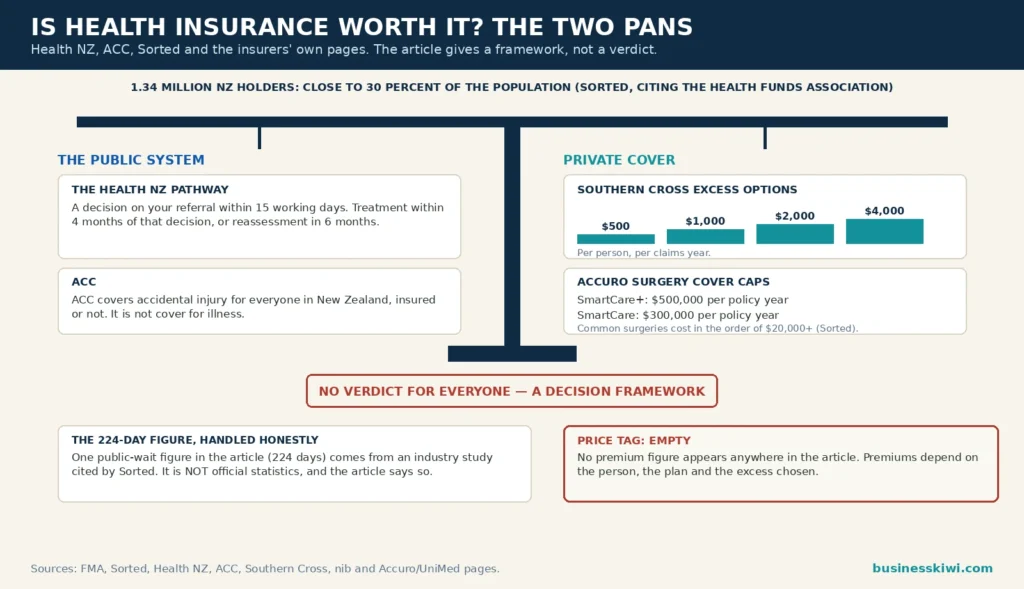
Every year, well over a million New Zealanders pay health insurance premiums for treatment they hope they will never need. Sorted, the personal finance guide run by the Commission for Financial Capability, puts the number at 1.34 million people, close to 30 percent of the population, citing figures from the Health Funds Association. The other 70 percent rely on the public health system, ACC, their savings, or a mixture of all three.
So who is making the better call? The honest answer is that it depends on what you would actually use the cover for, how long you might otherwise wait, and whether the premiums still make sense as they climb with age. Health insurance in New Zealand is not a substitute for the public system, and it is not a scam either. It is a narrower product than many people assume: it buys speed, choice and a measure of certainty for a defined set of treatments, and it leaves other risks exactly where they were. This article works through that decision without a verdict for everyone, because there is not one. What it can do is show you what the cover really buys, what it leaves out, who tends to get their money’s worth, and the questions that separate a policy worth holding from an expensive comfort blanket.
First, what you already have without paying a premium
Any decision about health insurance starts with the safety nets that are already in place, because paying to duplicate them is wasted money.
The public health system treats urgent and life-threatening conditions first, and it does so regardless of whether you hold insurance. If you arrive at an emergency department with a heart attack, a stroke or serious injuries, you will be treated. Nobody checks your policy status at the door. Public care is not entirely free in every corner of the system, as Sorted points out; there can be part-charges, for example for some GP visits and prescriptions. But hospital care for acute conditions is publicly funded.
The trade-off sits with planned care, the operations and specialist treatments that are needed but not immediately life-threatening. Health New Zealand describes how the process works. Your GP or another healthcare provider assesses you and, if needed, refers you to a specialist. You should hear whether you will receive specialist treatment within 15 working days. The specialist then gives you a priority score based on your level of need and your ability to benefit from treatment, weighed against everyone else waiting. The outcome, according to Health New Zealand, is one of three things: treatment within four months, reassessment in six months, or being sent back to your own doctor for ongoing care. In other words, getting a referral is not the same as getting a date for surgery. Your condition has to score highly enough against a queue of people who may be worse off, and thresholds vary by specialty and by region.
ACC is the second safety net, and it is one many people half-understand. ACC’s no-fault scheme covers everyone in New Zealand, including visitors, who is injured in an accident, whether they are working, unemployed, retired or still at school. It helps pay towards treatment, rehabilitation, help at home and, where you qualify, help with your income while you recover. What ACC does not cover is just as important. ACC itself states plainly that it cannot cover illness, conditions related to ageing, or emotional issues that are not linked to a covered injury. A worn-out hip from arthritis, a cancer diagnosis, a heart condition that develops over time: none of these are accidents, so none of them are ACC’s problem. That gap between accident and illness is precisely where the health insurance question lives.
What private health insurance actually buys
Strip away the marketing and a health policy buys you four main things.
The first is speed. Private treatment usually means being seen by a specialist within weeks rather than joining the public queue, and having surgery scheduled on a date that suits you rather than one allocated by priority score. Sorted cites an industry study that found the average time from a first GP referral to surgery in the public system was 224 days, roughly 100 days longer than going private, with private patients generally seen by a surgeon a couple of weeks after their first visit. Those figures come from an industry study rather than official statistics, and waits vary widely by procedure and region, but the direction of the difference is not seriously in dispute. For someone in pain, or unable to work properly while they wait, months matter.
The second is choice. Private cover generally lets you choose your specialist and, within the policy’s terms, where you are treated. Sorted makes a wry point here: you may end up with exactly the same surgeon you would have seen publicly, because many specialists work in both systems. What you are buying is not a better surgeon. It is the same surgeon, sooner, at a time you can plan around work and family.
The third is access to some treatments and medicines the public system funds slowly, restricts, or does not fund at all. The clearest example is non-PHARMAC medicines. PHARMAC decides which medicines are publicly funded, and some modern cancer and specialty drugs sit outside that list or carry strict eligibility criteria. Insurers structure this cover differently. Accuro builds cover for non-PHARMAC subsidised drugs into its SmartCare and SmartCare+ base plans when those drugs are used as part of covered surgery or a private hospital medical admission. nib sells it as an optional add-on called non-PHARMAC Plus that can be attached to eligible plans. The detail matters, because the limits, the drugs covered and the situations that qualify differ between insurers. If this benefit is a major reason you are considering cover, it deserves close reading rather than a tick on a brochure.
The fourth, on comprehensive plans, is help with day-to-day healthcare: GP visits, dental work, optical costs, physiotherapy and the like. nib’s Everyday plans are built this way, and Accuro offers optional GP, dental and optical, and natural health plans alongside its hospital base plan. These extras feel tangible because you claim on them often. Whether they are good value is a separate calculation, covered below, because you are largely prepaying your own routine costs through premiums, with the insurer taking its margin on top.
What health insurance does not buy
Just as important is the list of things a policy will not do, because disappointment at claim time usually traces back to one of them.
It does not replace emergency care. If you need acute treatment, you will be in a public hospital, and insurers write their policies on that assumption. Accuro’s policy wording, for example, lists acute care among the types of care it does not cover, noting that acute care sits with the public health system and ACC. Health insurance is a planned-care product.
It does not cover your income. If illness keeps you off work for six months, a health policy pays the hospital and the surgeon. It does not pay your mortgage. That risk belongs to income protection insurance and disability insurance, which are different products answering a different question. People sometimes cancel or decline those covers because they hold health insurance, without noticing the two do entirely different jobs.
It does not automatically cover conditions you already have. Pre-existing conditions are the single biggest source of declined claims and bruised expectations. As a rule, a health policy covers signs, symptoms and conditions that arise after the policy starts. Conditions you already had, or were already showing symptoms of, are excluded, permanently or for a set period, unless the insurer agrees in writing to cover them. There are exceptions worth knowing about. nib says that after three years on its Premium Hospital or Standard Hospital policies, some pre-existing conditions become covered as a loyalty benefit. Southern Cross says qualifying pre-existing conditions may be covered after three years of continuous cover on its UltraCare plan, provided there is a benefit for the treatment. Employer group schemes sometimes cover pre-existing conditions from day one, which is one reason workplace cover can be more valuable than it looks. But the default position is exclusion, and if you do not disclose a condition when you apply, the insurer can decline a claim for it later, even years later.
It does not cover everything on the treatment list either. Every policy has general exclusions, benefit limits and sub-limits. Fertility treatment, cosmetic surgery, obstetric care, some mental health treatment and long-term or geriatric care are commonly restricted or excluded unless a specific benefit includes them. Benefit ceilings also bite: Accuro’s SmartCare+ pays up to $500,000 per policy year for general surgery while its SmartCare plan caps the same benefit at $300,000. Those numbers sound abstractly large, and Sorted notes Southern Cross figures showing that almost all private procedures cost under $100,000, with no single procedure reaching $200,000. The ceiling is rarely the problem. The sub-limits on specific benefits, and whether diagnostics are covered when no surgery follows, are where policies quietly differ.

The money side: premiums, excesses and the age problem
Health insurance is unusual among financial products because the price is designed to rise steeply over the life of the policy. The Financial Markets Authority (FMA) warns that most premiums go up annually based on your age or inflation, and that policies which look cheap at the start can be the more expensive ones over the long run. Medical cost inflation, the rising price of the treatments themselves, pushes premiums up on top of the age effect. A premium that fits comfortably at 38 can be a serious line item at 68, which is exactly when you are most likely to claim. Sorted tells the story of a couple who held cover for a dozen years, let it go when premiums jumped by $400 a year, and then found themselves facing injuries with neither cover nor the income they once had. That pattern, paying in through your healthy years and dropping out just before the high-risk years, is the worst of both worlds, and it is common.
The excess is your main lever on price. The excess is the amount you pay towards a claim before the insurer pays anything. Southern Cross’s Wellbeing One and Wellbeing Two plans, for example, offer excess options of $500, $1,000, $2,000 and $4,000. On those plans the excess applies once per person per claims year, and only to the surgical procedures, chemotherapy for cancer and radiotherapy benefits. A higher excess lowers the premium because you are agreeing to fund the first slice of any big bill yourself. It follows that a high excess only works if you actually hold the cash. Choosing a $4,000 excess to cut the premium, without $4,000 you can reach quickly, converts insurance into a debt problem at the worst possible moment.
Sorted suggests thinking about the savings buffer and the excess together. Its general guidance is to hold an emergency fund of around three months of expenses. A household with solid savings can sensibly take a higher excess, or hospital-only cover, and let the buffer do the work that day-to-day benefits would otherwise do. A household with no buffer is buying something different: protection against a bill it genuinely cannot absorb, which makes comprehensive cover easier to justify even if the arithmetic looks less elegant.
Employer schemes change the calculation again. Group policies are usually priced on the group rather than your individual age, may be partly or fully subsidised, and sometimes cover pre-existing conditions. Sorted notes that these workplace policies are often cheaper for the employee for exactly those reasons. If your employer offers subsidised cover, the worth-it question usually answers itself while you are employed. The catch arrives when you leave: continuing the same cover individually can be expensive, and by then you are older and may have conditions a new policy would exclude.
Who tends to get value from health insurance
Certain situations tilt the balance towards cover being worth its cost.
People who cannot afford to wait are the clearest case. If your income depends on your body working properly, a tradesperson with a wrecked shoulder, a contractor with a hernia, a self-employed professional with failing eyesight, then months on a public waiting list are not just uncomfortable, they are expensive. The public system scores you against other patients on clinical need. It does not score you on the fact that your business stops earning while you sit at home. Private treatment, scheduled promptly, can protect income in a way that shows up in no premium comparison table. Note the limit, though: the policy gets you treated faster, it does not replace the income you lose while you recover. That is still income protection territory.
People with a family history of the conditions the public system rations hardest also get more from cover. Joint replacements, cataract surgery, hernia repairs, many gynaecological and urological procedures, and a range of diagnostic investigations are the classic planned-care battlegrounds where public thresholds are tightest. If your parents both needed hip replacements in their sixties, the probability that you will want one, and want it before you can barely walk, is not trivial.
People who join young and healthy get structurally better value, for two reasons. Premiums are lower at younger ages, and joining before conditions develop means those conditions are not pre-existing exclusions when they arrive. Sorted makes the same point about getting in early. The counterweight is that a healthy 28-year-old may pay for decades before claiming anything significant, and the money is gone whether they claim or not. Insurance is not an investment; years without a claim are not years wasted, but neither are they savings.
People whose employers subsidise a group scheme, discussed above, get value almost by default.
And some people simply value certainty highly. They would rather know that if a specialist says surgery is needed, it happens within weeks at a facility they chose, than optimise the expected cost. That is a legitimate preference, not a financial error. Insurance has always partly been the purchase of peace of mind. The mistake is paying for peace of mind you are not actually getting, because the policy excludes the condition you are worried about.
Who might reasonably decide against it
The case against is just as real, and it does not make someone reckless.
A household with substantial savings can self-insure the mid-sized risks. Self-insuring, in Sorted’s framing, means letting the public system cover urgent care, putting money aside yourself, and paying privately out of pocket if you ever decide a wait is unacceptable. It works because most single private procedures, while expensive, are not ruinous: Sorted notes that fairly common surgeries can cost in the order of $20,000 and more, which is a serious sum but a plannable one for a household with a six-figure buffer. What self-insuring cannot easily do is absorb several major events in a row, or an open-ended drug bill for a non-PHARMAC cancer medicine, which is why it suits the well-resourced better than the merely comfortable.
Younger people with no dependants, no health concerns and tight budgets may rationally prioritise other protections first: an emergency fund, income protection if their income supports others or a mortgage, KiwiSaver contributions. Health insurance bought at 25 and cancelled at 32 in a budget squeeze delivers little beyond seven years of modest cover.
People approaching retirement face the sharpest version of the dilemma. Premiums climb steeply through the sixties and seventies while incomes usually fall. Some long-term policyholders conclude that the same money, banked over the remaining years, covers a probable procedure or two, and that the public system will still handle anything acute. Others keep cover precisely because their claim probability is now highest. Both reasonings are coherent. The numbers worth running are the actual premium path the insurer projects, against the realistic cost of the one or two procedures you are most likely to need.
How to judge a policy: the checks that matter
If you lean towards cover, the decision shifts from whether to which, and the differences that matter are mostly not the ones on the front page of the brochure.
Start with the surgical and hospital core. This is the heart of any policy: what it pays for surgery and private hospital admission, and up to what limit. Compare that core first, and treat day-to-day benefits as an optional extra you price separately.
Check how diagnostics are handled. A policy that only covers scans and specialist consultations when they lead directly to covered surgery is much weaker than one covering standalone diagnostics, because diagnosis is where many people get stuck in the public queue. Accuro, for instance, sells a separate specialist plan for consultations and tests precisely because its base plan ties much of that cover to surgical events. Know which design you are buying.
Read the pre-existing conditions clause as if your future claim depends on it, because it does. What is excluded, for how long, and is there a pathway to cover after a period of continuous membership, as nib and Southern Cross offer on some plans? If an adviser is suggesting you switch insurers, the FMA’s warnings apply in full: existing health problems may be excluded under the new policy as pre-existing conditions even when your current policy would have paid, a new qualifying period may apply, and a claim could be declined that would have been accepted before. The FMA’s advice is blunt: keep your old policy running until the new one is in force, and make sure you understand what you gain and what you give up.
Understand the excess mechanics, not just the headline number. Does it apply per claim, per person per year, or per condition? Southern Cross applies its Wellbeing excess per person once each claims year and only to specified benefits; other insurers structure theirs differently. A per-claim excess on a policy you use several times in a year costs much more than the brochure suggests.
Look at the non-PHARMAC benefit closely if cancer cover motivates you. Which drugs, what dollar limit, in which settings? An add-on with a modest cap may not cover a modern immunotherapy course for long. This is an area where insurers genuinely differ, and where an adviser’s comparison of policy wordings earns its keep.
Finally, check the insurer and the paperwork. Since 31 March 2025, insurers providing services to consumers in New Zealand must hold a financial institution licence issued by the FMA, with a fair conduct programme explaining how they will treat consumers fairly; insurers must publish summary information about that programme on their websites. The FMA also stresses honesty at application: if an insurer finds you have not disclosed medical conditions or lifestyle details, it can change the terms of your cover or cancel benefits. Disclose fully, keep the paperwork, and review the policy when life changes, a new house, a baby, a different job, because cover set up for one life stage quietly stops fitting the next.
The middle paths worth pricing
The decision is not binary, and for many households the sensible answer sits between full cover and none.
Hospital-only or hospital-and-specialist plans strip out the day-to-day benefits and insure the big events, which is where insurance logic is strongest. Sorted’s advice to focus on the big risks points the same way: skip comprehensive cover for routine costs you can budget for, and protect against the bills you cannot. Day-to-day benefits are the part of the premium most likely to return less than you pay in across a few healthy years, because routine GP and dental costs are predictable expenses rather than risks.
A higher excess, paired with a genuine savings buffer, is the second lever. It keeps the catastrophic protection while cutting the premium substantially, and it suits people whose real fear is a $40,000 surgical bill, not a $70 GP visit.
Timing is the third. Joining a group scheme when an employer offers one, or taking out cover while you are young and free of conditions you would have to declare, both improve the deal in ways that cannot be recreated later. Conversely, reviewing cover at retirement, and honestly pricing whether to continue, restructure or self-insure, prevents the common outcome of paying the highest premiums of your life for cover you keep out of habit.
Frequently asked questions
Does health insurance cover emergencies in New Zealand?
No, not in the way most people mean it. Emergency and acute care is provided by the public hospital system, and ACC covers accidents. Health insurance is designed around planned treatment: specialist consultations, diagnostics and elective surgery. Insurers such as Accuro expressly do not cover acute care, on the basis that it belongs to the public system and ACC.
What is the difference between health insurance and ACC?
ACC is a no-fault scheme that covers injuries caused by accidents, for everyone in New Zealand, and helps with treatment costs and recovery support. It does not cover illness or conditions related to ageing. Health insurance is a private product you buy yourself, and its main territory is illness and non-acute conditions: it pays for private planned treatment, usually much faster than the public queue.
Are pre-existing conditions covered by health insurance?
Generally not at first. Conditions you had, or had symptoms of, before the policy started are usually excluded unless the insurer agrees otherwise in writing. Some insurers offer a pathway after a period of continuous cover: nib covers some pre-existing conditions after three years on its Premium Hospital or Standard Hospital policies, and Southern Cross says qualifying pre-existing conditions may be covered after three years of continuous cover on its UltraCare plan. Employer group schemes sometimes cover them from the start.
How much does health insurance cost in New Zealand?
There is no single price, because premiums depend on your age, the plan’s benefit limits, the excess you choose and the optional benefits you add. Premiums are lowest for young, healthy applicants and rise each year; the FMA notes that most premiums increase annually based on age or inflation, and that a policy that starts cheap can cost more over the long term. The only meaningful figure is a quote for your own circumstances, compared across at least the surgical core, the excess and the exclusions.
Is it better to self-insure by saving the premiums instead?
It can be, if your savings are deep enough. Sorted frames self-insuring as letting the public system handle urgent care while you hold a buffer for private treatment you choose to buy. The weakness is scale: Sorted notes common surgeries can cost in the order of $20,000 and over, so a buffer needs to be substantial, and it can be depleted by a single event. Self-insuring suits households with strong savings and a high tolerance for uncertainty. It suits almost nobody as an excuse to hold no buffer at all.
Does health insurance pay my income if I cannot work?
No. A health policy pays for treatment: the specialist, the hospital, the surgery, and sometimes medicines. It does not replace your earnings while you recover. Income replacement is the job of income protection insurance, and lump-sum cover for serious conditions sits with trauma and disability insurance products. Many people need to think about both questions: how treatment gets paid for, and how the household gets paid while it happens.
Should I switch health insurers to get a cheaper premium?
Be careful. The FMA warns that switching can leave you worse off: conditions covered under your current policy may be treated as pre-existing and excluded under a new one, new qualifying periods may apply, and lower premiums now can mean higher premiums later. The FMA advises keeping your old policy in force until the new policy is active, and checking the differences in cover in writing before you commit.
At what age does health insurance stop being worth it?
There is no fixed age, because the trade-off is personal: premiums rise steeply with age at the same time as the likelihood of needing planned surgery increases. What changes is the comparison. In your forties the premium buys decades of potential claims. In your seventies it buys a shorter window at a much higher price, and self-insuring a probable procedure or two becomes a realistic alternative for households with savings. The right time to run the numbers is at each renewal, not once.
Sources
- Financial Markets Authority, Insurance (consumer guidance): https://www.fma.govt.nz/consumer/everyday-finance/insurance/
- Sorted (Commission for Financial Capability), Is health insurance worth it?: https://sorted.org.nz/blog/is-health-insurance-worth-it/
- Health New Zealand, Planned care: https://info.health.nz/hospitals-services/services-support/planned-care
- ACC, Injuries we cover: https://www.acc.co.nz/im-injured/what-we-cover/injuries-we-cover
- ACC, What we do: https://www.acc.co.nz/about-us/who-we-are/what-we-do
- Southern Cross Health Society, Excesses for Wellbeing One and Wellbeing Two plans (factsheet, effective 22 October 2024): https://www.southerncross.co.nz/-/media/Southern-Cross-Health-Society/Health-insurance/Member-collateral/Factsheets/MC_LT_FYI_Wellbeing_Plan_Excess_FS.PDF
- Southern Cross Health Society, What plans cover pre-existing health conditions?: https://www.southerncross.co.nz/society/help/joining-southern-cross/what-plans-cover-pre-existing-health-conditions
- nib New Zealand, Top 5 health insurance myths debunked: https://www.nib.co.nz/free-resources/article/myth-busting-the-top-5-health-insurance-misconceptions
- Accuro Health Insurance (now UniMed), Health insurance for New Zealand residents: https://www.accuro.co.nz/personal-health-insurance/nz-resident?planId=1
This article is general information about how health insurance works in New Zealand and the factors people commonly weigh up. It is not personal financial advice, and it does not recommend any insurer or policy. Whether cover is worth it for you depends on your health, finances, employment and preferences. Premiums, policy terms and public waiting times change, so check current policy documents and quotes before deciding, and consider speaking with a licensed financial adviser about your own situation.