How Much Does Health Insurance Cost in NZ? Prices, Drivers and Honest Ways to Pay Less

Ask a simple question, get a frustrating answer. There is no price list for health insurance in New Zealand. No insurer publishes a table that says a 42-year-old non-smoker pays this much for hospital cover, and anyone who quotes you an “average premium” has made it up or scraped it from somewhere you should not trust. What insurers do publish, if you dig into their own brochures and member pages, is the machinery that produces your price: the excess discounts, the age bands, the stand-down rules, the scheme discounts. That machinery is worth understanding, because most of the levers that move a premium up or down are sitting in it, and several of them are in your hands.
This article stays with cost. If you are still working out what sort of plan suits you, that ground is covered in a full health insurance guide to choosing cover. Here we look at what people actually pay, why the number is what it is, and the legitimate ways to bring it down without quietly stripping out the protection you bought the policy for in the first place.
Why nobody can quote you a standard price
Health insurance in NZ is priced person by person. Your premium depends on your age, the plan and benefit limits you pick, the excess you accept, any optional extras you bolt on, and, for some products, your health history. Insurers generate the actual figure inside a quote tool or through an adviser once you hand over those details. Southern Cross, the country’s largest health insurer, lets members model changes through its Manage My Cover tool, where you can see how cover and premiums shift with different excesses, adding and removing modules, and changing plans. Note the pattern there: the price only exists once the combination exists.
That is also why comparison shopping is harder than it looks. Two policies with similar names can carry different benefit limits, different rules about which providers they pay in full, and different lists of what is excluded. A cheaper quote is sometimes a thinner policy wearing a similar label. None of that means price does not matter. It means price has to be read alongside the mechanics, which is what the rest of this article does.
The closest thing to a published price
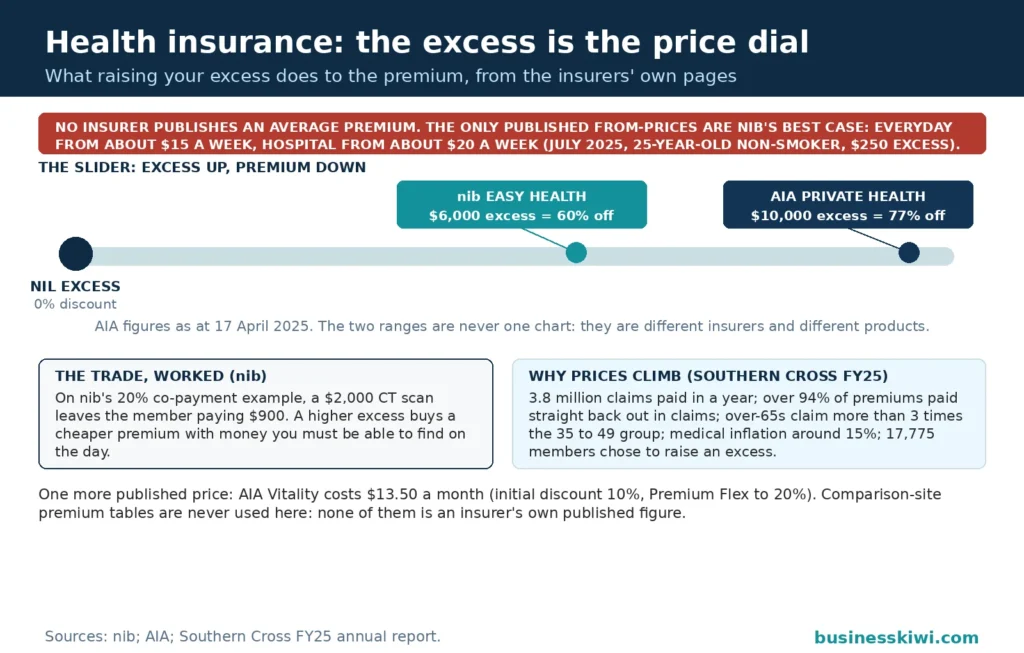
One major insurer does put starter figures on its own website. On nib’s health insurance guidance pages, its Everyday plans are described as starting from around $15 a week and its Hospital plans from about $20 a week. Read the fine print before you bank on either number. Those starting prices were published as at July 2025, they include a 2 percent direct debit discount, and the hospital figure is based on a 25-year-old male non-smoker carrying a $250 annual excess. In other words, the cheapest realistic customer, at the youngest adult age, with a modest excess already applied. A 55-year-old couple on a comprehensive plan will pay several times the “from” price, and nib itself points readers to a personalised quote for anything accurate.
The other published numbers worth knowing are not premiums at all. They are treatment costs, and they explain why premiums are sized the way they are. AIA publishes average treatment costs drawn from its own claims data. On its April 2026 figures, a hip replacement in the private system runs $35,000 to $50,000, an MRI scan $1,700 to $4,000, a CT scan $700 to $2,500, and chemotherapy anywhere from $15,000 to $400,000 across a policy year. You are not paying for paperwork when you pay a premium. You are pre-paying a share of bills like those, pooled with thousands of other policyholders.
Driver one: age, and the claims pool you age into
Age is the heaviest weight in the calculation. NZ health premiums are generally stepped, meaning they rise as you move through age bands rather than staying level for the life of the policy. Southern Cross puts it plainly on its renewal pages: the cost of cover increases each year as you get older, because healthcare needs grow and claims get larger. Your renewal premium also reflects the claims made by people of a similar age on the same plan, so you are priced partly on your own birthday and partly on your cohort’s hospital bills.
The gap is not subtle. In its 2025 annual report, Southern Cross recorded that the average amount claimed by members aged over 65 was more than three times the average for members aged 35 to 49. It also reported paying a record 3.8 million claims in that financial year, up 16 percent on the year before, and returning more than 94 cents of every premium dollar to members in claims. When a pool claims more, the pool pays more. On top of utilisation sits medical inflation, the rising cost of the treatment itself, which Southern Cross put at approximately 15 percent a year in the same report. Premiums chase both curves at once, which is why increases in recent years have felt steep even for people who have not claimed.
One structural point matters for older policyholders. Some insurers pool members above a certain age into a common rated group, so individual premiums stop stepping up with each birthday and instead move with the group’s overall claims experience. The detail varies by insurer and product, and it is worth asking yours directly how your plan prices age after 65 or 70, because the answer changes what your premium is likely to do in retirement.
Driver two: how much cover you buy
The second driver is the shape of the plan itself. Hospital and surgical cover, the part that pays for private surgery, cancer treatment and hospital admission, is the expensive core. Day-to-day cover for GP visits, dental, optical and physio sits on top of it, either as a separate plan or as add-on options, and each layer adds premium.
Cost sharing inside those day-to-day plans changes the price too. nib’s Everyday plans come in two reimbursement levels: its Standard version pays back 60 percent of eligible day-to-day costs, and its Premium version pays back 80 percent with higher annual limits and higher premiums. The pattern repeats everywhere. The more of each bill the insurer absorbs, and the higher the limits it absorbs it up to, the more you pay each week for the privilege.
Optional modules deserve a cold eye at renewal. Extras such as specialist and testing options, dental and optical add-ons, GP plans, non-PHARMAC drug cover and lump sum options are each priced into your premium. Southern Cross explicitly lets members add and remove modules and watch the premium move. If you bolted on a dental option three years ago and have claimed $80 against it since, you are looking at one of the few painless savings in this whole article.

Driver three: the excess, the biggest lever you control
An excess is the amount you agree to pay towards claims before the insurer starts paying, and trading a higher excess for a lower premium is the single most powerful cost lever in health insurance. Two insurers publish their exchange rates openly, and they make instructive reading.
The nib figures come from its Easy Health brochure and apply to a single-life policy; the AIA figures come from its health insurance brochure, published as at 17 April 2025. Both insurers note that discount levels can change, and the two products are built differently, so treat the table as a demonstration of the trade rather than a shopping chart. The demonstration is still striking. On these products, accepting a $500 excess cuts roughly a quarter off the premium, and pushing toward the top of the range can halve it or better.
Mechanics matter as much as percentages. At nib, the Easy Health excess applies per person across the policy year: once your claims in that year reach the excess amount, further eligible claims are paid in full up to benefit limits, and the slate wipes clean at the next anniversary. Southern Cross works on a similar per person, per claims year basis, but on its Wellbeing plans the excess bites only on specified benefits, namely surgical procedures, chemotherapy for cancer and radiotherapy. Day-to-day benefits sit outside it. And at nib, the excess you choose with base cover does not apply to claims under optional add-ons at all. A $4,000 excess sounds alarming until you learn it only stands between you and hospital claims, which are exactly the claims least likely to happen in a given year and the easiest to plan an emergency fund around. It is not free money, though. The year you do need surgery, the excess is a real bill, due at the worst possible time.
Plenty of people have already done this maths. Southern Cross reported that 17,775 of its members added or increased an excess on their plan in its 2025 financial year alone.
Driver four: co-payments hiding inside the plan
Excesses are not the only cost sharing in play. Some benefits carry a co-payment, a percentage of the bill that stays with you regardless of your excess. Under nib’s Easy Health, for example, a 20 percent co-payment applies to some specialist consultation and diagnostic benefits. Using the brochure’s own worked example, a $2,000 CT scan with a 20 percent co-payment and a $500 excess leaves you paying $900 of the scan: $400 of co-payment first, then the $500 excess from the remainder, with nib covering the other $1,100. Provider networks play a similar role. nib pays 100 percent of eligible costs, up to benefit limits, when you use its First Choice network; go outside it and the insurer pays up to its benchmark price, leaving any gap on you. Southern Cross runs an equivalent Affiliated Provider programme and credits it with helping to hold premium increases down. None of this shows up in the weekly premium figure, but it decides what the policy really costs you across a year of treatment.
Driver five: your health history, stand-downs and waiting periods
What you bring to the policy affects both price and cover. Fully underwritten policies assess your medical history at application, and conditions you already have are typically excluded, sometimes permanently. Simpler products skip the health questions but impose blanket rules instead. nib’s Easy Health asks nothing about your health history up front, then covers some pre-existing conditions only after three years of continuous cover, while permanently excluding others, including cardiovascular conditions, cancer, hip and knee conditions, back conditions and transplant surgery. Its standard Hospital policies take a similar line. Southern Cross generally excludes pre-existing conditions too, with a notable exception: its premium UltraCare plan may cover qualifying pre-existing conditions after three years of continuous cover, and members of some employer work schemes can be entitled to pre-existing cover as part of their scheme.
Waiting periods slice the same issue another way. Specific benefits often carry their own stand-downs, from a few months on everyday benefits to a year or more on things like obstetrics or certain surgeries. These rules rarely change the headline premium, but they change what the premium buys you in the first years, and they reset in ways that matter when you switch, which we come to below.
Discounts, work schemes and payment habits
Beyond the policy structure, smaller discounts stack up. nib takes 2 percent off premiums paid by direct debit, a trivial-sounding habit that compounds across years of renewals. AIA runs its discount through a wellness programme instead: AIA Vitality costs $13.50 a month, gives an initial 10 percent discount on eligible premiums for the first year, and then adjusts that discount annually under its Premium Flex rules. Reach its Platinum status and the discount can grow by 2 percent a year up to a maximum of 20 percent; stay at Bronze and it shrinks by 2 percent a year toward zero. Whether the membership fee is worth paying depends entirely on how engaged you stay, but the mechanism is real money, not marketing fluff.
Work schemes are the other quiet discount. Southern Cross notes that premiums under work and association schemes are influenced by the scheme’s own arrangements and claims experience, and group schemes can also carry concessions an individual buyer cannot get, including the pre-existing condition entitlements mentioned above. If your employer offers a scheme, subsidised or not, get its price before you shop as an individual. Family pricing has its own quirk, too: children usually ride on a parent’s policy at child rates until their early twenties (nib keeps dependants on until 21), after which an adult premium applies or they transfer to their own policy.
What the premium is actually buying in New Zealand
It helps to be clear about the gap private cover fills, because New Zealanders already fund a lot of healthcare through taxes. ACC covers everyone in the country, residents and visitors alike, for injuries caused by accidents, on a no-fault basis. What ACC will not touch is illness, conditions related to ageing, and most mental health conditions. The public hospital system treats urgent need first and queues the rest: non-urgent surgery and specialist assessments are rationed by waiting lists, and the wait for planned treatment can run to many months. Private health insurance buys your way around that queue for eligible treatment, plus choice over timing and provider, and in comprehensive plans a contribution to the everyday costs the public system charges for or does not provide at all, such as adult dental work and glasses. You are not duplicating ACC or emergency care. You are insuring speed, choice and the illness side of the ledger that ACC excludes.
Reviewing or switching: the traps are real
When a renewal lands with a double-digit increase, switching insurers is the obvious thought. Sometimes it is the right one. Just walk in knowing what resets.
A new insurer means a new application, and new applications mean full disclosure. Consumer Protection’s insurance guidance is blunt about this: you must give honest, complete and up-to-date information when you apply, when you renew and when you claim, and an insurer can refuse a claim, or cancel cover from the start date, if material information was left out. Your medical history will be assessed again, and anything that has developed since you took out your current policy is a pre-existing condition to the new insurer. That three-year clock on covering pre-existing conditions, where it exists at all, starts again from zero. Waiting periods on specific benefits start again too. Loyalty benefits built up over years with your current insurer do not transfer. In exchange you might get a lower premium, a better benefit structure, or an excess setting that suits you now. Plenty of people also hold the solution inside their existing policy: many switches that look attractive are matched by raising the excess or trimming modules at home, without surrendering years of continuous cover. Continuity provisions do exist in places. nib lets dependants turning 21 move onto their own policy with continuity of cover, on terms, rather than starting as strangers. Rules like that soften some moves, but a straight insurer-to-insurer jump should be treated as starting again, because that is how the new insurer will treat you. Two practical rules follow. Never cancel your existing policy before the new one is accepted and in force. And if you are mid-treatment or mid-claims-year, ask both insurers, in writing, how the move affects the treatment in train.
If you believe an increase or a decision is simply wrong, complain to the insurer first, and then to its dispute resolution scheme, which is free. Regulators expect fair treatment, too: since 31 March 2025 insurers serving NZ consumers must hold a financial institution licence from the Financial Markets Authority and run a fair conduct programme. That does not cap your premium, but it does mean there is a standard of conduct behind the paperwork.

A short, honest checklist for paying less
None of these will halve a premium overnight on their own. Together they are most of what is legitimately available.
- Raise the excess to the highest level you could genuinely pay from savings in a bad month, and put the premium saving aside as that fund.
- Strip modules you have not claimed on in two or three years, especially day-to-day extras you bought by default.
- Check whether your employer’s work scheme beats your individual price, and what concessions come with it.
- Pay by direct debit where it earns a discount, and claim any wellness or low-claims discounts your insurer offers.
- Re-price the policy at life changes: children leaving the policy, retirement approaching, or a partner gaining cover through work can all leave you paying for people or benefits you no longer need.
- Use your insurer’s own review tools, or an adviser, to model changes before renewal rather than after the increase lands.
- Compare like with like when you do get rival quotes: same excess, same benefit limits, same treatment of your existing conditions.
Frequently asked questions
How much does health insurance cost per month in NZ?
There is no standard figure, because no major insurer publishes a full price schedule. The only starter prices published by a major insurer are nib’s, which put Hospital cover from about $20 a week and Everyday cover from around $15 a week for a young, healthy adult with an excess applied, as at July 2025. Older buyers on comprehensive plans pay several times that. Your real price only exists once an insurer quotes on your age, plan and excess.
Why did my premium jump so much at renewal?
Usually a stack of reasons rather than one. You aged into a more expensive risk band, your age group’s claims on your plan rose, and medical costs themselves inflated. Southern Cross reported medical inflation of around 15 percent a year and record claim volumes in its 2025 annual report, and it paid out more than 94 cents of every premium dollar in claims. Insurers price to that pool experience, not to your individual claiming record alone.
How much can a higher excess save me?
More than most people expect. On nib’s Easy Health, moving from no excess to a $500 excess cuts 25 percent off the base premium, and a $4,000 excess cuts 55 percent. AIA’s Private Health table is steeper still, reaching a 70 percent discount at a $4,000 excess. The catch is that the excess becomes a real bill in a claim year, so only choose a level you could actually pay.
Does health insurance keep getting more expensive as I get older?
Yes, on stepped premium structures, which are the NZ norm. Premiums rise as you move through age bands because claiming rises sharply with age: Southern Cross members over 65 claimed on average more than three times as much as members aged 35 to 49 in its 2025 financial year. Some insurers pool members above a set age into a common rated group, which changes the pattern in later years. Ask your insurer how your plan treats age at retirement ages.
Will a new insurer cover my pre-existing conditions?
Generally not straight away, and some not at all. Typical arrangements exclude pre-existing conditions permanently, or cover some of them only after three years of continuous cover. Cancer, cardiovascular conditions and hip, knee and back conditions are commonly on the never list for pre-existing cover. This is the strongest argument for thinking carefully before switching insurers once you have any medical history.
Is paying monthly more expensive than paying annually?
It can be, depending on the insurer. The clearest published example is payment method discounts rather than frequency discounts: nib takes 2 percent off premiums paid by direct debit. Check your own policy documents for any discount tied to how you pay, and weigh it against cash flow. A small percentage on a large premium is still real money over a decade.
Can I reduce my premium without changing insurers?
Almost always, yes. Raising your excess, removing modules you do not use, and reviewing who is actually on the policy are all available inside most existing policies, and insurers provide tools to model the effect before you commit. Staying put also preserves your continuous cover history, which matters the day you need to claim on something that developed years ago.
This article is general information only. It is not financial advice, and it does not recommend any insurer or policy. Premiums, discounts and policy terms change, and the figures quoted were published by the insurers named and checked in October 2026. Read your own policy documents, and consider talking to a licensed financial adviser before making changes to your cover.
Sources
- Southern Cross Health Society, Policy renewal, southerncross.co.nz
- Southern Cross Health Society, Excesses for Wellbeing One and Wellbeing Two plans, southerncross.co.nz
- Southern Cross Medical Care Society Group, 2025 Annual Report Summary, southerncross.co.nz
- Southern Cross Health Society, Joining help and stand-down periods, southerncross.co.nz
- nib, Health insurance 101: How to protect your family’s health, nib.co.nz
- nib, Family health insurance, nib.co.nz
- nib, Easy Health brochure (Summary), nib.co.nz
- AIA New Zealand, AIA Health Insurance brochure, aia.co.nz
- AIA New Zealand, AIA Vitality, aia.co.nz
- Accident Compensation Corporation, What we cover, acc.co.nz
- Consumer Protection, Insurance, consumerprotection.govt.nz
- Financial Markets Authority, Insurance, fma.govt.nz