Redundancy in NZ: What You Get Paid, How the Process Works and Your Rights

The quick answer
New Zealand has no standard redundancy payout set by law. There is no legal formula, no weeks-per-year rule, and no minimum compensation amount. You are entitled to redundancy compensation only if your employment agreement says you are, and plenty of agreements say nothing at all, which means no compensation payment on top of your notice and final pay. What every redundant employee does get is their notice period, worked or paid out, and a final pay that includes wages owed, unused annual holidays and any other entitlements. Because so much turns on one clause in one document, the single most useful thing you can do when redundancy is raised is read your employment agreement before you do anything else.
The one-sentence answer: In NZ, redundancy pay exists only if your employment agreement creates it. The law guarantees a genuine reason, a fair process, proper notice and a correct final pay, not a payout.
What redundancy actually means
Redundancy is about the role, not the person. It happens when an employer no longer needs a position, or no longer needs as many people doing it, for genuine business reasons: a downturn in work, a restructure, a lost contract, a site closing, work being automated or moved. Employment NZ puts the employer’s duties plainly. The reasons for any redundancy must be genuine, the employer must follow a fair and proper process, and redundancy must be a last resort after redeployment options have been explored.
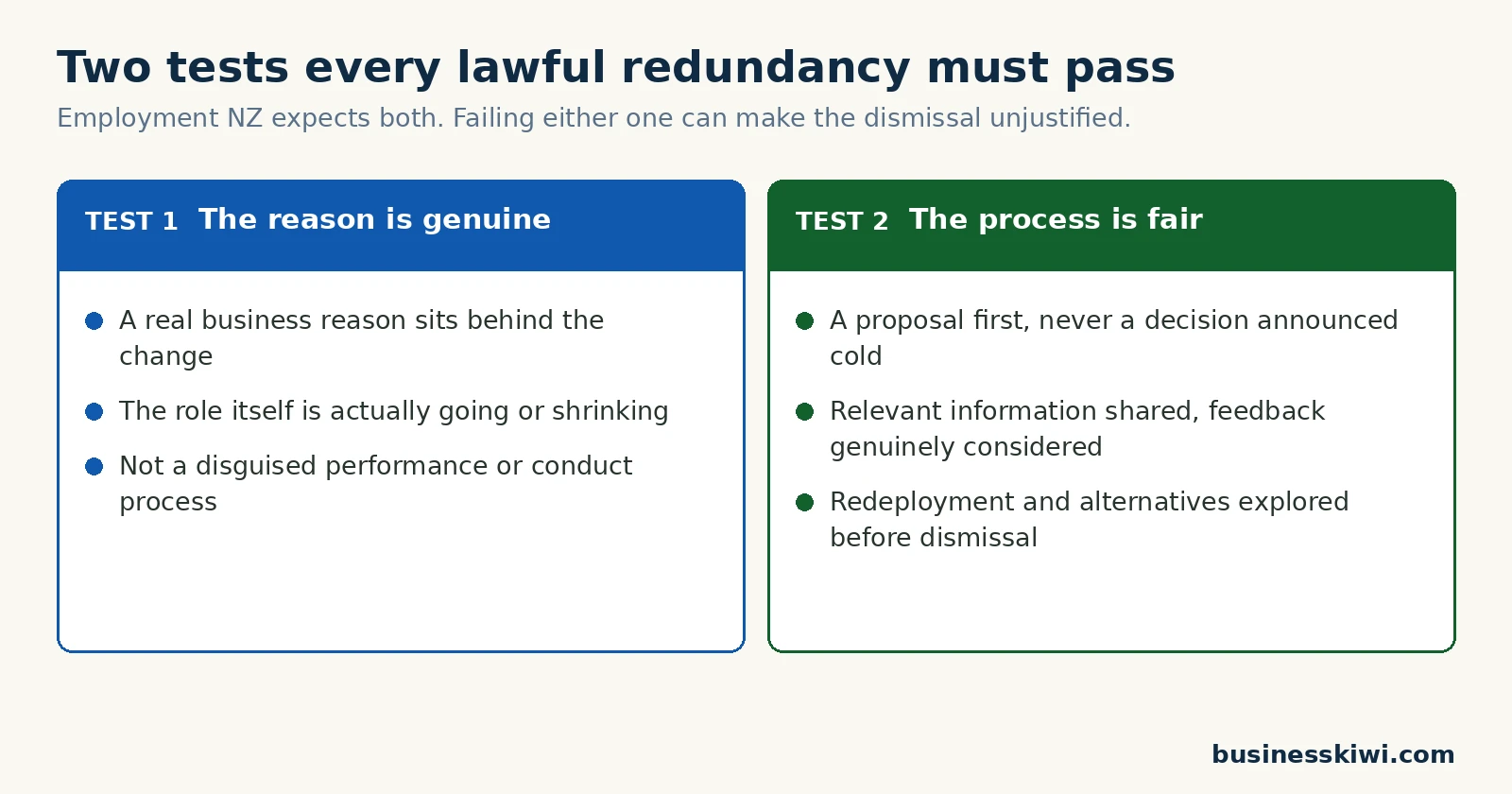
Two tests sit underneath every lawful redundancy:
- The reason must be real. If you lose your job and someone is then hired into an identical role, Employment NZ says that would very likely be considered an unjustified dismissal dressed up as redundancy. Redundancy also cannot be a shortcut around a performance process. Dissatisfaction with your work is a performance matter, with its own process, not a redundancy reason.
- The process must be fair. Even a genuine business reason does not save a redundancy that was decided in secret and announced as a done deal. The next sections cover what fair looks like.
Redundancy is different from dismissal for misconduct or poor performance, and different again from resignation. If your employer is calling something redundancy, the role itself should be disappearing or shrinking. That distinction decides which rules apply.
Is there a standard redundancy payout in NZ?
No, and this is the point most overseas articles get wrong about New Zealand. Some countries set statutory redundancy pay by formula. New Zealand does not. Employment NZ states the position directly: you are only entitled to redundancy compensation if it is stated in your employment agreement, and if the agreement does not mention redundancy pay, there would be no compensation.
In practice, agreements vary widely:
- No clause at all. Common, especially in smaller businesses. You receive notice and final pay, and nothing more.
- A clause that says no compensation is payable. Also common. Some agreements state this expressly so there is no doubt.
- A formula clause. Some agreements, particularly collective agreements and larger employers’ agreements, set compensation as an amount for the first period of service plus a further amount per year after that. The formula is whatever was negotiated; there is no standard version to compare yours against.
- Negotiated payments. Even where an agreement is silent, a payment can sometimes be negotiated as part of the process, particularly where the employer wants an agreed, clean finish. Employment NZ notes that whether an employee receives a redundancy payment depends on the agreement and any negotiations they have had with their employer.
So the honest answer to “how much redundancy pay will I get” is: it is in your agreement, or it is open for discussion, or it is zero. Anyone quoting you a standard NZ figure without asking about your agreement is guessing.
What you should receive either way
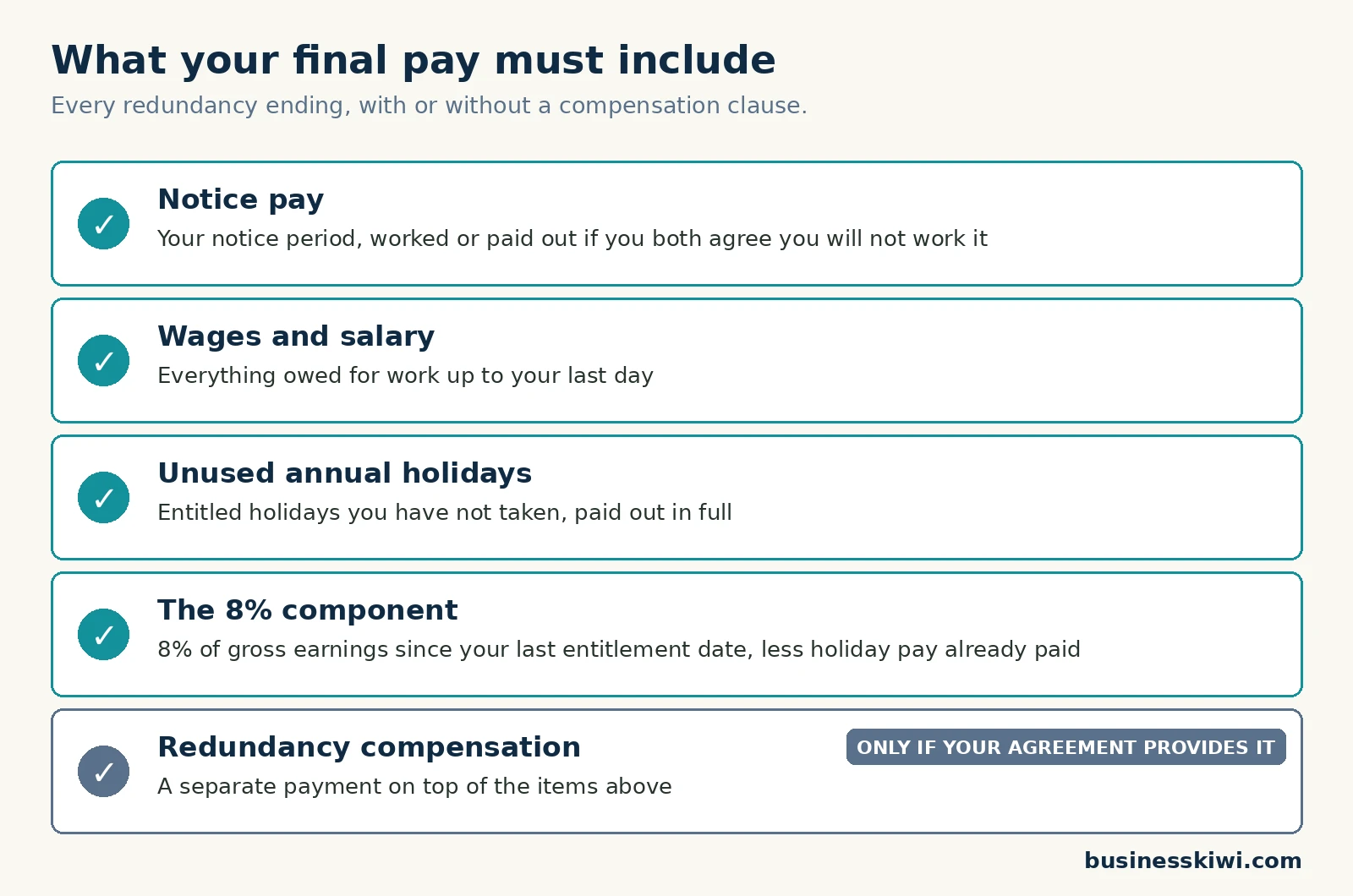
Compensation clause or not, a redundancy ending has set components. Check your final pay against this list.
Notice, worked or paid. You must be given notice, and paid for the notice period, unless you and your employer both agree to waive it, for example if you find a new job and want to leave early. Your employer can require you to work the notice period, but may agree that you do not. The notice period is the one in your employment agreement or workplace policy. If nothing is written down, “reasonable notice” must be given instead, and Employment NZ lists what reasonable depends on: the reason for the redundancy, your length of service, your seniority and pay level, how easily you can find other work, any compensation being paid, and what is normal in your industry.
Wages and salary to your last day. Pay for all time worked up to the end of employment, including any notice period worked.
Unused annual holidays. Your final pay must include payment for annual holidays you are entitled to but have not taken, plus holiday pay for the period since your last entitlement date, calculated at 8 percent of your gross earnings for that period, less any holiday pay already paid. This 8 percent component is the part most often missed when people eyeball their final pay.
Any other entitlements. Whatever else your agreement or workplace policies promise: alternative holidays (days in lieu) owing, long service leave if your agreement provides it, commission or bonuses already earned, and the support items mentioned in your agreement or the change proposal, such as outplacement help.
How redundancy pay is taxed
If you do receive redundancy compensation, Inland Revenue taxes it as a lump sum, sometimes called an extra pay, rather than at your ordinary pay rate. Your employer works out a flat PAYE rate from your annualised income, meaning your recent earnings grossed up to a yearly figure with the lump sum added, and applies that single rate to the whole payment.
These are Inland Revenue’s lump sum rates before the ACC earners’ levy, which is the right column for redundancy: IRD states that the ACC earners’ levy does not apply to redundancy payments. One wrinkle worth knowing is that the other parts of your final pay are not all treated the same way. Holiday pay paid out at the end of employment is also taxed as a lump sum, but the ACC levy generally does apply to that part. If your final pay looks lower than you expected, the tax treatment of each component is usually the reason, and your payroll team should be able to break it down line by line. Student loan repayments can also apply to lump sums if you have a student loan.

A practical tip follows from the flat-rate method. The rate is set by annualising your recent pay, so a redundancy payment that lands in the same period as other lump sums, such as a bonus or cashed-up leave, can be taxed at a higher flat rate than the same payment on its own. If too much tax comes off across the year, it is squared up in your end-of-year tax assessment; if too little comes off, the same assessment catches that too.
The process your employer must follow
A lawful redundancy follows a recognisable path. Employment NZ’s workplace change guidance sets out the shape of it, and the Employment Relations Act’s good faith duty sits behind every step: before making a decision that could end your employment, your employer must give you the relevant information and a genuine opportunity to comment on it.

- A proposal, not a decision. The process starts with a change proposal: what is proposed, why, and which roles are affected. If you are simply told the outcome at the first meeting, the process is already off track.
- Information. You are entitled to the information relevant to the proposal, enough to understand it and respond properly. That can include the business reasons, the structure being proposed, and, where only some roles will go, the selection criteria.
- Consultation. You get a real chance to give feedback, ask questions and suggest alternatives, in a meeting you can bring a support person or representative to. Your employer must consider what you say with an open mind before deciding.
- Alternatives and redeployment. Redundancy is a last resort. Your employer must consider redeployment into other roles in the organisation, including roles different from yours and roles at other locations, and must consider alternatives such as changed hours, job-sharing or reduced hours. Any agreed change must be recorded in writing and signed by both of you.
- The decision, then notice. Only after consultation does the employer confirm the outcome. If your role is disestablished and no redeployment is available or accepted, your notice period starts from the confirmation, and the support promised in your agreement, policy or the proposal must be provided.
- Final pay and loose ends. Employment ends at the end of notice, worked or paid out by agreement, and your final pay is calculated with the components listed earlier.
Selection deserves a special mention, because it is where many disputes start. Where a restructure keeps some roles and removes others, the employer should use clear selection criteria, apply them consistently, give you your own result, and let you comment on it. A selection process that was decided before it began is not a process at all.
If the business is sold or work is transferred
Redundancy can also arrive dressed as a sale. If the business, or part of it, is sold as assets or the work is contracted out, your employment with the old employer ends even if the buyer offers you a job doing the same work. That is called technical redundancy. A sale of shares is different: the employer stays the same legal entity, so employment simply continues and there is no redundancy.
Every employment agreement must contain an employee protection provision setting out the process for these situations. Some groups of employees, including specified cleaning, catering, laundry, orderly, caretaking and security roles, have stronger statutory protection under Part 6A of the Employment Relations Act and can elect to transfer to the new employer on their existing terms. If a sale or transfer is your situation, the detail matters more than usual, and getting advice early is worth it.
If you think your redundancy was unfair
A genuine reason handled badly can still be an unjustifiable dismissal, and so can a tidy process wrapped around a reason that does not hold up. If you believe your redundancy was not genuine, or the process was not fair, the usual path is:
- Raise it with your employer first, in writing, and keep copies of everything: the proposal, your feedback, the decision letter, your agreement and your final payslip.
- Use free mediation. Employment Mediation Services offers mediation to try to resolve employment problems before they escalate.
- Raise a personal grievance if it cannot be resolved. An unjustified dismissal grievance generally must be raised with your employer within 90 days of the dismissal, so do not sit on it. Our guide to raising a personal grievance in NZ explains the process and the time limits in full.
- The Employment Relations Authority is the next step if mediation does not settle it; the Authority investigates and decides.
Time limits are the trap in this area. Ninety days passes quickly when you are job hunting, so if you think the process was wrong, note the date of your dismissal and work back from it.
Your first week checklist
If redundancy has just been raised with you, these are the moves that protect your position:
- Ask for the proposal and all supporting information in writing, if you have not been given it.
- Find your employment agreement and read the redundancy, notice and employee protection clauses before your consultation meeting.
- Write down your questions and any alternatives you want considered, such as redeployment, reduced hours or a later finish date.
- Take a support person or representative to consultation meetings. You are entitled to one.
- Do not sign anything on the spot. Take documents away, read them properly, and get advice if the amounts are significant.
- Check your final pay against the components in this article: notice, wages, unused holidays, the 8 percent component, and any compensation your agreement promises.
- Ask what support is on offer, such as outplacement services, CV help or a reference, and get it confirmed in writing.
Frequently asked questions
How much redundancy pay am I entitled to in NZ? Only what your employment agreement provides. There is no statutory amount or formula in New Zealand. If your agreement has no redundancy compensation clause, your entitlement is your notice and your final pay entitlements, unless a payment is negotiated during the process.
Can my employer make me redundant and hire someone else? Not into the same role. If the work continues and a replacement is hired into an identical position, Employment NZ says the redundancy would very likely be considered unjustified. Genuine change to the role or structure is different, but the business reason has to be real.
Does my employer have to consult me before making me redundant? Yes. Good faith consultation before the decision is a legal requirement, not a courtesy: relevant information, a genuine opportunity to comment, and your feedback considered before anything is confirmed.
What notice period am I entitled to? The period in your employment agreement or workplace policy. If nothing is specified, reasonable notice, which depends on your service, seniority, pay, prospects of other work, any compensation, and industry norms. Notice must be paid if you and your employer agree you will not work it out; if you are required to work it, you are paid as normal.
Is redundancy pay taxed? Yes. Inland Revenue taxes redundancy compensation at the lump sum (extra pay) flat rates, based on your annualised income, and the ACC earners’ levy does not apply to the compensation itself. Holiday pay in the same final pay is also taxed as a lump sum, but the levy generally applies to that part.
What if there is no redundancy clause in my agreement? Then there is no contractual right to compensation, and your ending is notice plus final pay. It is still worth asking about redeployment and support during consultation, and a negotiated payment is possible even if it is not guaranteed.
How long do I have to challenge a redundancy? A personal grievance for unjustified dismissal generally has to be raised with your employer within 90 days of the dismissal. Mediation is available before and after that step, and the Employment Relations Authority decides unresolved cases.
The bottom line
Redundancy in New Zealand runs on your employment agreement, not on a national payout table. The law guarantees the things around the money: a genuine reason, a fair consultation process, proper notice, redeployment considered before dismissal, and a final pay that includes every holiday and entitlement owing. Read your agreement first, take part in the consultation properly, check the final pay line by line, and watch the 90-day clock if the process felt wrong. Those four habits protect you far better than any payout estimate from the internet.
More guides on work and careers sit in our Jobs & Education section.