Dyer Street Kindergarten: Fees, Hours and What Parents Need to Know
Dyer Street Kindergarten sits on Roberts Street in Epuni, a few minutes from the centre of Lower Hutt, and it is one of the kindergartens run by Hutt City Kindergartens, the not-for-profit association that has provided kindergarten education across the Hutt Valley for more than 95 years. It runs a single all-day session, 8:30am to 2:30pm, Monday to Friday, for children aged over two. For parents weighing it up against other early learning options in the Hutt, the useful questions are practical ones: how big is the group, who teaches there, what does the Education Review Office say, and what will a week actually cost once the funding rules are applied?
This profile answers those questions from the official record. The details come from the kindergarten’s own page on the Hutt City Kindergartens website, the association’s published fees information, and the Education Review Office (ERO) institution page for the service. Where the official sources disagree with each other, both versions are given rather than one being quietly chosen. One example comes up early: the kindergarten is licensed for more children than it currently takes, and the at-a-glance table below shows both numbers with their sources.
Dyer Street Kindergarten at a glance
Two gaps are worth flagging straight away. The kindergarten’s Equity Index (EQI) rating does not appear on the kindergarten’s own website, the association’s fees material or the ERO material read for this profile, so it is not stated here. And the most recent ERO report for the kindergarten itself is older than parents might expect, dating from October 2018. The ERO section below explains what that report found and why there is nothing newer to draw on.
The kindergarten and who runs it
Dyer Street Kindergarten is part of Hutt City Kindergartens, the community association that runs 22 kindergartens across the Hutt Valley, taking in Upper Hutt, Stokes Valley, the central Hutt, the Western Hills and Wainuiomata. The association describes itself as not for profit, here for children rather than shareholders, and says it has been growing young learners in the Hutt Valley for 95 years. ERO’s 2018 report refers to the same body by its formal name, the Hutt City Kindergarten Association, and records that Dyer Street was one of 19 kindergartens in the Lower Hutt region under its governance at that time. The association’s head office is in Epuni, on Witako Street, and it provides the senior teaching and management support behind each kindergarten.
That structure matters to parents in a couple of ways. Decisions about fees, term dates and enrolment systems are made at association level and apply across its kindergartens, which is why the fees information quoted later is an association document rather than a Dyer Street one. At the same time, each kindergarten has its own head teacher and teaching team, and its own local community. Dyer Street’s immediate community is Epuni and the surrounding central Hutt suburbs, and ERO described the kindergarten in 2018 as serving a culturally diverse community.
The licence position needs a short explanation, because two different numbers appear in the official sources. ERO’s 2018 report records the kindergarten as licensed for 50 children aged over two, which is the legal maximum set at licensing. The kindergarten’s own website currently publishes a group size of 40 maximum. Those are not the same measure: the licence is the ceiling the service may not exceed, while the group size is the number the kindergarten actually works to. Parents comparing kindergartens should use the 40 figure as the practical one, since that is what the kindergarten itself publishes now, and treat the 50 as the licensed ceiling recorded by ERO in 2018.
Roll numbers move across time. ERO’s current institution listing shows a total roll of 51; its 2018 report recorded 60, and its 2015 report 78. A roll counts every enrolled child across the week rather than the number present on one day, which is why a roll of 51 sits comfortably alongside a daily group size of 40. None of the permitted sources explains the downward trend across the three snapshots, and this profile does not speculate.
Philosophy: wonder, belonging and learning through play
The kindergarten’s own description of itself centres on warmth and curiosity. Its website says the team works to create a warm, respectful environment that actively supports children’s exploration, nurturing a sense of wonder and joyfulness as children make their own learning discoveries by following their interests and having fun. Relationships sit underneath that: the team describes itself as committed to developing relationships with children, with family and whānau, and with the wider community.
At association level, the philosophy is described as inspired by Froebelian thinking, the tradition behind the kindergarten movement itself, which values play, creativity and the natural world. The association says manaakitanga (care and hospitality) and whanaungatanga (relationships and connection) are at the heart of what it does. In practice at Dyer Street, the kindergarten says its programme supports the development of the whole child: cognitively, emotionally, physically, socially and culturally.
ERO’s reading of the philosophy in 2018 was a close match. The reviewers recorded that the kindergarten’s philosophy emphasised social competence, belonging, communication and partnership with families, and they found building children’s social competence and friendship skills to be a clear focus and a strength. For parents, the practical translation is that this is a play-based kindergarten where social learning and belonging come first, rather than a structured school-readiness programme. Literacy and numeracy are woven through play rather than taught as separate lessons, a point ERO also made in 2015.

The programme: space to move, inside and out
The physical setting does a lot of the work. The kindergarten describes a large, open outdoor area that allows space for active movement, complemented by a spacious and well-resourced indoor play area. When ERO visited in 2018, the outdoor area was being redeveloped to offer more opportunities for children to interact with nature, and the reviewers described a spacious, thoughtfully resourced learning environment and a busy, joyful atmosphere in which children were challenged to try new experiences, take risks and explore nature, with teachers learning and playing alongside them.
Day to day, the programme follows the children’s interests. Teachers notice what children are drawn to, respond to those interests and extend ideas through conversation. Each child’s learning is recorded in a learning portfolio that captures their interests, discoveries, growing friendships and progress, and parents are encouraged to contribute their own perspectives and aspirations to it. ERO in 2018 found portfolios were used well, and that a new system for assessment, planning and evaluation had recently been introduced to gather better information about children’s cultural and home contexts; one of the reviewers’ next steps was for teachers to make consistent use of that information in planning.
A few features of the programme are worth pulling out for parents. Children with diverse learning needs were found to be well supported, with external agencies accessed in consultation with parents. Aspects of tikanga Māori are part of the curriculum, and teachers were working to improve their use of te reo Māori and to develop more localised bicultural practice, which ERO identified as the kindergarten’s main direction for growth. And because the kindergarten sits beside a primary school, transition is built into the year: ERO noted a good relationship with the adjacent school, with regular reciprocal visits and strategies to support children’s and parents’ confidence when starting school.
Like every licensed early learning service in New Zealand, the kindergarten works from Te Whāriki, the national early childhood curriculum. Parents who visit should expect children choosing much of their own activity, teachers joining play rather than directing it from the front, and a lot of time outdoors. A visit during a session is the best way to judge whether that exploratory style fits your family.
Hours, sessions and term dates
Dyer Street runs one session shape only. The kindergarten is open Monday to Friday, with the day running from 8:30am to 2:30pm. That six-hour day matches the way most Hutt City kindergartens operate, and it has a direct funding consequence parents should understand: a child who attends all five days is enrolled for 30 hours a week, which is more than the 20 hours the government funds for three, four and five year olds. The fees section below works through what that means in dollars.
ERO’s 2018 report recorded the same session pattern, daily sessions from 8:30am to 2:30pm, so the shape of the day has been stable for some years. There is no before or after session care published by the kindergarten, and no holiday programme: the service runs to the association’s term calendar. There is no early drop-off or late pick-up window published either, and the association’s fees material notes that a late fee may be charged if children are repeatedly collected late, which tells parents the 2:30pm finish is a real one.
The association publishes its term dates for 2026 on its website, under the heading “2026 Term Dates | Rā wā 2026”. Kindergarten terms broadly follow the school terms, with closures on public holidays that fall in term time. Because the exact dates matter for planning around the school holidays, parents should read the association’s published term dates directly rather than relying on the general pattern, and confirm any teacher-only days with the kindergarten office.
One further practical point follows from the single session shape. Because every child attends the same 8:30am to 2:30pm day, there is no shorter morning-only option of the kind some kindergartens offer younger children. A two year old starting at Dyer Street is starting into a six-hour day. Some families stage the start by enrolling for fewer days across the week, building up towards five days as the child settles. The desired days are something the enrolment process asks about, covered in the enrolling section below.
Fees and 20 Hours ECE: what it costs
Dyer Street Kindergarten offers 20 Hours ECE, the government scheme that funds up to 20 hours a week of early childhood education for three, four and five year olds, up to six hours in any one day. The association’s published fees and whānau payments flyer sets out how the money works across its kindergartens, and the key points for Dyer Street families are these.
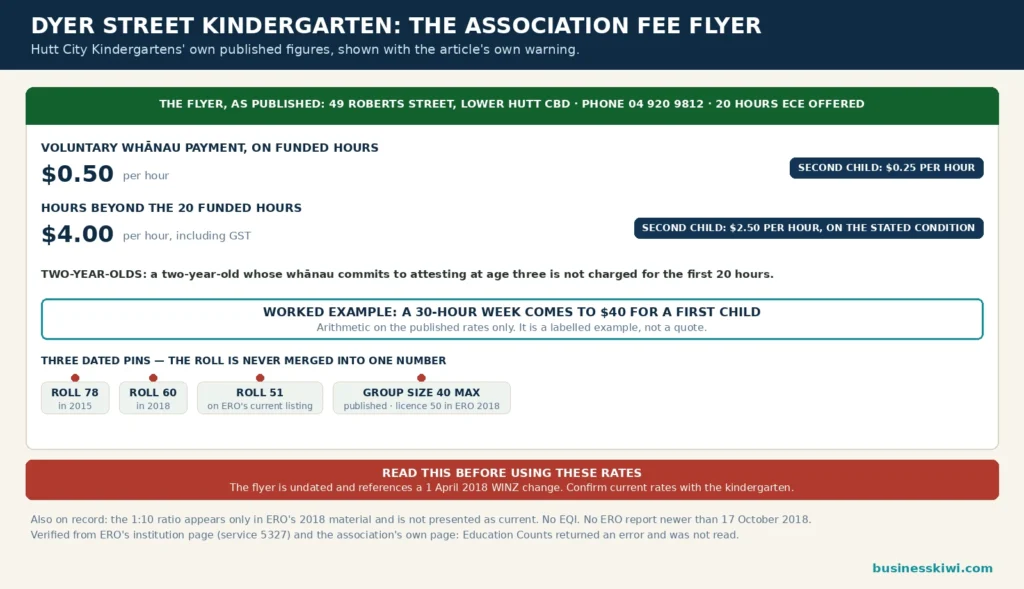
First, no compulsory fee can be charged for hours covered by 20 Hours ECE. Instead, the association asks families to make a voluntary whānau payment of $0.50 per hour for funded hours, as a contribution towards running costs such as new resources and outdoor areas. For a child using the full 20 funded hours, that request adds up to $10 a week, and it is genuinely voluntary: the flyer is explicit that it is not a compulsory fee. Families with more than one child at kindergarten at the same time are asked for $0.25 per hour for the second and any additional children. The payment counts as a donation for tax purposes, and the kindergarten will provide a receipt on request that can be used to claim a tax credit.
Second, hours beyond the funded 20 are charged. If a child attends more than 20 hours a week, or the family spreads the child’s 20 Hours ECE across more than one service so that some kindergarten hours fall outside the funding, the association charges a fee of $4.00 per hour including GST for those additional hours. Families with more than one child who use their full 20 Hours ECE entitlement with the association for all their children pay a discounted rate of $2.50 per hour including GST for the second child. At Dyer Street, the maths for a full week is simple to follow: five days at six hours is 30 hours, of which 20 can be funded, leaving 10 hours charged at $4.00, which comes to $40 a week for a first child attending every day, before any voluntary whānau payments the family chooses to make. A child attending three days a week, 18 hours, sits entirely inside the funded entitlement and would have no compulsory fee at all.
Third, two year olds are handled in a way that surprises some parents. Two year olds are not eligible for 20 Hours ECE, which starts at age three. The association’s flyer says that if a child is aged two when they start, and the family confirms the child will use their 20 Hours ECE at the kindergarten once they turn three, the family will not be charged a fee for the first 20 hours. In other words, the kindergarten carries the same no-fee position for two year olds who are committed to staying on, rather than charging for the year before funding begins. Hours beyond 20 in a week for a two year old would still attract the hourly fee.
The fine print is worth a quick read. Fees are charged for each session a child is enrolled to attend, even if the child is absent, and for public holidays falling in a regular kindergarten week. If a child is absent through illness for more than five consecutive days they would normally attend, the family can ask for a refund, supported by a medical certificate. Fees are invoiced at the start of each week with payment due the following Monday, and families sign a fee contract when they complete the enrolment form. The association asks for two weeks’ notice when a child is leaving. Families on lower incomes may be able to get help through the WINZ Childcare Subsidy, and the flyer suggests asking the kindergarten administrator about it.
One caution belongs in this section, stated plainly. The flyer is the association’s published fees information and it is the source for every figure above, but the document itself is not dated and one of its references, to WINZ income brackets, is to a change made on 1 April 2018, so it may not be the most recent version of the association’s fees material. The flyer itself says the current fee level is always advertised on the kindergarten notice board, and that families will be given at least 10 weeks’ notice of any change to the fee. So treat the $4.00 hourly figure as the association’s published rate, and confirm the current figure with the kindergarten before relying on it for budgeting. No other fee figure for this kindergarten is quoted in this profile, and fee figures that circulate on third-party listing sites are not used here.
What ERO found
The most recent ERO report for Dyer Street Kindergarten itself is the Education Review dated 17 October 2018, with the review team on site in September 2018. It was written under ERO’s previous review framework, which asked how well placed the service was to promote positive learning outcomes for children, and it set the next review for three years, the timeframe ERO attached to services it judged well placed under that framework. No newer report for this kindergarten appears on ERO’s institution page, which now directs readers to material about the governing organisation; parents should read the 2018 findings as a considered snapshot of the kindergarten at that time rather than a current verdict, and can ask the kindergarten what has changed since.
The 2018 findings were positive about the experience children were having. Reviewers described children benefiting from a busy, joyful learning environment, challenged to try new experiences and explore nature, with building children’s social competence and friendship skills identified as a clear focus and a strength. Teachers were found to learn and play alongside children, respond to their interests and extend their ideas through rich conversation. New children and their families were warmly welcomed, teachers purposefully built strong, trusting relationships with parents and whānau, and a range of partnership practices supported families to contribute confidently to their children’s learning.
The report also recorded the service’s basic facts as they stood at the review. The kindergarten was licensed for 50 children aged over two, with a roll of 60 children, of whom five were Māori, in a culturally diverse community. The reported ratio of staff to children for the over-twos was 1:10, meeting minimum requirements. On qualified teachers, ERO’s information table recorded 80 percent or more, while the report’s narrative described the teaching staff as fully qualified; both statements are ERO’s, and the difference is best understood as the table recording a regulatory band while the narrative described the team in place at the time. A new head teacher had been appointed in 2016.
The next steps ERO and the kindergarten agreed on in 2018 were to improve the bicultural curriculum, continue building culturally responsive practice, particularly for Māori and Pacific learners, and embed the new assessment, planning and evaluation system. The 2015 report had made similar points, and the 2018 reviewers recorded that progress was evident while cultural responsiveness remained an area for further development. Parents visiting in 2026 can reasonably ask the teaching team how that work has developed since, since it was the clearest thread running through both reports.
The teaching team
The kindergarten’s website publishes its current team by first name and role. The Head Teacher is Catherine. The teachers are Charlotte, Linda, Sasha and Maree, and the kindergarten administrator is Beth. First names only are published, which is the association’s house style across its kindergarten pages, and no surnames are given here for the same reason.
A team of a head teacher plus four teachers against a published group size of 40 is consistent with the ratio ERO recorded in 2018, 1:10 for children over two, although the kindergarten’s own website does not publish a current ratio and this profile does not present one as current. What can be said from the published record is the shape of the team: a named head teacher, a settled group of teachers rather than a single teacher with relievers, and a dedicated administrator, who is the person families deal with over enrolment paperwork and fees. ERO in 2018 described the head teacher as promoting professional trust, discussion and debate, with opportunities for teachers to take on leadership roles according to their strengths, and the teaching team as reflective and improvement focused. Whether the individuals ERO described are the same people in the current team cannot be confirmed from the permitted sources, since ERO did not name the head teacher it referred to, and the website’s first names cannot be matched to 2018 staff with certainty. The current names above are the kindergarten’s own published team at the time of writing.
Enrolling: what to do next
The enrolment pathway runs through the association’s website, which carries an online enrolment enquiry form. The form asks for the parent or caregiver’s details, the child’s details including date of birth, the kindergarten the family wants to enrol at, and the desired days of enrolment across the week. Families can also contact the kindergarten directly on 04 920 9812, by email at htdyerst@huttkindergartens.org.nz, or through the association’s head office on 04 920 9800.
On the paperwork side, the association’s fees information explains two linked steps. Completing the enrolment form includes signing the declaration about how the child’s 20 Hours ECE will be used, which is the legal agreement the Ministry of Education requires, and there is no waiting period once the form is complete: the funded hours can start straight away. Families also sign a fee contract as part of enrolment, covering any hours beyond the funded entitlement. If a family later wants to change how the child’s 20 Hours ECE is used, for example because the child starts at another service as well, they need to tell the teaching team immediately and sign an updated agreement.
A few questions are worth asking before you commit. Ask whether there is a waiting list for your preferred days, since the published group size is 40 and the roll ERO lists is 51 across the week. Ask how the kindergarten handles the step up from part-week to full-week attendance for younger children. Ask for the current fee for hours beyond the funded 20, given the published flyer may not be the latest version, and ask how the voluntary whānau payment works in practice. Ask about the starting age for your child if they have only just turned two, and about what happens at the end of the day and across the term breaks if your family needs care beyond 2:30pm or outside term time, because the kindergarten does not provide it. And visit during a session if you can. The feel of the room and the outdoor area at full roll will tell you more than any profile can.
Frequently asked questions
Where is Dyer Street Kindergarten?
It is at 49 Roberts Street in Epuni, Lower Hutt. The Ministry of Education service number is 5327, the phone number is 04 920 9812 and the email is htdyerst@huttkindergartens.org.nz.
What ages does Dyer Street Kindergarten take?
Children aged over two years. The service is licensed for children over two, with no children under two, and the association offers places for children aged 2 and over at all of its kindergartens. Children generally stay until they start school at five.
What are the session times?
One session shape only: Monday to Friday, 8:30am to 2:30pm, in school terms. There is no shorter morning session and no before or after session care published by the kindergarten.
How many children attend, and what is the ratio?
The kindergarten publishes a group size of 40 maximum, against a licence that allows 50 children aged over two. ERO’s current listing shows a roll of 51 across the week. ERO reported a ratio of 1:10 for children over two in 2018; the kindergarten’s own website does not publish a current ratio.
How much does Dyer Street Kindergarten cost?
For three, four and five year olds, the first 20 hours a week are covered by 20 Hours ECE with no compulsory fee; the association asks for a voluntary whānau payment of $0.50 per hour towards running costs. Hours beyond 20 in a week are charged at $4.00 per hour including GST on the association’s published fees flyer, or $2.50 per hour for a second child in a family using its full entitlement with the association. Confirm the current fee at the kindergarten, because the published flyer may not be the latest version.
Does it offer 20 Hours ECE?
Yes. The association offers 20 Hours ECE at its kindergartens, up to six hours a day and 20 hours a week for three, four and five year olds. You claim it by signing the declaration on the enrolment form, and it can start as soon as the form is complete.
What did ERO say about Dyer Street Kindergarten?
ERO’s most recent report for the kindergarten, dated 17 October 2018, found a busy, joyful learning environment, strong relationships with families, and social competence as a clear strength. It set the next review for three years and agreed next steps with the kindergarten around the bicultural curriculum, culturally responsive practice, and embedding its assessment and planning systems. No newer report for the service appears on ERO’s website.
How do I enrol my child?
Complete the enrolment enquiry form on the Hutt City Kindergartens website, choosing Dyer Street and your desired days, or contact the kindergarten directly. You will complete an enrolment form covering the 20 Hours ECE declaration and sign a fee contract. Ask about availability for your preferred days, because the daily group is capped at 40 by the kindergarten’s own published group size.
Sources
- Hutt City Kindergartens, Dyer Street Kindergarten: https://www.huttkindergartens.org.nz/page/dyer-street
- Hutt City Kindergartens, Home (association overview and enrolment enquiry): https://www.huttkindergartens.org.nz/
- Hutt City Kindergartens, Fees and Whānau Payments (PDF flyer): https://www.huttkindergartens.org.nz/site_files/20879/upload_files/Feesandwhanaupaymentinfoflyer(1).pdf?dl=1
- Education Review Office, Dyer Street Kindergarten institution page, including the Education Review reports dated 17 October 2018 and 10 September 2015: https://ero.govt.nz/institution/5327/dyer-street-kindergarten
This article is general information about Dyer Street Kindergarten, drawn from the official sources listed above at the time of writing. Fees, hours, term dates, staffing and ERO findings change over time, and ERO reports reflect the service as it was when the review team visited. Confirm the details that matter to your family directly with the kindergarten before making enrolment decisions.