Avalon Kindergarten in Lower Hutt: Sessions, Fees and What Families Can Expect
Avalon Kindergarten sits on Walters Street in Avalon, Lower Hutt. It is one of the 22 kindergartens run by Hutt City Kindergartens, the not-for-profit association that says it has been part of growing up in the Hutt Valley for 95 years. It runs a single daily session, 8.30am to 2.30pm, Monday to Friday, in term time, with a published group size of 30 children at most. Families come to it from across the Hutt Valley, the kindergarten says, helped by a central location and by the fact that Hutt City Kindergartens does not zone its kindergartens. Any family can enrol at any of them.
This profile brings together what the association itself publishes about Avalon: who teaches there, how the session and term are organised, how its fees and voluntary whānau payment work, what children do during the day, and how enrolment and the waiting list operate. Where a figure could not be verified on an official page, this article says so rather than filling the gap. Two gaps matter. The Education Counts profile could not be loaded, so the current roll and licensed number of child places are not stated below. The Education Review Office report could not be retrieved either, so no ERO judgement is quoted. Everything else traces to pages published by Hutt City Kindergartens and read in full.
Avalon Kindergarten at a glance
Where Avalon Kindergarten is, and who runs it
Avalon Kindergarten is at 25 Walters Street in Avalon, Lower Hutt, postcode 5011. The kindergarten describes its location as central, and says families travel to it from across the Hutt Valley. It also says it has relationships with several local primary schools, which matters when children move on to school.
The kindergarten is not a standalone centre. It is one of 22 kindergartens operated by Hutt City Kindergartens across the Hutt Valley, including Upper Hutt, Stokes Valley, Central Hutt, the Western Hills and Wainuiomata. The association’s legal name, as listed in the Ministry of Education’s glossary of kindergarten associations, is Hutt City Kindergartens Association Incorporated. It is not-for-profit, and says so in its own tagline: for your child, not for profit. Its head office is on Witako Street in Epuni, Lower Hutt, contactable on 04 920 9800.
That structure shapes how Avalon works. Session times, term dates, fees, enrolment and the curriculum framework are set at association level for the whole network, while the day-to-day life of the kindergarten, its teachers, its waiting list and its grounds belong to the individual kindergarten. Fees and term dates below are therefore the association’s published position for its sessional kindergartens, Avalon included. The forest, bridge and playhouse described later are Avalon’s own, in the kindergarten’s own words.

The kindergarten day: sessions, group size and terms
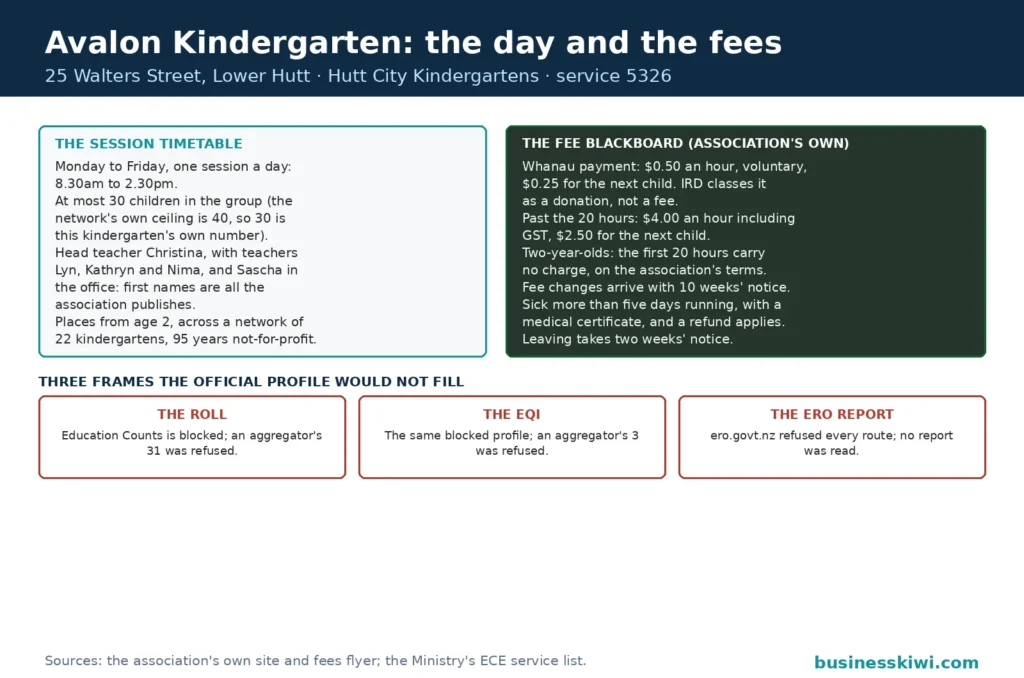
Avalon Kindergarten runs one session a day, 8.30am to 2.30pm, Monday to Friday. That is a six-hour session, and the length matters for fees, because 20 Hours ECE can cover up to six hours in a single day. A five-day child is at kindergarten for 30 hours a week, 20 inside the funded entitlement and 10 outside it. A three-day child is there for 18 hours, all inside the entitlement. The fees section works through both patterns.
The published group size at Avalon is 30 children at most. Read that figure for what it is: the association’s stated maximum group size for this kindergarten, not a roll and not a licence number. The association says the maximum session size across its kindergartens is generally 40, so Avalon’s figure of 30 is specific to this kindergarten. The roll, the number actually enrolled, is a different figure, and it could not be verified because the Education Counts profile would not load. Families who want the current roll or licensed capacity should ask the kindergarten directly.
Avalon is a term-time kindergarten, following the association’s termly calendar rather than the all-year calendars some other kindergartens in the network use. Its published 2026 term dates are: Term 1, 22 January to 2 April; Term 2, 20 April to 3 July; Term 3, 20 July to 25 September; and Term 4, 12 October to 18 December. Those dates sit close to primary school terms.
During term breaks, the association runs a Holiday Kindergarten for families enrolled at its term-time and all-year kindergartens. The locations change from break to break and are advertised at the start of each term, and the association stresses that early enrolment is essential because places are limited. A family relying on cover through the school holidays should therefore plan ahead rather than assume a place at Avalon itself, because the holiday programme may run from a different kindergarten in the network that term.
Fees, the whānau payment and 20 Hours ECE
Kindergarten fees confuse many families because three different things happen at once: a government entitlement, a voluntary payment the association asks for, and a fee that applies only to hours outside the entitlement. Avalon, as one of the association’s 19 sessional kindergartens, sits under the standard structure. Three kindergartens in the network, Fetu Ao, Nettie Riley and Titiro Whakamua, have different fee structures, but Avalon is not one of them.
Start with 20 Hours ECE, the government scheme under which children aged three, four and five at teacher-led services can receive up to 20 hours a week of early childhood education with no compulsory fee, up to six hours per day. Families claim it through the enrolment form, whose declaration tells the Ministry of Education how the entitlement will be used, and once the form is completed there is no waiting period. The entitlement can be split across more than one service within those daily and weekly limits, and unused hours cannot be carried forward.
Within those funded hours, the association asks every family to make a voluntary whānau payment of $0.50 per hour, dropping to $0.25 per hour for a second or subsequent child attending at the same time. The word voluntary is doing real work: the association’s fees flyer states that no compulsory fee can be charged for 20 Hours ECE hours, and that this payment is asked for rather than required. The flyer says it goes towards new resources and improving outdoor areas, and the association links it to its commitment to fully qualified teachers. The payments are classed as a donation by Inland Revenue, with a receipt available on request for tax credit purposes.
Hours outside the entitlement are charged. If a child attends more than 20 hours a week, or the family spreads 20 Hours ECE across more than one centre so that some Avalon hours fall outside it, the extra hours cost $4.00 per hour including GST, dropping to $2.50 for a second or subsequent child using their full entitlement with the association. The association promises at least 10 weeks’ notice of any fee change, and says the current fee is always advertised on the kindergarten notice board.
Two-year-olds are treated separately. A two-year-old whose family confirms they will use their 20 Hours ECE at the kindergarten once the child turns three is not charged a fee for the first 20 hours, though the family will be asked for the whānau payment that would apply once the child is using the entitlement.
The association’s fees flyer adds the conditions underneath those headline rates. Fees are charged for any public holiday in a regular kindergarten week, and for each session a child is enrolled to attend, even if absent. If a child is away ill for more than five consecutive days on which they would normally attend, the family can ask for a refund, with a medical certificate to support the request. Fees are invoiced at the start of each week, due the following Monday. Families sign a fee contract on enrolment, a late fee may apply if children are repeatedly collected late, and two weeks’ notice is asked when a child leaves.
Worked examples help, using only the published rates and simple arithmetic. A child attending five days a week is enrolled for 30 hours. Twenty sit inside 20 Hours ECE, attracting the voluntary payment of $0.50 an hour, $10 a week if paid in full. The remaining 10 hours are charged at $4.00 an hour, $40 a week. The total is $50 a week, $10 of it voluntary. A child attending three days is enrolled for 18 hours, all inside the entitlement, so there is no fee, and the voluntary payment, if paid in full, is $9 a week. A second child attending five days alongside a sibling comes to $30 a week at the discounted rates. These are illustrations from the published rates, not quotes: the actual invoice depends on how a family attests its 20 Hours ECE.
Help with fees exists beyond the kindergarten’s own structure. The association points families to the Work and Income Childcare Subsidy, by brochure at the kindergarten, by phone or on its website. Eligibility is a Work and Income decision, and no subsidy rates or thresholds are given here, because the association does not publish them and they change.
What children learn and do at Avalon
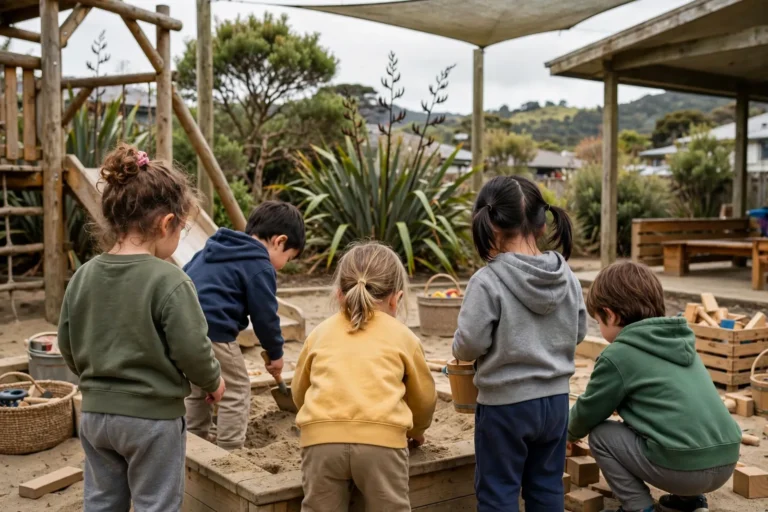
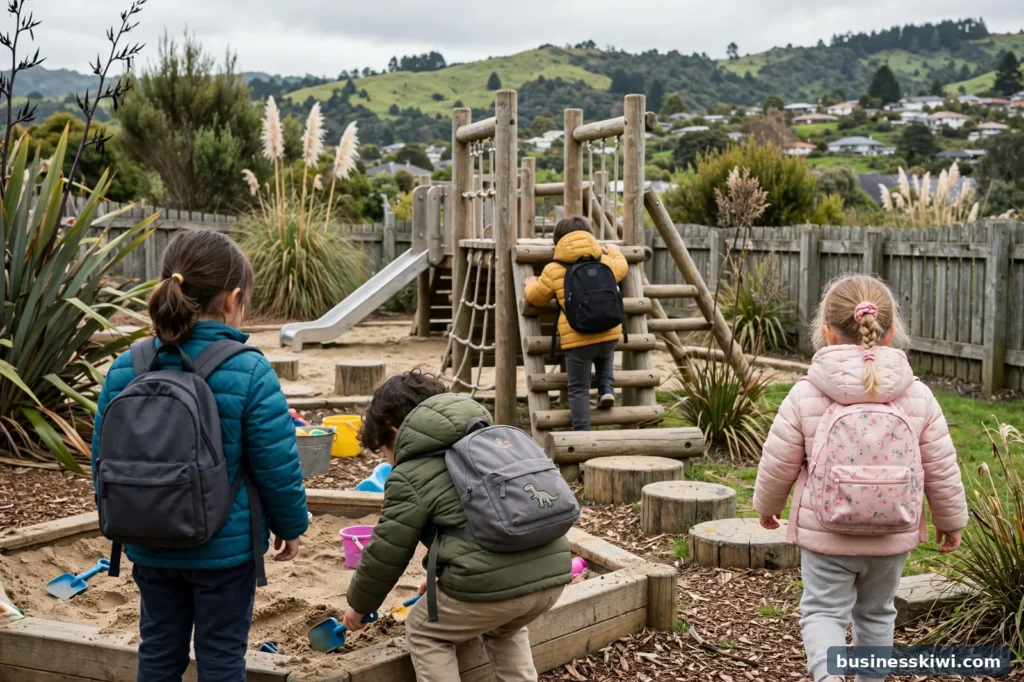
Avalon’s own description leads with place. It has a spacious outdoor area, developed with native plantings and rocks to give it a distinctively New Zealand character, with a forest area, a bridge, a playhouse and vegetable planters connecting children with nature. Inside, the environment is arranged for exploration, with creative art spaces, books, technology and literacy areas. Its teachers, the kindergarten says, are friendly and experienced, and actively engage with children to support their learning.
Underneath that local description sits the association’s philosophy. It says it is inspired by Froebelian philosophy, valuing play, creativity and the natural world, in warm, inclusive environments where manaakitanga and whanaungatanga sit at the heart of the work. The belief in a child’s right to play is, in its words, at the heart of its programmes. Play that looks simple from the gate is deliberately supported by teachers introducing new and challenging experiences based on children’s interests. Through play, the association says, children learn to share and cooperate, make friends and ask for help, building independence, concentration, perseverance, creativity and curiosity.
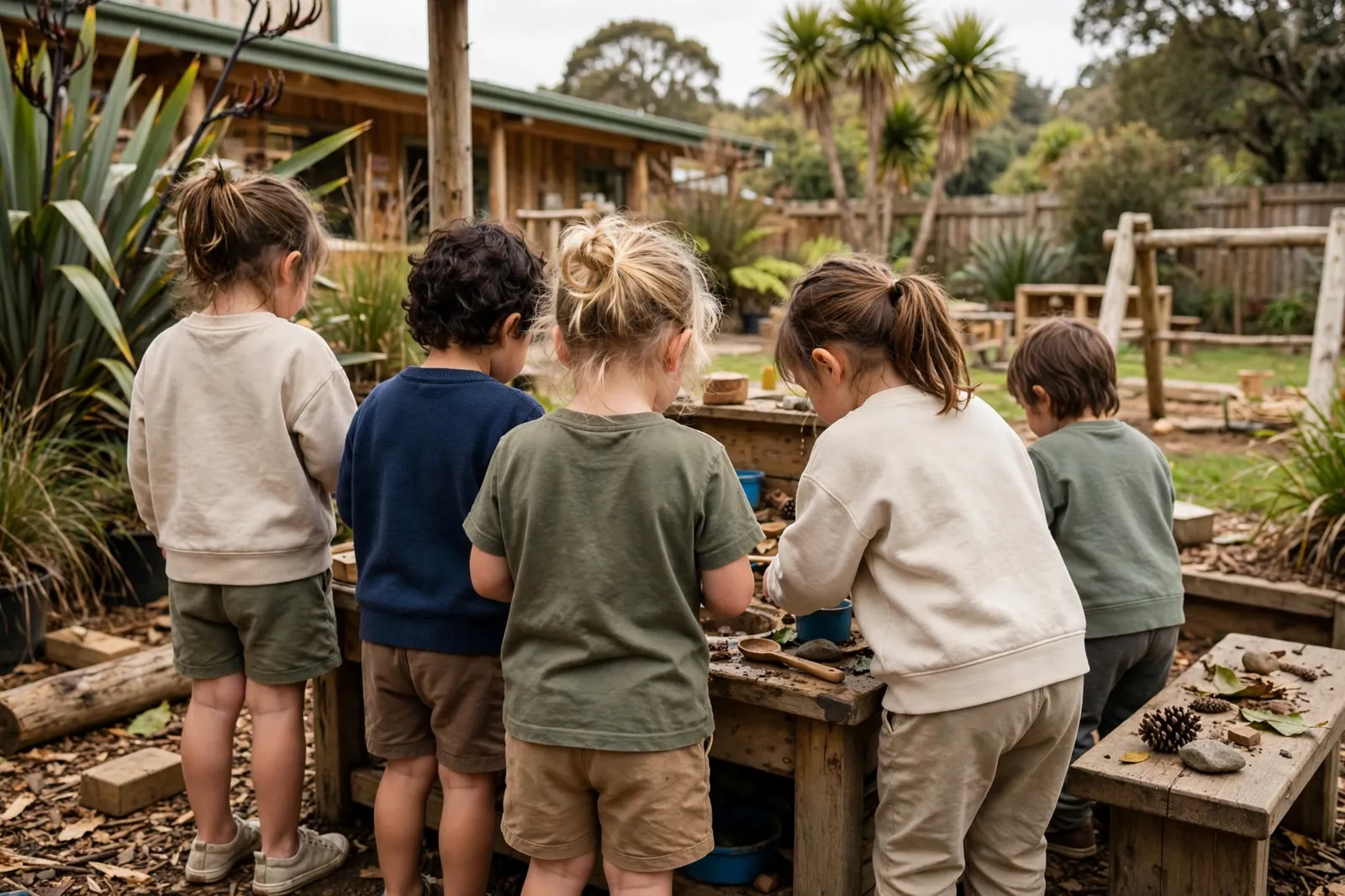
The formal curriculum is Te Whāriki, the national early childhood curriculum. The association’s curriculum page describes a core programme spanning music and movement, language and literature, science and nature, art, carpentry, construction, active play, sensory activities, sand, water, maths, puzzles, blocks, dramatic play and technology. Teachers build programmes around what they observe in each child, work alongside the child to extend strengths and interests, and review programmes regularly in partnership with parents. Activities reflect the cultural diversity of attending families, supplemented at times by community visitors and excursions. The learning through play page lists the everyday activity types: sand and water, blocks, playdough, art, gardening, drama, music, messy play, cooking, outdoor play, carpentry and puzzles. For a parent picturing an Avalon day, that list, plus the forest, playhouse and vegetable planters, is the most concrete published picture of what a child will spend time doing.
The teaching team
The association publishes Avalon’s team by first name. The head teacher is Christina. The other teachers listed are Lyn, Kathryn and Nima, and the kindergarten administrator is Sascha. No surnames are published, so none are given here. Families who need a surname, for a funding form for example, should ask the kindergarten.
What the association does publish, at network level, is its staffing standard. It says all its teachers are fully qualified, holding at least a Diploma in Early Childhood Teaching, are certificated and registered, and hold current first aid certificates. It also employs a speech-language therapist and early intervention staff who support children’s learning. The whānau payment is explicitly linked by the association to supporting that commitment to fully qualified teachers.
For children with individual learning or developmental needs, the association says it works closely with families and has strong connections with agencies and specialists who can offer additional support, and it directs parents to the head teacher with questions. Two smaller points from its frequently asked questions are worth recording: a child does not have to be toilet-trained to attend, and the team will work with the family on that stage; and a child does not have to be fully immunised to attend.
Enrolling, the waiting list and getting a place
Enrolment begins with a pre-enrolment form. The association’s online enquiry form collects the caregiver’s details, the child’s details including birth date, the kindergarten the family wants, and the desired days. A member of the kindergarten team then makes contact, and the enrolment forms themselves are completed in person at the kindergarten.
Timing is the part families most often get wrong, because enrolment rewards starting early. The association’s advice is to enrol a child when they turn two. The child then goes on the waiting list, the kindergarten keeps in touch with newsletters, updates and invitations to family events, and the family is contacted when a space becomes available. A start date will most likely fall near the child’s third birthday, although at some kindergartens children start earlier, and the actual start depends on the waiting list at the chosen kindergarten.
The waiting list is managed by the head teacher. The child’s age is usually the main factor in when they start, but time on the list, family needs, and whether the child already attends another early childhood service also count. Places open up as children turn five and leave for school. Families can join more than one waiting list across the network, and the association asks them to tell the other kindergartens once they accept a place, and to stay put once a child has started, for stability and friendships.
There is no zoning. Families can enrol at any of the 22 kindergartens, and the association encourages visiting several before deciding, by phoning ahead or calling in during session time. An Avalon family is equally free to compare Avalon with nearby kindergartens in the network before committing.
One practical extra deserves a mention. The association runs a van service that picks up and collects children, free for families whose children would otherwise not be able to attend. The vans, two of them, can only serve the areas of greatest need. Eligibility and seats are questions for the head teacher.
Settling in, and the move to school
The association publishes a settling-in guide for new families, and its advice is practical rather than sentimental. Explore the kindergarten together slowly during the first session. Help the child hang up their own bag, find where lunchboxes are stored, and locate the toilets and hand-washing facilities. Join in activities alongside the child at first. Then, as confidence grows, step back gradually, extend the time the child spends there without you, tell the child when you will be back, and tell the teacher you are leaving so they can support the child through it. The guide is honest that tears happen, that settling takes time with some children, and that parents are welcome to phone to check how a child is doing.
Parents do not have to stay, and the choice is theirs. Whānau are welcome at any time. Families can also be involved more formally: as parent helpers reading stories, helping with puzzles or baking, sharing a skill, accompanying trips, helping with gardening or working bees, or joining the Parent Group. Every kindergarten has a Parent Group that shares in the management of the centre alongside the teachers, discussing the programme, looking after grounds and buildings, organising social events and fundraising.
The other transition, out of kindergarten and into school, is built into the programme. The association’s preparing for school page says kindergarten programmes link directly to the learning areas of the primary curriculum, with many reading, writing and maths experiences, and teachers working on communication, perseverance, problem solving, fine motor skills, responsibility, social skills, curiosity, and early literacy and numeracy. Kindergartens work closely with local schools, often making exchange visits, and teachers run a transition programme for each child moving on. Avalon’s own page notes its relationships with several local primary schools, the local end of that approach. The association can also provide information on local schools and help organise school visits.
What about the ERO report and the roll?
Most profiles of this kind summarise the service’s Education Review Office report and its official roll. This one does not, and the reason is access, not judgement. ERO’s website returned an access error on every route tried, and no ERO report for Avalon Kindergarten was read, so no ERO finding or recommendation is stated anywhere in this article. Treat any ERO claim about this kindergarten on a third-party directory site with caution until you have read the report itself on ERO’s site.
The same applies to the roll and licensed capacity. The Education Counts profile, which holds the official maximum licensed child places, could not be loaded either, so no roll, licensed places figure or equity index is stated. The figures this article does give, a group size of 30 maximum and service number 5326, come from the association’s own site and the Ministry’s published service numbering, and each is labelled for what it is. A parent who needs the official numbers today can ask the kindergarten administrator, or open the Education Counts profile directly when it is accessible.
Frequently asked questions
Where is Avalon Kindergarten?
Avalon Kindergarten is at 25 Walters Street, Avalon, Lower Hutt 5011. The kindergarten describes its location as central, with families travelling from across the Hutt Valley. There is no enrolment zone, so families from any suburb can enrol there.
What are Avalon Kindergarten’s session times?
Sessions run Monday to Friday, 8.30am to 2.30pm. Avalon is a term-time kindergarten. The published 2026 terms run from 22 January to 2 April, 20 April to 3 July, 20 July to 25 September, and 12 October to 18 December. A Holiday Kindergarten operates in term breaks from locations advertised each term.
How much does Avalon Kindergarten cost?
Hours inside 20 Hours ECE carry no compulsory fee. The association asks for a voluntary whānau payment of $0.50 per hour for those hours, dropping to $0.25 per hour for a second or subsequent child. Hours beyond 20 in a week are charged at $4.00 per hour including GST, or $2.50 per hour for a second or subsequent child using their full entitlement with the association. A five-day child, enrolled for 30 hours a week, therefore costs $40 a week in fees plus $10 a week in voluntary payment if the family pays it in full.
What is the whānau payment, and do I have to pay it?
The whānau payment is a voluntary contribution towards the cost of running the kindergartens, including resources, outdoor areas and fully qualified teachers. It is $0.50 per hour for hours under 20 Hours ECE, and it is not compulsory: no compulsory fee can be charged for those hours. The payments are classed as a donation by Inland Revenue, with a receipt available on request.
When should I enrol my child at Avalon Kindergarten?
Enrol when your child turns two. That puts them on the waiting list, keeps your family in touch through newsletters and events, and means you are contacted when a place opens. Most children start near their third birthday, depending on the waiting list, which the head teacher manages by the child’s age, time on the list, family needs and any other service attended.
Does my child have to be toilet-trained or fully immunised to start?
No to both, on the association’s published answers. The teaching team will work with your family on toilet learning, and children do not have to be fully immunised to attend.
Who are the teachers at Avalon Kindergarten?
The association lists the head teacher as Christina, with teachers Lyn, Kathryn and Nima, and Sascha as administrator. It publishes first names only, so no surnames appear here. Across the network, all teachers are said to be fully qualified, certificated and registered, with current first aid certificates.
What will my child do during the day at Avalon Kindergarten?
Learning is through play, under Te Whāriki, the national early childhood curriculum. Avalon’s description highlights its outdoor area with native plantings, a forest with a bridge, a playhouse and vegetable planters, and indoor spaces for art, books, technology and literacy. The programme spans music and movement, science and nature, carpentry, construction, sand and water, maths, puzzles, blocks, dramatic play and cooking, shaped around each child’s interests.
Sources
- Hutt City Kindergartens, Avalon Kindergarten page: the kindergarten’s own description, address, phone, mobile, email, staff first names, group size of 30 maximum and session times.
- Hutt City Kindergartens, home page: the association’s philosophy, its 22 kindergartens, places for children aged 2 years and over, 95 years in the Hutt Valley, not-for-profit status and the enrolment enquiry form.
- Hutt City Kindergartens, Fees and Whānau Payments page: the sessional kindergarten fee structure, 20 Hours ECE, the $0.50 and $0.25 whānau payments, the $4.00 and $2.50 hourly fees including GST, the two-year-old position and Work and Income help.
- Hutt City Kindergartens, Fees and Whānau Payments flyer (PDF): fee conditions, including the 10 weeks’ notice of fee changes, fees charged for public holidays and enrolled sessions, illness refunds after more than five consecutive days, invoicing, the fee contract and two weeks’ notice of leaving.
- Hutt City Kindergartens, Enrolling Your Child page: the pre-enrolment process, enrolling at age two, waiting list contact and start dates near the third birthday, and the absence of zoning.
- Hutt City Kindergartens, Kindergarten Term Dates and Hours page: Avalon listed among the termly kindergartens, the 2026 term dates, the session time bands and the Holiday Kindergarten.
- Hutt City Kindergartens, Frequently Asked Questions page: waiting list management by the head teacher, teacher qualifications, toilet training and immunisation positions, the van service, parent involvement and how concerns are raised.
- Hutt City Kindergartens, Our Curriculum page: Te Whāriki, its five strands, the core programme areas and how teachers build programmes around each child.
- Hutt City Kindergartens, Learning Through Play page: the play philosophy and the published list of activity types.
- Hutt City Kindergartens, Starting Kindy page: the settling-in guidance for new families.
- Hutt City Kindergartens, Preparing for School page: transition to school, exchange visits with local schools and the skills the programme develops.
- Hutt City Kindergartens, About Us page: the association’s offer to families, qualified teachers, maximum session sizes across the network and its promises to families.
- Hutt City Kindergartens, Get Involved page: parent helpers and Parent Groups.
- Hutt City Kindergartens, Choosing a Kindy page: visiting kindergartens before deciding.
- Ministry of Education, Education Counts directory: the profile for this service, service number 5326, could not be loaded for this research (access error on every route); no roll, licensed places or equity index figure is taken from it.
- Education Review Office: the report for this service could not be retrieved for this research (access error on every route); no ERO finding is stated in this article.
This article is general information about Avalon Kindergarten and Hutt City Kindergartens, based on the association’s own published pages as read in October 2026. Fees, session times, term dates, staffing and waiting list positions change, and the association’s published fee is the one advertised on the kindergarten notice board. Confirm the details that matter to your family, including current fees, availability and start dates, directly with Avalon Kindergarten or Hutt City Kindergartens before making enrolment decisions.