Lakeview Kindergarten: Fees, Hours and What Parents Need to Know
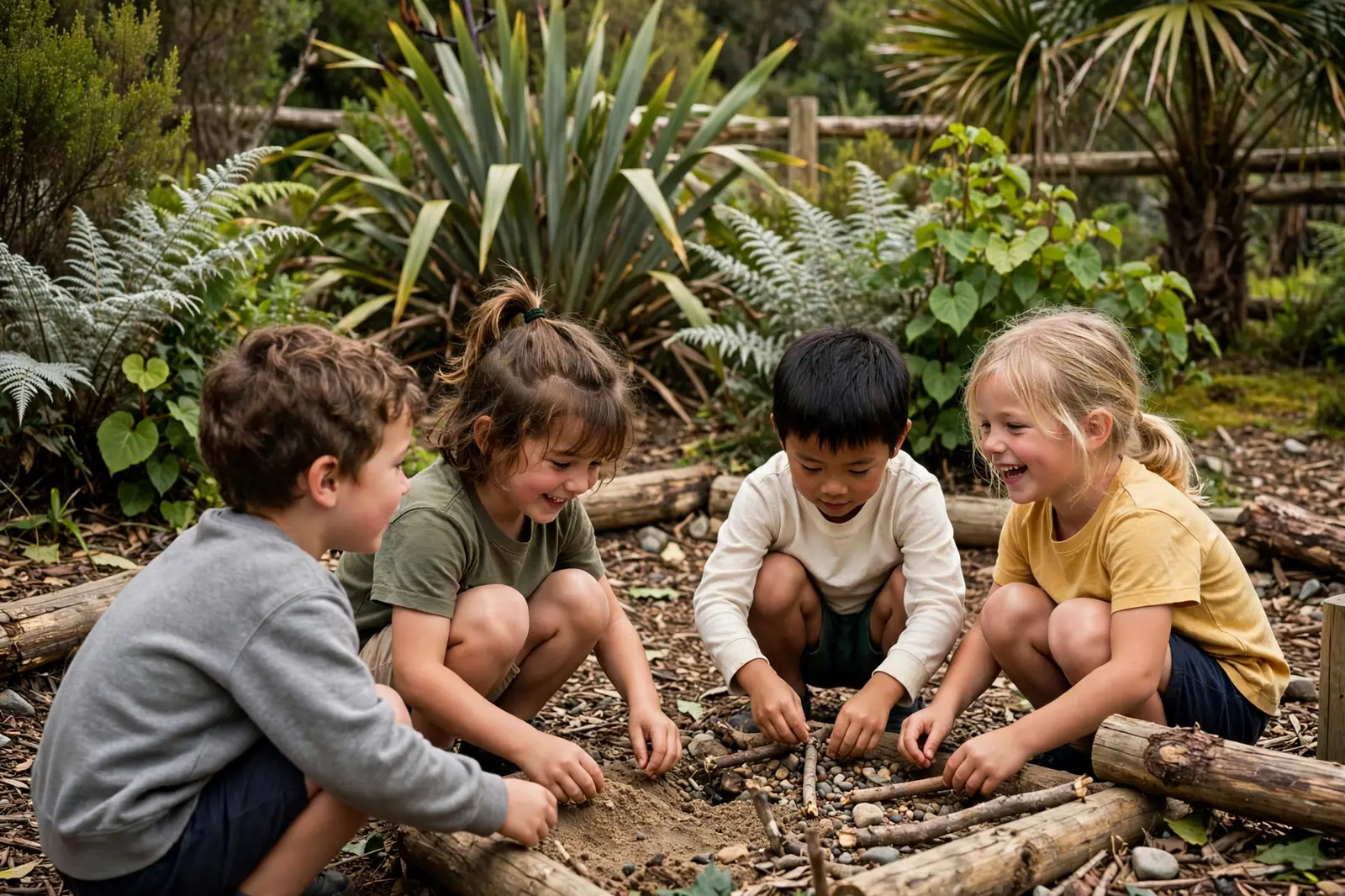
Lakeview Kindergarten is a free kindergarten on Lake View Road in Waipukurau, the main town of Central Hawke’s Bay. It is one of 16 kindergartens governed and managed by the Heretaunga Free Kindergarten Association, and it has a character that sets it apart from many town kindergartens: it is an Enviroschool with a bush programme, a philosophy built around mindfulness and calm, and a teaching team that ERO last evaluated in 2023. For parents in Waipukurau and the surrounding districts, the practical questions are the usual ones. What hours does it keep, what does it cost, who teaches there, and what did the Education Review Office find?
This profile answers those questions from the official record: the Education Review Office (ERO) institution page for the service, which carries its most recent Akarangi quality evaluation, and the Heretaunga Kindergartens website and 2026 whānau booklet for Lakeview itself. Where the two sources differ, or where a figure parents often ask about is published by neither, the article says so rather than smoothing it over. One point up front, because it drives everything else: for most families this kindergarten is free, and the fees section below explains exactly how that works and where the exceptions sit.
One identification note matters before anything else. New Zealand has another early learning service with a similar name, Lakeview Private Kindergarten in Takapuna, Auckland. That is a different, privately owned service with a different official name. Everything in this profile is about the Waipukurau kindergarten only: Lakeview Kindergarten, Ministry of Education service number 5301.
Lakeview Kindergarten at a glance
Two gaps in that table are deliberate. The kindergarten’s Equity Index (EQI) rating does not appear on the association’s website or in the ERO material read for this profile, so it is not stated here. Neither source publishes a teacher to child ratio either, so none is quoted.
A free kindergarten run by the Heretaunga association
Lakeview is not a standalone centre. It is governed and managed by the Heretaunga Free Kindergarten Association, the body behind 16 kindergartens across Flaxmere, Hastings, Havelock North and Central Hawke’s Bay. The association’s current branding shortens its name to Heretaunga Kindergartens, but it is the same organisation ERO describes. Day to day, that structure means the kindergarten’s programme, staffing and policies sit inside an association framework, while the local teaching team runs the service and holds the relationships with Waipukurau families.
The free kindergarten model shapes what parents experience. There is no owner drawing a margin from fees, sessions follow a school style day rather than childcare hours, and the association invites a small voluntary donation instead of charging for the core programme. ERO’s 2023 evaluation noted that the association had been through significant leadership change, which had slowed progress on some improvement steps from earlier reports, and that its leaders were deliberately shifting the organisation toward greater collaboration and relational trust across its kindergartens. That context matters when reading the ERO findings below: some of what ERO asked for sits with the association, not with the Lakeview team alone.
ERO also records a fact that says a lot about who this kindergarten serves: almost half of the children enrolled are Māori. Lakeview is a genuinely local service for its town, drawing from Waipukurau and the farming districts around it, and its bicultural practice is not an add-on but a central part of how ERO and the association both describe it.
Philosophy: tamariki as taonga, in a mindful and sustainable place
The kindergarten’s philosophy starts from a simple position: tamariki are taonga, treasures whose learning and development are affirmed and celebrated. Its published vision is to provide an environment where kaiako support children to engage in playful learning, in a place that is mindful and sustainable.
Several threads run through the philosophy as the association publishes it. Children learn with and alongside each other through free play, supported by teachers. The mana of each child is respected, valued and enhanced through bicultural practice. The environment is deliberately inviting, calm and nurturing, with ongoing opportunities for open ended, unhurried play. The kindergarten’s guiding whakataukī, translated on its own page as “The uniqueness of the child will guide our work”, captures the individual focus: each child is known as an individual, not processed as part of a group.
Two commitments stand out from the general kindergarten pattern. The first is mindfulness. The kindergarten fosters learning around mindfulness and promotes children’s self regulation, emotional awareness and emotional intelligence, which fits the calm atmosphere its philosophy describes. The second is the association’s stated commitment to engaging with and promoting Te Ao Māori and to meeting its commitment to Te Tiriti o Waitangi. ERO’s evaluators treated that commitment as a work in progress rather than a finished strength, and their findings on it are covered in the ERO section below.
For parents, the practical reading is of a kindergarten that runs at a deliberately gentle pace: unhurried play, an emphasis on emotional wellbeing, and nature woven through the week. Families wanting a high energy, academically pushed programme will not find that pitch here. Families wanting their child known well, outdoors often, and settled before they are stretched will recognise the intent.
The programme: play, nature and a key teacher for every child
Like every kindergarten in the association, Lakeview works from Te Whāriki, the national early childhood curriculum, delivered as a play based, localised programme. Children follow their interests through free play, with teachers supporting and extending what emerges rather than running a fixed timetable of activities.
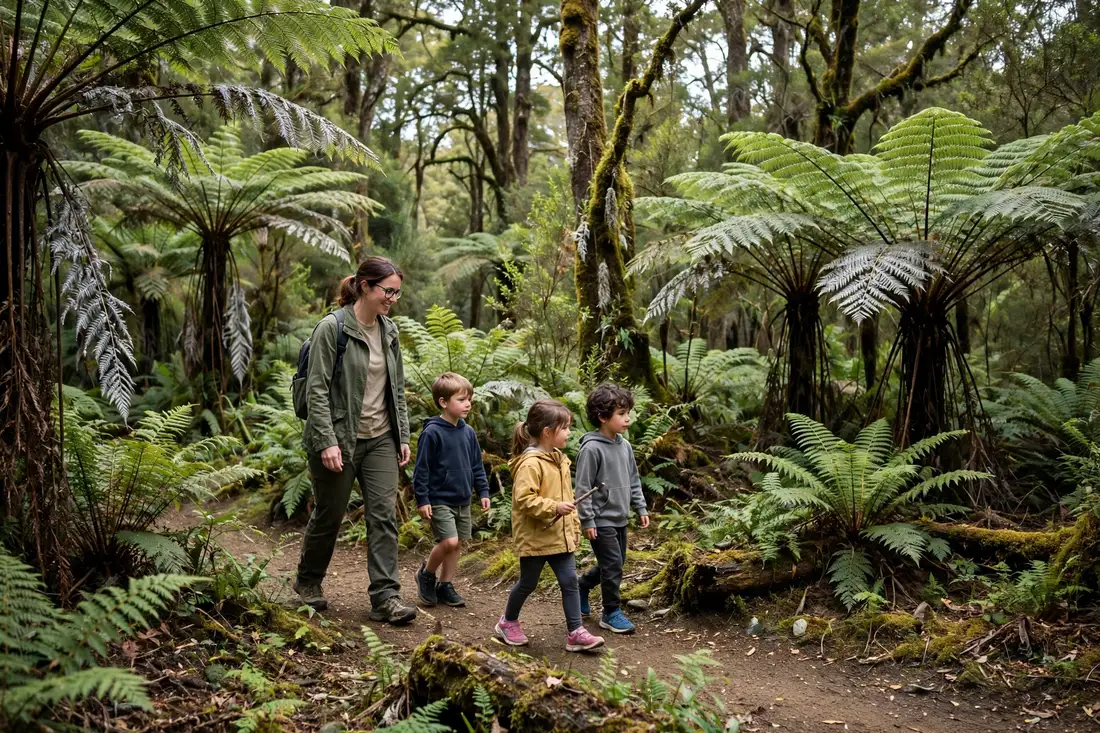
The best known feature of the programme is its connection to the local bush. Lakeview is an Enviroschool, and once a week small groups of children go on excursions to Ōtaia, the Lindsay bush area near Waipukurau, as part of its Enviroschools kaupapa. Children harvest and propagate seeds collected at Ōtaia, then care for the seedlings in a purpose built shadehouse at the kindergarten. The association describes the children as kaitiaki, guardians, and the sequence from bush to shadehouse gives that word practical content: the same children who collect the seed raise the plants it produces.
Every child at Lakeview has a key teacher and an individual plan, developed with the family to promote that child’s learning outcomes. Parents work in partnership with the key teacher, and ERO found that this partnership drives an individualised assessment process in which children’s progress and achievements are celebrated. Each child’s learning is documented in a profile book, which belongs to the child, can be taken home at any time, and can be read at the kindergarten. Alongside the book, the kindergarten uses Storypark, an online tool, to share learning between home and kindergarten as it happens.
Communication with whānau runs through several channels: daily chats, meetings with teachers, whiteboard messages, newsletters, the whānau notice board, the website and Facebook. Parents are welcome to spend time in sessions, to help on excursions, and to share their own skills with the children. The association is also explicit about why attendance matters: Ministry funding follows attendance rather than enrolment, and regular attendance is what keeps the kindergarten fully resourced, as well as building each child’s learning, friendships and routines.
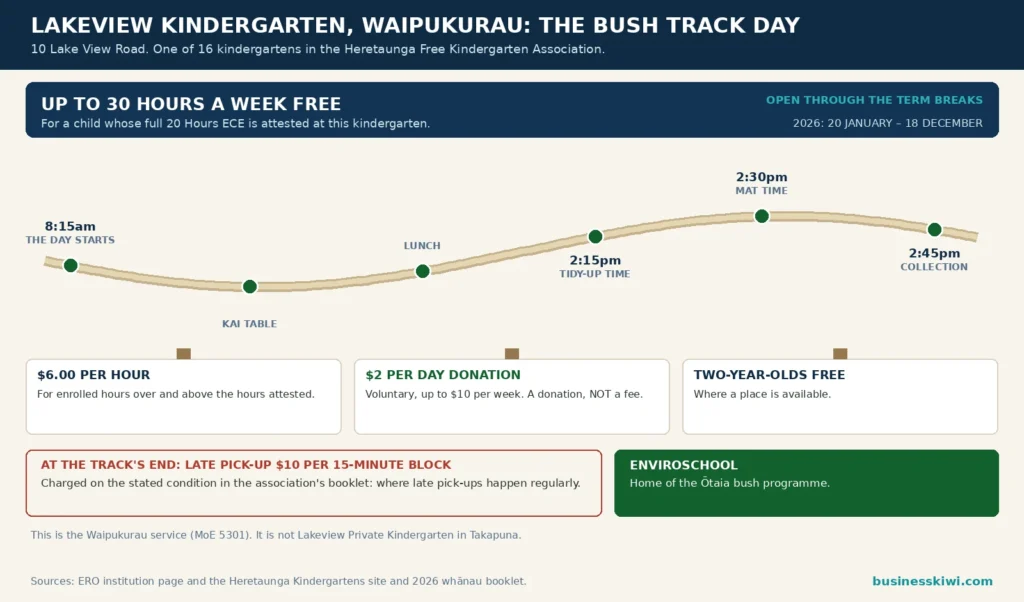
The rhythm of the day, as the association’s booklet sets it out, is simple. Children with early bookings can arrive from 8:00am. Free play curriculum experiences run through the day until tidy up time at 2:15pm. Morning tea is eaten at a designated kai table between 9:30am and 10:00am, and lunch between 12:00pm and 1:00pm, with food provided from home in lunchboxes. A group mat time follows tidy up at 2:30pm, and final collection for children booked until the end of the session is at 2:45pm.
Hours, opening dates and closures
Lakeview keeps a single, simple session pattern. It is open Monday to Friday from 8:15am to 2:45pm, a six and a half hour day, every week of its operating year. For 2026 the kindergarten is open from 20 January to 18 December.
Unlike most kindergartens, Lakeview does not close for the school holidays during the year. It stays open through the term breaks, which is a significant practical advantage for working families in Central Hawke’s Bay, because care arrangements do not collapse four times a year. The exceptions are the Christmas and summer break, statutory holidays, and a small number of kaiako professional development days.
The 2026 statutory holiday closures are Waitangi Day (Friday 6 February), Good Friday (Friday 3 April), Easter Monday (Monday 6 April), Anzac Day (Saturday 25 April), King’s Birthday (Monday 1 June), Matariki (Friday 10 July), Hawke’s Bay Anniversary (Friday 23 October) and Labour Day (Monday 26 October). The professional development closures for 2026 are Friday 17 April, the week of Monday 13 July to Friday 17 July, and Friday 9 October.
One historical note prevents confusion. ERO’s earlier report, from 2017, recorded the kindergarten as opening from 8:30am to 2:30pm. Those were the hours at that time. The hours the association currently publishes, 8:15am to 2:45pm, are the ones that apply now, and they are the hours used throughout this profile.
The session structure has the usual kindergarten implication. The day ends at 2:45pm, so families who need care into the late afternoon will need a separate arrangement for those hours. What Lakeview offers in exchange is continuity across the year: the same hours, in term time and holidays alike, from late January to mid December.
Fees and 20 Hours ECE: how a free kindergarten charges
Lakeview’s fee position is the strongest single reason many families choose it, and the association publishes the full arrangement in its 2026 whānau booklet, so it can be stated precisely.
Children aged three, four and five are eligible for 20 Hours ECE, the government scheme that funds up to 20 hours a week of early childhood education, up to six hours in a single day. At Lakeview, if a family attests their child’s full 20 hours to the kindergarten, the child is eligible for a total of 30 hours a week free. Because the kindergarten day is six and a half hours, a child attending four or five days a week with their hours fully attested pays nothing for those hours.
Two year olds are also free at this kindergarten, where a place is available, provided the family intends to use the child’s 20 Hours ECE entitlement at the kindergarten once the child turns three.
The one charge in the arrangement is precise. If a family does not attest all or any of their child’s 20 Hours ECE to this kindergarten, a fee of $6.00 per hour is charged for any enrolled hours over and above the attested hours. In practice that charge mainly affects families splitting their child’s funded hours with another service. The association invites families who have questions about donations and fees to talk with their child’s teacher.
Two smaller figures complete the picture, both from the same booklet. The association invites whānau to support the kindergarten with a voluntary donation of $2 per day, up to $10 per week, which helps cover extras beyond government funding such as outings, entertainment events and additional resources. It is a donation, not a fee, and the booklet frames it that way. And there is a late pick up fee: if a child is picked up more than 10 minutes after the end of the session and it happens regularly, a fee of $10 per 15 minute block is added to the weekly invoice.
Every figure in this section comes from the kindergarten’s own published 2026 booklet. Fees and funding settings do change, so confirm the current position with the kindergarten when you enrol, particularly if your child will attend another service as well.
What ERO found in its 2023 Akarangi evaluation
The most recent ERO evaluation of Lakeview Kindergarten is an Akarangi quality evaluation, with the review team on site in August 2023 and the report dated 3 November 2023. Akarangi is ERO’s current framework for early childhood services. It judges how well a service’s learning and organisational conditions support equitable and excellent outcomes for all children. Akarangi judgements run through stages from Whāngai (establishing) and Whakaū (embedding) up to Whakawhanake (sustaining).
ERO’s judgements for Lakeview Kindergarten were:
In narrative terms, ERO found a responsive curriculum that fosters children’s mana and supports them to take responsibility for their own and others’ wellbeing. A range of strategies was used well to promote early language development. Children with diverse learning needs were purposefully supported to participate in an inclusive learning environment. Reviewers described positive outcomes being well promoted through a learning culture where people and places are strongly connected, with children sustaining play in self directed learning that reflects their lived experiences, and parents working in partnership with their child’s key teacher on individualised assessment.
The developing side of bicultural practice was named plainly. A growing understanding of Māori ways of being and doing was beginning to foster increased use of te reo Māori within daily practices, which is the language of a service partway through that journey rather than at its end. Understanding the effectiveness and impact of teaching strategies on individual and groups of children was identified as a growing area of practice.
At association level, ERO found that significant change in association leadership had affected the capacity to progress key next steps from previous reports. Leaders were enacting an organisation wide shift toward collaboration, relational trust and sustained improvement, and professional learning was responsive to teacher goals. However, evaluation was not yet being used systematically enough in two respects: to seek evidence about whether professional learning was actually improving teaching practice and children’s outcomes, and to understand the impact of improvement actions against strategic priorities.
Four improvement actions were recorded. For the kindergarten itself: further enhance the bicultural curriculum through working in partnership with whānau Māori, and continue to deepen assessment for learning practices, evaluating the impact of teaching strategies and recognising and responding to inequities in children’s outcomes. For the association: develop a systematic process for understanding and responding to the teaching and learning needs of each kindergarten, and prioritise building internal evaluation capability and leadership at all levels.
During the review, the service addressed one non-compliance ERO identified: reviewing its emergency management plan on at least an annual basis, with improved practices implemented as required. ERO records the service as having addressed it.
The figures attached to the 2023 report belong to their moment. ERO recorded a service roll of 59 children at the time, against a licence for 40 children at any one time. Those numbers are compatible: the roll counts every child enrolled across the week, while the licence caps how many can attend on a single day. ERO’s current institution listing shows a total roll of 56, which is the more recent figure. ERO also recorded that 100 percent of the teaching team were qualified teachers.
The earlier ERO report, from December 2017 under the previous framework, judged the kindergarten well placed to promote positive learning outcomes for children, and noted the philosophy evident in practice, a well considered outdoor environment, and progress on most of the development areas set in 2014. No ERO review has been published for the service since November 2023, so the 2023 evaluation is the current official picture, read with its date in mind.
The team
The association’s Lakeview page publishes the teaching team by name, which is more transparency than many services offer. The Head Teacher, titled Kaiako Matua on the page, is Krissy Swenson, who holds a Diploma of Teaching in Early Childhood Education. Naming her here rests on the association’s own current webpage; ERO’s reports do not name the head teacher.
Alongside her, the published team is Lee Gilby (Bachelor of Teaching and Diploma of Teaching, both in Early Childhood Education), Chris Johnson (Bachelor of Teaching, Early Childhood Education), Rachel Bishop (Graduate Diploma in Teaching), Wendy Gough (Diploma of Teaching, Early Childhood Education) and Bridget Richardson (Bachelor of Education, Early Childhood Education).
That list is consistent with ERO’s 2023 record that all of the teaching team were qualified teachers, and with the association’s wider claim that its kaiako are 100 percent qualified. Six named teachers for a licence of 40 children a day also gives parents a concrete sense of the team’s depth, although neither the association nor ERO publishes the roster pattern or a teacher to child ratio, so how those six teachers are deployed across a day is a question to ask on a visit.
Enrolling: what to do next
Enrolment starts with a form and two documents. The association’s booklet asks families to complete the enrolment form and bring a copy of the child’s birth certificate and immunisation records. If a place is available, children can start from their second birthday, and they can stay right up to their sixth birthday, which gives families flexibility about when a child moves on to school.
Enrolments, attendance and communication across the association are managed through a system called Discover, with a companion Xplor Home app for families. Enrolment enquiries, signing children in and out, and messages can all be handled online. Once an enrolment is confirmed, the teaching team sends out the access details. Families are also asked to verify their child’s attendance each week, either through a link in a Sunday evening email or through the app, because Ministry funding depends on verified attendance.
The practical first step is a conversation and a visit. Phone the kindergarten on 06 858 9436 (the association’s 2026 booklet prints 06 858 8521 on its enrolment page, and the mobile 021 0249 4670 appears in both) or email lakeview@hfka.co.nz. A few questions are worth asking. Ask about places for your child’s age, remembering the licence is 40 children a day and two year olds are admitted only where a place is available. If your child will also attend another service, ask exactly which of your hours would be attested to Lakeview, because that is what decides whether the $6.00 per hour charge applies to any of them. Ask how the weekly Ōtaia bush excursions work for your child’s age group, and what happens for your family in the professional development weeks, particularly the full week closure in July.
Frequently asked questions
Where is Lakeview Kindergarten?
It is at 10 Lake View Road in Waipukurau, Central Hawke’s Bay, and it is not the similarly named Lakeview Private Kindergarten in Takapuna, Auckland, which is a different service. The Ministry of Education service number is 5301, the phone number is 06 858 9436 and the email is lakeview@hfka.co.nz.
What ages does Lakeview Kindergarten take?
The service is licensed for 40 children over the age of two, with no children under two. The association says children can start from their second birthday if a place is available, and can stay up to their sixth birthday.
What are the opening hours?
Monday to Friday, 8:15am to 2:45pm. For 2026 the kindergarten is open from 20 January to 18 December, and unusually it stays open through the school holidays during the year, closing only for the Christmas break, statutory holidays and teacher development days.
How much does Lakeview Kindergarten cost?
For most families, nothing. Children aged three to five who attest their full 20 Hours ECE to the kindergarten get up to 30 hours a week free, and two year olds are also free where a place is available. A fee of $6.00 per hour applies to enrolled hours over and above attested hours. The association also invites a voluntary donation of $2 per day.
Does it offer 20 Hours ECE?
Yes. The association’s own booklet sets out the arrangement: up to six funded hours in a day and 20 funded hours in a week, and attesting the full entitlement to Lakeview makes a total of 30 hours a week free.
What did ERO say about Lakeview Kindergarten?
ERO’s Akarangi quality evaluation, dated 3 November 2023, judged outcome indicators and learning conditions at Whakaū (embedding) and organisational conditions at Whāngai (establishing). ERO found a responsive curriculum, strong connections between people and places, and inclusive support for children with diverse learning needs, and set improvement actions around the bicultural curriculum, assessment for learning, and the association’s evaluation systems.
How many children attend, and are the teachers qualified?
The licence allows 40 children per day. ERO’s current listing shows a total roll of 56, and its 2023 report recorded a roll of 59. ERO recorded that 100 percent of the teaching team were qualified teachers in 2023, and the association publishes a named team of six teachers led by Head Teacher Krissy Swenson. No teacher to child ratio is published.
How do I enrol my child?
Complete the enrolment form and provide a copy of your child’s birth certificate and immunisation records. Contact the kindergarten on 06 858 9436 or lakeview@hfka.co.nz to check availability for your child’s age and to arrange a visit before you enrol.
Sources
- Education Review Office, Lakeview Kindergarten institution page and Akarangi Quality Evaluation Report, 3 November 2023: https://ero.govt.nz/institution/5301/lakeview-kindergarten
- Heretaunga Kindergartens, Lakeview Kindergarten page (Central Hawke’s Bay): https://www.heretaungakindergartens.co.nz/kindergartens/lakeview/
- Heretaunga Kindergartens, Lakeview Kindergarten Whānau Welcome Booklet 2026 (PDF): https://www.heretaungakindergartens.co.nz/wp-content/uploads/2026/02/Kindergartens-Lakeview-A4-Print-Booklet-2026-low-res.pdf
This article is general information about Lakeview Kindergarten, drawn from the official sources listed above at the time of writing. Fees, hours, opening dates, staffing and ERO findings change over time, and ERO reports reflect the service as it was when the review team visited. Confirm the details that matter to your family directly with the kindergarten before making enrolment decisions.