Clinical Coder Jobs NZ: The Work, the Training Pathways and the National Pay Scale

Every hospital stay generates a pile of clinical notes. Diagnoses, operations, complications and treatments sit in the record in plain medical language. Someone has to turn that record into standard codes. Only then can the health system count it, fund it or learn from it. That someone is a clinical coder.
Clinical coding is a small, specialised occupation in New Zealand. Health New Zealand | Te Whatu Ora employs about 220 coders. The whole workforce was counted at 255 people in the 2018 Census. This guide explains what coders do, who employs them, how training works, and what the national pay scale pays.
The short answer
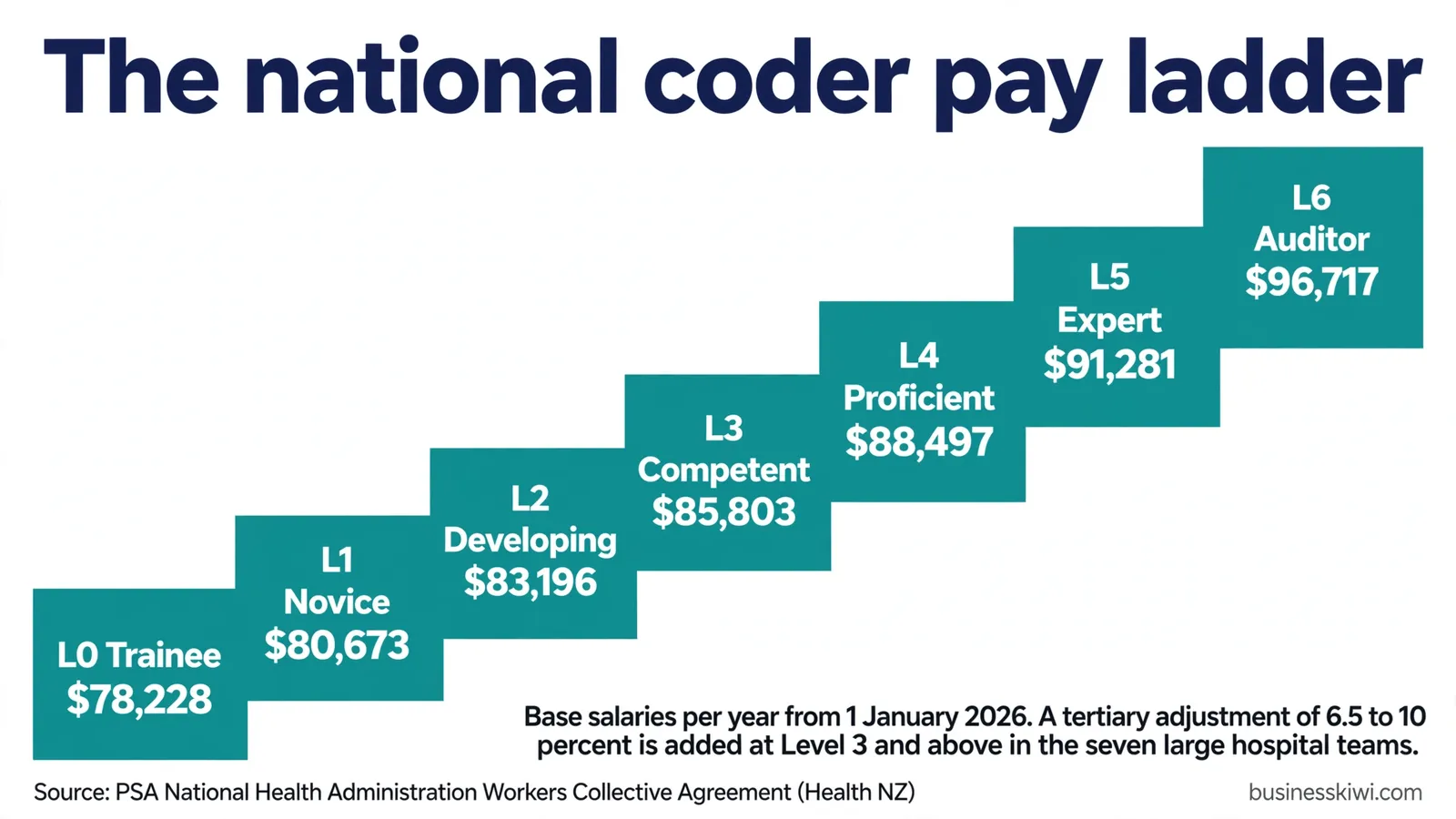
A clinical coder reads the clinical record of a hospital patient. They assign standard codes for each diagnosis and procedure. In New Zealand public hospitals the coding uses ICD-10-AM for diseases and injuries, and ACHI for interventions. The Australian Coding Standards (ACS) act as the rule book. The coded record goes into the National Minimum Dataset. There it drives hospital funding calculations, health statistics and service planning. Most coders work in Health NZ hospital coding teams. Pay follows a national collective agreement scale. It runs from $78,228 for a trainee to $96,717 for an auditor, at rates effective from 1 January 2026.
What a clinical coder actually does
The core task is translation. A coder works through the notes for a patient’s episode of care. They decide which diagnoses and procedures the documentation supports. Each one is matched to a code in the classification. The coder then checks the coded record as a whole, because the order and combination of codes matter.
Day to day, the work looks like this:
- Analyse discharge records and match codes to diseases, injuries and procedures
- Use coding software to process and code patient records
- Ask doctors and other clinical staff to clarify unclear documentation
- Keep up with changes to the classification, the coding standards and the software
- Take part in coding audits and peer review, where other coders check your work
- Answer queries about coded records
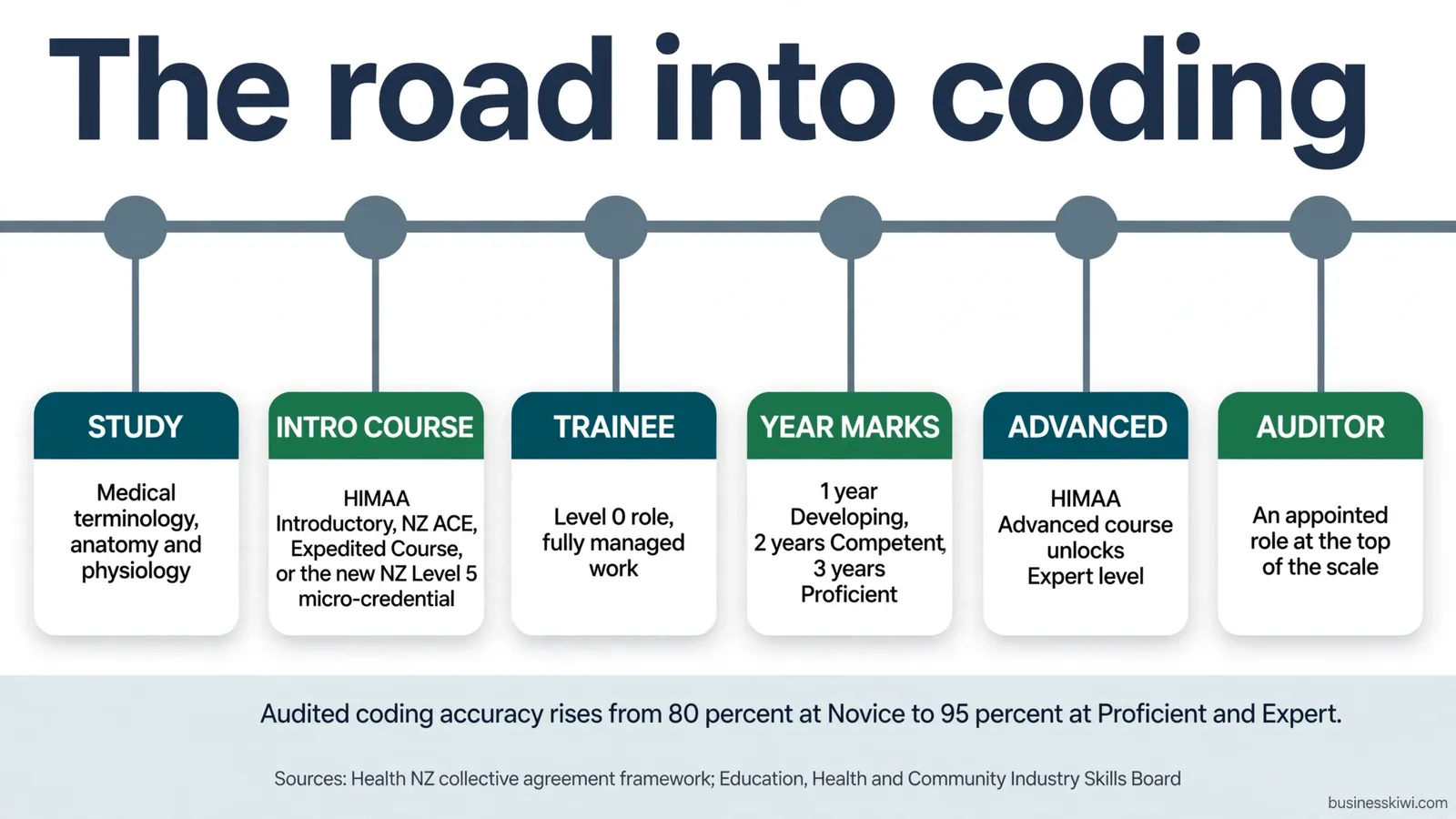
Accuracy is measured, not assumed. The national framework for hospital coders sets audited targets at each level. A novice coder must average 80 percent coding accuracy and 90 percent DRG accuracy in audits. The expected pace is two to three coded events per hour. By the competent level the targets rise to 90 percent coding accuracy, 95 percent DRG accuracy, and three to four events per hour. Expert coders are audited at 95 percent on both measures.
Speed matters because the data has deadlines. One Health NZ position description sets the team targets plainly. It expects 95 percent of discharges coded by the sixth working day, and 100 percent by the 20th of the month. Coders also review error and quality reports each day. They fix problems before records go to the national collection.

The system behind the codes
New Zealand codes every inpatient and same-day patient discharged from a public hospital. Health NZ lists the tools used nationally: ICD-10-AM for diseases and injuries, and ACHI for interventions. The ACS set the national standards for coding with both classifications. New Zealand coding conventions and national reporting requirements sit on top.
The current edition is the Twelfth Edition of ICD-10-AM, ACHI and ACS. Editions move on a three-year cycle. Australian body IHACPA develops them, with New Zealand input through the national collections team.
Coded records flow into the National Minimum Dataset (NMDS). At load, National Collections runs each event through the AR-DRG grouper. The grouper uses the diagnoses, procedures and other event data to assign a diagnosis related group. The same process applies WIESNZ, the New Zealand casemix costweight model. The Casemix Framework for Publicly Funded Hospitals uses those case-weighted values. In plain terms, the codes a coder assigns help decide what a hospital’s work is worth. Sloppy coding misstates the work a hospital did.
Who employs clinical coders in New Zealand
Public hospitals are the main employers. Health NZ runs coding teams in its districts, and those teams code the discharges for their hospitals.
Health NZ also employs coders outside the district teams. Its national collections service includes a Foundation Collections and Classifications team. Coders there handle mortality coding and New Zealand Cancer Registry coding, and code events for private hospitals. This group has its own framework under the same agreement. It absorbed the coders who previously worked for the Ministry of Health.
Private hospitals employ coders too, on their own terms. The national pay scale below belongs to the Health NZ agreement, so it does not bind private employers. Experienced coders also have flexibility in how they work. The agreement counts coders who work remotely for the larger teams when it sets extra pay eligibility.

Qualifications and training pathways
There is no single licence or degree for this job. The Careers NZ profile states there are no specific entry requirements. Employers usually prefer qualifications and experience in two areas though: medical terminology, and clinical coding itself. Most people build the two in order.
Step one is medical terminology. You need solid knowledge of anatomy, physiology and medical terms before coding makes sense. The recognised options include the Comprehensive Medical Terminology course run by the Health Information Management Association of Australia (HIMAA), studied by distance learning. Auckland University of Technology offers a Certificate in Medical Terminology. The national framework also accepts the HIMAA terminology challenge exam. That route suits people who picked up the knowledge in health work.
Step two is an introductory coding course. The main route is HIMAA’s Introductory ICD-10-AM Clinical Coding course, studied online from Australia. The sector standards body notes that most New Zealand coders have taken this programme. Two local options also appear in the national framework: the NZ ACE Course, and an expedited coding course. Careers NZ describes the Expedited Coder Course, run by ACT Coding Company, as currently the only New Zealand-based clinical coding course. Training usually takes under a year.
Step three is a brand new New Zealand credential. In 2026 the Education, Health and Community Industry Skills Board published guidance for a new micro-credential. It is called Apply Clinical Coding Principles and Processes in a Health and Wellbeing Setting. It sits at Level 5 on the New Zealand framework, carries 30 credits, and builds on skill standard 40882. It was created because no clinical coding standards existed on the New Zealand framework before it. It is designed for someone already working in a coding setting, under an experienced coder’s guidance. It covers 300 notional hours across six components. Providers still need endorsement and NZQA accreditation to deliver it, so check local availability before counting on this route.
From there, the ladder continues inside the job. Coders progress through the framework levels as they gain experience and meet the requirements. Progression to the expert level requires the HIMAA Advanced Coding Course. HIMAA also offers intermediate courses and a Clinical Coder Certification.
School leavers are not locked out. Three years of secondary education is recommended. The useful subjects are biology, chemistry, digital technologies, maths and English. Many coders arrive from other health work. Nursing, medical science, medical reception and health clerical roles all give relevant grounding. Computing and statistics help too.
Skills and personal qualities
Coding rewards a particular mix of skills:
- Strong knowledge of medical terminology, anatomy and physiology
- Real accuracy and an eye for detail, sustained across a full day of records
- Pattern recognition and problem solving, for documentation that does not fit neatly
- Good time management, because coding queues run to monthly deadlines
- Clear communication, to query clinicians about their notes
- Computer and database confidence, since the work is software-based
- Discretion, because coders read sensitive patient information all day
One Health NZ position description sums up the hiring bar for experienced coders. It asks for a HIMAA or equivalent qualification in clinical coding, preferably at intermediate level or above. It also asks for at least three years of practical coding in ICD-10-AM. For trainee roles the bar is lower: the terminology grounding, and the ability to start the introductory course.
What clinical coders earn
Hospital coder pay in the public system is set by the PSA National Health Administration Workers Collective Agreement, between Health NZ and the PSA. Its coder scale applies to workers whose work maps to the clinical coder role profile. The agreement runs from 1 January 2025 to 30 June 2027. The rates below took effect on 1 January 2026.
| Level | Framework title | Base salary per year |
|---|---|---|
| 0 | Trainee/Apprentice | $78,228 |
| 1 | Novice | $80,673 |
| 2 | Developing | $83,196 |
| 3 | Competent | $85,803 |
| 4 | Proficient | $88,497 |
| 5 | Expert | $91,281 |
| 6 | Auditor | $96,717 |
A few details matter when you read this scale. The trainee level is for unqualified coders, and the work at that level is fully managed. The auditor level is an appointed role. Nobody progresses into it automatically. In the agreement’s first year the same scale ran from $76,694 to $94,821.
There is one significant extra. A tertiary adjuster allowance is paid on top of base salary at Level 3 and above. It applies in the larger listed teams: Waitematā, Te Toka Tumai Auckland, Counties Manukau, Waikato, Capital Coast, Canterbury and Southern. The adjustment is 6.5 percent at Level 3, 8 percent at Level 4, and 10 percent at Levels 5 and 6. Coders who work remotely for one of those facilities count as eligible. One worked example: an expert coder on the Level 5 base of $91,281, in a listed team, gets about $100,409 a year with the 10 percent adjustment. Coders in smaller district teams do not receive the adjustment. Check for it before you compare offers.
The Careers NZ profile matches this scale with rounder figures. It says clinical coders usually earn $76K to $89K a year, and auditors can earn $94K. Those figures track the agreement’s 2025 rates. The 2026 lift now sits slightly above them.
Job outlook and demand
The official careers assessment rates chances of getting work as a clinical coder as good. An ageing population has more health problems, so hospitals generate more events to code. A worldwide shortage of clinical coders adds pressure, as some New Zealand coders leave to work overseas.
Set that against the size of the occupation. This is a niche workforce of a few hundred people, not a mass hiring market. Health NZ employs about 220 coders, and the 2018 Census counted 255 nationwide. Hospitals replace and add coders steadily rather than in waves. The sector also built a local training credential in 2026, because the skills were needed.
The honest caveat is about entry, not demand. Trainee positions are limited, and most employers prefer trained coders. The demand is real. It is strongest for people who arrive with the terminology and introductory study already done.
How to get a clinical coder job
- Build the terminology base first. Study medical terminology, anatomy and physiology through a recognised course. If your health background already covers it, the challenge exam route may suit.
- Complete an introductory coding course. The HIMAA introductory course is the commonest path. The framework also recognises the NZ ACE Course and the expedited course.
- Watch Health NZ’s own careers pages and district career centres for trainee vacancies, and apply at Level 0. New coders are placed on the salary level that matches their qualification level. They keep that level if they later move teams.
- Treat your first years as the real qualification. Expect audited accuracy and throughput targets. Framework levels roughly track experience: one year to Developing, two years to Competent, three years to Proficient.
- Keep building. The HIMAA intermediate and advanced courses, and later coder certification, separate experienced coders from expert and auditor pay.
Registration and certification
Clinical coders are not a registered profession in New Zealand. There is no registration board, no practising certificate and no protected title. Quality control works differently. It runs through employer hiring standards, the national framework’s levels and audited targets, and HIMAA qualifications.
Certification does exist as a voluntary professional step. HIMAA runs a Clinical Coder Certification. The national framework recognises certification at the expert level, and notes an additional payment may apply.
Related roles
Coding sits inside the wider health information field. Coders who want a change of direction often move into auditor roles. Data analyst, team leader and coding manager roles are also common steps. The national collections service offers specialist work in mortality coding and cancer registry coding. Health information management, the broader profession above all of this, covers how health records and data are governed and used. People also enter coding from medical reception, health records and nursing. Some move the other way.
Watch-outs before you commit
Most online coding courses teach the wrong system. Global course sellers usually teach the American ICD-10-CM and CPT systems. New Zealand codes with ICD-10-AM, ACHI and the ACS. A United States qualification does not line up with what Health NZ asks for.
Do not expect a trainee role to be easy to land. The roles exist, but employers prefer trained coders and trainee positions are limited. Arriving with the introductory course finished changes your odds.
Pay depends on the team, not just the level. The tertiary adjustment lifts pay by up to 10 percent, but only in the seven listed large teams. Two coders at the same level can be on different total pay.
Progression is earned, not automatic. Each framework level carries accuracy, throughput and training requirements. Time served alone does not move you up the scale.
Private pay is a separate conversation. The national scale covers Health NZ roles. Private hospital pay is set by those employers. It is not published in the agreement.
More career guides: browse the Jobs & Education section for the rest of our job and training guides.
Frequently asked questions
What does a clinical coder do each day?
A coder reads hospital patient records and assigns standard codes to the diagnoses and procedures in them. The day also includes checking coded work and clarifying notes with clinical staff. Coders review quality reports and keep up with classification updates. The coded records feed national data collections, statistics and funding calculations.
What qualifications do I need to become a clinical coder in NZ?
There are no legally required qualifications. Employers usually want recognised study in medical terminology first. After that, they want an introductory clinical coding course, such as HIMAA’s Introductory ICD-10-AM course. A new Level 5 New Zealand micro-credential has also been created (30 credits, skill standard 40882). It is aimed at people working in coding settings, and providers are coming on board to deliver it.
How much do clinical coders earn in New Zealand?
Public hospital coders are paid on the national collective agreement scale. From 1 January 2026 it runs from $78,228 for a trainee to $91,281 for an expert coder. Auditors receive $96,717. Coders at Level 3 and above, in the larger listed hospital teams, also receive a tertiary adjustment. It adds 6.5 to 10 percent on top of base pay.
Is clinical coding a registered profession?
No. There is no registration board or practising certificate for clinical coders in New Zealand. Standards are held through employer requirements, HIMAA qualifications, and the national framework’s audited accuracy targets. HIMAA Clinical Coder Certification is available as a voluntary credential.
Can I train and work as a clinical coder from home?
The main training routes are distance courses, so study from home is normal. HIMAA’s terminology and coding courses are delivered online from Australia. Remote work itself is an established arrangement for experienced coders. The agreement includes coders who work remotely for the larger hospital teams when it sets extra pay eligibility. Trainee roles are more likely to be based with a hospital team.
How long does it take to become a clinical coder?
The study itself usually takes under a year: a terminology course, then an introductory coding course. After that, the framework levels roughly follow experience. Allow about one year to Developing, two years to Competent and three years to Proficient. You also need to meet the accuracy, throughput and training requirements at each step.
Are clinical coders in demand in New Zealand?
The official careers assessment rates chances of getting work as good. It points to an ageing population and a worldwide shortage of coders. It is a small occupation though: Health NZ employs about 220 coders. Demand is strongest for trained coders, and trainee positions are limited.
The bottom line
Clinical coder jobs suit people who like precise, quiet, systems-based work. They also suit people who want a health career without patient contact. The path in is short and practical: terminology, an introductory coding course, then a trainee role. Pay is transparent for once, because the public scale is published in the agreement. It climbs from $78,228 to $96,717 as you move from trainee to auditor. The catch is scale. With only a few hundred coders in the country, jobs appear steadily rather than often. The people who win them usually arrive already trained.
Sources
- Health New Zealand | Te Whatu Ora and PSA, National Health Administration Workers Collective Agreement, 1 January 2025 to 30 June 2027 (coder pay scales and coder framework, clause 11.5.10)
- Health New Zealand | Te Whatu Ora, Data classification and clinical coding, info.health.nz
- Health New Zealand | Te Whatu Ora, National Minimum Dataset (NMDS) File Specification, version 16.3, July 2025 (AR-DRG and WIESNZ, section 4.6.4)
- Health New Zealand | Te Whatu Ora, Position Description: Clinical Coder, Capital Coast and Hutt Valley, July 2026
- Careers New Zealand / Tahatū, Clinical Coder job profile (job data published via Wintec Future You)
- NZQA, Framework record for skill standard 40882, Apply clinical coding principles and processes in a health and wellbeing setting
- Education, Health and Community Industry Skills Board, Guidance Notes for micro-credential 5380, Apply clinical coding principles and processes in a health and wellbeing setting (Level 5), March 2026
This article is general information about clinical coder jobs in New Zealand. It is not career, legal or financial advice. It does not replace the collective agreement, employer position descriptions or course provider information. Pay rates, course details and entry requirements change over time. Check the current collective agreement, and the Health NZ and HIMAA pages, before you make decisions.