Digital Marketing Coordinator Salary NZ: Pay, Salary Range & Career Information

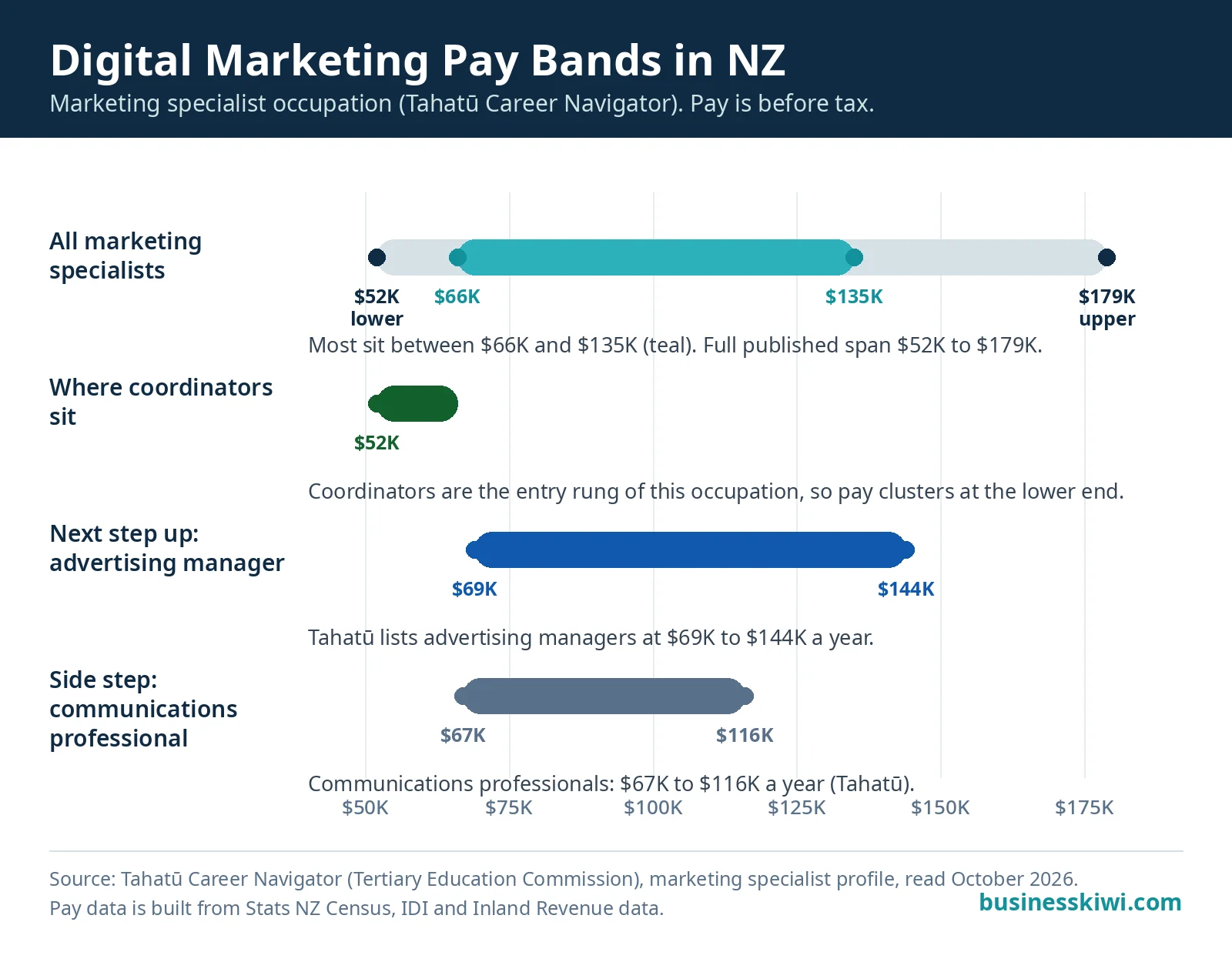
The short answer: There is no official salary line published just for digital marketing coordinators in New Zealand, so be wary of any site that quotes one to the dollar. The closest official figures come from Tahatū Career Navigator, the Government careers service run by the Tertiary Education Commission. Tahatū puts marketing specialists, the occupation family coordinators belong to, at $52,000 a year at the lower end, with most earning between $66,000 and $135,000 and an upper figure of $179,000, all before tax. Coordinator roles sit at the entry end of that occupation, so coordinator pay clusters around the lower figure and the bottom of the main range.
If you are looking at a coordinator role, or hiring for one, the honest question is where a job sits inside those official bands, and why. This guide works through the published figures, what the job actually involves day to day, and the things that move a coordinator from the bottom of the range towards the middle.
What the official pay data says, and what it does not
Tahatū is the careers service the Tertiary Education Commission launched to replace Careers NZ, and its occupation profiles are built on government data rather than recruiter surveys. The Commission states that Tahatū’s job and pay data comes from Stats NZ Census data, Stats NZ’s Integrated Data Infrastructure and Inland Revenue data. That is about as solid a base as NZ salary information gets.
For the marketing specialist occupation, Tahatū publishes three pay points. The lower figure is $52,000 a year. The most common range is $66,000 to $135,000 a year. The upper figure is $179,000. Pay is shown before tax, and about 13,000 people work in the occupation. Tahatū also rates employment change in the occupation as a strong increase, which tells you demand for marketing staff is growing rather than shrinking.
Here is the limitation, stated plainly. Tahatū folds every marketing role into that one occupation profile, from a first-year coordinator through to a senior specialist running national campaigns. It does not publish a separate coordinator figure, a digital-only figure, or a split by city or by agency versus in-house work. Neither does Stats NZ at this level of detail, and private sector marketing roles have no collective agreement to draw on.
So the table below uses the official figures exactly as published, and shows how they apply at coordinator level. Anything more precise than this, from any source, has been estimated by someone, and usually by someone selling recruitment services.
Salary at a glance
Two things stand out from those numbers. First, the range is wide, because the occupation covers a long career ladder. Second, the gap between the $52,000 lower figure and the main range is where a coordinator’s first few years play out. Your pay growth in this job is mostly about how fast you move from running tasks to owning channels.
What a digital marketing coordinator actually does
The coordinator is the person who makes a marketing plan happen on the ground. A marketing manager or specialist usually sets the strategy. The coordinator then builds the emails, schedules the social posts, updates the website, sets up the campaigns, chases the images and copy, and pulls the reports together at the end of the month.
A typical week mixes creative and admin work. You might photograph products for a social post in the morning, build a newsletter after lunch, sit in on a campaign planning session, update product pages on the website, brief a designer, and finish the week loading next month’s content calendar. In a small business, the coordinator is often the whole marketing department. In a larger organisation or an agency, the same title means a narrower slice of the work, repeated across several clients or brands.
That breadth is exactly why the role is the standard entry point into digital marketing. If you want the wider picture of the channels this work feeds into, our guide to digital marketing in Auckland covers how the main channels fit together and how businesses buy them. The coordinator is the person inside that picture doing the daily work.

What moves a coordinator’s pay
Within the official bands, five things do most of the work.
Experience in the seat. A coordinator in their first year is learning the tools. By year three, a good coordinator runs campaigns with little supervision, and that independence is what employers pay for.
Channel ownership. Coordinators who only schedule posts stay near the bottom of the range. Coordinators who own a channel end to end, such as paid search, SEO or email, and can show results, move up fastest. Ownership means planning, budget awareness, testing and reporting, not just loading content.
Analytics skill. Plenty of people can post content. Far fewer can open the analytics, work out what the numbers mean, and change the plan because of them. That skill gap shows up in pay.
Employer size and sector. A coordinator at a large organisation with a structured pay band usually starts higher than one at a small business paying what it can afford. Sectors competing hard for digital skills, such as finance, tech and large retail, tend to sit higher in the range. Small organisations often trade a lower salary for broader experience, which can pay off at the next move.
Tool depth. Working fluency across the standard stack, the website CMS, the email platform, the ad managers and a design tool, makes a coordinator useful from day one. Each extra system you genuinely know removes a reason to keep you at the entry rate.
Pay by region: what can honestly be said
Readers often ask whether Auckland pays more than Wellington or Christchurch for this role. The honest answer is that no official source publishes a regional split for marketing pay, so this page will not invent one.
What can be said is structural. The jobs are not spread evenly. Auckland holds the largest pool of head offices, agencies and big marketing teams. Wellington has a strong cluster around government and national organisations, plus its own agency scene. Christchurch has a smaller pool again, and regional centres smaller still. More roles in one place means more chances to move for a pay rise, which is the main way location affects what a coordinator earns over a few years.
Cost of living cuts the other way. A salary at the lower end of the range goes further in Christchurch or a regional city than it does in Auckland. When you compare offers, compare what is left after rent, not just the headline figure.
Agency work versus in-house work
Coordinators work in two main settings, and the settings shape the job as much as the salary does.
Working agency side
You juggle several clients at once, across different industries. The variety is the training: you see more campaigns, more tools and more problems in two years than many in-house roles offer in four. The trade-offs are pace and pay. Agency coordinator roles often start at the lower end of the occupation’s range, and the workload follows client deadlines. The payoff comes later, because agency-trained coordinators are attractive hires for in-house specialist roles.
Working in-house
You market one organisation and learn its products, customers and systems deeply. Pay bands in larger organisations are usually more structured, with clearer steps as you take on specialist or senior work. The risk is narrowness: if your one employer uses a small set of channels, your skills can date. Good in-house coordinators fight that by owning side projects, testing new channels and keeping their reporting sharp.
Neither setting is simply better paid across the board, whatever recruitment marketing suggests. Agencies often win on speed of learning; larger in-house employers often win on starting band and stability. The strongest career pattern is a stint in one setting, then a move to the other with a pay step attached.
Skills and qualifications that lift pay
Tahatū puts training for this occupation at 0 to 2 years, which fits how people actually enter the job. Some coordinators arrive with a degree or diploma in marketing, communications or media. Others come from retail, admin or customer service roles and learn the tools on the job. Employers weight a portfolio of real work heavily: campaigns you helped run, content you made, numbers you can explain.
The skills that most often separate a $52,000 coordinator from one moving into the main range are practical ones. Search and social advertising setup. Email marketing and basic automation. SEO fundamentals and confident CMS use. GA4 reporting that goes past screenshots to explanations. Short-form video and simple design work for content. Clear writing, because most digital channels still run on words.
Platform certificates, such as the free Google and Meta training programmes, will not transform a salary on their own. They do help a CV past the first screen, and they give a new coordinator the vocabulary to learn faster in the role. Treat them as a starting ticket, not the destination.

The career path from coordinator
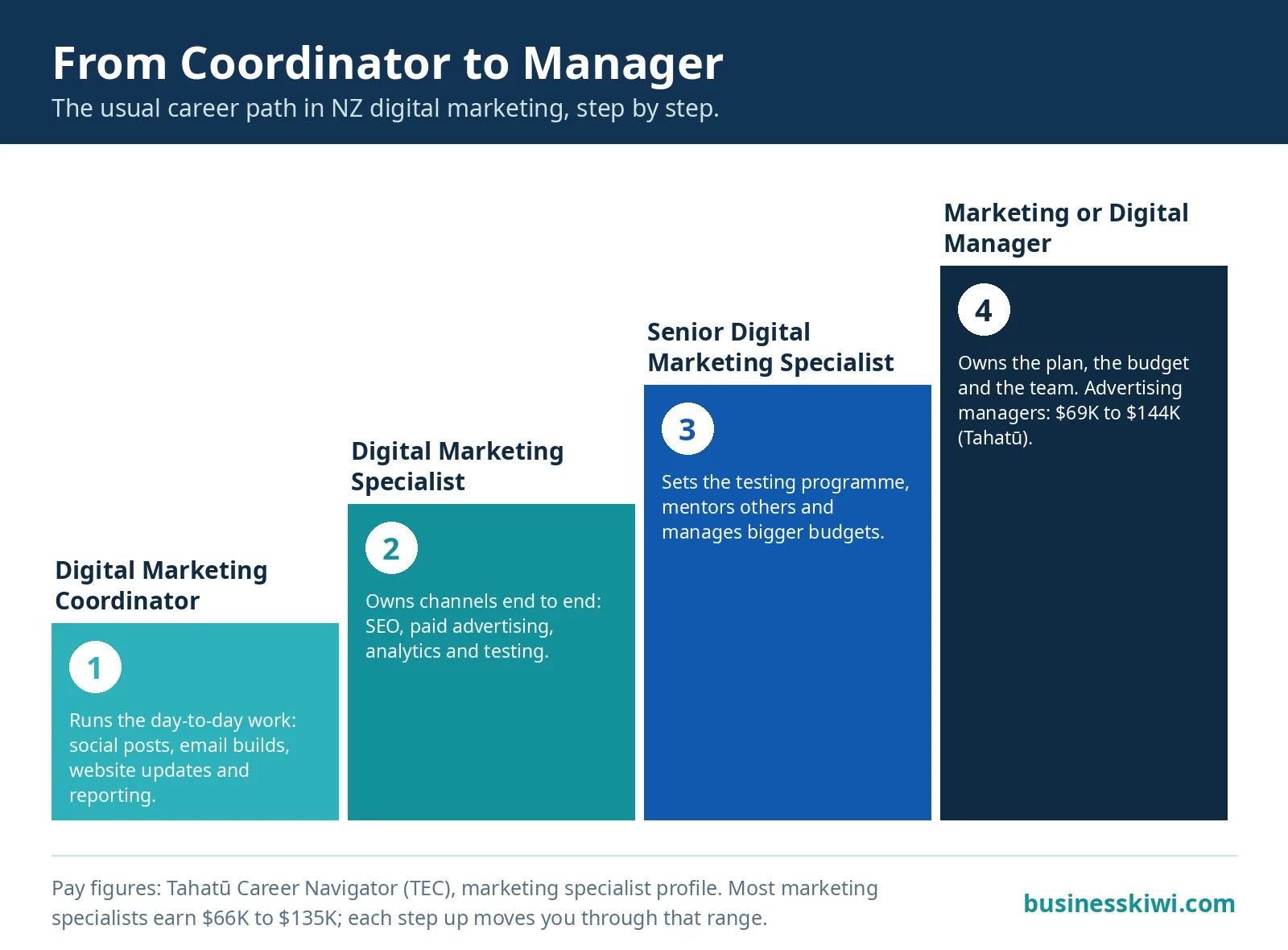
The ladder out of a coordinator role is well worn, and each step moves you through the official pay range.
Step 1: Digital marketing coordinator. You run the day-to-day work: social posts, email builds, website updates, campaign setup and reporting.
Step 2: Digital marketing specialist or executive. You own channels end to end. You plan the SEO work, run the paid campaigns, manage a testing programme and report on results with recommendations attached.
Step 3: Senior specialist. You set the direction for your channels, mentor coordinators, manage bigger budgets and lead the larger campaigns.
Step 4: Marketing or digital manager. You own the plan, the budget and the team. Tahatū’s neighbouring profile for advertising managers, the closest published management figure, sits at $69,000 to $144,000 a year, and communications professionals sit at $67,000 to $116,000, which shows the shape of the steps beyond specialist level.
Sideways moves count too. Content, communications and brand roles all recruit from the coordinator pool, and each carries its own pay range on the same official footing.
How to increase your salary as a coordinator
Pay growth in this occupation rewards evidence. A few habits make the biggest difference.
Specialise in one channel while keeping your general skills. The coordinator who becomes the team’s paid media or SEO person is harder to replace and easier to promote.
Keep a results file. Record the campaigns you worked on, what you did, and what changed: traffic, leads, sales, cost per result. Numbers you can talk through calmly are the strongest material you can take into a pay review or an interview.
Ask for the next level of work before you ask for the money. Run a small campaign end to end. Own the monthly report. Cover a specialist’s leave. Then the pay conversation is about work you already do.
When you do move, present yourself well. A NZ-style CV that leads with campaign results rather than duties, and a cover letter written for the specific employer, both lift the quality of offers you are choosing between.
Finally, be willing to move employers every few years early in your career. Internal pay steps are usually smaller than the jump a good coordinator can make into a specialist role elsewhere. Each move should add a skill, a channel or a level of responsibility, not just a new logo.

Frequently asked questions
How much does a digital marketing coordinator earn in NZ?
There is no separate official figure for the coordinator title. Coordinators belong to the marketing specialist occupation, where Tahatū puts the lower figure at $52,000 a year and the most common range at $66,000 to $135,000. Coordinator pay clusters at the lower end of those official figures and rises as the role takes on specialist work.
Is there an official salary figure just for digital marketing coordinators?
No. Tahatū, the Government careers service, publishes pay for the marketing specialist occupation as a whole. Sites quoting an exact coordinator salary are using recruiter or survey estimates, not official data. This guide uses the official occupation figures and says where coordinators sit within them.
What does a marketing specialist earn in New Zealand?
Tahatū lists a lower figure of $52,000, a most common range of $66,000 to $135,000, and an upper figure of $179,000 a year, before tax. The data behind those figures comes from Stats NZ Census and Integrated Data Infrastructure data and Inland Revenue data.
Do I need a degree to become a digital marketing coordinator?
No single qualification is required. Tahatū puts training for the occupation at 0 to 2 years. Many coordinators hold a diploma or degree in marketing or communications, but others enter from retail, admin or service roles and learn the tools at work. Real campaign experience and a portfolio of work carry a lot of weight with employers.
Does a coordinator job in Auckland pay more than one in Christchurch?
No official source publishes regional pay for this occupation, so nobody can quote that gap honestly. Auckland has the largest pool of roles and agencies, Wellington has a strong government and national organisation cluster, and Christchurch has fewer roles. The bigger pool mainly helps when you move jobs, which is when pay usually jumps.
Which pays better, an agency or an in-house role?
It depends on the employer more than the setting. Agency coordinator roles often start lower in the range but train you across many clients and tools. Larger in-house employers usually offer more structured pay bands. Many coordinators do a stint in each setting and take a pay step with the move.
How do I move from coordinator to a higher paying role?
Own a channel end to end, build proof of results, and take on specialist work before the title arrives. The usual path runs coordinator, specialist, senior specialist, then manager. Tahatū puts advertising managers at $69,000 to $144,000, so the steps beyond coordinator are worth real money.
The bottom line
A digital marketing coordinator in New Zealand earns at the entry end of the marketing specialist occupation: from around the official lower figure of $52,000, moving into the $66,000 to $135,000 most common range as the role grows into specialist work. Treat any exact coordinator salary quoted without an official source behind it with suspicion. What actually decides your pay is how quickly you move from running tasks to owning channels and proving results, and that part is largely in your hands.
For more NZ pay guides and career information, browse our jobs and education guides.
Sources: Tahatū Career Navigator (Tertiary Education Commission), Marketing specialist profile; Tertiary Education Commission, Tahatū Career Navigator data notes. Pay figures are before tax and were read in October 2026.