Windley School: Enrolment, Zone, Curriculum & Key Information
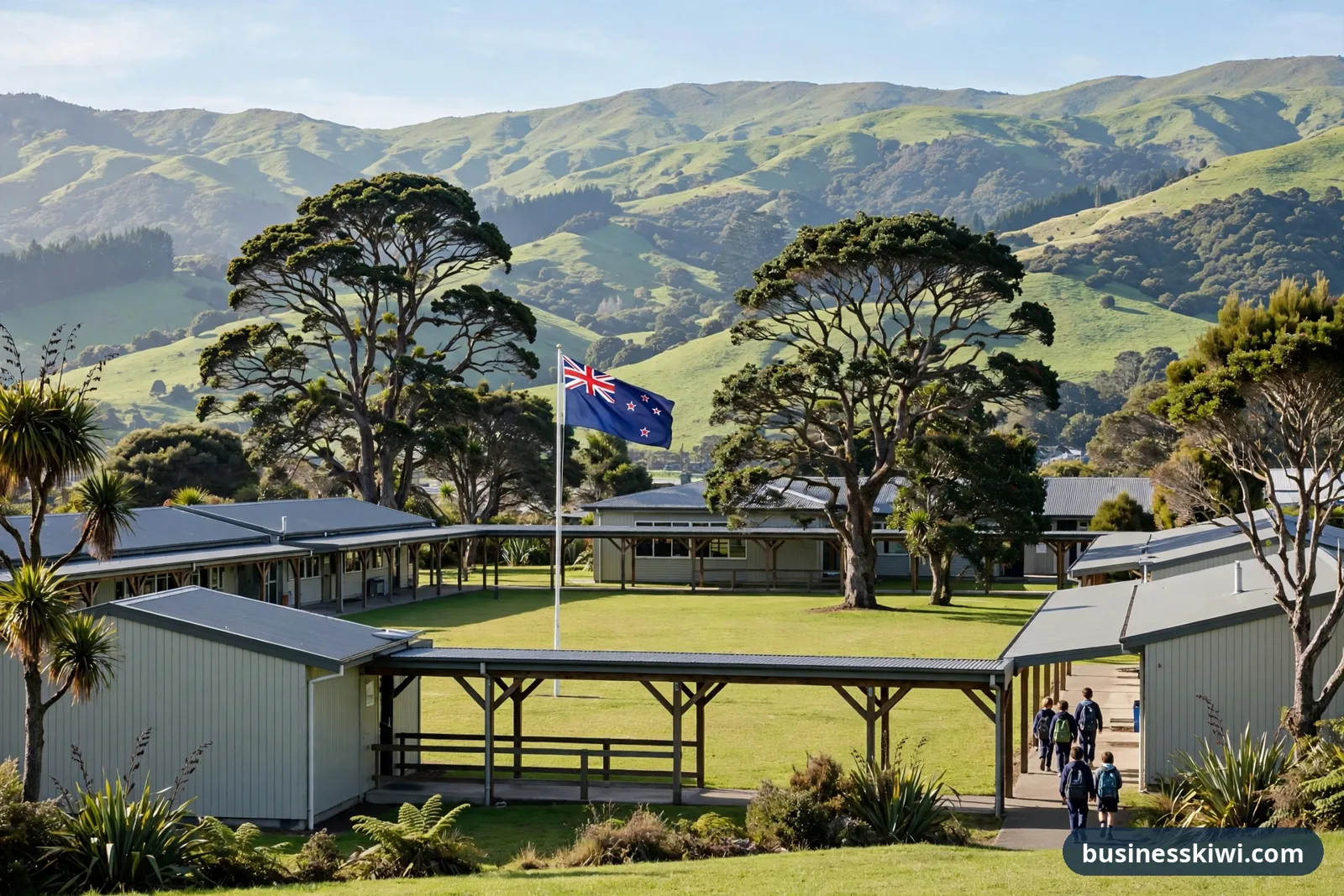
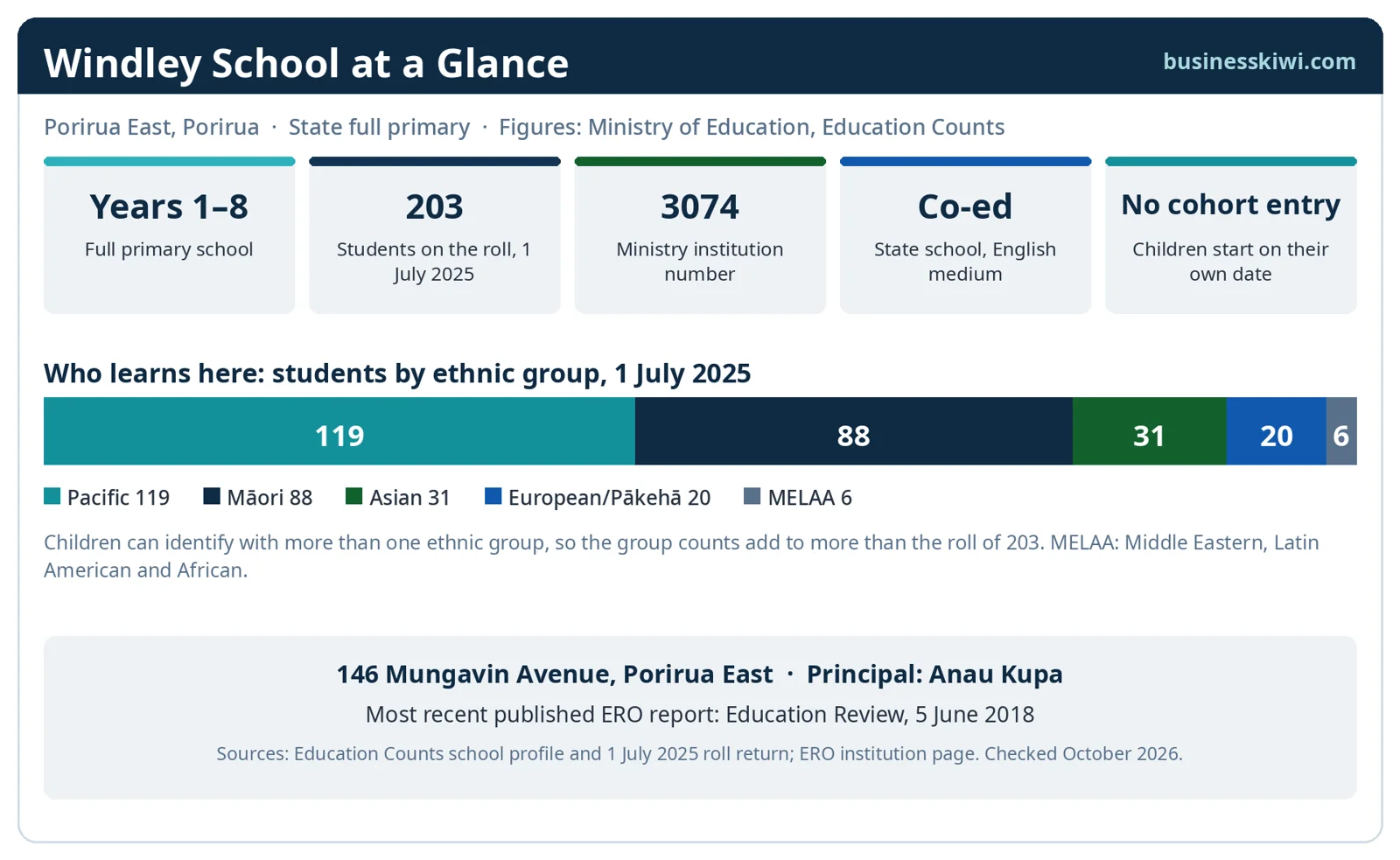
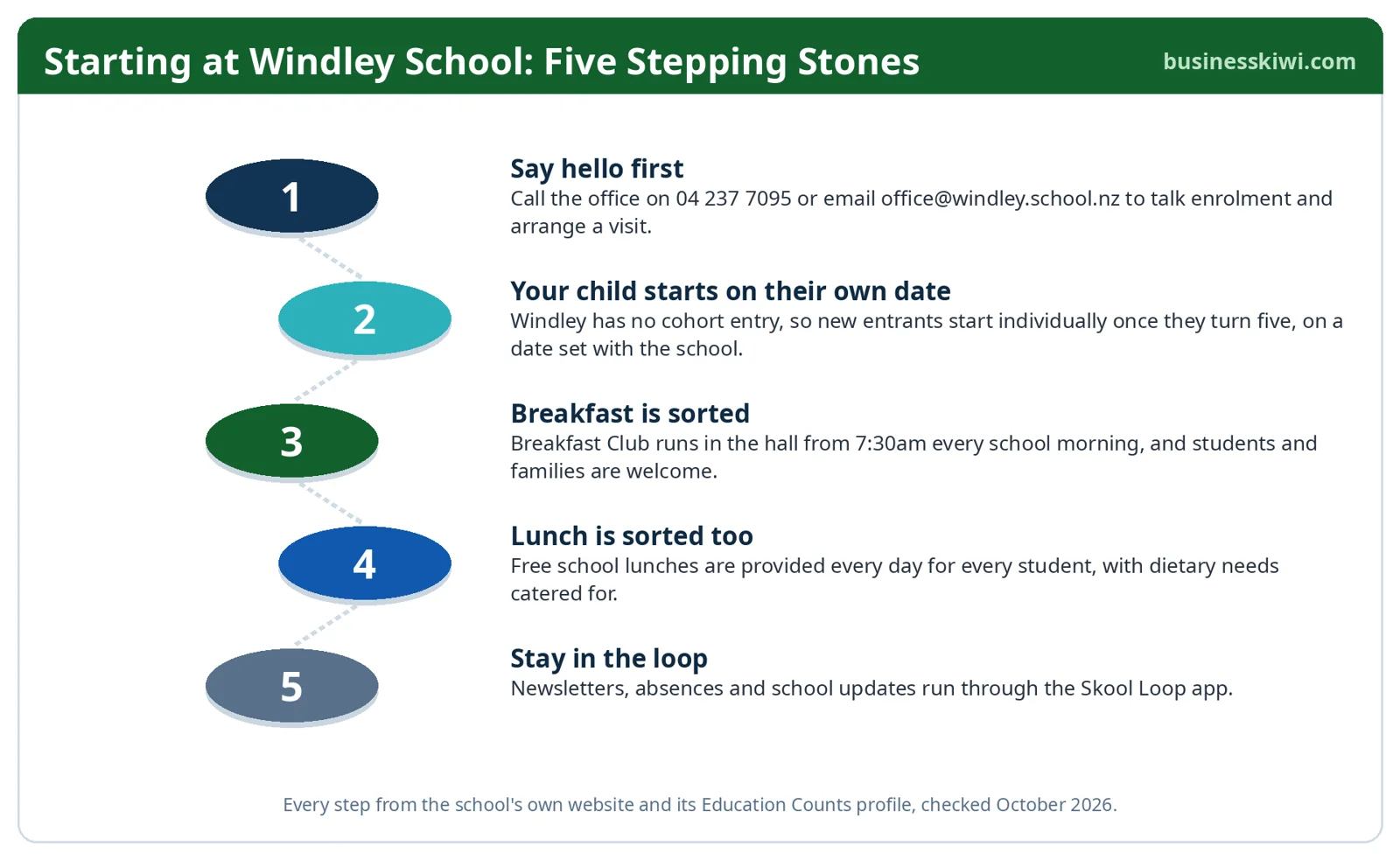
The short answer: Windley School is a state full primary school at 146 Mungavin Avenue in Porirua East, Porirua. It teaches Years 1 to 8, is co-educational, and had 203 students on its roll at 1 July 2025. There is no enrolment zone recorded for the school on its official Ministry profile, children start on individual dates rather than in cohort groups, and the school runs a daily Breakfast Club and free lunches for every student.
Windley School serves the Cannons Creek side of Porirua East, in the hills east of the Porirua city centre, and its community is one of the most culturally diverse in the Wellington region. This profile pulls together what the official records actually say: the Ministry of Education’s Education Counts data, the school’s own website, and the Education Review Office’s published reports. Where a detail is not published officially, the profile says so instead of guessing.
Windley School at a glance
| School | Windley School |
| Ministry of Education institution number | 3074 |
| Address | 146 Mungavin Avenue, Porirua East, Porirua 5024 |
| School type | Full primary (Years 1 to 8) |
| Authority | State |
| Gender | Co-educational |
| Roll | 203 (1 July 2025) |
| Principal | Anau Kupa |
| Language of instruction | English medium |
| Cohort entry | No |
| Enrolment zone | None recorded on the official profile |
| Donations | Should not be requested, unless for a school camp |
| Phone | 04 237 7095 or 0800 115 053 |
| office@windley.school.nz | |
| Most recent published ERO report | Education Review, 5 June 2018 |
Where the school sits
The school stands on Mungavin Avenue, a main street through Cannons Creek in Porirua East. Most of its families live in the surrounding streets, and the school works with its neighbours through the Porirua East Kāhui Ako, the local Community of Learning that links early learning services, primary schools and the college in this part of the city.
Porirua East families have several state primaries within a short distance of each other, each with its own character. Windley’s point of difference starts with its size and span: just over 200 students across eight year levels, big enough to run specialist programmes, small enough that staff know families well. Because it is a full primary, children can stay from their first day at five through to the end of Year 8.
The roll: 203 children in 2025
The Ministry’s 1 July 2025 roll return puts Windley at 203 students. The roll is spread fairly evenly across the eight year levels. Year 5 is the largest group with 35 students and Year 3 the smallest with 15. The full return reads: Year 1, 24; Year 2, 29; Year 3, 15; Year 4, 21; Year 5, 35; Year 6, 21; Year 7, 28; Year 8, 30.
The roll has come down over time. When ERO last reviewed the school on site in 2018, the roll stood at 307. The Ministry does not publish a single student to teacher ratio for the school, so this profile does not invent one.
Diversity is the defining feature of the roll. In the July 2025 return, 119 students identify as Pacific, 88 as Māori, 31 as Asian, 20 as European or Pākehā, and 6 as MELAA (Middle Eastern, Latin American and African). Children can identify with more than one group, so those counts add to more than 203. Pacific children form the largest group, at close to three in five of the roll, and the school’s welcome message greets families in Samoan, Tongan, Cook Islands Māori, Niuean, Tuvaluan, Fijian, Hindi and te reo Māori, as well as English.
Voice, Action and Identity
The school’s vision is “E Tipu Nga Rakau Iti”, and its mission is to shape collaborative communities with whānau and tamariki to create world class learning journeys. Underneath those statements sits a graduate profile built on three beliefs the school shortens to VAI.
Voice means every learner has a voice that can change the way things are. Action means learners make a difference. Identity means know who you are, be who you are, show who you are. The principal’s message on the school’s website ties the three together: the school aims to keep children’s identity, cultural values and beliefs intact while they learn, and it treats strong relationships between teachers, students and families as the base everything else sits on.
That emphasis is not new. ERO’s earlier reports describe a school that has worked for years on culturally responsive practice and family engagement. The current statements are the modern form of the same idea.
Te marau a te Kura: the local curriculum
Windley’s local curriculum is called Te marau a te Kura. The school builds it on the New Zealand Curriculum and Te Marautanga o Aotearoa, and states plainly that its foundation is literacy and mathematics. Literacy covers oral language, reading and writing, which matters in a school where many children are building English alongside a home language. Parents who want to understand the reading levels their child will move through in the junior years can pair this with our guide to reading levels and ages in NZ, which sets out the colour wheel and text levels used in most New Zealand classrooms.
Health and wellbeing, hauora, is the other stated pillar. The school says its community emphasised hauora as a focus, so it is woven through school life rather than taught as a single subject, with social and emotional learning sitting inside it.
Programmes with a name
Two programmes get their own pages on the school’s website. Adventures in Learning runs in Years 1 to 4. It is an inquiry programme with extra adult support in the room, built to grow children’s language, curiosity and key competencies, and to give them plenty of chances to ask questions and search for answers.
Kowaiau is the senior school counterpart. It helps senior students understand their own strengths and weaknesses and build self-management skills, so they can take control of themselves and influence others positively. Both programmes exist to give students voice, action and identity in practice, not just on the wall.
Breakfast Club and free lunches
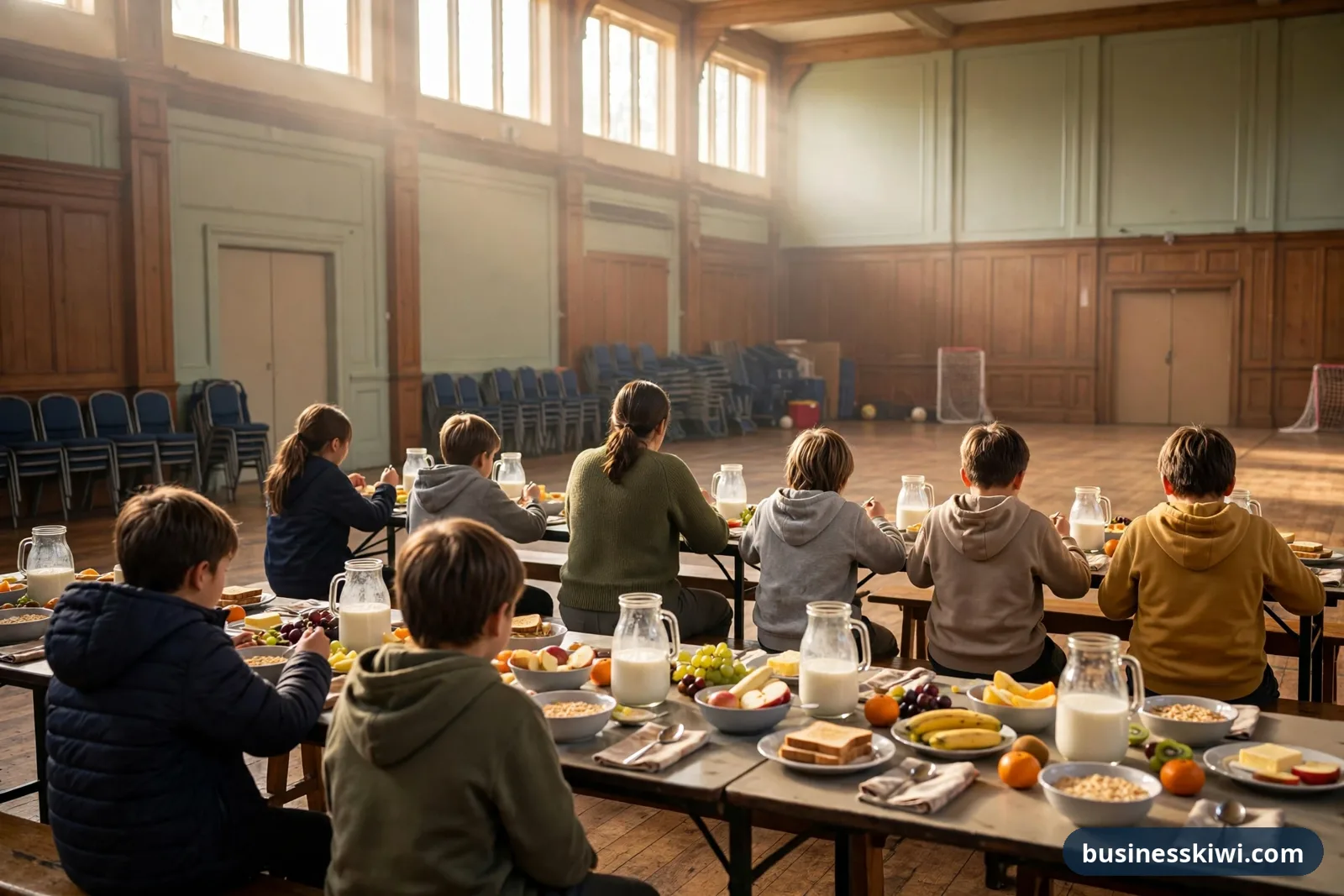
Food is a practical part of the school day at Windley, and it is organised, not incidental. The Breakfast Club runs in the hall every school morning from 7:30am to 9:00am. It is organised by Denise Sione, volunteers from Arise Church help on Wednesdays, and students and their families are welcome to sit down together before the day starts.
Lunch is covered as well. The school provides free lunches every day for all students. Families with a child who needs halal, vegetarian or another dietary option are asked to let the school know, and the school caters for those requirements.
Attendance, in the school’s own numbers
Windley publishes its attendance data openly, in an Attendance Management Plan on its website, and the picture it gives is honest. Regular attendance, meaning students present more than 90 percent of the time, averaged 39 percent in 2023, 41 percent in 2024 and 48 percent in 2025. Chronic absence, students present less than 70 percent of the time, fell from 22 percent in 2023 to 18 percent in 2025.
The direction is up, and the school has set public targets for where it goes next: regular attendance averaging 60 percent in 2026, 65 percent in 2027 and 70 percent in 2028, with chronic absence down a further 10 percent in 2026. The school also told families in a 2026 newsletter that punctuality has lifted sharply, with 68 percent of students arriving on time regularly, up from a 2025 baseline of 31 percent.
Parents should read those numbers fairly. They describe a school working on a hard problem in the open, with a plan, baseline data and targets anyone can check.
Enrolling at Windley School
Enrolment at Windley is straightforward on paper. The school’s Education Counts profile records no enrolment zone, which means there is no home zone boundary published for the school and no out-of-zone ballot process described in the official profile. Families should still confirm enrolment directly with the office, because the office holds the current position and the school’s enrolment policy sits in its SchoolDocs policy set.
There is no cohort entry. Children do not wait for a group start date at the start of a term. Each new entrant starts on their own date once they turn five, arranged with the school. That makes early contact worthwhile: a visit, a conversation about start dates, and time for your child to see the school before their first day.
On cost, Education Counts records the school’s donations position in the standard scheme wording: donations should not be requested, unless for a school camp. Combined with free breakfasts and lunches, the day-to-day cost of attending is low. Two practical details are not published on the school’s website: its bell times, and any uniform requirement or supplier. Ask the office about both when you enrol, rather than relying on third-party listings, which are often out of date.
What ERO found
The Education Review Office’s most recent published report for Windley School is its Education Review of 5 June 2018, following a review team visit in April 2018. One currency point matters before the findings: the school told parents in a 2025 newsletter that ERO evaluation partners visited in May 2025 and that it was waiting for the draft report. As at October 2026, the 2018 report is still the newest report published on ERO’s page for the school, so it is the latest published set of findings available to parents.
ERO’s headline in 2018 was progress. Trustees and leaders had made sound progress on the matters raised in the 2015 review. School targets were appropriately set, tracked and monitored. Planning and teaching had become more deliberate and focused. The curriculum was inclusive and increasingly responsive to the diverse cultures of the school community.
The detail behind that headline was specific. Assessment information was being collated and analysed better, every teacher had target students, trustees were receiving regular, well-analysed reports, and a number of target students made accelerated progress through 2017. Leaders had built teacher capability deliberately, through induction, coaching and mentoring. The curriculum had been reviewed and redeveloped, with te ao Māori woven through it and Pacific and other cultures celebrated in classrooms.
ERO was equally clear about what still needed work. Schoolwide achievement remained low across reading, writing and mathematics, reading achievement had declined, and reducing disparity between groups was the central task. ERO asked the school to keep prioritising achievement, to strengthen its internal evaluation by analysing its data more deeply, and to carry the gains it had made in mathematics teaching into literacy. It undertook to provide an internal evaluation workshop and expected to review the school again in about three years.
Read together, the 2015 and 2018 reports tell one consistent story: a school with strong community relationships and a genuinely inclusive curriculum, working on the hard, slow task of lifting achievement for every group of learners. Parents should weigh the 2018 findings as dated: the last published word from ERO, not a verdict on the school today.
| ERO report | Date | Note |
|---|---|---|
| Education Review | 5 June 2018 | Most recent published report; findings summarised above |
| Education Review | 5 May 2015 | Earlier review; set the priorities the 2018 review followed up |
Schooling in Porirua East
Windley is one of a cluster of schools serving Porirua East, and it helps to see where it fits. It is a full primary, so it covers the whole primary journey in one place, including the intermediate years (Years 7 and 8) that some nearby primaries do not offer. Its near neighbour Glenview School is a contributing primary covering Years 1 to 6, whose students move on after Year 6. Families who want one school from age five to the end of Year 8 will notice that difference straight away. After Year 8, Windley students move on to secondary schooling in Porirua, in the same community they have grown up in.
Term dates 2026
The school publishes its own term dates, and they match the national pattern with a mid-December finish. Our NZ school holidays guide sets out the holiday breaks between each term.
| Term | Dates 2026 | Public holidays and closures |
|---|---|---|
| Term 1 | Monday 2 February to Thursday 2 April | Waitangi Day, Friday 6 February |
| Term 2 | Monday 20 April to Friday 3 July | ANZAC Day observed, Monday 27 April; King’s Birthday, Monday 1 June |
| Term 3 | Monday 20 July to Friday 25 September | None in term time |
| Term 4 | Monday 12 October to Monday 14 December | Labour Day, Monday 26 October; two curriculum days to be advised |
Contacting the school
The office is the first stop for enrolments, absences and questions.
Phone: 04 237 7095 or 0800 115 053
Email: office@windley.school.nz
Address: 146 Mungavin Avenue, Porirua East, Porirua 5024
App: Skool Loop, for updates, newsletters and reporting absences
Frequently asked questions
What year levels does Windley School teach?
Windley is a full primary school, so it teaches Years 1 to 8. Children can start at five and stay through to the end of Year 8, then move on to secondary school.
How many students go to Windley School?
The Ministry of Education’s 1 July 2025 roll return records 203 students. The roll was 307 when ERO reviewed the school in 2018, so the school is smaller now than it was then.
Does Windley School have an enrolment zone?
No enrolment zone is recorded for Windley School on its official Education Counts profile, and no zone streets are published. Confirm the current enrolment position with the school office, because the office holds the school’s enrolment policy and any updates.
When can my child start at Windley School?
Windley does not use cohort entry, so children start on their own date once they turn five, arranged with the school. Contact the office ahead of your child’s fifth birthday to set a start date and arrange a visit.
Does Windley School provide food for students?
Yes. The school runs a Breakfast Club in the hall every school morning from 7:30am to 9:00am, open to students and families, and it provides free lunches every day for all students. Tell the school about dietary requirements such as halal or vegetarian, and it will cater for them.
What did ERO say about Windley School?
ERO’s most recent published report, from 5 June 2018, found sound progress since 2015, better use of achievement information, and an inclusive, culturally responsive curriculum. It also said schoolwide achievement remained low and set achievement and internal evaluation as the ongoing work. The school advised parents in 2025 that ERO evaluation partners had visited that year, with a new report in progress.
Does Windley School have a uniform, and what are the school hours?
The school does not publish a uniform requirement or its bell times on its website, as at October 2026. Ask the office when you enrol. Breakfast Club does run from 7:30am, which is published.
For more school and education guides, browse our Jobs and Education section.
Sources
- Ministry of Education, Education Counts: Windley School profile and contact details (institution 3074), and student population by year level as at 1 July 2025. Read 12 October 2026.
- Education Review Office: Windley School institution page and Education Review reports of 5 June 2018 and 5 May 2015. Read 12 October 2026.
- Windley School (official website, windley.school.nz): home page, principal’s message, curriculum, special programmes, breakfast club and lunches, term dates 2026, attendance management plan, and school newsletters. Read 12 October 2026.