Corinna School in Porirua East: A Parent’s Guide to Enrolling, the Zone and What ERO Found
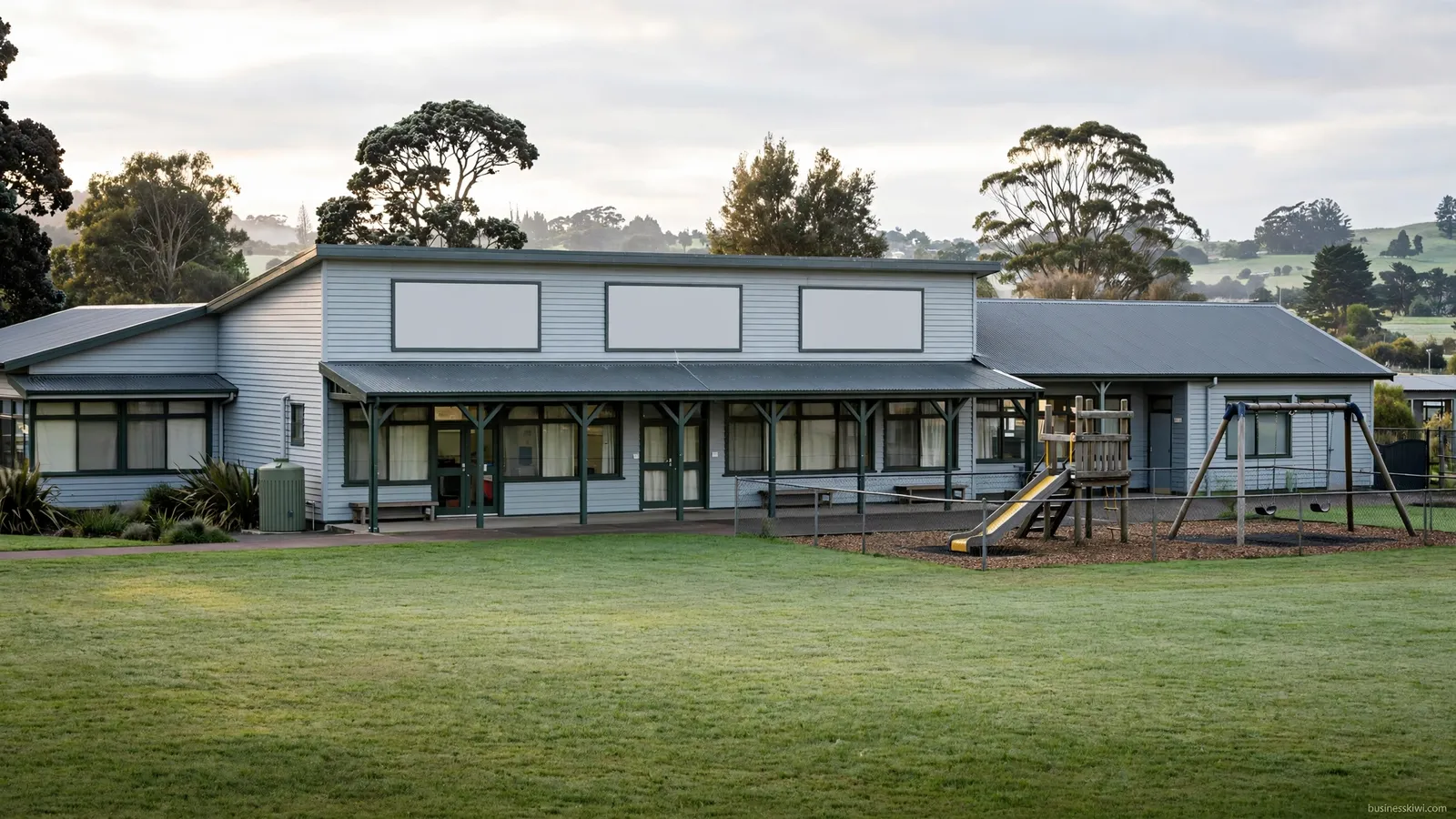
Corinna School is a state full primary school in Waitangirua, in Porirua East. It teaches children from Year 1 to Year 8, so a child can spend all eight primary years in the one school. The school has served its local community since 1967, and its motto sums up the tone it sets: Expect the Best.
This guide brings together what the Ministry of Education, the Education Review Office and the school itself publish about Corinna School. It covers the enrolment process, the school zone, what learning looks like, what the latest ERO evaluation found, and the practical details parents usually want before you visit. If your family is moving into Porirua East, or your child is about to turn five, this is the place to start.
Corinna School at a glance
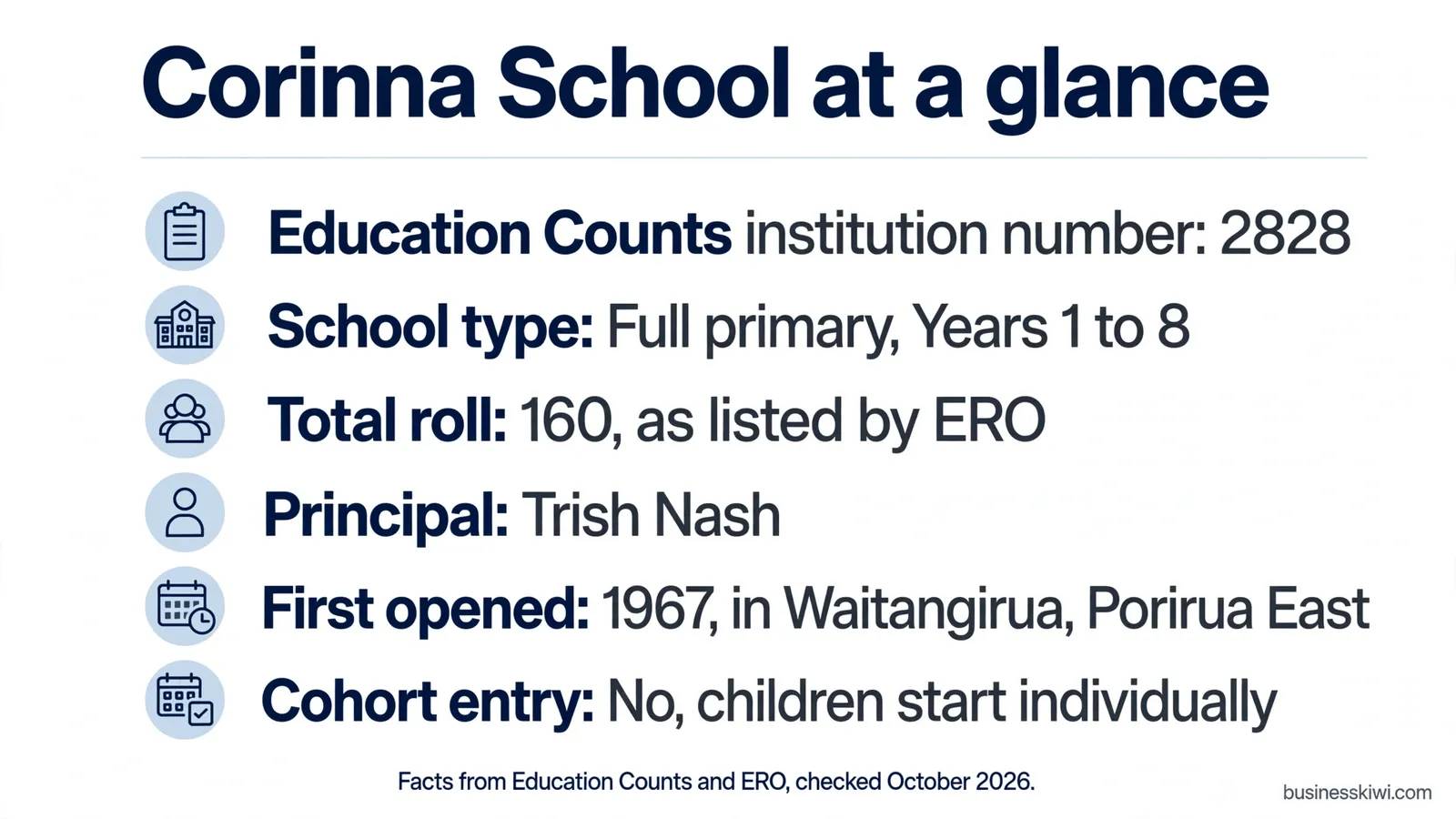
| Fact | Detail |
|---|---|
| School | Corinna School |
| Education Counts institution number | 2828 |
| School type | Full primary, Years 1 to 8 |
| Authority | State |
| Gender | Co-educational |
| Total roll | 160 (as listed by ERO) |
| Principal | Trish Nash |
| Address | 36 Kalingo Street, Porirua East, Porirua 5024 |
| Phone | 04 235 9570 |
| admin@corinna.school.nz | |
| First opened | 1967 |
| Cohort entry | No |
| School donations | In the donations scheme |
| Latest ERO report | School Evaluation Report, 2 December 2024 |
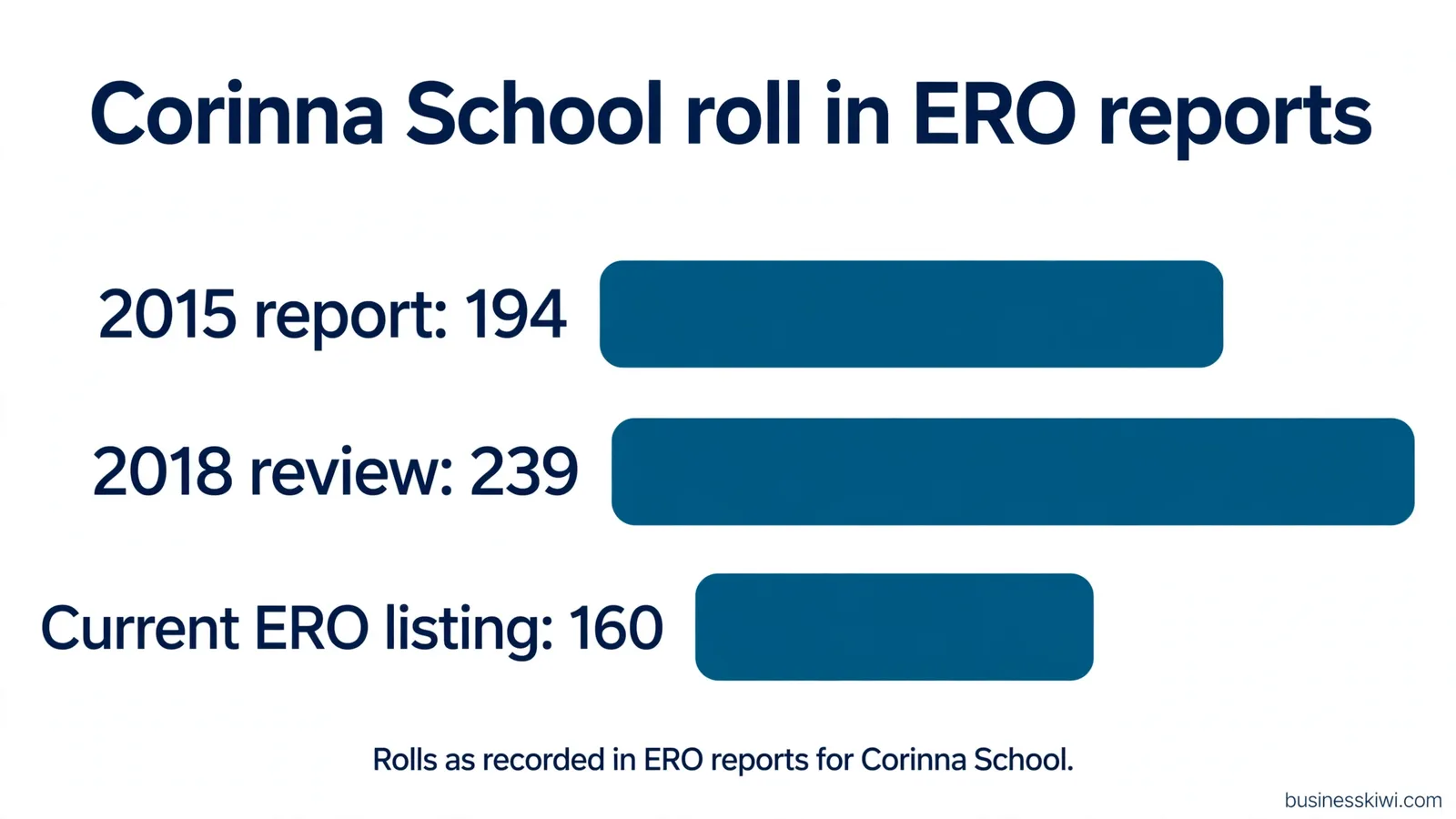
Two points in that table are worth explaining. The roll figure comes from the Education Review Office, which lists a total roll of 160 on the school’s report page. The school’s Education Counts profile does not publish a roll figure or an Equity Index value on the page itself, so no figure of that kind is quoted here from anywhere else. Rolls also move over time, and the ERO section below shows how Corinna’s roll has changed across its last three reports.
About Corinna School
Corinna School sits on Kalingo Street in Waitangirua, with access from Corinna Street and Warspite Avenue as well. It has been part of the Waitangirua community since 1967, which makes it one of the long-standing schools of Porirua East. Generations of local families have passed through it, and that local roots feeling runs through everything the school publishes about itself.
The school’s own welcome, signed by principal Trish Nash, puts students and whānau at the centre of the school, and describes a community that works together for its children. The vision published in the school’s latest ERO report reads: “Our learning community will be lifelong learners, able to use all the key competencies to shine in a range of context with voice, action and identity.”
That last phrase matters locally. Corinna belongs to the Porirua East Kāhui Ako, the group of schools in the area that work together on shared goals. The Kāhui Ako has a shared graduate profile called VAI, and Corinna teaches toward it. Voice means every learner has a voice that can change the way things are. Action means learners make a difference in their school and their community. Identity means knowing who you are, being who you are, and showing who you are. For parents, it is a useful picture of what the school wants a Year 8 leaver to look like at the end of eight years.
The community the school serves is a proudly diverse one. ERO’s 2018 review recorded the roll at that time as 27 percent Māori, 38 percent Samoan, 12 percent Tokelauan, 10 percent Cook Island Māori, 7 percent other Pacific peoples and 6 percent other ethnic groups. Those figures are from 2018, so they describe the school as it was then rather than today, but they explain why language, culture and identity sit at the centre of the school’s work. Girls made up 51 percent of the roll and boys 49 percent at that review.
The roll itself has shifted across recent reports. ERO recorded 194 students in 2015 and 239 at the 2018 review, and its page now lists a total roll of 160. A smaller roll means smaller numbers moving through each year level, and ERO’s latest report, covered below, describes settled and respectful learning environments across the school.
That 2018 review is worth a quick look for what it says about the school’s character, because its strengths match what the newer report found. Reviewers described teaching practice that responded to children’s language, culture and identity, a curriculum shaped around students’ needs and wellbeing, and a collaborative team of leaders and teachers with high expectations for every learner. The roll had also grown steadily in the years before that review. Schools change over time, and the December 2024 evaluation below is the current word, but the through line between the two reports is consistent.
Enrolment and the school zone
Corinna School takes enrolments from a child’s fifth birthday. The school asks families to enrol at least three months before their child is due to start, which gives the office time to plan classes and gives your child time to settle in with visits before the big day. Most children born in New Zealand can start school on the day they turn five, and Corinna does not use cohort entry, so each child starts individually rather than waiting for a group start date.
When you enrol, the school asks you to bring:
-
A copy of your child’s birth certificate
-
Your child’s passport, with evidence of residency or a student visa, if your child was born overseas
-
Your own passport, if you were born overseas
-
Proof of address, such as a letter showing your name and address
Corinna School has an enrolment zone. The school publishes its home zone as a map, and the enrolment page of its website links to that zone document. The map itself is the authoritative version of the boundary, and the boundary streets are not listed in text on the school’s site, so they are not listed here either. If you are unsure whether your address sits inside the zone, check the map on the school’s enrolment page or ask the school office before you rely on a place.
The zone matters because of how enrolment schemes work in New Zealand. Under the Ministry of Education’s rules, a child who lives inside a school’s home zone is guaranteed a place at that school. A child who lives outside the zone can still apply, but a place depends on space being available. If more children apply than there are places, the school runs a ballot, and applications are taken in a set order of priority: children accepted into a special programme first, then siblings of current students, siblings of former students, children of former students, children of board employees and board members, and then all other applicants. Children who miss out go on a wait list. The school may also ask for proof that the address you give is your usual place of residence, which is one reason Corinna asks for proof of address at enrolment.
Starting school is a change the school plans for carefully. ERO’s latest report found that transitions into Corinna, between classes and on from the school are well considered, so a new entrant is not simply dropped into the deep end on day one. Enrolling early helps that process, because it lets the school include your child in any pre-start visits and lets teachers plan for the children coming through. If your child has extra learning or health needs, raise them at enrolment rather than waiting. The report found children with additional needs are very well supported at Corinna, and early notice gives the school time to have the right support ready from the first week.

Curriculum and school life
Learning at Corinna follows the New Zealand Curriculum, and the school’s latest ERO report gives a clear picture of how that learning is going. Most learners meet the curriculum expectations for reading, and the majority reach the expected level in writing and mathematics. Teaching is described as responsive, and the learning environments as settled and respectful, with local contexts, identities and cultures strongly reflected in what children learn.
Culture is not an add-on at this school. ERO found that te reo Māori, tikanga Māori and mātauranga Māori are embedded in everyday classroom practice. Given the school’s largely Māori and Pacific community, that grounding in language and identity sits alongside the basics rather than competing with them. Wellbeing is watched closely too. The school tracks hauora for its learners and runs initiatives that its own evidence shows lift engagement, and children with additional learning needs are very well supported, making progress against the goals in their individual plans.
School life has a strong whānau feel. The school’s news page records events such as a Whānau Fun Afternoon in Term 1 2026, where families come into the school, and a Years 1 and 2 Football Festival in 2026 where the school’s youngest students proudly represented Tuvalu on the field. Sport, culture and family events are part of the calendar alongside classroom learning, and transitions into the school, between classes and on to secondary school are planned with care. Porirua’s colleges, including Porirua College, Aotea College and Mana College, are the usual next step after Year 8.
What ERO found in December 2024
The Education Review Office published its latest evaluation of Corinna School on 2 December 2024. It is a School Evaluation Report under ERO’s Te Ara Huarau approach, which looks at how well a school is improving outcomes for its learners over time. ERO’s next public report on the school is due within three years of that date.
The headline findings were positive. Most learners are positively engaged at school and achieve well. Most, including Pacific learners, meet curriculum expectations in reading, and the majority achieve at the expected level in writing and mathematics. Learners who are at risk of not achieving are closely monitored and supported, and some make accelerated progress. ERO described leadership at the school as highly effective and purposeful, and teaching as creating settled, respectful environments where learning reflects the local community.
The report is also honest about two areas the school is working on. Boys have yet to achieve as well as girls in reading and writing, which the school is addressing through its assessment and teaching work. Attendance is the other focus. The majority of learners attend regularly, but regular attendance sat below the Ministry of Education’s 2024 target, and the school works closely with whānau and outside agencies to lift it.
The agreed next steps from the evaluation are to keep increasing regular attendance through strategic planning and wrap-around support for families, to strengthen assessment practice so teaching responds even more precisely to what each learner needs next, and to keep building the school’s strong whānau and aiga relationships into reciprocal learning partnerships. Alongside the evaluation, the school’s Board Assurance Report records that the board attested to meeting its requirements across board administration, curriculum, health and safety, personnel, finance and assets for 2024 to 2027.
These are not just words on a page. Under ERO’s approach, the school works with an ERO evaluation partner on the agreed actions and reports back on progress at six-monthly and annual points. The annual actions include setting attendance goals in the school’s strategic planning, using assessment information more deliberately to lift teaching and learning, and reporting regularly to parents and whānau on their children’s progress. The hauora work in the report works the same way: the school tracks wellbeing closely because its evidence shows that good hauora supports engagement, and engagement supports achievement. For a parent reading the report, the picture is of a school that knows its own weak spots and has a written plan, with dates attached, for working on them.
Practical information for parents
Cost is a fair first question for any school. Corinna is in the school donations scheme, and its Education Counts profile states that donations should not be requested, except for a school camp. That means the school does not ask families for the usual annual donation, although a camp can still carry a cost. For anything else that might come up during the year, ask the office early so there are no surprises.
On uniform, the school does not publish a uniform list or uniform rules on its website. If a uniform applies, the office can tell you what is required and where to get it. The same honest limit applies to the school day itself: bell times are not published on the school’s website, so confirm start and finish times with the office when you enrol, especially if you are organising work or after-school care around them.
For term dates, Corinna follows the national pattern set by the Ministry of Education, and schools choose their own exact start and finish dates inside the Ministry’s ranges. In 2027, Term 1 starts between Thursday 28 January and Wednesday 3 February and ends on Friday 9 April. Term 2 runs from Tuesday 27 April to Friday 2 July, and Term 3 from Monday 19 July to Friday 24 September. Term 4 starts on Monday 11 October and ends no later than Friday 17 December. Check Corinna’s own first and last days with the school before you book travel around the summer break.
The office is the right first contact for enrolments, zone questions and visits. The school is at 36 Kalingo Street in Porirua East, the phone number is 04 235 9570, and the email is admin@corinna.school.nz. A visit before your child starts is well worth it. You can see the classrooms in action, meet the teachers your child will start with, and ask the questions this guide could not answer from published sources.
For day-to-day school life, the What’s Happening page on the school website is where events and celebrations are posted, from whānau afternoons to sports festivals. Checking it every so often is the simplest way to see what is coming up and what your child might be part of next.

Related guides: our Glenview School profile covers the other Waitangirua primary in Porirua East, our Windley School profile covers the neighbouring school in the same suburb, and our reading levels guide explains how children progress through reading at primary school. For more education guides, browse the Jobs & Education section.
Frequently asked questions
What year levels does Corinna School teach?
Corinna is a full primary school covering Years 1 to 8. A child can start as a new entrant at age five and stay through to the end of Year 8, then move on to a college for Year 9.
Where is Corinna School?
The school is at 36 Kalingo Street in Waitangirua, Porirua East, in Porirua. The grounds can also be accessed from Corinna Street and Warspite Avenue, as the school’s website explains.
How many students attend Corinna School?
ERO lists a total roll of 160 on the school’s report page. Earlier ERO reports recorded 194 students in 2015 and 239 in 2018, so the roll has come down in recent years.
Does Corinna School have an enrolment zone?
Yes. The school has a home zone and publishes the zone map through the enrolment page of its website. Children who live in the zone are guaranteed a place. Families outside the zone can apply, and places are allocated by ballot if applications exceed the spaces available.
When can my child start at Corinna School, and what do I need to enrol?
Children can start on their fifth birthday, and the school does not use cohort entry, so there is no set group start date to wait for. Enrol at least three months ahead if you can, and bring your child’s birth certificate, passport and visa evidence if your child was born overseas, your own passport if you were born overseas, and proof of your address.
Does Corinna School charge school donations?
No donation is requested. The school is in the donations scheme, and its Education Counts profile states that donations should not be requested except for a school camp, so a camp may be the one cost families are asked to contribute to.
What did ERO say about Corinna School?
ERO’s December 2024 evaluation found most learners engaged and achieving well, with most meeting expectations in reading and the majority at the expected level in writing and mathematics. Leadership was described as highly effective. The school’s agreed next steps are lifting regular attendance, strengthening assessment, and deepening its partnerships with whānau and aiga.
Sources
-
Ministry of Education, Education Counts: Corinna School profile, https://www.educationcounts.govt.nz/find-school/school/profile?district=44®ion=9&school=2828
-
Ministry of Education, Education Counts: Porirua City schools directory, https://www.educationcounts.govt.nz/find-school/schools?district=44®ion=9
-
Education Review Office: Corinna School reports, including the School Evaluation Report of 2 December 2024, https://www.ero.govt.nz/institution/2828/corinna-school
-
Corinna School: official website, https://www.corinna.school.nz/
-
Corinna School: Enrolment Information, https://www.corinna.school.nz/whats-happening-at-corinna/enrolment-info
-
Corinna School: What’s Happening at Corinna, https://www.corinna.school.nz/whats-happening-at-corinna/
-
Ministry of Education: FAQs about Enrolment Schemes, https://web-assets.education.govt.nz/s3fs-public/2026-08/FAQs%20about%20Enrolment%20Schemes_English.pdf
-
Ministry of Education: School terms and holidays dates, https://www.education.govt.nz/school-terms-and-holidays-dates
This article is general information about Corinna School in Porirua, based on Ministry of Education, Education Review Office and school sources published at the time of writing. It is not published by or for the school. Enrolment, zoning and cost details can change, so confirm anything that matters for your family with the school office before you act on it.