Bookkeeping Courses in NZ: Levels, Costs and How to Choose

The short answer
New Zealand has no legal qualification requirement for bookkeepers, so a course is about skills and credibility rather than a licence to practise. Your main options are short online courses that teach the day-to-day tasks, private provider certificates that add software training in Xero and MYOB, and the New Zealand Certificate in Business (Accounting Support Services) (Level 4), the formal qualification listed on the New Zealand Qualifications and Credentials Framework (NZQCF). Published prices for the courses covered in this guide run from $599 plus GST for a short introductory course to an approximate domestic tuition fee of $3,867 for the Level 4 certificate at Otago Polytechnic. Most study is online or blended, and most learners study part time around work.
What a bookkeeping course covers
Bookkeeping is the work of recording and classifying a business’s financial transactions, and course content follows the tasks a bookkeeper actually performs. The Institute of Certified NZ Bookkeepers (ICNZB) lists the standard tasks as processing purchase and sales invoices, receipts and payments, completing bank reconciliations, reporting for GST, preparing payroll and looking after employee leave records, and producing end-of-month reports such as the balance sheet, profit and loss statement, cash flow statement and aged receivables and payables reports. Good courses teach those tasks in that order, from raw transactions through to reports a business owner or accountant can rely on.
The polytechnic version of the Level 4 certificate shows the shape clearly. At Otago Polytechnic the 50 credits are made up of four courses: accrual accounting (15 credits), accounting software (15 credits), accounting for taxation (10 credits) and payroll (10 credits). The accounting software course teaches you to set up accounting software with an established chart of accounts, process transactions and produce financial reports for a GST-registered business. The payroll course covers maintaining payroll administration records and preparing a PAYE return.
Private online certificates cover similar ground in smaller pieces. The Career Academy’s Certificate in Bookkeeping has 14 modules, including bookkeeping fundamentals, the general journal, the general ledger and trial balance, depreciation, adjusting entries, financial statements, understanding GST, an introduction to payroll, fringe benefit tax, income tax fundamentals, budgeting and cashflow, and practical modules in MYOB Business Essentials, Xero and Microsoft Excel. Expect any solid course to combine the underlying accounting method with hands-on practice in at least one accounting software package, because almost all modern bookkeeping is done in software rather than in paper ledgers.
Levels and qualifications
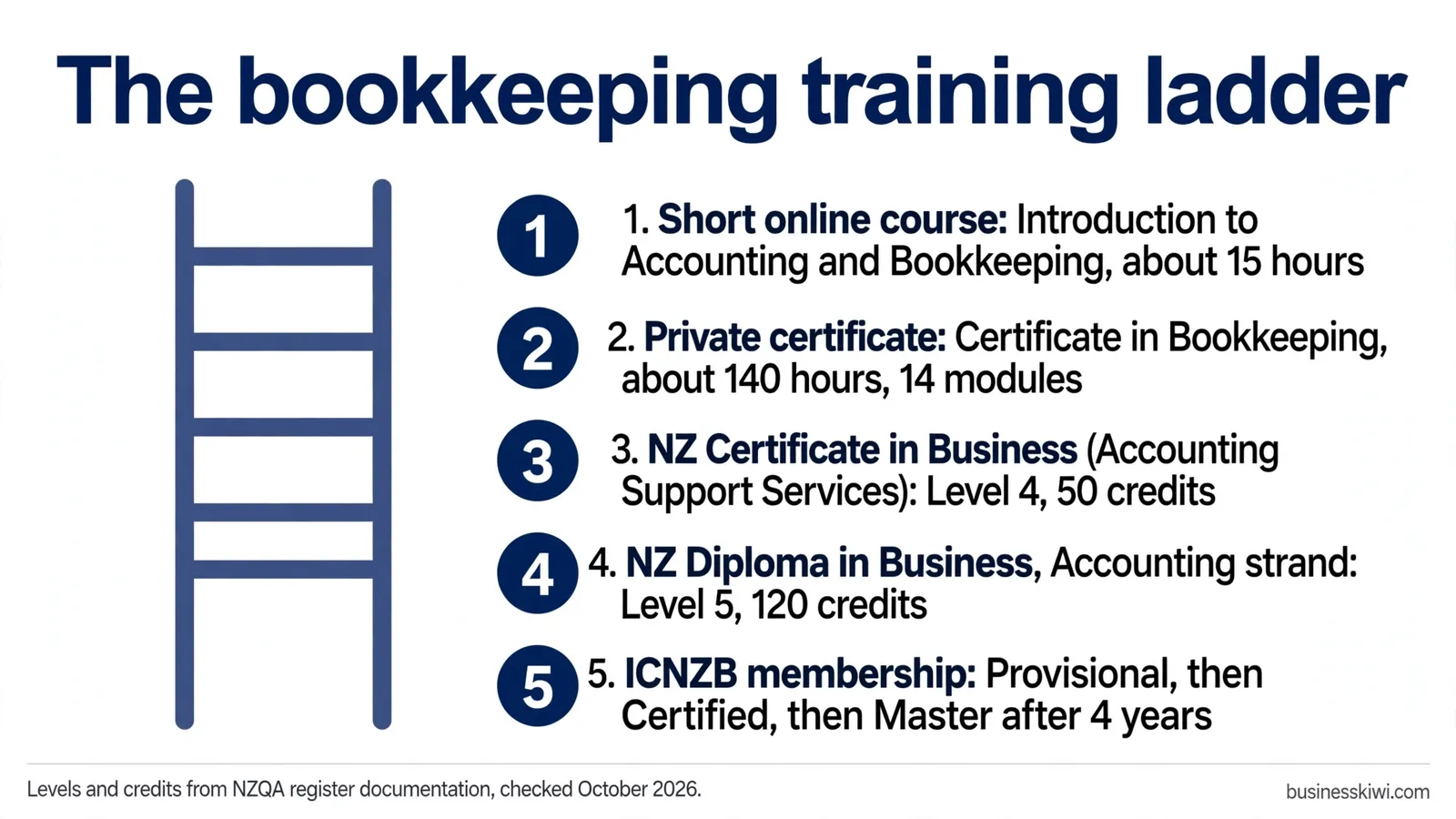
The NZQCF organises qualifications into ten levels, with complexity rising from Level 1 to Level 10. Certificates sit at Levels 1 to 6 and diplomas at Levels 5 to 7, with degrees starting at Level 7. Bookkeeping training mostly lives at Levels 3 to 5, plus a large number of short courses that sit outside the framework altogether.
The key formal qualification is the New Zealand Certificate in Business (Accounting Support Services) (Level 4). NZQA’s register documentation for the business qualifications lists it at Level 4 with 50 credits, under qualification reference 2455, and it is designed to prepare you for entry-level accounting support work. Polytechnics deliver it under the same qualification title, so Otago Polytechnic and Open Polytechnic both teach towards the same Level 4 outcome, one blended and one online. Entry to the polytechnic programmes generally requires 40 credits at NCEA Level 1, including 10 literacy credits and 10 numeracy credits, or a relevant qualification at Level 2, or a recognised equivalent. Otago Polytechnic also offers special admission for applicants over 20 who do not meet those requirements.
The next formal step up is the New Zealand Diploma in Business (Level 5), which NZQA lists at 120 credits with strands that include Accounting. Otago Polytechnic treats the Level 4 certificate as a pathway into that diploma, and from there into applied management degrees in accounting. That ladder matters if you think you might move from bookkeeping into accounting technician or accounting roles later.
Below and beside the framework sit the private certificates and short courses. The Career Academy, for example, awards its own Certificate of Achievement on completion of its Certificate in Bookkeeping, and describes the course as industry-accredited. That is a provider certificate, not a New Zealand Certificate on the NZQCF, and the two should not be confused. Provider certificates can still be useful, especially for software skills, but they carry a different status from a framework qualification when an employer or a professional body assesses your training. Software certifications, such as the Xero advisor certification that some courses include access to, sit in this same practical category.
The professional pathway: ICNZB certification
Because anyone can legally call themselves a bookkeeper in New Zealand, professional membership is how experienced bookkeepers signal that their skills have been tested. ICNZB states plainly in its guide to becoming a certified bookkeeper that there are currently no qualifications required to become a New Zealand bookkeeper, but that the duties themselves require experience and training.
ICNZB offers three membership levels. Provisional Member is the entry level, aimed at people starting out or doing bookkeeping as part of a wider job who want professional development. ICNZB Certified Bookkeeper suits people running their own bookkeeping business, contracting to another bookkeeper, or working as an employee performing bookkeeping. ICNZB Master Bookkeeper is available once you have held Certified Bookkeeper membership for four years. ICNZB says its members have their skills tested by the association and must comply with its Code of Ethical Conduct, which is the reassurance membership is meant to give clients and employers.
A course fits into this pathway in two ways. It gives you the underlying skills that certification assessments test, and it helps you build the experience record you need. The Career Academy also bundles membership of a different body, the New Zealand Qualified Bookkeepers Association (NZQBA), with some courses, including six months of free membership with its Certificate in Bookkeeping. Whichever body you aim for, check what it recognises before you pay for training, because course recognition is not automatic.

Study modes: online, blended and part time
Fully online study is the default for bookkeeping training. Open Polytechnic delivers the Level 4 certificate entirely online, and The Career Academy’s courses are 100 percent online with no exams and no fixed class times. Online courses usually sell access for a set window rather than a fixed term. The Career Academy gives six months of access to its Certificate in Bookkeeping, which covers about 140 study hours, and 18 months for its longer pathway programmes.
Blended study mixes online learning with face-to-face workshops. Otago Polytechnic delivers the Level 4 certificate this way in Dunedin, with learning scheduled flexibly outside core working hours and on-campus drop-in tutorials for extra support. The full-time load is 17 weeks at roughly 12 hours of work per week, and part-time study is available for those who cannot commit to that pace.
Part time is the norm rather than the exception in this field, because many learners are already working in administration or running a small business. When you compare courses, compare the access window or term length against the stated study hours, not just the headline duration. A 140-hour course with six months of access is a gentle pace for someone working full time, while a 17-week full-time programme is a much bigger weekly commitment.
What bookkeeping courses cost
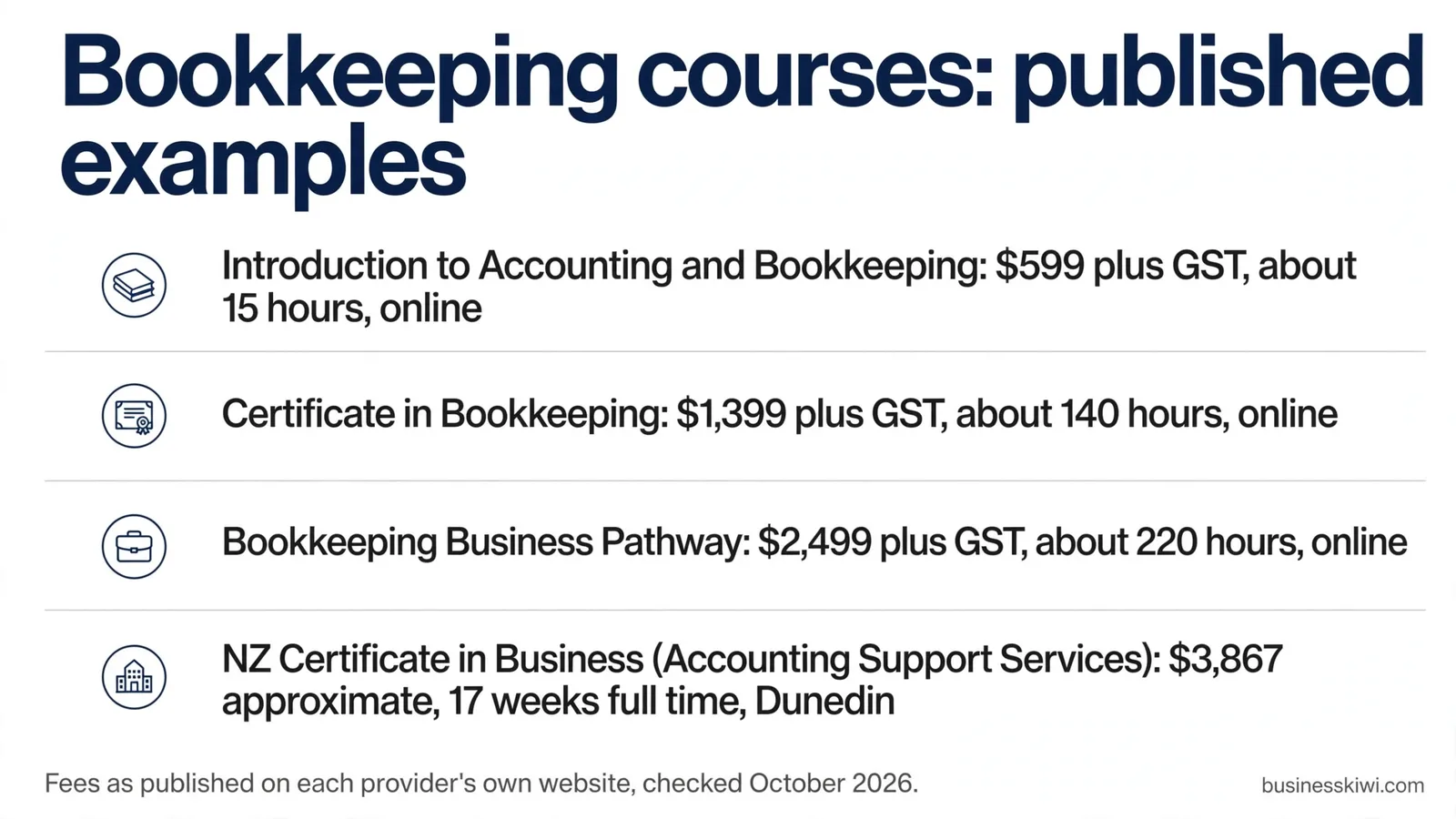
Fees vary by provider type more than by topic, so the honest way to compare is with published examples. The figures below were published on each provider’s own website and checked on 20 October 2026. Prices change, so confirm the current fee before you enrol.
The Career Academy publishes upfront prices for its online courses. Its Introduction to Accounting and Bookkeeping, a beginner course of about 15 study hours across seven modules, costs $599 plus GST. Its Certificate in Bookkeeping costs $1,399 plus GST for about 140 study hours, and its Bookkeeping Business Pathway, which combines the Certificate in Bookkeeping with a course on starting a bookkeeping business using Xero, costs $2,499 plus GST for about 220 study hours. The Career Academy also offers payment plans from $29 per week with no deposit and no credit check, with the total cost the same as the upfront price.
At the polytechnics, Otago Polytechnic publishes an approximate domestic tuition fee of $3,867 for the full Level 4 certificate qualification. That buys a framework qualification with 50 credits, assessed courses and a pathway into the Level 5 diploma, which is a different product from a short online course even where the topics overlap. Open Polytechnic delivers the same Level 4 qualification online, and its pricing should be checked on its own course page, as its fee and any current fees-free offer are not stated in the programme overview text this guide is based on.
Two cost points apply everywhere. First, check whether the price is shown including or excluding GST, because private providers often quote plus GST while polytechnic tuition fees are generally the full amount. Second, check what is included. Some courses bundle extras such as e-book libraries, software access and association membership, while others charge for printed materials or hard-copy certificates on top of the headline fee.
How to choose a bookkeeping course
Start with the outcome you need. If you want to do the books for your own business, a short course that covers transactions, GST and your software may be enough. If you want a job in an accounts team, or clients of your own, look for a course that teaches the full task list, including payroll and end-of-month reporting, and that gives you assessed practice rather than videos alone.
Check the qualification status next. If the course leads to a New Zealand Certificate or Diploma, it should name the qualification, its NZQCF level and its credit value, and you can verify it against NZQA’s register documentation. If it is a provider certificate, the provider should be upfront that the award is its own. Be wary of any course that uses the word certificate loosely or implies NZQA approval it does not have.
Check the software coverage. Employers and clients in New Zealand work mainly in Xero and MYOB, so a course that includes practical work in at least one of them, and ideally exposure to both, is worth more than a theory-only course. The Career Academy’s Certificate in Bookkeeping includes modules in both Xero and MYOB Business Essentials, and the polytechnic accounting software course teaches software setup and reporting for a GST-registered entity.
Finally, check the practicalities. Confirm the entry requirements, the access window or term dates, the total study hours, whether tutor support is included, and what happens if you need more time. If professional membership matters to you, check whether the course is recognised by ICNZB or includes membership of a bookkeepers’ association, and factor any membership fees into your total cost.
Who these courses suit, and where they lead

Bookkeeping courses suit career changers moving into office and accounts work, administrators who have picked up invoicing or payroll tasks and want to do them properly, and small business owners who want to understand their own numbers. The Career Academy lists job outcomes for its Certificate in Bookkeeping that include bookkeeper, accounts technician, purchase and sales ledger clerk, payroll data entry clerk, finance administration assistant, accounts payable and receivable clerk, credit control assistant and small-business bookkeeper. Otago Polytechnic aims its Level 4 certificate at people moving into entry-level accounting support roles, as well as people already in administration roles who want to take on accounts work.
Tahatū, the official careers site that has replaced Careers NZ, lists bookkeeper as one of the job titles covered by its accounts officer profile, alongside accounts payable and receivable officer, billing administrator and finance officer. Tahatū describes accounts officers as managing and monitoring financial information for organisations, puts the most common pay range at $59,000 to $85,000 a year, and records about 17,000 people in the role with employment change steady. Its accounting technician profile, the next step up for many bookkeepers, shows pay of $59,000 to $82,000 a year with zero to two years of training. None of these roles legally requires a qualification, but training is how most people build the skills and the track record to get hired.
Related guides: our client accounting software guide compares the main packages bookkeepers use, our accountant fees guide shows what professional help costs if you would rather buy it in, and our accountant salary guide covers the next step up the ladder. For more training and careers guides, browse the Jobs & Education section.
Frequently asked questions
Do I need a qualification to work as a bookkeeper in New Zealand?
No. ICNZB confirms there are currently no qualifications required to become a bookkeeper in New Zealand. In practice, employers and clients still look for training and experience, because bookkeeping errors are costly. A certificate, framework qualification or professional membership is how you show your skills have been taught and tested.
What is the main bookkeeping qualification on the NZQCF?
The New Zealand Certificate in Business (Accounting Support Services) (Level 4). NZQA’s register documentation lists it at Level 4 with 50 credits under reference 2455. It is delivered by polytechnics, including Otago Polytechnic in a blended format and Open Polytechnic online, and it pathways into the New Zealand Diploma in Business (Level 5) with an Accounting strand.
How much does a bookkeeping course cost in NZ?
Published prices checked on 20 October 2026 range from $599 plus GST for The Career Academy’s short introductory course, to $1,399 plus GST for its Certificate in Bookkeeping, to an approximate domestic tuition fee of $3,867 for the Level 4 New Zealand Certificate at Otago Polytechnic. Always check whether a quoted price includes GST, and confirm the current fee on the provider’s own site before enrolling.
How long does a bookkeeping course take?
It depends on the type. The Career Academy’s Certificate in Bookkeeping is about 140 study hours with six months of access, so most learners finish in a few months of part-time study. The Level 4 certificate at Otago Polytechnic runs for 17 weeks full time at roughly 12 hours per week, with part-time options that stretch the same content over a longer period.
Is a private certificate the same as a New Zealand Certificate?
No. A New Zealand Certificate is a qualification listed on the NZQCF with a set level and credit value, quality assured through NZQA processes. A private provider’s certificate, such as The Career Academy’s Certificate of Achievement, is awarded by the provider itself and is usually described as industry-accredited. Both can teach useful skills, but only the framework qualification carries NZQCF status.
Will a bookkeeping course teach me Xero or MYOB?
Most practical courses include software training, because bookkeeping is now done in accounting software. The Career Academy’s Certificate in Bookkeeping includes modules on accounting with Xero and accounting with MYOB Business Essentials, and the polytechnic Level 4 certificate includes a 15-credit accounting software course. Check the module list before you enrol if a particular package matters to you.
What is ICNZB certification, and do I need it?
ICNZB is the Institute of Certified NZ Bookkeepers, the professional body for bookkeepers. Its membership runs from Provisional Member through ICNZB Certified Bookkeeper to ICNZB Master Bookkeeper, which requires four years at the Certified level. Membership is voluntary, not a legal requirement, but ICNZB members have their skills tested by the association and must follow its Code of Ethical Conduct, which reassures clients and employers.
The bottom line
Choose the course that matches the work you want to do. Short online courses are a low-cost way to learn the basics and your software. A private certificate adds structure, tutor support and a broader task list. The Level 4 New Zealand Certificate costs more and asks more of you, but it is the option that carries formal NZQCF status and a pathway into diploma-level accounting study. Whichever route you take, verify the qualification status, the software covered and the full price, including GST, on the provider’s own site before you commit.
Sources
-
NZQA, Change report for the republication of New Zealand Business Qualifications, July 2022. https://www.nzqa.govt.nz/nqfdocs/summaries/2022/Jul22/revsumJul22-14.html
-
NZQA, New Zealand Qualifications and Credentials Framework fan diagram description. https://www2.nzqa.govt.nz/about-us/consultations-and-reviews/nzqcf-nzqa-rules/alt-text-nzqcf-image/
-
Otago Polytechnic, New Zealand Certificate in Business (Accounting Support Services) (Level 4). https://www.op.ac.nz/programmes/nzqa/new-zealand-certificate-in-business-accounting-support-services
-
Open Polytechnic, NZ2455 New Zealand Certificate in Business (Accounting Support Services) (Level 4). https://www.openpolytechnic.ac.nz/qualifications-and-courses/nz2455-new-zealand-certificate-in-business-accounting-support-services-level-2/tab//QT02
-
The Career Academy, Certificate in Bookkeeping. https://careeracademy.co.nz/courses/certificate-in-bookkeeping/
-
The Career Academy, Bookkeeping courses. https://careeracademy.co.nz/subject/bookkeeping/
-
The Career Academy, Bookkeeping Business Pathway. https://careeracademy.co.nz/product/bookkeeping-business-pathway/
-
The Career Academy, Introduction to Accounting & Bookkeeping. https://careeracademy.co.nz/courses/introduction-to-accounting-bookkeeping/
-
Institute of Certified NZ Bookkeepers, Become an ICNZB Certified Bookkeeper, Volume 1: The Essentials of Bookkeeping, March 2023. https://icnzb.org.nz/assets/Resources/Knowledge-base/Guide-to-become-an-ICNZB-Certified-Bookkeeper/Volume-1-Essentials-of-Bookkeeping_March-2023.pdf
-
Tahatū Career Navigator, Accounts officer occupation profile. https://tahatu.govt.nz/work/explore-career-ideas/occupation/T00667-accounts-officer
-
Tahatū Career Navigator, Accounting and finance career ideas. https://tahatu.govt.nz/work/explore-career-ideas/143-accounting-and-finance
This article is general information about bookkeeping courses and training in New Zealand. It is not financial, tax or careers advice for your individual situation. Course details, fees and entry requirements change over time, so check the current information on the provider’s own website and with NZQA before you enrol.