Disbursements: What the Word Means on a Bill, and How GST Applies

The short answer
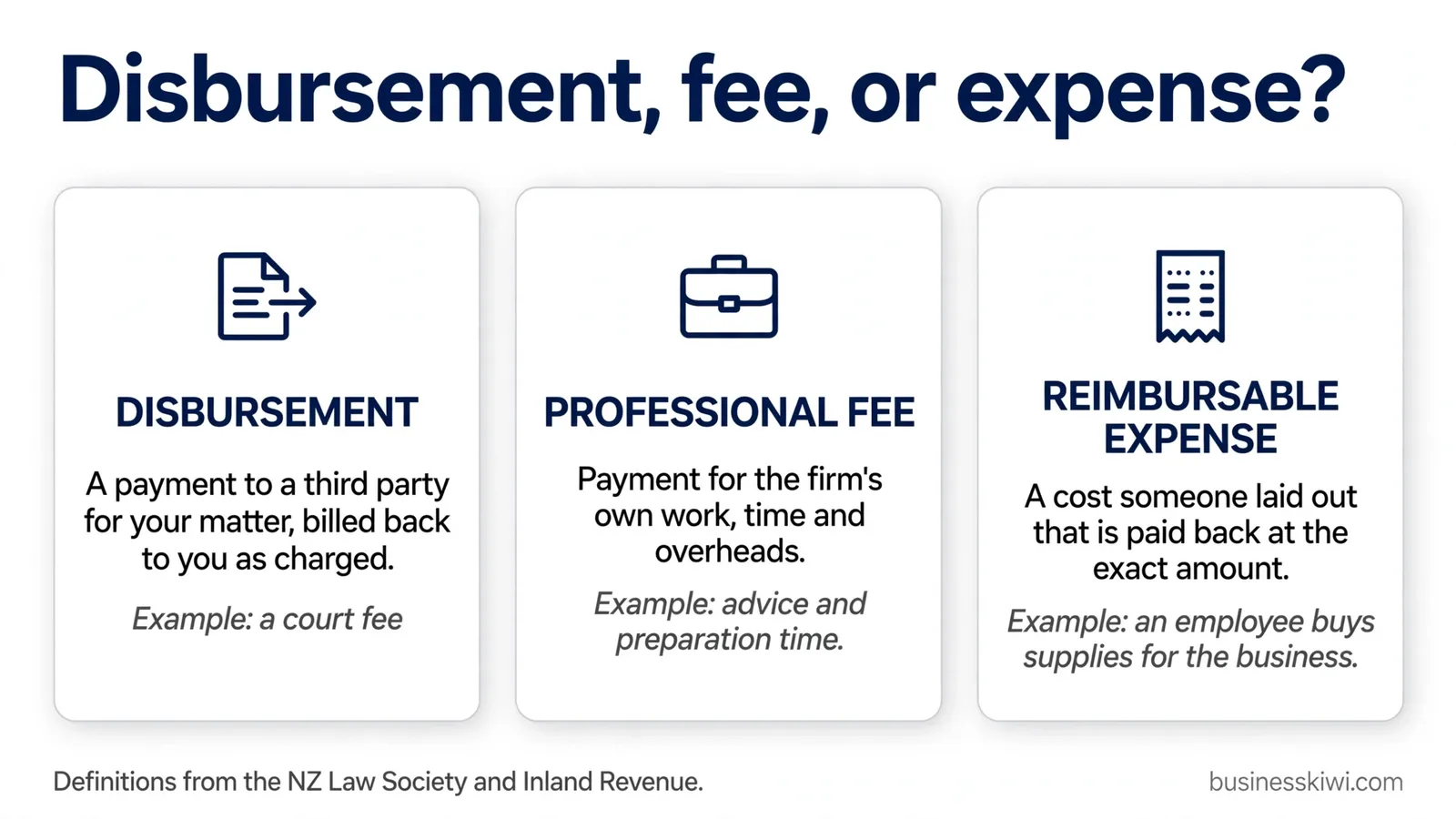
A disbursement is a payment your lawyer, accountant or other professional makes to a third party on your behalf, then bills back to you at cost. It is your cost, not payment for the firm’s own work. The firm simply paid first because it was handling your matter.
The New Zealand Law Society puts it this way: a disbursement is “a payment to a third party, billed to the client as charged to the law practice”. Two things follow. The payment must go to someone outside the firm, and the amount on your bill should be the amount the firm was charged, with nothing added.
The word matters because GST treatment turns on it. A true disbursement, paid as your agent, carries no GST from the firm. A cost the firm incurred itself and passed on is part of its fee, and GST applies to it the same way.
What counts as a disbursement
Disbursements show up most often on lawyers’ bills, because legal work constantly triggers payments to outsiders. Typical examples include:
-
Court filing and hearing fees, paid to the court for your proceeding
-
Land transfer and registration fees, paid on a property transaction
-
Fees for serving documents on another party
-
An expert witness’s fee, where the expert is engaged for your matter
-
An identifiable courier charge
Accountants use the word the same way. When an accounting firm pays a government filing fee or outside charge for a client and bills it back at cost, that line is a disbursement. Inland Revenue’s guidance uses a law firm as its example but states that the same treatment applies to payments made in the same circumstances by other registered businesses, so these rules are not limited to lawyers.
Notice what is missing from the list. Photocopying done in the office, secretarial time, phone calls and the firm’s own software or licence costs are not payments to a third party for your matter. Firms sometimes bill them, but under the Law Society’s principles they are not disbursements, and calling them that can mislead. They belong in the fee, or in a disclosed “sundry fees” line.
Disbursements vs professional fees
A professional fee is payment for the firm’s own work: the lawyer’s advice, the accountant’s preparation time. For lawyers, the Conduct and Client Care Rules say a fee must be fair and reasonable for the services provided. The fee is also where the firm’s overheads are recovered: staff time, office costs and general expenses that cannot be tied to one client.
A disbursement is different in kind. The firm gains nothing from it. It is a pass-through: money out to a third party, then the same amount back from you. That is why the Law Society insists a disbursement be billed “as charged”, and why a hidden mark-up is a disciplinary problem. In one cited case, a lawyer who charged office expenses as a set percentage of the fee, and added an undisclosed uplift to Land Information New Zealand disbursements, was censured and ordered to refund fees.
The practical test is simple. If the line pays for the firm’s own time, work or overheads, it is a fee, whatever the firm calls it. If it repays an outside party for something bought for your matter, it is a disbursement. The Legal Complaints Review Officer has made the same point about labels such as “file opening fees” and AML check charges: the firm’s own work is fee work, not a disbursement or an expense.
Disbursements vs reimbursable expenses and outgoings
“Expense” is the wider, looser word. It covers any cost someone incurs. A disbursement is a particular kind of expense: one paid to a third party in the course of completing a client’s instructions, which the client repays.
“Reimbursable expense” usually describes the employee version of the same idea. An employee pays for something the business needs, and the business pays them back the exact cost. For GST, an employer can claim back the GST on what the employee bought only if the employee is reimbursed that exact cost, the employer is GST-registered, and the employee holds the taxable supply information, which may be in the employee’s own name. A flat allowance does not qualify, because there is no exact cost and no matching document.
“Outgoings” is broader still. It is the word leases and costs documents often use for the running costs that get passed on, such as rates, insurance and service charges under a commercial lease. The document that uses the word defines it, not tax law, and the label alone tells you nothing about whose cost anything really was.
The theme running through all three terms: the GST answer never follows the label on the invoice. It follows a question of substance, whose cost was it really? That is the agency question, and it decides the GST treatment.

The agency question: whose cost is it really?
In law, an agent is a person engaged to bring a principal into a contractual relationship with a third party. When your lawyer pays a court fee for your case, the lawyer acts as your agent. The legal relationship is between you and the court, and you are the one liable for the fee. The firm simply handled the payment.
Inland Revenue’s guidance makes the same distinction. A firm acts as agent where it receives a supply for which the client is legally liable to pay: paying statutory fees, or arranging and paying for other goods and services for the client. It acts as principal where it buys things it needs to do its own work, such as secretarial support, telephone calls and photocopying, and passes the cost on. Those costs enable the firm to provide its services; they are not incurred as agent for any client.
Whether a firm acted as agent or principal is, in Inland Revenue’s words, a mixed question of fact and law, decided on the circumstances of each supply. The same item can fall on different sides of the line. Photocopying proves the point: copying on the firm’s own machines is the firm’s cost, but copies an outside bureau produces for a specific proceeding, where court rules require them, are a third-party cost of that proceeding.
Clues that a payment was made as agent include: the third party’s invoice is addressed to you or issued for your matter; the charge is a government or court fee arising only because of your transaction; the billed amount matches the third party’s charge exactly; and your engagement letter says the firm will pay such costs for you. Clues pointing to principal are the mirror image: the firm’s own supplier, a general overhead, and an estimated or rounded amount rather than an exact pass-through.
GST on disbursements: the Inland Revenue position
Section 60 of the GST Act deals with agency. Section 60(2) deems a taxable supply made to an agent on behalf of a principal to be a supply made to the principal.
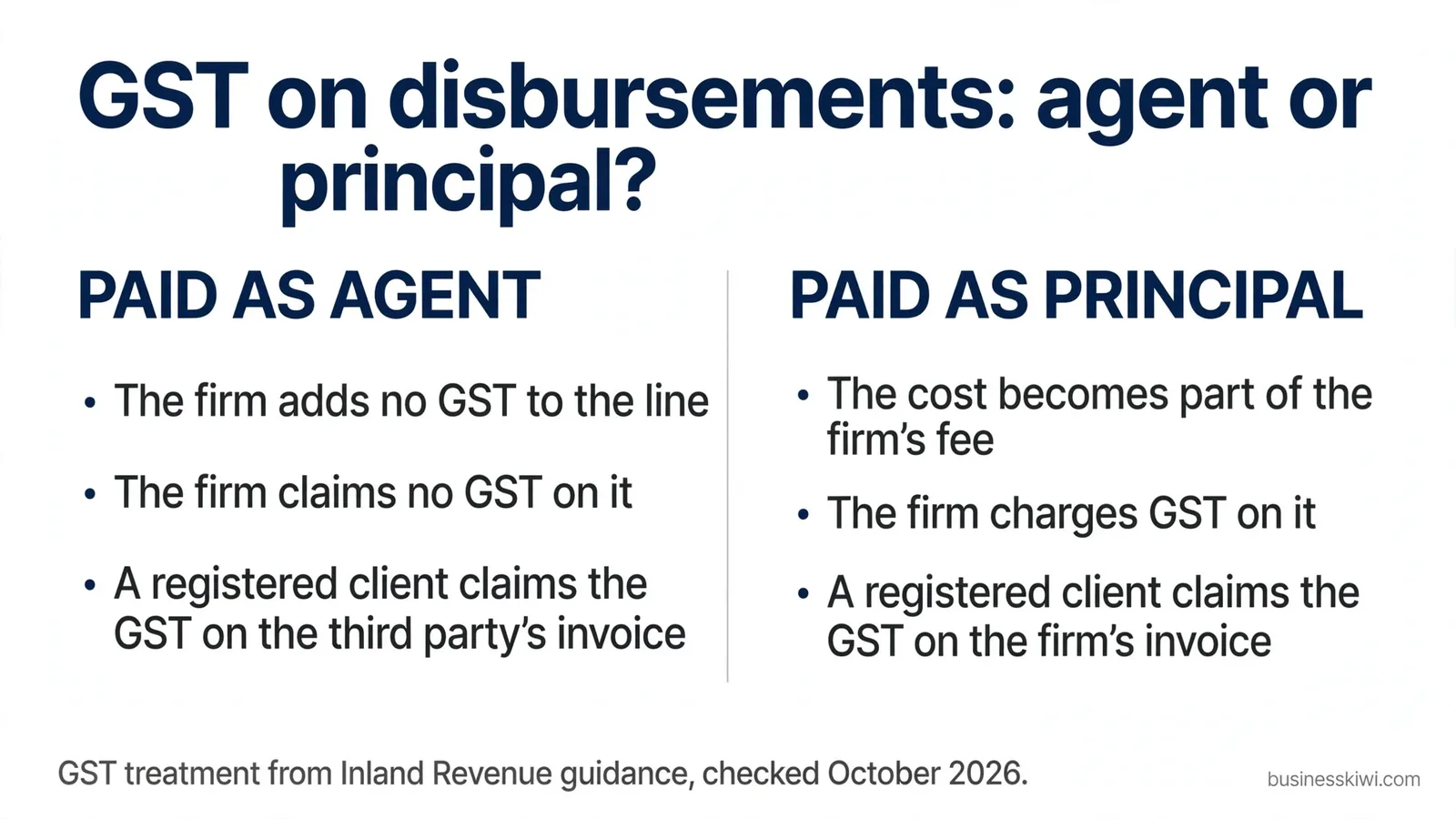
Where the firm paid as your agent, the supply is treated as made to you, not to the firm. The firm does not account for GST output tax on the amount, and claims no input tax on it either. When you repay the firm, Inland Revenue’s position is that the reimbursement is not consideration for a supply of services by the firm. In plain terms, the firm adds no GST to a true disbursement line. Any GST sits inside the third-party charge itself.
If you are GST-registered and the purchase was for your taxable activity, you claim that GST yourself. You support the claim with the third party’s taxable supply information, which may be in your name or, as the Act allows, in the firm’s name, provided the firm keeps a record of your name, address and GST number. Inland Revenue’s current guidance for agents confirms the arrangement: an agent can receive taxable supply information on the client’s behalf, the agent’s name and GST number can appear on it, and the client is still the buyer. Keep the firm’s bill too. It is the other half of your evidence.
Where the firm paid as principal and on-charges the cost, the agency rule does not apply. Inland Revenue considers that the on-charged amount forms part of the total fee for the firm’s services. The firm claims the GST on its own purchase, because the supply was made to the firm. It then charges GST on the whole amount it bills you, the on-charged cost included. If you are GST-registered, you claim that GST from the firm’s invoice.
Example A: paid as agent. A supplier charges $200 plus $30 GST, a total of $230, for something bought for your matter, and your lawyer pays it as your agent. The lawyer’s bill shows a fee of $1,000 plus $150 GST, and the $230 as a separate disbursement line with no GST added. You pay $1,380. The firm returns GST only on its fee. If you are GST-registered, you claim $180 of input tax: $150 on the fee from the firm’s invoice, and $30 on the disbursement, supported by the supplier’s invoice and the firm’s bill.
Example B: paid as principal. Your accountant pays $100 plus $15 GST, $115 in total, for an outside service the firm uses in doing your work. The firm claims the $15 as its own input tax. On your bill, the cost appears as $100 plus $15 GST, inside the firm’s charges. You pay $115 for that line, and if you are GST-registered you claim the $15 from the firm’s invoice. The dollars look similar to Example A. The GST path is different: in Example A your claim rides on the third party’s invoice, in Example B on the firm’s invoice.
None of this lets a firm strip GST out of its own charges by relabelling them. If the firm was the real buyer, the cost is part of its fee and GST applies, whatever the invoice calls it. A client who is not GST-registered cannot claim GST back in either example: for them, GST inside a disbursement is simply part of the cost.
A special case: disbursements in court costs
If you win a court case, the court may order the other side to pay your costs and disbursements. In that setting the word has a set meaning. Under rule 14.12 of the High Court Rules 2016, disbursements are expenses paid or incurred for the purposes of the proceeding that would ordinarily be charged for separately from legal professional services in a solicitor’s bill of costs. The rule lists court fees, expenses of serving documents, photocopying for documents the rules require, and telephone or video conference costs. Expert witness fees can be included where the court approves the class. Disbursements must be specific to the proceeding, reasonably necessary and reasonable in amount.
Inland Revenue’s draft interpretation statement on court-awarded costs and disbursements (PUB00516, published for comment in December 2025) explains the GST side. An award is compensation, not payment for a supply. The winner does not return GST on the award or issue taxable supply information for it, and the loser cannot claim an input tax deduction on it. Courts take the winner’s GST position into account when fixing the amount, so a winner who could not recover GST is not left out of pocket.
How disbursements appear on an invoice
On a well-drawn professional bill, disbursements appear as their own section, separate from the fee. Each line names the third party or the charge, and the amount is the exact amount the firm was charged. No GST is added by the firm to a genuine disbursement line, although the third-party amount itself may include that party’s GST (see Example A).
Items that are not third-party payments should not be in that section: under the Law Society’s principles they belong in the terms of engagement and under a “sundry fees” heading. If a related agency business sits behind a charge, that should be disclosed, with its invoice available.
The general rules for what an invoice must contain are covered by this site’s invoicing and tax invoice guides. For disbursements, the basics are the separate section, the exact amounts, and paperwork you can ask to see.

What clients should check and ask
Before you pay, check the disbursements section against these points:
-
Is each line a payment to a third party? If a line pays for the firm’s own work or overheads, it is a fee item, and you can ask why it sits with the disbursements.
-
Does the amount match the third-party charge? A disbursement should be billed as charged. Ask for the underlying invoice or receipt if an amount looks rounded, estimated or uplifted.
-
Was it disclosed in advance? For lawyers, the basis of charging should be in the terms of engagement. An agency or sundry charge that was never disclosed is a fair thing to challenge.
-
Is the GST treatment consistent? GST charged by the firm on a disbursement line suggests the firm is treating the cost as its own supply. That may be right, if the firm bought as principal, but ask which basis applies: it affects what you can claim if you are GST-registered.
-
Have you claimed the right GST? On a true disbursement your claim rests on the third party’s document and the firm’s bill. Make sure you receive both, and that the firm holds your correct name, address and GST number for agent purchases.
If a lawyer’s bill still does not make sense, the billing rules sit in the Lawyers and Conveyancers Act (Lawyers: Conduct and Client Care) Rules 2008, and the Law Society’s standards process deals with billing complaints. For any professional, the first step is the same: ask the firm to explain the line, in writing, before you pay it.
Related guides: our how to write an invoice guide covers building an invoice step by step, our tax invoice guide covers the GST document rules in full, and our claiming business expenses guide covers what your own business can claim. For more money guides, browse the Finance section.
Frequently asked questions
What does “disbursements” mean on a lawyer’s bill?
It means payments the lawyer made to third parties for your matter, billed back to you at cost: court fees, land transfer fees and expert witness fees are typical examples. It is not payment for the lawyer’s own work. That is the fee.
Are disbursements charged on top of the fee?
Yes, usually. A professional bill normally has two parts: the fee for the firm’s own work, and the disbursements the firm paid out for you. Both are payable by you, but they differ in kind, and the GST treatment differs.
Do disbursements include GST?
It depends on the item. A third-party charge may itself include GST, inside the amount passed on to you. The firm does not add its own GST to a true disbursement, because the supply was made to you, not to the firm. GST does apply to costs the firm incurred as principal and on-charges, because those form part of the firm’s fee.
Can I claim GST back on disbursements?
If you are GST-registered and the cost relates to your taxable activity, yes. On a true disbursement you claim the GST yourself, using the third party’s taxable supply information and the firm’s bill as evidence. If you are not GST-registered, you cannot claim GST on anything, and the GST inside a disbursement is simply part of your cost.
Is photocopying a disbursement?
Usually not, when the firm does it in-house. Inland Revenue treats a firm’s own photocopying as a cost incurred as principal, and the Law Society says internal photocopying is not a payment to a third party. Copying produced by an outside bureau for a specific matter, or required by court rules, can be a genuine disbursement.
Can a firm add a mark-up to a disbursement?
A disbursement should be billed as charged. Adding an undisclosed uplift to a third-party charge, such as a registry fee, has been treated as misleading billing practice by the Law Society; in one cited case it led to censure and fee refunds. A handling or agency fee should be disclosed in the terms of engagement and shown as a fee, not hidden inside a disbursement.
What if my accountant charges disbursements?
The same principles apply. Inland Revenue’s guidance states that the GST treatment applies to payments made in the same circumstances by other registered businesses, not just law firms. A genuine third-party pass-through, such as a government filing fee your accountant paid for you as agent, is a disbursement. The firm’s own costs are part of its fee and carry GST.
The bottom line
A disbursement is someone else’s charge that your professional paid for you and passes on at cost. A fee is payment for the professional’s own work. An expense is any cost at all, and a reimbursement is an expense paid back. The labels matter less than the substance: who really bought the item decides whose invoice the GST sits on, and who can claim it. When a bill is unclear, ask which third party was paid, ask to see their invoice, and ask whether the firm paid as your agent or as principal. Those three questions resolve almost every disbursement query.
Sources
-
Inland Revenue, Tax Information Bulletin Vol 6 No 1 (July 1994), “Disbursements by professional firms on behalf of clients – GST”: https://www.taxtechnical.ird.govt.nz/-/media/project/ir/tt/pdfs/tib/volume-06—1994-1995/tib-vol6-no01.pdf
-
Inland Revenue, “Taxable supply information issued by agents”: http://www.ird.govt.nz/gst/tax-invoices-for-gst/agents-issuing-or-getting-tax-invoices
-
Inland Revenue, exposure draft interpretation statement PUB00516, “GST – Court awarded costs and disbursements” (December 2025): https://www.taxtechnical.ird.govt.nz/-/media/project/ir/tt/pdfs/consultations/expired-consultations/pub00516.pdf
-
New Zealand Law Society, practice briefing, “Open and Transparent Billing”: https://www.lawsociety.org.nz/professional-practice/practice-briefings/open-and-transparent-billing/
This article is general information about disbursements and how they are treated in New Zealand. It is not legal, tax or accounting advice for your situation. GST treatment turns on the facts of each payment, including whether the firm acted as agent or principal. If a bill or a GST return turns on the distinction, check with your lawyer or accountant, or ask Inland Revenue.