Crombie Lockwood: The New Zealand Insurance Broker Now Trading as Gallagher

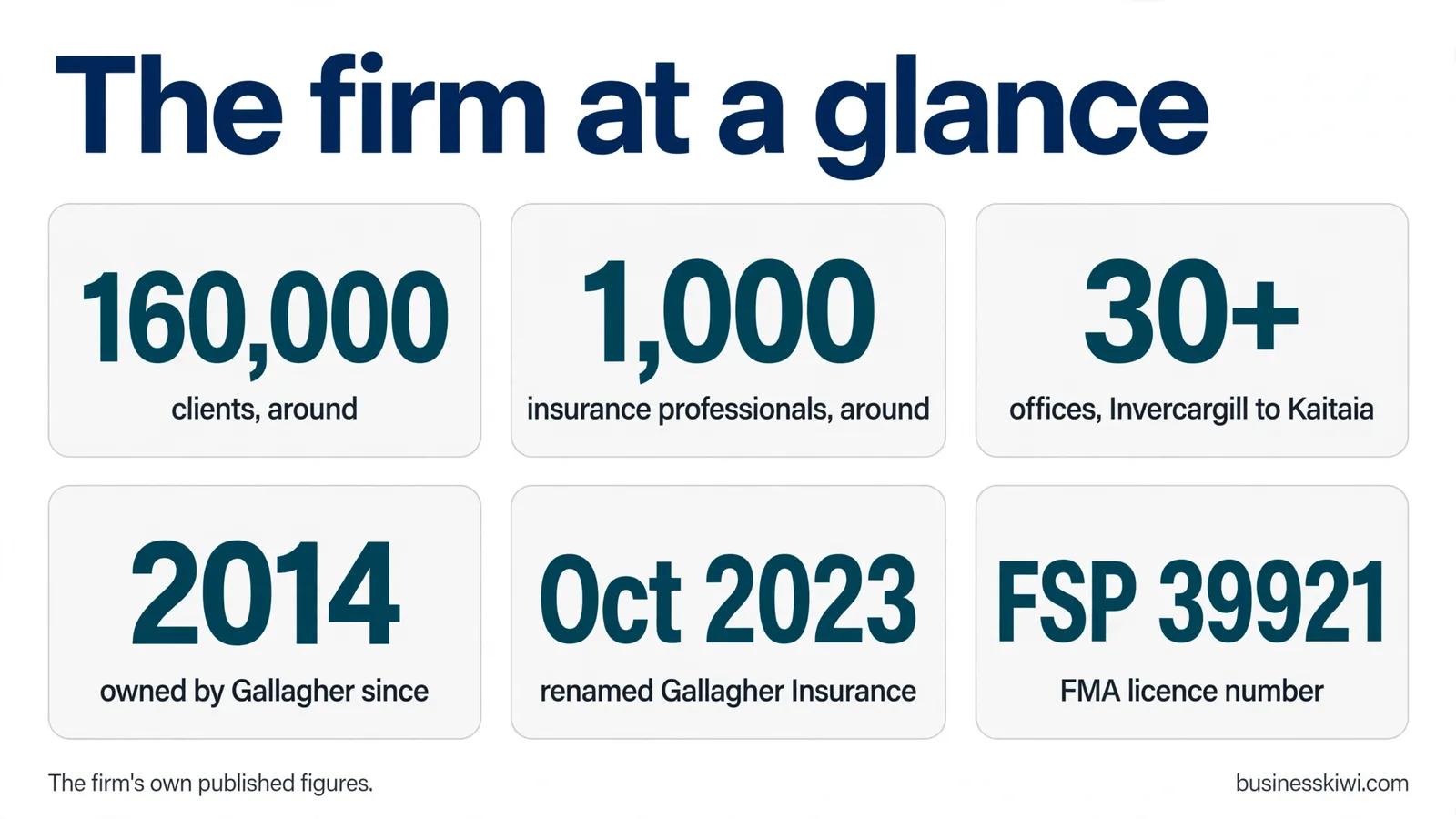
Anyone searching for Crombie Lockwood today will notice something odd. The name still opens the firm’s old website, but the business on the other side of the door is called Gallagher Insurance. The name on the sign changed in October 2023, when one of New Zealand’s best known insurance brokers took the name of the global group that has owned it since 2014.
This profile explains what the firm is, what it does, and how it works, using only the firm’s own published pages and its own disclosure document. It is a factual guide, not a recommendation, and nothing here ranks this firm against any other.
The short answer
Crombie Lockwood was a New Zealand insurance broking firm. It is now the New Zealand business of Gallagher, a global insurance brokerage group, and it trades as Gallagher Insurance. The firm acts as a broker and adviser rather than an insurer. It advises on and arranges business, rural, personal and life and health insurance for, in its own words, around 160,000 clients, and employs around 1,000 insurance professionals in more than 30 offices. The legal entity behind the service is Arthur J. Gallagher & Co (NZ) Limited, which holds a Financial Markets Authority licence (FSP 39921) to advise on fire and general and life and health insurance products.
Broker or insurer: what the firm actually is
An insurer is the company that carries the risk. It sets the policy terms, collects the premium and pays claims from its own balance sheet. A broker sits between the client and the insurer. The broker’s job is to understand what a client needs to protect, take that risk to the insurance market, negotiate terms, and place the cover with one or more insurers.
Crombie Lockwood, now Gallagher Insurance, is firmly on the broker side of that line. Its disclosure document describes its broking division as insurance advisers and brokers arranging cover across fire and general insurance and life and health insurance. When it arranges a policy, the contract of insurance is between the client and an insurer. The firm does not itself underwrite the risk.
That distinction matters at claim time. The broker helps a client prepare, manage and negotiate a claim, and the firm lists that help among its core responsibilities. But the decision to pay sits with the insurer, and the firm’s terms state plainly that it does not guarantee any insurer’s solvency or ability to pay.
From Crombie Lockwood to Gallagher: history and ownership
The firm’s own account of its history is short on dates. Announcing the name change on 1 October 2023, it said the Crombie Lockwood brand had been built in New Zealand over 45 years. It did not publish a founding year in the material reviewed for this profile, so this article does not invent one.
What the record does show is a business that grew into one of the country’s largest brokerages under its own name, led for many years by two of its original founders, Steve Lockwood and Carl O’Shea. In 2014 the firm was bought by Arthur J. Gallagher & Co, the United States based brokerage group. For almost a decade it kept trading as Crombie Lockwood under that ownership.
The parent group has its own long history. The firm states that Arthur J. Gallagher founded the business in Chicago in 1927, and that his grandson, J. Patrick Gallagher Jr., has led it as chief executive since 1995. The group is listed on the New York Stock Exchange as an S&P 500 company. At the time of the New Zealand rebrand, the firm described Gallagher as the third largest insurance broker in the world, operating from 850 offices in more than 130 countries. That ranking is the group’s own description of itself.
From 2 October 2023 the New Zealand business took the Gallagher name and became Gallagher Insurance. The firm said the change was about using the global brand to find capacity, coverage and pricing options for New Zealand clients in a difficult market. It also stressed continuity. The New Zealand operation kept its own local executive, led by chief executive Carl O’Shea, and the firm later noted that two of its original founders, Steve Lockwood and Carl O’Shea, still guide the business. Clients kept the same brokers and the same branches.
The scale of the New Zealand operation
By its own published figures, this is a large brokerage. The firm’s About page says it advises on and arranges insurance on behalf of around 160,000 clients. It puts its team at around 1,000 insurance professionals in more than 30 offices across the country.
Scale matters for a practical reason. A brokerage of this size places a great deal of premium into the market, which is the basis of its negotiating position with insurers. It is also structured in layers: local branch brokers for everyday clients, specialist teams for sectors and complex risks, and group companies behind the scenes for product manufacturing, premium funding and offshore placements. For an individual client, the everyday experience is the local broker. The structure behind that broker is what this profile describes.
Business and corporate insurance services
Business insurance is the firm’s core. Its business pages list the main lines it arranges for companies: business liability, business interruption, commercial property, commercial motor vehicle, cyber, professional indemnity, marine, rural cover, boat and watercraft, travel insurance for business, employee benefits programmes, and packaged cover for small and medium businesses, including a product it calls SMARTpak. It also runs insurance schemes built with industry bodies and associations.
The liability page alone lists public liability, statutory liability, employer’s liability, professional indemnity, directors and officers liability, employment disputes cover, product liability, crime and fidelity, trustees liability, and several narrower covers, including internet liability and criminal defence costs.
For larger organisations, the corporate list overlaps but shifts emphasis. It adds directors and officers liability, trade credit insurance, insolvency and turnaround insurance, and risk engineering, the firm’s specialist risk management advice service.
Two supporting services round out the business offer. A regular payments plan lets clients spread premiums across the year, and a dedicated Asian Division provides insurance advice to migrant business communities. The firm also says its brokers work with businesses of every size, from sole traders to large commercial operations.

Industries and sectors it serves
The firm organises much of its expertise by sector. Its site carries dedicated industry coverage for aged care and healthcare, agriculture, aviation, bloodstock, construction, education, energy, entertainment, financial services, forestry, hospitality and food services, manufacturing, marine, mining, not for profit organisations, professional services, technology, trades and transport.
The sector pages follow a pattern. They name the kinds of clients served and the exposures that matter in that industry. The mining page, for example, covers operators, contractors, traders and financiers across a project life cycle. The technology page lists IT consultants, software developers, network engineers, hosting providers and telecommunications businesses among its clients.
The schemes business cuts across the sectors. Working with industry bodies, associations and large organisations, the firm builds group insurance arrangements for members. Its own examples include plumbers and electricians, automotive trades, schools and early childhood centres, chartered accountants and barristers, farmers, forestry and wine growers, hotels, pubs and restaurants, churches and sports bodies, retirement villages, and transport operators. Under a scheme, cover is arranged once at group level and members join under it.
Personal insurance and the Onesurance range
Individuals and families are the firm’s second market. Its personal lines list covers home, contents, car, landlord, boat and watercraft, travel, pet, and life and health insurance. House cover is broken into replacement sum insurance, rental property cover and holiday house cover.
The most distinctive personal product is Onesurance, a suite of home, contents, motor vehicle and landlord policies created exclusively for the firm. The policies are underwritten by two insurers, IAG New Zealand and Vero New Zealand, and placed through Monument Insurance (NZ) Ltd, a related Gallagher company that acts as an underwriting agent. That arrangement is worth a reader’s attention. It is a broker designed product, sold through the broker’s own group, which is common in this market and fully disclosed on the firm’s own product page. The firm presents the benefit as flexibility: automatic and optional benefits, and a choice of policy limits, so cover can be matched to the household.
The group companies behind the broker
The disclosure document names three related companies that sit behind the front line brokerage, and each explains a piece of how the firm works.
Monument Insurance (NZ) Limited is a wholesale underwriting agency. It creates insurance products for the firm’s clients, including the Onesurance range, and it is an authorised body under the firm’s Financial Markets Authority licence, so it can provide financial advice services under that licence rather than its own.
Monument Premium Funding Limited provides premium funding, the finance facility that lets a client pay a large annual premium in instalments. The firm discloses that if it arranges premium funding, it is remunerated by the funding company, usually as a percentage of the cost of the insurance funded, and that interest and administration costs apply.
Offshore Market Placements Limited is the specialist arm that sources cover from international markets. It works only with the firm’s brokers, finding alternatives to the New Zealand market for specialist and niche risks.

How dealing with the firm works
The firm’s terms set out a standard broking process. A client explains what they need to protect. The broker assesses the risk, advises on cover, and negotiates with insurers before placing the policy. The firm then provides the policy documents, unless the insurer sends them directly, and it handles client money, such as premiums and claim payments, under the Insurance Intermediaries Act 1994.
Two client responsibilities in the terms deserve plain English. First, disclosure. When asking a broker to arrange or renew a policy, the client must pass on all relevant information, not just answers to the questions asked. The terms warn that if a client misrepresents or withholds relevant information, an insurer may refuse a claim or cancel the policy entirely. Second, accuracy. The firm relies on what the client tells it and does not verify that information, so clients are told to check their documents and flag errors straight away.
Renewals run on standing authority. Unless a client instructs otherwise, the terms say the client authorises the firm to renew a policy on their behalf when it falls due. That is convenient, and it is also a reason to read renewal documents rather than file them unread. Cover can also be placed with a limited range of insurers. The firm discloses that some insurers do not make their products available to brokers at all, and that in some cases it may recommend only a limited range, or even one insurer, based on that insurer’s appetite, expertise, financial strength and service record.
At claim time, the firm’s stated role is to help prepare, manage and negotiate the claim. Branch pages also advertise 24/7 claims support. If something goes wrong with the service itself, the terms describe an escalating complaints process: the broker first, then their manager, then a client and conduct committee, aiming to resolve matters inside four weeks. Retail clients who are still unhappy after that can take the complaint to Financial Services Complaints Ltd, the external dispute scheme named in the document.
How the firm is paid
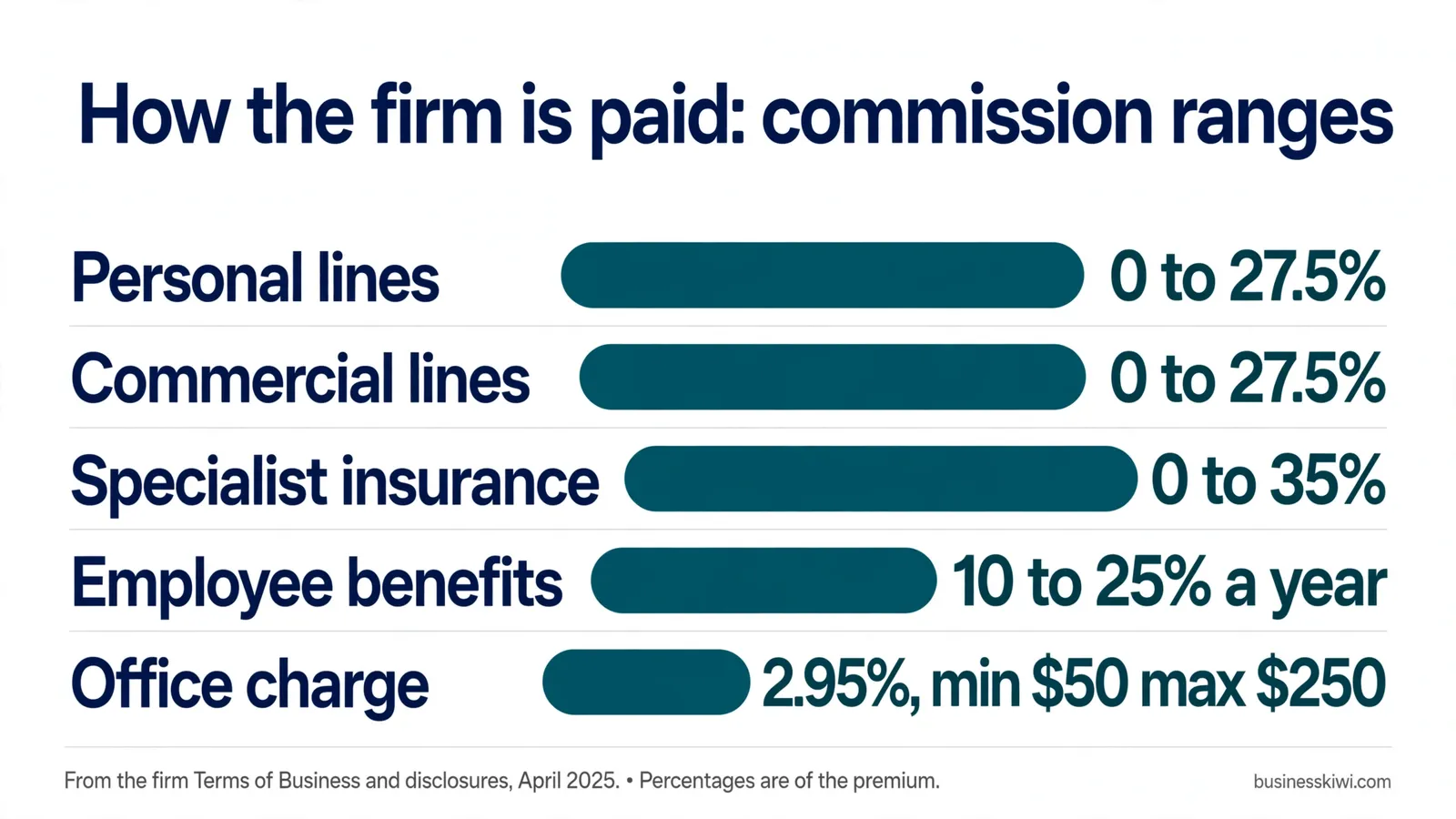
Broker payment is the question most clients never ask, and this firm publishes its answer in detail. Its April 2025 terms and disclosure document states that commission from insurers is its main form of remuneration, calculated as a percentage of the premium, excluding government charges, taxes, fees and levies. The document gives ranges by product type.
For personal lines such as home, car and contents, insurers pay the firm between 0 percent and 27.5 percent of the premium. Commercial lines carry the same stated range, 0 percent to 27.5 percent. Specialist insurance, including insolvency and travel, runs from 0 percent to 35 percent. Employee benefits insurance pays 10 percent to 25 percent each year. Life and health works differently, because those policies are not renewed annually in the same way. For personalised life and disability insurance, first year commission ranges from 40 percent to 230 percent of the premium, with ongoing trail commission of 3 percent to 10 percent. For medical insurance, the first year range is 10 percent to 140 percent, with trail commission of 5 percent to 25 percent.
On top of commission, the firm may charge the client directly. Its office charges for fire and general insurance are 2.95 percent of the premium for policies taking effect on or after 16 June 2025, with a minimum of $50 and a maximum of $250 per policy, and a flat $35 charge for a mid term change. A separate broker fee can also apply, and the firm says it tells the client the amount when a policy is arranged or renewed. Alternatively, a client can agree a service fee instead of commission.
The document is also candid about the edges. The firm keeps the interest earned on premiums while they sit in its trust account. It can be paid for consulting or administrative services to insurers, and for acting under an underwriting authority on an insurer’s behalf. It may share remuneration with third parties who refer clients. And its advisers work under a duty to give priority to the client’s interests, with a conflicts register and annual training described in the same document.
Locations and how to make contact
The firm’s branch network covers the country. Its About page puts the network at more than 30 offices, in locations from Invercargill to Kaitaia, and its website offers a find a broker search by region, branch or individual broker’s name. The Invercargill branch, for example, operates from Earnslaw Street and serves Southland across personal, commercial, rural and specialist lines.
The simplest contact point is the national phone number published across the site, 0800 276 624. The site also routes existing clients to dedicated pages for making a claim, paying an invoice and finding policy wordings. As with any large firm, the practical tip is to identify the local branch or the specialist team for your sector rather than starting with a general enquiry, because the firm’s own structure is built around branches and industry specialists.
Related guides: our house insurance guide covers insuring the home itself, and our estate insurance guide explains cover for estates. For more money guides, browse the Finance section.
Frequently asked questions
Is Crombie Lockwood still operating in New Zealand?
The business is still operating, but not under that name. It has traded as Gallagher Insurance since October 2023, after being owned by the Gallagher group since 2014. The brokers and branches continued under the new brand.
Is Crombie Lockwood an insurance company?
No. It is, and always was, an insurance broker and adviser. It arranges policies that are underwritten by insurers. It does not carry the insurance risk itself, and its own terms state that it does not guarantee any insurer’s ability to pay claims.
Who owns Crombie Lockwood?
The firm has been owned by Arthur J. Gallagher & Co since 2014. The New Zealand legal entity is Arthur J. Gallagher & Co (NZ) Limited, part of a global brokerage group founded in Chicago in 1927 and listed on the New York Stock Exchange.
What types of insurance does the firm arrange?
Its published lists cover business lines such as liability, interruption, commercial property, commercial vehicles, cyber, professional indemnity, marine and rural cover, plus personal lines including home, contents, car, landlord, travel, pet and life and health insurance.
How is the firm paid for its work?
Mainly by commission from insurers, calculated as a percentage of the premium. Its disclosure document gives ranges, including 0 percent to 27.5 percent for personal and commercial lines and 0 percent to 35 percent for specialist insurance. It may also charge office charges and broker fees, and a client can agree a service fee instead of commission.
What happens if I need to claim?
You contact the firm, which states that it helps clients prepare, manage and negotiate claims, with branch pages advertising 24/7 claims support. The claim itself is decided and paid by the insurer under the policy terms, not by the broker.
Can I complain about the service?
Yes. The firm’s terms describe a staged process from your broker to their manager and then to a client and conduct committee, aiming to resolve complaints within four weeks. Retail clients who remain unhappy can then go to Financial Services Complaints Ltd, the external dispute resolution scheme.
The bottom line
Crombie Lockwood is best understood as a name from this firm’s past. The business behind it is now Gallagher Insurance: a large, nationally branched New Zealand brokerage, owned since 2014 by one of the world’s biggest broking groups, holding an FMA licence in its own right and publishing a fuller account of how it is paid than most clients ever think to ask for. Whether it is the right broker for any particular reader depends on their sector, their local branch and the insurers it can access for their risk, and this profile deliberately makes no judgement on that. What it does establish is what the firm is, where it came from, what it sells, and how the money flows.
Sources
- Gallagher Insurance NZ (formerly Crombie Lockwood), website homepage and product navigation, ajg.co.nz
- Gallagher Insurance NZ, About page: who we are, our people and leadership team, ajg.co.nz
- Gallagher Insurance NZ, media release: Crombie Lockwood takes up Gallagher name, 1 October 2023, ajg.co.nz
- Gallagher Insurance NZ, Crombie Lockwood becomes Gallagher Insurance, 16 November 2023, ajg.co.nz
- Arthur J. Gallagher & Co (NZ) Limited, Terms of Business and Important Disclosure Information, April 2025
- Gallagher Insurance NZ, Business insurance hub page and Business liability insurance page, ajg.co.nz
- Gallagher Insurance NZ, Insurance schemes page and Onesurance page, ajg.co.nz
- Gallagher Insurance NZ, Home insurance page, Mining industry page, Technology industry page and Southland branch page, ajg.co.nz
This article is general information about Crombie Lockwood in New Zealand, the insurance broker now trading as Gallagher Insurance. It is based on the firm’s own published pages and disclosure documents at the time of writing. It is not financial advice, it does not recommend this or any other broker or insurer, and it makes no comparison between providers. Product lists, office networks and disclosure terms change over time, so check the firm’s current website and its current terms of business before making any decision.