Estate Insurance in NZ: Insuring a Deceased Estate’s Home

When someone dies owning a home, the grief arrives first and the paperwork follows close behind. Somewhere in that paperwork sits a problem many families do not see coming: the house still needs to be insured, often for a year or more, while the estate is sorted out. Probate has to be granted and debts and taxes settled before the property can be sold or transferred to whoever inherits it. For all of that time the home is still exposed to fire, storm, burst pipes and burglary, and in most cases it is sitting empty.
Estate insurance is not a special product you buy off a shelf. It is the practical job of keeping valid house and contents cover in place over a deceased person’s property, in the estate’s name, until the estate no longer owns it. That job belongs to the executor named in the will, or the administrator the court appoints if there is no will. This guide explains what happens to the existing policies, why an empty house changes the cover, and the traps that catch executors out.
The short answer
A house policy does not simply carry on untouched when the policyholder dies, and it does not automatically end either. The insurer needs to be told about the death, the policy needs to be recorded in the name of the estate with the executor as the contact, and the insurer needs to know the house is now empty. An unoccupied home is a different risk from a lived-in one, and most policies carry conditions that bite once a home has been empty for a set period, commonly 60 days. Keep the premiums paid, follow the empty-home conditions, and keep the cover running until the property passes to a new owner or a beneficiary. Do those things and the estate’s biggest asset stays protected. Do nothing, and the cover may quietly thin out, or the policy lapse, at exactly the moment something goes wrong.
What happens to the house policy when the owner dies
The insurer must be told
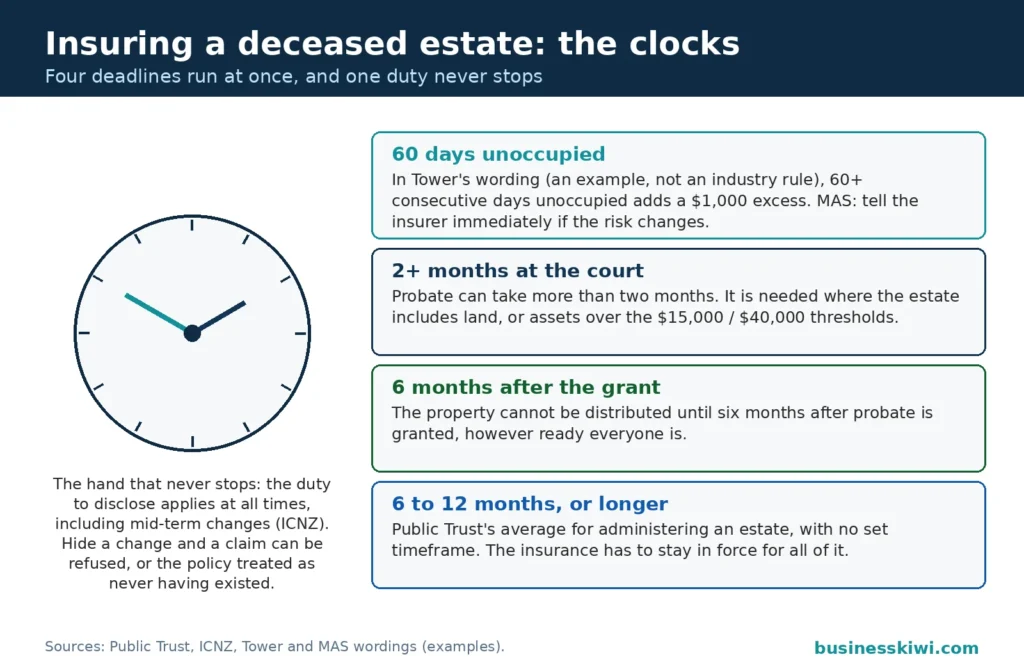
A death is a fundamental change to an insurance contract. The person the insurer agreed to cover is gone, the person responsible for the property has changed, and the way the property is used has usually changed too. The Insurance Council of New Zealand (ICNZ) is clear that the duty to tell your insurer the things it needs to know applies at all times: when you take out a policy, each time it renews, and whenever anything changes in between. If an insurer is not told something it needed to know, ICNZ warns it may refuse part or all of a claim, or treat the policy as though it never existed.
There is no single published deadline by which every insurer must be told about a death, and none of the insurer documents reviewed for this guide states one. Treat it as an early job anyway, in the first few weeks, because several clocks start running from the death whether the insurer knows or not. The unoccupied conditions described below are the obvious one. Premium payments are another: if premiums were paid from the deceased’s bank account, those payments can stop when the account is restricted, and a policy that lapses for non-payment leaves the estate bare.
When you call, expect the insurer to ask for evidence such as a death certificate and proof that you are the executor or administrator. Community Law notes that executors routinely have to supply a death certificate, and evidence of their authority to act, when dealing with the deceased’s bank, power company and other organisations. Insurers work the same way.
Whose name the policy sits in
Once notified, the insurer will usually re-record the policy so the insured is the estate (often noted as the estate of the deceased person) with the executor or administrator as the contact for renewals, claims and correspondence. Ask for exactly that, and ask for your own address or email to be the contact on file. This matters more than it sounds. Insurers write to the last address they hold, and a renewal notice or a cancellation warning that lands in the letterbox of an empty house may never be seen. If the policy was in joint names, for example where a spouse or partner also owns the home and is named on the policy, the surviving policyholder remains insured in their own right, but the insurer still needs to know about the death and about who is now living in the house.
Renewals, premiums and refunds during administration
Policies run for a set term and then renew. Administration often spans at least one renewal, and Public Trust puts the average time to administer an estate at 6 to 12 months, sometimes longer. At renewal the executor should check the policy schedule like any owner would: is the sum insured still enough to rebuild the house, are the details of the property right, and has the insurer changed any terms? ICNZ points out that making sure the sum insured is high enough to cover a rebuild is the policyholder’s responsibility, and that does not change because the policyholder is now an estate.
Premiums during administration are an estate expense, paid from estate funds. Getting at those funds can be slow before probate is granted, because banks generally need to see the grant, or agree to a release, before money moves. Public Trust makes the point that urgent bills, and it names insurance specifically, may be able to be paid from assets it can call in straight after a death, without waiting for probate. If the estate’s lawyer or a trustee company is helping, ask them how the premium will be paid and by when. If you pay personally in the meantime, keep the receipts. Public Trust confirms executors can recover reasonable out-of-pocket expenses of administering the estate.
If a policy ends partway through a paid term, the unused portion of the premium is generally refundable. Tower’s current house policy wording, for example, states plainly that when a policy is cancelled it refunds the unused portion of the premium. Expect similar treatment, rather than identical wording, from other insurers.

The unoccupied problem
Why empty homes worry insurers
A lived-in house has people in it to hear a pipe burst, smell smoke, notice a broken window and make the place look occupied. An empty house has none of that. A slow leak can run for weeks and rot floors and walls. A fire can take hold without anyone raising the alarm. A property with mail spilling from the box and lawns growing long advertises itself to burglars and vandals. Insurers price and condition their policies around that reality, whether the house is empty because of a holiday, a renovation, or a death.
What the conditions look like
Conditions differ between insurers and between policy types, so the deceased’s own policy wording is the document that matters. Two examples from insurers’ own current documents show the shape of them.
Tower’s house policy defines an unoccupied house as one where no one stays overnight. If the house has been unoccupied for more than 60 consecutive days when a loss happens, Tower applies an additional excess of $1,000 to the claim, unless the house is recorded on the policy as a holiday home. Its contents policy applies the same excess. The same 60-day line runs through other parts of Tower’s cover: its gradual damage benefit, which deals with hidden leaking pipes, does not respond to gradual damage occurring while the house has been unoccupied for more than 60 consecutive days, and its temporary accommodation benefit falls away on the same basis.
MAS takes a different route in its house policy. Its policyholders must tell the insurer immediately about changes that alter the nature of the risk, and its own list of examples includes renting the property out or leaving it unoccupied for a period of more than 60 days. In other words, where Tower adjusts the claim, MAS puts the obligation on you to speak up first, and its wording also requires the property to be locked, with keys removed, whenever it is unattended.
Read the deceased’s policy for its own version. Some wordings, particularly older ones, go further than an extra excess and can suspend or exclude cover for an unoccupied home unless the insurer has agreed in writing to continue it. The pattern to take away is simple: the 60-day mark turns up again and again, administration almost always runs longer than 60 days, so an executor who does not talk to the insurer will almost certainly drift into the restricted zone.
Keeping an empty house within the conditions
A few practical habits keep an empty estate property insurable and defensible at claim time:
- Visit regularly, or arrange for a family member, neighbour or property manager to do so, and keep a simple record of visits. A visit that finds a leak in week one is the difference between a repair and a rebuild.
- Turn the water off at the mains if the house will be empty for a stretch and the insurer or a plumber advises it, and drain or protect pipes where frost is a risk. Water damage is the classic empty-house loss.
- Clear the letterbox, mow the lawns and keep curtains and blinds in a lived-in pattern. The goal is a house that does not announce it is empty.
- Keep some heating on through winter if the property and the insurer’s conditions call for it, and make sure smoke alarms work.
- Lock everything, remove the keys from the property, and consider moving portable valuables to secure storage, telling the insurer if the contents position changes.
- Write down what you agreed with the insurer, when, and with whom, and get any changed conditions confirmed in the policy documents.
Above all, tell the insurer the true position. A house described as occupied when nobody has slept there for three months is a house whose claim rests on a false statement, and that is far worse than an extra excess.

The executor’s duty to look after the insurance
Keeping insurance in place is not an optional extra for executors. It is part of the job description. Public Trust, the Crown-owned trustee company that administers estates across New Zealand, lists an executor’s responsibilities as including maintaining the insurance of assets and completing insurance documents, alongside applying for probate, notifying organisations of the death, paying debts and taxes, and distributing the estate.
The legal frame sits behind that list. Probate is a High Court order that confirms a will is valid and gives the executor authority to deal with the estate. Community Law explains that probate is needed where the estate includes land, or certain assets above set limits held with one institution ($15,000 or $40,000 depending on the type of asset), and that where there is no will the equivalent is letters of administration. The court process itself can take more than two months, and the property generally cannot be distributed until six months after the grant, to allow time for claims against the estate. Add selling a house, settling tax and resolving family questions, and Public Trust’s estimate of several months to a year or more is easy to understand. The house needs cover for that whole period, not just until the funeral is over.
There is a personal edge to this. Public Trust states that executors can be held accountable if they act negligently or fail to meet their legal duties. If the estate’s main asset burns down or is gutted by an undetected leak while the executor never told the insurer about the death, never paid the premium, or let the policy lapse, beneficiaries who have lost their inheritance will ask hard questions about who is responsible for the gap. Arranging and maintaining insurance, and keeping records of what was done, is the executor’s protection as much as the estate’s.
One more trap deserves mention: underinsurance. The deceased may have set the sum insured years ago, and rebuild costs move. ICNZ’s guidance is to check the schedule details are correct, the sum insured is enough to rebuild, and to tell the insurer about improvements. An executor who renews without thinking inherits whatever figure is on the schedule. Asking the insurer how the sum insured was calculated, and whether a rebuild calculator or professional assessment supports it, is a reasonable step for the person now responsible for the asset.
Contents, cars and other policies
Contents
Contents cover follows the same logic as the house. The policy is in the deceased’s name, the home is now empty, and unoccupied conditions apply to it as well, as Tower’s contents wording shows. Decide early what happens to the contents. If furniture and effects stay in the house until distribution, keep the contents policy running in the estate’s name and tell the insurer the house is unoccupied. If the house is cleared and items go into storage or to family, tell the insurer that too, because the insured location and risk have changed again. Specified items, such as jewellery or collections named on the schedule, deserve a specific conversation.
Vehicles
The deceased’s car is an estate asset too, and its insurance is written on the same disclosure basis. Tell the motor insurer about the death. Who drives the car, where it is garaged and whether it is used at all will all have changed, and ICNZ’s disclosure guidance applies to motor policies just as it does to house policies. Many estates keep the car insured, unused and garaged, until it is sold or transferred, but that position should be agreed with the insurer rather than assumed. Do not let family members drive it on the assumption that the old policy covers anyone who picks up the keys.
A rental property in the estate
If the deceased owned a tenanted rental, two things run on in parallel. The tenancy continues, with rent coming into the estate and landlord obligations still needing to be met, so get advice about the tenancy itself. The insurance must match the use. Tower’s wording makes the general point clearly: the house is insured for the type of use recorded on the certificate of insurance, and if the use changes, for example because the property is rented out, the insurer must be contacted immediately, because landlord cover is a different product from owner-occupier cover. An estate that inherits a rental should confirm a proper landlord policy is in force, and an estate that decides to rent out the deceased’s own home to cover costs must switch the cover before tenants move in, not after. Between tenancies, the unoccupied conditions apply to landlord policies as well.
Selling or transferring the home
The end point for most estate properties is a sale on the open market or a transfer to a beneficiary who inherits the house. Either way, the estate’s cover should run right up to the change of ownership and no further:
- Keep the policy in force until settlement day on a sale. The estate owns the house, and carries the risk, until settlement, and a fire the week before settlement is the estate’s problem and the estate’s claim.
- Tell the insurer once settlement or transfer has happened and cancel the policy from that date. The unused portion of the premium is refundable under typical wording, Tower’s included, and goes back into the estate.
- The buyer, or the beneficiary taking the house, arranges their own insurance starting from settlement or transfer. Cover is not transferred with the title, and the estate’s policy will not protect the new owner.
- If the property is transferred to a beneficiary who will live in it, the gap to avoid is any day on which nobody’s policy covers the house. A short overlap is harmless; a gap is not.
Premiums, in the end, are one of the ordinary costs of administration, met from the estate before beneficiaries are paid. There is no standard price for insuring an estate property, and no official source publishes one. The cost depends on the house, its location, the sum insured and how the insurer treats the empty-property risk, which is another reason to talk to the existing insurer first: continuity with the insurer that already knows the house is usually the simplest path.
If something goes wrong, and where to get help
If the insurer declines a claim or you believe the estate has been treated unfairly, complain to the insurer first and use its internal complaints process. If the complaint stays unresolved, the Insurance & Financial Services Ombudsman Scheme (the IFSO Scheme) investigates complaints about insurers, independently and free of charge, looking at the facts, the law and the contract, once the provider’s own process has run its course.
For the administration itself, executors do not have to work unaided. Public Trust can support an executor with some or all of the process, including probate and letters of administration, managing assets and paying debts. Citizens Advice Bureau provides free general information on wills, executors and estates, and Community Law’s manual explains probate in plain language. Govt.nz’s guide to what to do when someone dies confirms the executor or administrator handles the estate’s accounts and assets, and its myTrove tool lets you notify multiple organisations of a death at once, including insurers, banks and utilities. Where real money or family conflict is at stake, an estate lawyer is worth the fee, itself an estate expense.
Finally, a word for anyone reading this while planning their own affairs rather than clearing up someone else’s. The executors who cope best inherit a filing system, not a scavenger hunt. A current will, a list of insurance policies with insurer names and policy numbers, and sums insured reviewed now and then will save your family weeks. If you are setting money aside for the end of life itself, funeral cover is a separate topic, and our funeral insurance guide explains how those policies work. For the house side in ordinary times, our house insurance guide covers choosing cover and setting a sum insured.
Frequently asked questions
Does house insurance stop automatically when the owner dies?
No. The policy does not vanish on the death, but it does not glide on unchanged either. The insurer has to be told about the death, the insured name needs to become the estate with the executor as contact, and the insurer needs to know the house is empty. Until that conversation happens, the estate is relying on a contract written for a person, and a home, that no longer exist in that form.
Is there a deadline for telling the insurer?
No single deadline is published across insurers, and the documents reviewed for this guide do not state one. Do it within the first few weeks anyway. Premium payments can fail when accounts are restricted, insurers write to the address they hold, and the unoccupied conditions in most policies start to bite at around 60 days regardless of whether the insurer has been told.
Who pays the premiums while the estate is being administered?
The estate does. Premiums are an administration expense, paid from estate funds before anything is distributed to beneficiaries. If estate funds are locked up pending probate, Public Trust notes urgent bills such as insurance may be able to be paid from assets called in early. An executor who pays personally can recover reasonable out-of-pocket expenses, so keep receipts and records.
Can an executor be personally responsible if the house is damaged while uninsured?
Potentially, yes. Maintaining the insurance of assets is one of the responsibilities Public Trust lists for executors, and Public Trust states executors can be held accountable if they act negligently or fail to meet their legal duties. Letting cover lapse, or never telling the insurer the house is empty, is exactly the kind of failure that exposes an executor if the worst then happens.
What happens to the insurance when the estate sells the house?
The estate keeps its policy running until settlement, then cancels it and the unused portion of the premium is refunded to the estate. The buyer insures the house in their own name from settlement. Insurance never transfers with the property itself, so the two policies should meet at settlement day with no gap and no unnecessary overlap.
Sources
- Public Trust, How to choose an executor (including executor responsibilities, personal accountability and administration timeframes), publictrust.co.nz
- Community Law, Community Law Manual: Wills, and Dealing with the deceased’s property, communitylaw.org.nz
- New Zealand Government, What to do when someone dies, govt.nz
- Tower Limited, House insurance Plus cover policy wording, tower.co.nz
- Tower Limited, Contents insurance policy wording, tower.co.nz
- MAS, House Insurance Policy, mas.co.nz
- Insurance Council of New Zealand, Guide to disclosure, and House and contents insurance: sum insured explained, icnz.org.nz
- Insurance & Financial Services Ombudsman Scheme, ifso.nz
For more guides on looking after your money and your home, see our Finance hub.
Disclaimer
This article is general information only, about how insurance over a deceased estate’s property generally works in New Zealand. It is not legal advice, insurance advice or financial advice for your situation, and policy wordings differ between insurers and change over time. Executors should read the deceased’s own policy documents, talk to the insurer early, and get professional legal or insurance advice where the estate or the property calls for it.