Employers Liability Insurance in NZ: What It Covers When ACC Cannot

Every employer in New Zealand pays ACC levies, and most assume that settles the injury question. It does not. ACC is a no-fault scheme with deliberate edges. It pays for accidental injury, and it stops there. Illness, stress-related harm that is not tied to a covered injury, and a court claim for exemplary damages all sit outside the scheme, and each of them can land on an employer’s desk as a legal bill.
Employers liability insurance is the commercial policy built for those edges. It responds when an employee is injured in connection with the business and ACC does not pay, and it covers the legal costs of defending the claim. This guide explains where ACC stops, what the policy wordings actually promise, and where the exclusions bite.
The short answer
Employers liability insurance covers an employer’s legal liability to pay damages when an employee sustains injury in connection with the business and ACC cover does not respond. Depending on the wording, it can also cover exemplary damages, the one damages claim the Accident Compensation Act 2001 leaves open even where ACC does cover the injury, plus the legal costs of defending covered claims.
It does not pay compensation that ACC itself pays. It does not cover fines or penalties. It does not cover employment disputes such as unpaid wages or personal grievances. Two real policy wordings, from IAG and from DUAL New Zealand, are used throughout this article to show how the cover is framed, because the detail lives in the wordings, not in marketing summaries. No law requires an employer to hold this policy. Employers buy it because a single uncovered claim can carry damages and defence costs well beyond the premium.
What ACC covers, and where it stops
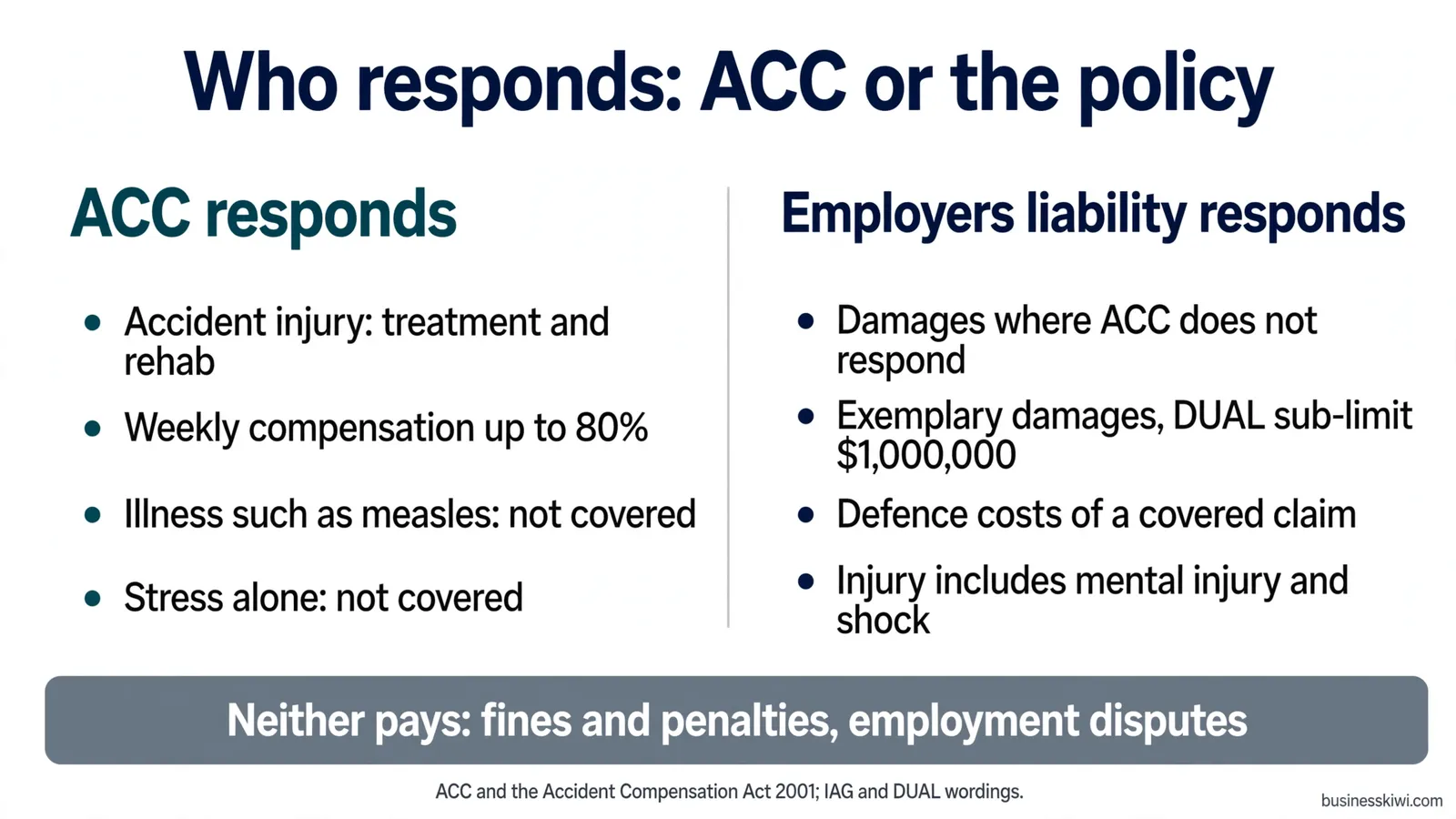
ACC provides no-fault cover for personal injury caused by accident. When a claim is accepted, ACC can help with treatment, rehabilitation and support such as transport, childcare and help around the home. If the injured person cannot work, weekly compensation can replace up to 80 percent of what they earned before the injury.
The scheme’s own list of what it does not cover is where employers need to pay attention. ACC does not cover illness, sickness or contagious diseases such as measles. It does not cover stress, hurt feelings or other emotional issues unless they are linked to an injury ACC already covers. It does not cover conditions that come with ageing, such as arthritis, most hernias, or injuries that happen over time unless a work activity is causing them. Cover decisions are made under the Accident Compensation Act 2001, and an employer has no say in how ACC decides.
The Act also shuts the courtroom door for covered injuries. Section 317 provides that no person may bring proceedings in a New Zealand court for damages arising directly or indirectly out of personal injury covered by the Act. Section 318 applies the same bar to claims for work-related gradual process, disease or infection. Some proceedings survive the bar, including claims about property damage and personal grievances such as unjustifiable dismissal, but section 317(3) prevents any court or tribunal from awarding compensation in those proceedings for the covered personal injury itself.
One exception is deliberate. Section 319 states that nothing in the Act prevents a person bringing proceedings for exemplary damages for conduct that resulted in personal injury covered by the Act. A court may award exemplary damages even if the defendant was prosecuted over the same conduct and convicted or acquitted, or was never charged at all. Exemplary damages punish outrageous conduct rather than compensate loss, and they are the main damages exposure an employer keeps even when ACC accepts the claim.
So the gaps are of two kinds. The first is harm ACC declines: illness, disease and mental harm that falls outside its cover rules. The second is a damages claim ACC never pays: an exemplary damages action after a serious safety failure.
What employers liability insurance covers

The IAG Employers Liability Policy wording (CP3031/1) covers all sums the insured becomes legally liable to pay, including punitive or exemplary damages, arising from an employee sustaining injury. The injury must be sustained in New Zealand, after the policy’s retroactive date, in connection with the business. The claim must first become known to the insured during the period of insurance and be notified to IAG as soon as possible, and no later than 30 days after the period ends. Defence costs are covered as well, with IAG’s prior written consent, even if the action against the insured looks groundless, false or fraudulent.
The DUAL New Zealand “Mind The Gap” Employers Liability Wording splits the promise into two clauses. The first covers damages for an employee’s personal injury, sustained in New Zealand and arising out of or in the course of employment, where ACC cover is determined not to exist. The second covers punitive or exemplary damages where the injury is covered by ACC. That second cover is sub-limited to the lesser of the policy’s indemnity limit or $1,000,000, and it forms part of the limit rather than sitting on top of it. Defence costs under the DUAL wording are paid in addition to the indemnity limit, up to an amount equal to that limit.
What counts as injury is broader than broken bones. IAG’s definition covers accidental death and accidental bodily injury, including sickness, disease, disability, shock, fright, mental anguish and mental injury. DUAL’s definition of personal injury is similar, covering sickness, disease or infection, and disability, shock, fright, mental anguish or mental injury arising out of or in the course of employment. That breadth is deliberate. The claims this product exists for include harm that develops without a single accident, and mental harm after traumatic events at work.
Who counts as an employee also matters. IAG defines an employee as a person employed by the insured in connection with the business whose remuneration the insured deducts PAYE from at source. DUAL covers past, present and prospective employees under a contract of service or apprenticeship, full-time, part-time or casual. Volunteers and independent contractors sit outside these definitions as written, which is worth checking against how a business actually engages its people.
Both wordings are claims-made policies. Cover turns on when the claim is made and notified, not only on when the injury occurred, and both wordings work back to a retroactive date. Events before that date are outside cover.
What it does not cover
The exclusions define this product as much as the cover does. Read across the two wordings, the main ones are these.
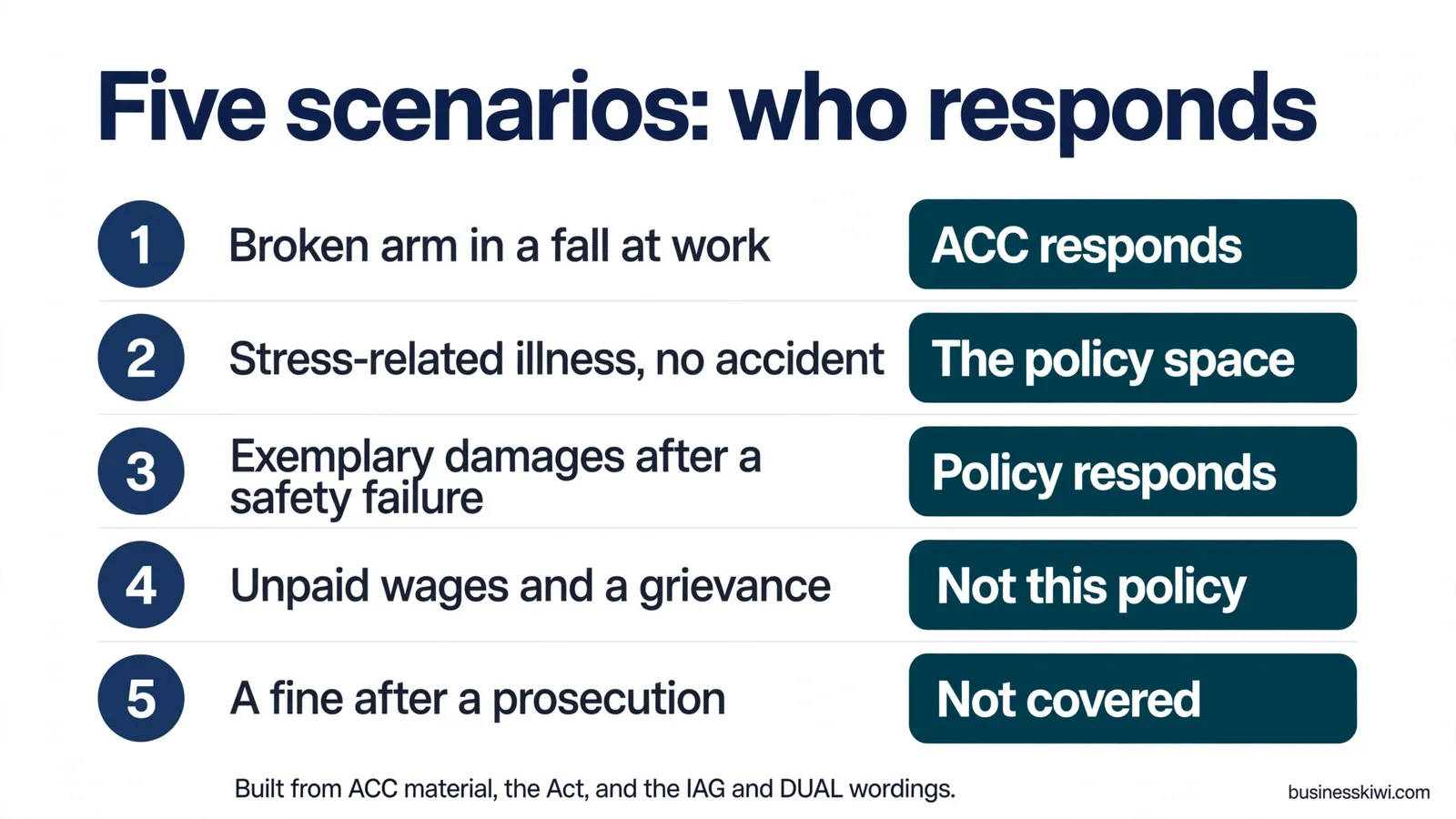
There is no cover where compensation is, or would have been, available under the Accident Compensation Act 2001. IAG states this as an exclusion, and DUAL’s first insuring clause only responds where ACC cover is determined not to exist. The policy never duplicates ACC.
Fines and penalties are not covered. IAG excludes fines and penalties outright, and DUAL’s definition of damages excludes any statutory remedy, penalty, fine or reparation order. An employer prosecuted after a workplace incident cannot use this policy to pay a fine.
Employment disputes are not covered. IAG excludes liability arising out of the Employment Relations Act 2000, including unpaid wages and other employee benefits. A personal grievance belongs to employment law processes, and to other insurance products, not to this one.
Asbestos is excluded under the IAG wording. So is liability from dishonesty, fraud or wilful breach of any Act, regulation or bylaw. DUAL excludes claims from wilful, intentional or deliberate conduct the insured knew, or should reasonably have known, was likely to cause injury, and it excludes a physical-harm class altogether: trespass to the person, assault, battery, false imprisonment, intentional physical harm, malicious prosecution, sexual harassment and sexual abuse are not covered.
Ignoring a safety regulator’s notice can void the response. Both wordings exclude liability connected with failing to comply with a lawful improvement, prohibition or similar notice under the Health and Safety at Work Act 2015.
Finally, the wordings exclude claims the insured already knew about, claims from events before the retroactive date, and injury sustained outside New Zealand under the IAG wording’s New Zealand jurisdiction requirement.
How it sits alongside statutory liability and other covers
NZI’s liability product material lists these covers side by side, which is the clearest way to see the boundaries. In NZI’s words, employers liability protects New Zealand business owners for legal liability and associated legal costs for an injury to an employee not covered by ACC. Statutory liability, a separate product, provides cover for liability arising out of unintentional breaches of most New Zealand statutes affecting commercial businesses. Public liability, another separate product, responds to claims by members of the public, not to claims by the business’s own employees.
One serious workplace incident can touch all three areas at once. An injured employee may bring a damages claim of the kind described above. A regulator may prosecute the business under health and safety law, which is statutory liability territory. A visitor or customer hurt in the same event claims against the business as a member of the public. The products are sold side by side because the triggers differ, and holding one does not mean holding the others.
Who needs it
Any business with employees carries some exposure of this kind, because the exposure follows the workforce rather than the industry. Manual trades and primary industries face the obvious physical risks. Office-based employers are not immune: the injury definitions in the wordings reach mental injury, shock and fright, and exemplary damages claims can follow any serious failure that injures a worker, whatever the setting.
The practical test is financial. Could the business fund damages and a defended court case from its own resources without serious damage? If not, the policy is doing real work. A business with no employees has no one who can claim under it, and a sole trader’s own injuries are an ACC and personal insurance matter, not an employers liability one.
What drives the cost
No insurer publishes a premium for this product on the pages read for this article. It is priced business by business, so any figure quoted online as a going rate should be treated with suspicion. The wordings do show what the price is built from.
IAG calculates the premium from the figures in the proposal, charges a provisional premium, and adjusts it after the annual period against the actual figures, with any refund capped at 50 percent of the provisional premium. In plain terms, the size of the workforce and its payroll drive the starting price, and the insurer checks the real numbers afterwards. The limits chosen matter too. Under the IAG wording, the liability limit and the defence costs limit are two separate sums insured, and one cannot be used to pay the other. DUAL applies a deductible to each claim, so the excess a business selects changes both its price and its share of any claim. Continuity has a price as well: if IAG declines to renew, its extended reporting period extension charges 90 percent of the last annual premium for a further 12 months of notification time. What the business does, how many people it employs, the limits and excess it picks, and how cleanly its cover history runs are the levers an insurer prices on.

Making a claim
Because these are claims-made wordings, timing is the first obligation. IAG requires the claim to be first known to the insured during the period of insurance and notified as soon as possible, and in any event within 30 days after the period ends. DUAL requires the claim to be first made against the insured during the period and notified as soon as reasonably possible. Circumstances that might become a claim should be notified too, because both wordings contain continuous cover provisions that protect an insured who told the insurer about a problem early.
Once a claim exists, the insured must not admit liability. IAG’s conditions state that the insured must not admit liability for, or settle, or incur costs over a claim without the insurer’s written agreement, and that the insurer has the sole right to conduct the defence, negotiations and any settlement. DUAL applies a deductible to each claim, and treats all claims arising from the same personal injury event as one claim under its conditions. The DUAL wording also includes one hour of free advice from a panel law firm on matters that might lead to a claim, which is best used early rather than after positions have hardened.
Accuracy at the front end matters as much as speed at the back end. IAG’s conditions require the proposal to be complete and accurate, and give the insurer remedies, including treating the policy as void, if the insured made a fraudulent or misleading statement. A claim handled late, admitted early or built on a sloppy proposal can fail for reasons that have nothing to do with the injury itself.
Watch-outs
The most common misunderstanding is expecting this policy to respond to employment disputes. It will not. Unpaid wages, unjustifiable dismissal and personal grievance costs sit outside the IAG wording expressly, and grievance proceedings themselves are preserved by the Accident Compensation Act under a different legal track.
The second is assuming ACC acceptance closes the matter. It closes compensation. It does not close an exemplary damages claim, and it does not stop a regulator prosecuting. Fines from that prosecution are not insurable under this policy either.
The third is switching insurers carelessly. A claims-made policy’s retroactive date and continuous cover terms carry the business’s history. Moving provider without checking that the new wording picks up the old exposure can open a gap that only appears when a claim lands.
The fourth is the defence costs structure. Under IAG, defence costs have their own separate limit. Under DUAL, they are paid in addition to the indemnity limit, capped at the same amount. Two policies with the same headline limit can therefore leave a business with quite different total protection.
Related guides: our business insurance guide covers the main covers a business holds, and our public liability insurance guide covers claims by members of the public. For more money and insurance guides, browse the Finance section.
Frequently asked questions
Is employers liability insurance compulsory in New Zealand?
No. ACC cover is compulsory and funded by levies, but employers liability insurance is a voluntary commercial purchase. Employers buy it to cover the damages and defence costs that fall outside ACC.
If ACC covers my employee’s injury, can they still sue me?
Not for ordinary compensatory damages. Section 317 of the Accident Compensation Act 2001 bars court proceedings for damages arising out of covered personal injury. Section 319 preserves one claim: exemplary damages for outrageous conduct. That preserved claim is a core reason this insurance exists.
Does employers liability insurance cover stress claims?
ACC does not cover stress or emotional issues unless they are linked to an injury ACC covers. The IAG and DUAL wordings define injury to include mental injury, shock, fright and mental anguish arising from employment, which is the space stress-related claims fall into. Whether a particular claim responds depends on the full wording and the facts.
Does it pay WorkSafe fines?
No. Fines and penalties are excluded under the IAG wording, and DUAL’s definition of damages excludes statutory penalties, fines and reparation. Defence of regulatory charges belongs to statutory liability insurance, a separate product.
What is the difference between employers liability and statutory liability insurance?
Employers liability covers the business’s liability to its own employees for injury ACC does not cover, plus exemplary damages. Statutory liability, as NZI describes it, covers liability arising from unintentional breaches of most New Zealand statutes affecting commercial businesses. Different claimants, different triggers, different policies.
How much does employers liability insurance cost?
There is no published rate. Insurers price it from the proposal: the type of work, the size of the workforce and payroll, the limits and excess chosen, and the business’s history. IAG’s wording charges a provisional premium and adjusts it afterwards against actual figures.
When do I have to tell the insurer about a claim?
Immediately, in practical terms. These are claims-made policies. IAG requires notification as soon as possible and no later than 30 days after the period of insurance ends. Late notification is one of the simplest ways to lose cover.
The bottom line
ACC does most of the heavy lifting when a worker is hurt, and the Accident Compensation Act stops most damages claims before they start. What remains is a narrow but expensive strip of exposure: harm ACC declines, exemplary damages after serious failures, and the legal costs of defending either. Employers liability insurance is built precisely for that strip. Its value sits in the wording details, in the exclusions for disputes and fines, in the claims-made timing rules, and in how defence costs are limited. Read those parts before relying on the headline.
Sources
- ACC, “Injuries we don’t cover”, acc.co.nz
- ACC, “What to do if you’re injured”, acc.co.nz
- Accident Compensation Act 2001, sections 317, 318 and 319, legislation.govt.nz
- IAG New Zealand Limited, Employers Liability Policy wording CP3031/1 04/18, iag.co.nz
- DUAL New Zealand, Mind The Gap Employers Liability Wording 02.18, nz.dualinsurance.com
- NZI, Liability flyer NZ7019GL/1, nzi.co.nz
This article is general information about employers liability insurance in New Zealand. It is not legal or insurance advice for a particular business. Policy wordings differ between insurers, so check the wording itself, and take advice from your broker or lawyer about your own situation before relying on any cover described here.