Public Indemnity Insurance in NZ: The Name Mix-Up, Explained

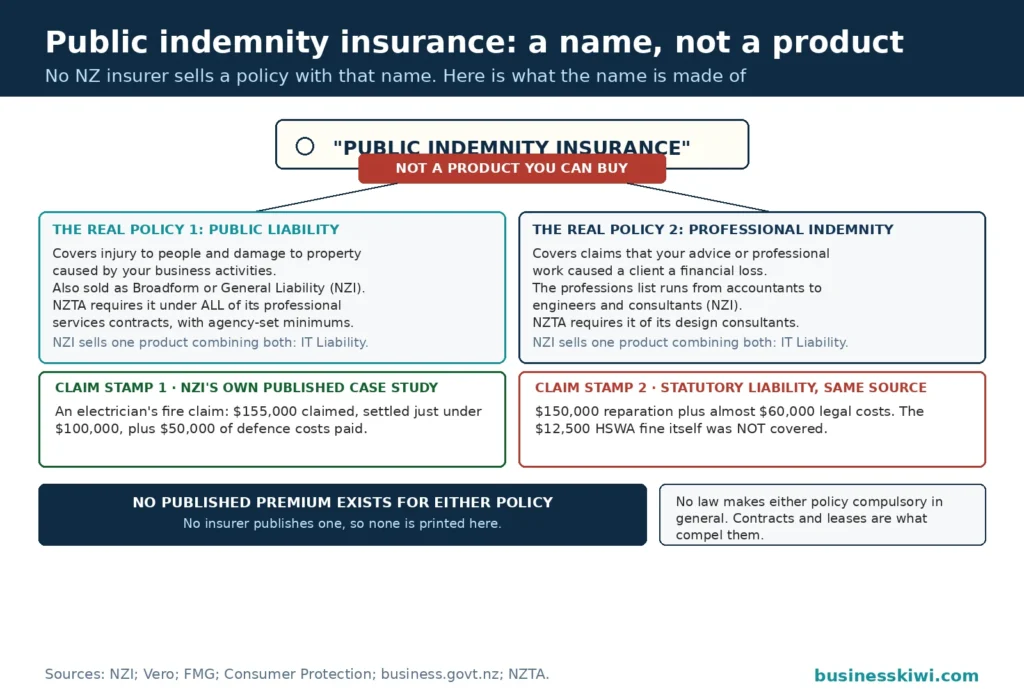
Search for “public indemnity insurance” and you will find plenty of pages willing to sell it to you. What you will not find, on any New Zealand insurer’s own product list, is a policy that goes by that name. It does not exist as a standard product here. The phrase is a blend of two real but quite different covers: public liability insurance and professional indemnity insurance. Somewhere along the way the two names got folded into one, and the folded version is what thousands of business owners now type into Google.
That matters because the two products respond to different problems. Buying one when your risk sits in the other leaves you paying a premium for cover that will not respond to the claim you actually face. This article sorts out the naming, defines each product the way NZ insurers themselves describe them, and works through which one a given business needs, or whether it needs both. BusinessKiwi has detailed guides to each product on their own; this page sticks to the terminology question and the decision between them.
Why “public indemnity” is not a product you can buy
Look at how the insurers organise their shelves. NZI lists its business liability range as separate products, including Public Liability, Professional Indemnity, Statutory Liability and Employer’s Liability. Vero Liability, a specialist liability insurer, does the same: Public and Products Liability sits as one product, Professional Indemnity as another. Nowhere in either range does “public indemnity” appear. If an insurer does not list it, an insurer cannot sell it to you.
The blend is easy to understand once you see the parts. “Public” comes from public liability. “Indemnity” comes from professional indemnity. Put together, the phrase sounds plausible, and it gets used loosely in conversation by people who mean one, the other, or a vague idea of “insurance in case someone sues me”. Insurers add to the fog with their own aliases. NZI states plainly that its public liability cover is “also known as Broadform or General Liability insurance”. So a single real product already travels under three names before the blended fourth one gets invented.
There is a second reason the word indemnity confuses people. Indemnity is also a general insurance principle, not just part of a product name. Consumer Protection, the government consumer agency, explains that an insurance policy is designed to put you back in the financial position you were in before your loss, and that this is called indemnity. Nearly every policy works on that basis. So “indemnity” on its own tells you how insurance pays, not what it covers. The useful question is never the label. It is what event triggers the claim.
The two real products, in the insurers’ own terms
Public liability insurance is about physical harm and physical damage connected to your business activities. NZI describes it as cover that applies “if you, your employees or your products accidentally injure someone or cause damage to other peoples’ property”. Vero Liability puts it in legal terms: the policy responds to claims where a business is legally liable to pay compensation for unintended and unexpected personal injury and property damage arising out of its products or services. The claimant is usually a third party, meaning a customer, a visitor, a passer-by, a neighbouring business, or a client whose property you were working on. The policy pays the compensation you are liable for and, just as importantly, the legal costs of defending the claim. NZI makes the point that the cover can respond even where you believe you were not at fault, because the defence costs alone can be substantial.
Professional indemnity insurance is about financial loss caused by your professional work itself: your advice, your designs, your judgement, your services. Vero Liability defines it as insurance that “responds to claims for breach of professional duty or negligence resulting in financial loss”. NZI describes the trigger from the client’s side: if your recommendations or advice prove unsuitable and a client suffers financial loss as a result, they may take legal action to recover it. Nothing needs to be broken and nobody needs to be hurt. The loss is measured in dollars on the client’s balance sheet. Like public liability, the policy covers both compensation you are legally liable to pay and the cost of defending the claim. Vero Liability is blunt about why the defence cover matters: the cost of defending a claim can be significant whether or not the claim is justified.
The shortest way to hold the distinction is this. Public liability responds when your business activities hurt someone or damage something. Professional indemnity responds when your professional advice or service costs someone money. One is physical, the other is financial. Most mix-ups come from blurring that line.

Public liability vs professional indemnity, side by side
Two rows in that table deserve a moment. First, the “does not cover” lines are mirror images, which is exactly why the naming confusion is expensive: each policy leaves a gap shaped like the other. Second, both policies pay defence costs as a core feature, not an extra. In many real disputes the legal bill is the part that arrives first and grows fastest.
Two scenarios, two different policies
Examples make the boundary easier to see than definitions do. The following scenarios are illustrative, built to show which policy responds and why.
Scenario one: the tradesperson. A plumber is replacing a hot water cylinder in a client’s home. A joint fails after the job is done and water runs through the ceiling below, ruining a room’s contents. On a bigger site, picture a builder whose unsecured material falls and injures a passer-by. In both cases the loss is physical: damaged property, or an injured person, caused by the business’s work. That is public liability. Professional indemnity would not respond, because nobody is claiming the plumber’s advice was negligent. They are claiming his work caused damage.
This pattern is not hypothetical in shape. NZI publishes a case study on its own liability page involving a residential electrician who installed recessed lights. Weeks later a fire caused extensive damage, and the homeowners’ insurer claimed $155,000, alleging a loose neutral wire in a fitting was the cause. An engineer confirmed the fault. The claim settled for just under $100,000 and NZI’s public liability cover paid the settlement plus $50,000 in defence costs. Note the split: a third of the total cost was legal and expert fees, on a claim the insured effectively lost. Defence costs are not a footnote in liability insurance. They are a large part of what you are buying.
Scenario two: the consultant. A management consultant advises a client on restructuring its operation. The client follows the advice, signs commitments based on it, and ends up materially worse off. The client alleges the advice was negligent and sues for the financial loss. Nothing is damaged and nobody is injured, so public liability has nothing to respond to. This is professional indemnity territory: a claim for breach of professional duty resulting in financial loss, exactly as Vero Liability frames its product. The same logic applies to an accountant whose error leaves a client with a tax problem, or an engineer whose design mistake forces expensive remedial work. The professional’s output is words, numbers and judgement, and the loss is financial.
Now the twist that catches people out. The same consultant, working from a small office, has a client slip on a wet floor during a meeting and break a wrist. That claim is about an injury on the premises, not about advice. It belongs to public liability. One business, two completely different claims, two different policies. Which is why the question is never “which policy is better” but “which risks does my business actually carry”.

Who needs one, who needs both
Start with what the insurers say about their own customers. For professional indemnity, Vero Liability’s core customers are lawyers, accountants, engineers, architects and consultants, and it describes the product as suited to anyone whose business is providing opinion, advice or other professional services to clients. NZI’s list runs the same way, adding real estate agents and financial advisors. For public liability, Vero Liability’s answer to “who should consider this product” is simply any business or organisation. That breadth is deliberate. Any business that works on other people’s property, has the public through its doors, or makes and supplies things carries some version of the physical risk.
In practice the split usually looks like this. A trades business working on client sites generally treats public liability as the foundation cover, because its daily risk is damaging property or injuring someone while doing physical work. A pure advice business, working from a laptop, generally treats professional indemnity as the foundation, because its daily risk is a client acting on its advice. Most businesses in between need to look honestly at both exposures. The consultant with a client-facing office, the architect who also visits construction sites, the IT firm whose technicians install hardware in client premises: each carries a physical risk alongside the professional one.
Insurers have built products around that overlap. NZI’s Information Technology Liability cover explicitly combines professional indemnity and public liability in one policy for technology businesses, on the logic that an IT provider’s advice can cost a client money while its equipment and people can also cause physical damage. NZI also bundles several liability covers into a single SME package, and FMG’s business liability cover similarly folds products cover and optional statutory and employer’s liability benefits into one liability policy. Bundling is convenient, but it does not change the underlying question. Check that both exposures are actually in the bundle rather than assuming the package name covers everything.
Contracts settle the question for many businesses before preference gets a say. The NZ Transport Agency Waka Kotahi, to take one official example, requires professional indemnity cover from consultants doing design work under its professional services contracts, and requires public liability cover under all of those contracts, with minimum levels of public liability set by the agency. Government and corporate principals commonly work this way. If your clients require a cover as a condition of the work, the decision has effectively been made for you.
The neighbouring covers that get mixed into the same conversation
Product liability is the third name that often joins the confusion. It covers liability arising from products you have sold or work you have completed, where the product itself causes injury or damage. NZI’s own material separates the two in a simple table: public liability covers amounts you are liable for arising from damage or injury to a third party, while products liability covers liability from damage or injury caused by products you have sold or work you have done. In the New Zealand market the two are commonly sold together rather than as separate purchases. Vero Liability sells them as a single combined product, Public and Products Liability, and FMG’s business liability cover includes cover for loss, damage or injury in connection with your products. If you make, import or sell physical goods, check whether products liability is inside your public liability policy. Usually it is, but “usually” is worth verifying on your own schedule.
Statutory liability is a different animal again. It responds when your business is prosecuted for an unintentional breach of a New Zealand statute, covering defence costs and, where the law allows, penalties and reparation. NZI lists examples such as the Fair Trading Act 1986, the Building Act 2004 and the Health and Safety at Work Act 2015, and is explicit that fines under the health and safety Act cannot be insured against; the Act prohibits it. In NZI’s published case study, a statutory liability policy paid $150,000 in court-ordered reparations and almost $60,000 in legal costs after a workplace fall, while the $12,500 fine itself fell outside the cover. Statutory liability sits alongside public liability in many packages, but it answers a regulatory risk, not a third party claim.
Employer’s liability covers the gap left by ACC. ACC pays the treatment and rehabilitation costs for most personal injuries in New Zealand, which is why injured people generally cannot sue for those costs here. But NZI notes that ACC does not cover stress, stress-related conditions and some long-term conditions, and FMG frames its liability cover as responding to personal injury that is not covered by ACC. Where an employee in that gap situation takes the business to court, employer’s liability is the cover designed to respond, including defence costs. It is a separate cover from public liability, which is aimed at third parties rather than your own staff. Vero Liability’s public and products policy also mentions punitive or exemplary damages awarded by a court for personal injury as a specific area of cover, one of the few routes by which an injury claim can still land on a business in an ACC system.
Is public liability insurance compulsory in New Zealand?
For most businesses, no law requires you to hold it. Government guidance for small businesses, through business.govt.nz, presents insurance as part of managing your risks, something to weigh against what your business does, rather than a universal legal duty. That guidance makes two points worth keeping: no single policy covers all your business risks, so more than one policy is normal, and it is possible to be over-insured as well as under-insured.
The compulsion that does exist arrives through contracts, not statutes. The NZ Transport Agency example above is typical of larger principals: public liability required under every professional services contract, professional indemnity required where design work is involved, minimum cover levels specified. Landlords, head contractors, councils and corporate clients impose similar conditions. Professional indemnity, too, is often driven this way, required by clients, by contract terms, or by the expectations of a profession, rather than by a general law applying to everyone. So the honest answer is that these covers are voluntary in law for most businesses and close to unavoidable in practice for many. A business that turns down work because it cannot produce a certificate of insurance learns that distinction the expensive way.
What does it cost?
Here is a finding worth stating plainly: none of the insurers whose product pages were read for this article publishes a premium for public liability or professional indemnity cover. There is no rate card to quote. Premiums are priced per business, after the insurer knows what you do, where you work, your turnover, your claims history and the limit of cover you want. Any website giving you a confident “typical cost” for these products is estimating, and the estimate is not the insurer’s.
What can be said from the official material is how to approach the number when you get one. Consumer Protection advises shopping around, because insurers call products different names and offer varying levels of protection for different events. Business.govt.nz suggests speaking to an insurance broker about the types of cover your business needs, and warns that insurance can be expensive, so the cover should fit your actual risks and deliver value. Judge a quote against the exposure it answers, not against a generic benchmark. A premium that looks cheap next to a $155,000 property damage claim, or next to $50,000 of defence costs on a claim you lose, is being measured against the wrong thing.
How buying works, and the disclosure duty that comes with it
You can arrange these covers directly with an insurer or through a broker, and both routes are normal. Consumer Protection notes that a broker may be helpful for identifying risks and comparing policies and prices, which can be useful if you are in business or need expert advice, and that you can also arrange insurance directly with the insurer. Some liability insurers sell only through intermediaries: Vero Liability states that its products are available through insurance brokers and advisers, and NZI likewise works with broker partners for its liability range. A broker’s job is to match your risk to the right product, which matters more in liability cover than in most, because the naming confusion this article describes is precisely where a mismatched policy gets sold.
Whichever route you take, one obligation sits on you from the start: disclosure. Consumer Protection sets it out clearly. You must be honest and give complete, up-to-date and relevant information when you apply for insurance, when you renew, when you make a claim, and when your circumstances change. Answer every question on the application, even ones that seem irrelevant. If someone else completes the form, read it before signing. If you later realise something was left out, contact the insurer. The consequences of getting this wrong are severe: if information you provided was incorrect or incomplete, and it was material, meaning it would have affected the insurer’s decision to insure you or the premium charged, the insurer may refuse a claim or cancel the policy from its start date. A liability policy bought cheaply on a thin application is not a saving. It is a dispute waiting for its moment.
Two practical habits follow. First, describe your business activities in full when you apply, including the work you do occasionally rather than your main line only, since claims tend to come from the edges of a business. Second, review the cover when the business changes: new services, new premises, first employees, products added. Consumer Protection’s disclosure duty applies at renewal and on change of circumstances, not just on day one. If a dispute does arise with an insurer, broker or adviser, Consumer Protection points policyholders to the provider’s complaints process and to financial dispute resolution schemes.
Frequently asked questions
Is public indemnity insurance a real product in New Zealand?
No. No NZ insurer lists a product by that name. It is a blended search term combining public liability insurance and professional indemnity insurance, which are two separate products with different triggers. If a policy document or quote uses the phrase, ask which of the two actual products it refers to before you rely on it.
What is the difference between public liability and professional indemnity?
Public liability responds when your business activities injure a third party or damage their property. Professional indemnity responds when a client claims your professional advice or service breached your duty or was negligent and caused them financial loss. Physical harm and damage sit with the first; purely financial loss from professional work sits with the second.
Do I need both public liability and professional indemnity?
That depends on your exposures. If clients rely on your advice and people or property are also around your work, both risks are live and many businesses carry both. Insurers combine them in some products, such as NZI’s IT Liability cover for technology businesses. Contracts may also require both, as NZ Transport Agency professional services contracts do.
Is public liability insurance legally required in NZ?
Not for most businesses, as a matter of general law. Government business guidance treats insurance as risk management rather than a universal legal obligation. In practice, contracts, leases and client requirements often make it compulsory for a particular job, and principals such as the NZ Transport Agency set minimum levels of cover for their contractors.
Does public liability cover injuries, given ACC exists?
ACC covers the treatment and rehabilitation costs of most personal injuries in New Zealand, but it does not cover property damage at all, and gaps remain. FMG describes its liability cover as responding to personal injury not covered by ACC, and policies can also respond to court-awarded punitive or exemplary damages for personal injury. Property damage claims, which ACC never touches, are the everyday core of public liability.
What does public liability insurance cost in NZ?
Insurers do not publish premiums for these products on their product pages, so there is no official price to quote. Premiums are assessed per business based on activities, turnover, claims history and the cover limit chosen. Treat any generic “average cost” figure with caution, and compare quotes against the exposure being covered.
Does professional indemnity cover me if the claim is unfair?
Yes, that is a central part of the product. Vero Liability points out that the cost of defending a claim can be significant whether or not the claim is justified, and the policy covers defence costs as well as compensation you are legally liable to pay. NZI makes the equivalent point for public liability: cover can respond even if you are not at fault.
What happens if I do not disclose something when I apply?
Consumer Protection warns that if information is incorrect or incomplete, and it is material to the insurer’s decision or pricing, the insurer may refuse your claim or cancel the policy from its start date. The duty applies when you apply, at renewal, when you claim, and whenever your circumstances change.
Sources
- NZI, Business Liability Insurance (Public Liability, Statutory Liability, Employer’s Liability, Professional Indemnity and related covers), nzi.co.nz
- Vero Liability, Public & Products Liability, veroliability.co.nz
- Vero Liability, Professional Indemnity Insurance, veroliability.co.nz
- FMG, Business Liability, fmg.co.nz
- Consumer Protection (MBIE), Insurance, consumerprotection.govt.nz
- Business.govt.nz (MBIE), Laying the groundwork for good governance, “Get insured” section, business.govt.nz
- NZ Transport Agency Waka Kotahi, Professional services insurance requirements, nzta.govt.nz
This article is general information about insurance terminology and product types in New Zealand. It is not financial advice and does not recommend any specific policy or provider. Insurance policies differ in their terms, limits and exclusions, and whether a claim is covered depends on the policy wording and the facts. Talk to an insurer or an insurance broker about cover for your own business, and read the policy wording before you buy.