Payment Protection Insurance in NZ: What It Covers, What It Excludes and Why the FMA Calls It Poor Value

The short answer
Payment protection insurance is an optional add-on sold alongside a loan, credit card or other credit contract. If a listed event stops you earning, such as illness, injury, redundancy or death, the insurer pays some or all of the repayments on that debt, usually to the lender. The Financial Markets Authority (FMA) reviewed the credit card version in 2021 and found it was poor value for consumers. Many holders of older policies pay for cover they may never be able to claim on, so the wording, not the sales pitch, is what matters.
What payment protection insurance is
The legal name in New Zealand is consumer credit insurance. The Credit Contracts and Consumer Finance Act defines it as insurance where the insurer’s liability is worked out by reference to what the insured person owes under a credit contract, in the event of disability, death, sickness, injury or unemployment.
You will meet the same basic product under several names: payment protection insurance (PPI), consumer credit insurance (CCI), credit card repayment insurance (CCRI) when attached to a credit card, loan protection or loan repayment insurance when attached to a loan, and CreditCare, the product name in the Provident Insurance wording examined for this guide.
Two features define the product class. First, the benefit is tied to a debt: it is calculated from your repayments or balance, and it is normally paid to the lender or applied to the debt rather than paid to you as income. Second, it is sold at the point of borrowing. The FMA notes that add-on insurances are optional products offered alongside another purchase or a finance arrangement, such as financing a vehicle. Consumer Protection gives the same example: payment protection insurance added to car finance is credit-related insurance, and the lender responsibility principles apply to how it is sold.
This product is not compulsory. A lender cannot require you to buy its policy as a condition of the loan, and you do not have to use the insurer the lender recommends.
What it typically covers
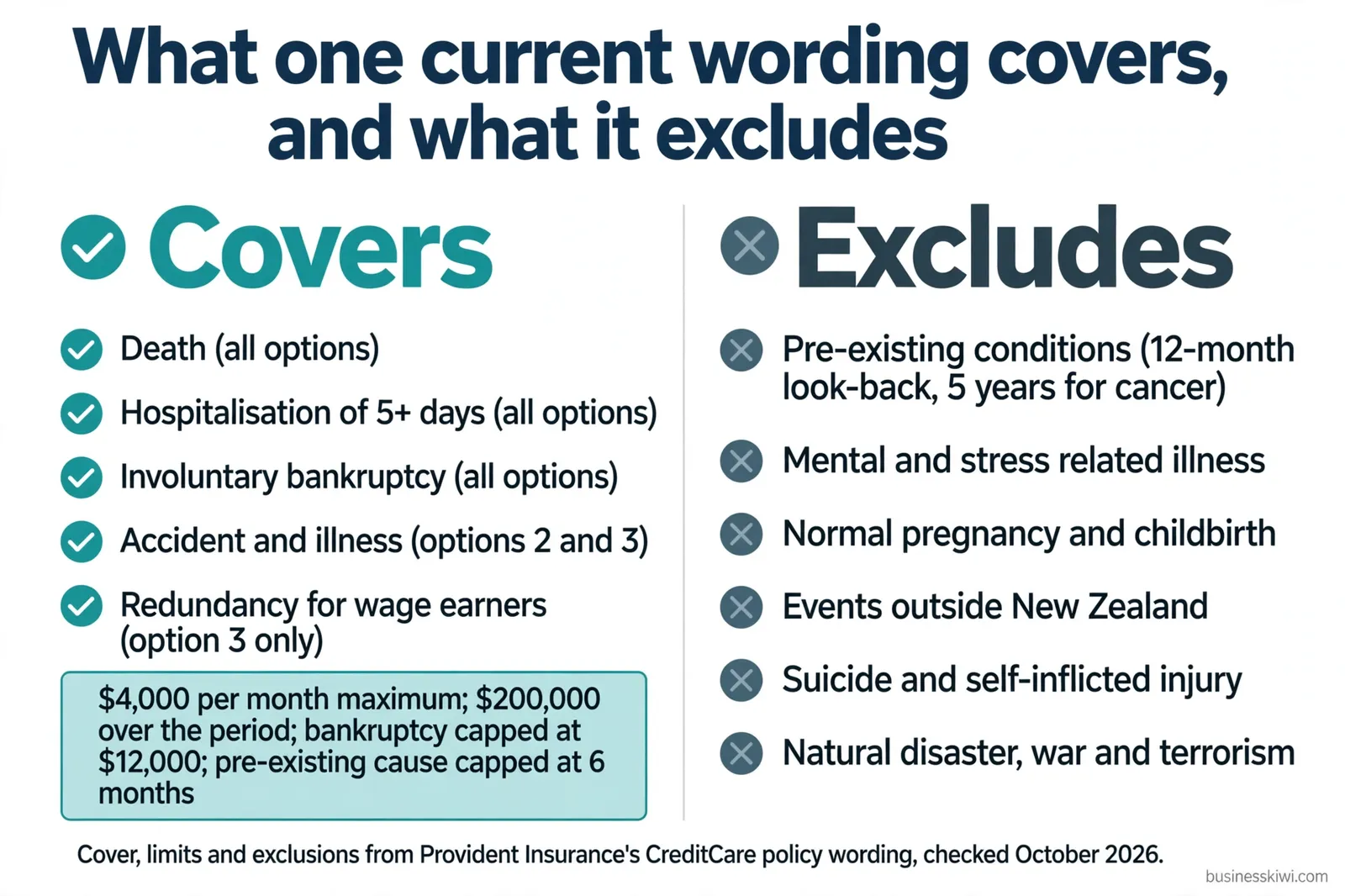
Cover depends entirely on the option you selected. The Provident CreditCare wording, a current New Zealand policy read in full for this guide, offers three options. Option 1 covers death, hospitalisation and bankruptcy. Option 2 adds accident and illness. Option 3 adds income disruption: redundancy and industrial action for wage earners, and business interruption for self-employed policyholders.
Within those options, the wording provides:
- On death, payment of the remaining amount due under the credit contract, after early repayment adjustments and less any arrears owing at the date of death. Terminal illness is treated the same way, based on a diagnosis that death is expected within six months.
- For accident or illness that stops you working in your usual full time employment, payment of the instalments that fall due, calculated daily, starting seven days after you stop working.
- For hospitalisation of five or more consecutive days, payment of instalments from the day of admission, for up to six months.
- For involuntary bankruptcy, payment of instalments starting 30 days after bankruptcy, for up to six months and up to a total claim of $12,000.
- For involuntary redundancy, payment of instalments starting 30 days after the redundancy date, for a minimum of two months and up to a maximum of 12 months, if you register as unemployed with Work and Income and actively seek work.
Every benefit is capped. Under the Provident wording the most the insurer will pay is the lower of the claim limit for the event or the amounts due under the credit contract, up to $4,000 per month and $200,000 over the period of cover, which runs for a maximum of five years. Amounts already due before the insured event are not paid. Credit card versions differ in shape but not in spirit: the FMA describes CCRI as covering some or all of a customer’s outstanding credit card repayments in circumstances including bankruptcy, redundancy, injury, illness or death.
| Cover event | What the Provident CreditCare wording pays | Options and limits |
|---|---|---|
| Death or terminal illness | The remaining amount due under the credit contract, less any arrears | All options |
| Accident or illness stopping work | Instalments from 7 days after you stop working | Options 2 and 3; pre-existing cause capped at 6 months |
| Hospitalisation of 5 or more days | Instalments from the day of admission | All options; up to 6 months |
| Involuntary bankruptcy | Instalments from 30 days after bankruptcy | All options; up to 6 months and $12,000 |
| Involuntary redundancy (wage earners) | Instalments from 30 days after redundancy | Option 3; 2 to 12 months; must register with Work and Income |
The exclusions and eligibility traps
This section decides whether the product is worth anything to you, and it is where the FMA’s concerns concentrate. CCRI is an automatic acceptance product: no medical or occupational underwriting is done before the policy is issued. Nobody checks your circumstances at the start, so the checking happens at claim time instead, through exclusions and prescriptive conditions. The FMA’s conclusion is blunt: customers may not receive the benefits they expect.
The Provident wording shows what that means in a real policy. Claims are not covered if they arise from:
- A pre-existing condition, as the policy defines it: any condition, sign, symptom, event or cause known to exist at the start date, or for which advice, diagnosis, care or treatment was sought, or ought reasonably to have been sought, in the 12 months before the start date. For cancer related conditions the look-back is five years. Where an accepted claim is due to a pre-existing condition, payments are capped at six months.
- Mental or stress related illness, including psychiatric conditions, depression and anxiety.
- The normal effects of pregnancy or childbirth, and choosing non-essential or non-emergency surgery.
- Suicide, self-inflicted injury, criminal activity, alcoholism or drug abuse, and events while under the influence of alcohol or drugs.
- Natural disaster, war, terrorism, declared states of emergency, and any event other than redundancy caused by a pandemic or epidemic.
- An insured event that happens outside New Zealand.
Employment status is a second trap. In the Provident wording, full time employment means 20 hours or more per week for salary or wages. The redundancy definition excludes voluntary redundancy, resignation, dismissal and retirement, and it excludes people who are self-employed or seasonal, casual, contractual, temporary or part time. A self-employed person cannot claim the redundancy benefit at all. Their cover is business interruption instead, defined narrowly as physical loss or damage to the business premises, prevention of access, or failure of essential services. Losing a major client or a downturn in trade is not a covered event under that wording.
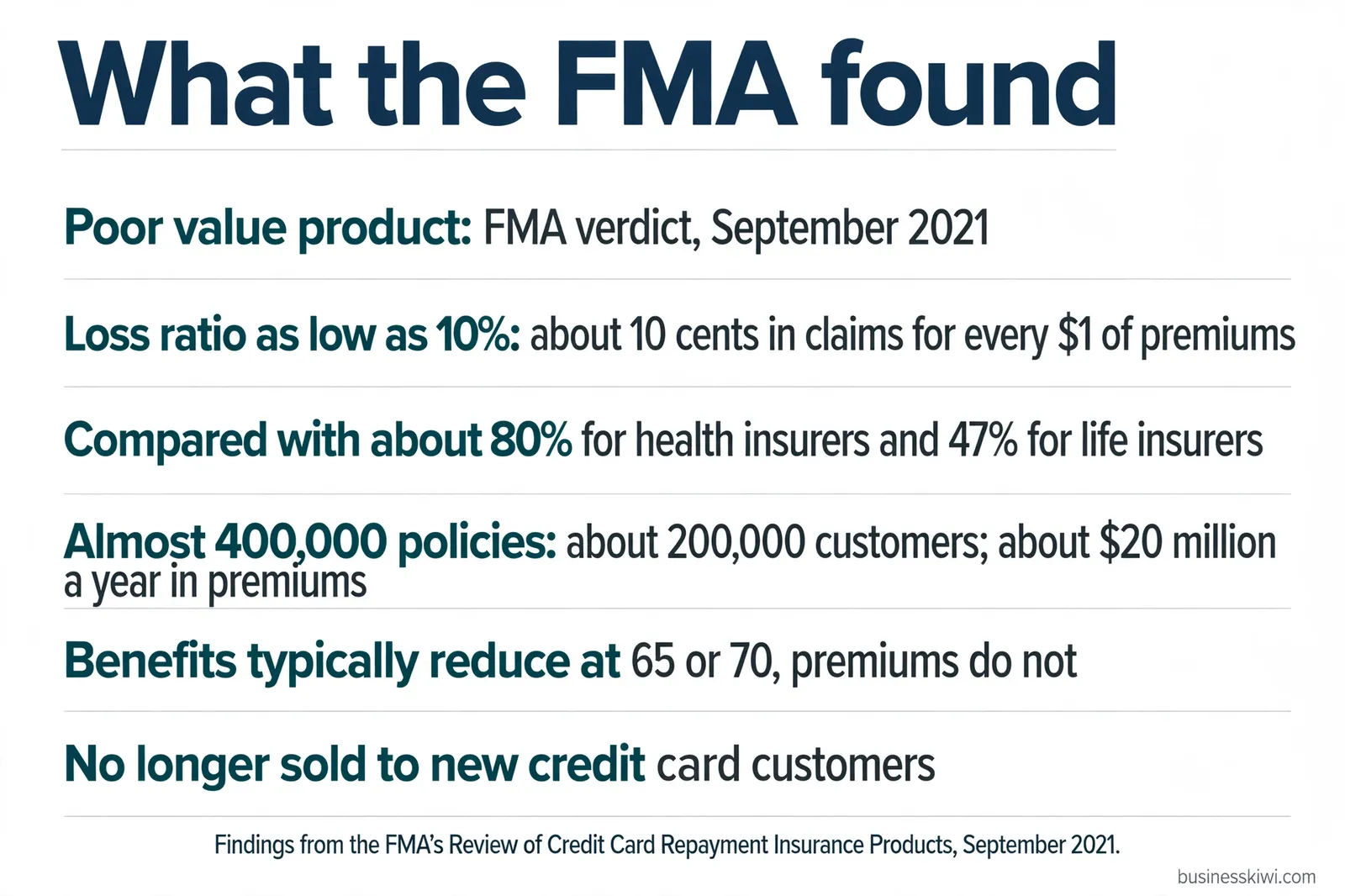
Age is a third trap, and the FMA documented it across the market. Policy benefits typically change once a customer turns 65 or 70: life cover generally remains, but disability, trauma and redundancy cover is removed. Several firms told the FMA they did not contact customers when that milestone occurred, and premiums were not reduced to reflect the reduced benefits.
The lesson is consistent: eligibility is decided when you claim, using definitions you may never have read.

How premiums are charged
There are two common charging patterns.
For credit card repayment insurance, the premium follows your balance. The FMA explains that it only shows when you have a balance owing. If you owe nothing, no premium is charged. If you owe a lot, you could be paying hundreds of dollars a year. The charge should be itemised on your statement as a premium, separate from interest. Some providers cap premiums, but the FMA notes that not all do. Because the premium moves with the balance, the long term cost is easy to underestimate.
For loan-linked cover, the premium is set at the start of the loan for the period of cover. The Provident wording sets out what happens if the loan ends early. If you fully prepay the credit contract, or cancel the policy with the financier’s consent, a part refund may be due. The rebate is calculated in accordance with the Credit Contracts and Consumer Finance Act 2003 and is paid to the financier, to be offset against what you owe. Two practical points follow. Ask for the total premium in dollars before you agree. And if you repay or refinance early, check whether a premium refund is owed and where it went. The FMA found incorrect premium charging among the failures in its review, so checking is not paranoia.
You can also cancel. The Provident wording gives a 21 day cooling off period: cancel within it, without having claimed, and you receive a full refund. Your own policy’s period may differ, so read its cancellation clause.
What the FMA found
The FMA’s September 2021 review is the central official document on this product class in New Zealand. It gathered data from 16 underwriters and distributors in late 2020. Its conclusion is that CCRI is a poor value product that poses a continued risk for existing policyholders on eligibility to claim and ongoing suitability.
The numbers are stark. Insurers reported almost 400,000 CCRI policies still on their books. Because some cover two lives, the FMA estimates as many as 200,000 customers still hold them, paying in-force premiums of approximately $20 million a year. Claim loss ratios, the share of premiums paid back as claims, could be as low as 10 percent: about 10 cents in claims for every $1 of premiums. The FMA compares that with loss ratios of approximately 80 percent for health insurers and 47 percent for life insurers.
The low payout rate was not only about low claiming. Providers treated CCRI as a low touch product, so many customers did not claim at all. Many had a poor understanding of their policy, including how to claim, and some did not realise it was optional. Suitability checks were weak: some providers had customers self-assess whether the product was right for them, with no consideration of individual circumstances, an approach the FMA calls unacceptable. Nearly all participants had no ongoing suitability assessment.
Administrative failures added direct harm. Provider reviews had uncovered incorrect premium charging, errors in marketing materials, unclear disclosures, cancellation requests not actioned, failings with deceased estates, cover not cancelled when customers passed the eligible age, and data errors between distributors and underwriters.
Enforcement followed in a related case. ANZ admitted breaching the Financial Markets Conduct Act 2013 after the FMA alleged it charged certain customers for CCRI policies that offered no cover or benefit. The claim covered 307 policies charged after April 2014. On 5 March 2021 the Auckland High Court ordered ANZ to pay a $280,000 civil penalty, in the first civil proceedings the FMA brought under the Act’s fair dealing provisions. ANZ cooperated after notification and compensated affected customers.
The FMA’s consumer page records the market outcome: credit card issuers are no longer offering CCRI to new customers. The FMA allows that there may be the occasional case where this kind of insurance is suitable, and it encourages holders to talk to their provider or a financial adviser about whether it is still suitable. Its add-on guidance, updated in September 2026, makes the same general point for the wider class: these products are optional, and policies may contain exclusions, eligibility requirements, waiting periods, benefit limits and maximum payment periods.
None of this means every policy is worthless for every person. It does mean the official record shows a product class where customers paid far more in premiums than policyholders received back in claims, where eligibility was often only tested at claim time, and where the regulator has told holders to check whether they still need what they are paying for.
How it differs from income protection and life insurance
These products are often confused. They are built differently.
Payment protection insurance protects a debt. The benefit is calculated from the repayments or balance on one credit contract, it is usually paid to the lender or applied to the debt, and it ends when the debt ends or the period of cover expires. Acceptance is usually automatic, with eligibility tested at claim time.
Income protection insurance protects your income. It pays a monthly benefit based on your earnings if illness or injury stops you working, and the money is yours to spend on any cost. It is individually underwritten, so your health, job and history are assessed when you apply. Holding both products can mean paying twice for overlapping protection against the same event.
Mortgage repayment cover, the subject of a separate guide on this site, is different again. It is an underwritten disability policy matched to a home loan repayment, with waiting periods and payment terms you choose. It is not the tick-box, balance-based add-on the FMA reviewed, and it should not be judged by that review.
Life insurance pays a lump sum when you die. A payment protection death benefit, in the Provident wording, is limited to clearing the amount due under the one credit contract. It is not a substitute for life cover sized to a family’s wider needs. ACC is different again: it covers injuries from accidents, not illness, and it is not insurance you buy.
If you have it, or you are offered it

Work through these checks before you buy, and yearly if you hold a policy.
- Find out whether you have it. Check your card statement for an itemised premium line, and your loan documents for a policy or registration certificate. The FMA notes the cover was often sold with a quick tick box, so you may hold it without remembering.
- Read the eligibility definitions, not the brochure. Check full time employment, the pre-existing condition look-back, the redundancy definition if you are casual, part time, fixed term or self-employed, and any age at which benefits reduce or stop.
- Check the exclusions against your real life. If the event you most fear is on the excluded list, the policy does not do the job you bought it for.
- Add up the true cost. For card cover, look at a year of statements. For loan cover, ask for the total premium and whether interest is charged on it if financed with the loan.
- Check for overlap. If you hold income protection or mortgage repayment cover, work out whether this policy would pay anything extra for the same event.
- Know how to cancel and what refund applies. Use the cooling off period if you have just bought. After that, follow the cancellation clause and confirm any refund in writing.
- If your circumstances change, ask the provider whether the cover is still suitable. The FMA expects providers to contact policyholders when benefits or eligibility change, or at least annually.
If something has gone wrong, complain in order. Start with the insurer or lender’s internal complaints process. The Provident wording directs unresolved complaints to the Insurance and Financial Services Ombudsman (IFSO) Scheme, which is free and independent. Every lender and insurer must belong to an approved dispute resolution scheme. Keep your statements, policy booklet and registration certificate: they are the evidence a claim or complaint turns on.
The closest relatives on this site are our income protection insurance guide, which covers the underwritten product that pays you rather than a lender, and our mortgage protection insurance guide for repayment cover matched to a home loan. For the borrowing side, our credit score guide explains how lenders assess you, and our small loans guide covers the consumer lending framework. More money guides are in the Finance section.
Frequently asked questions
Is payment protection insurance compulsory in NZ?
No. It is optional. A lender cannot make your loan depend on buying its policy, and you do not have to use the insurer it recommends.
Why does the FMA call credit card repayment insurance poor value?
Its 2021 review found claim loss ratios as low as 10 percent, about 10 cents in claims for every $1 of premiums, compared with about 80 percent for health insurers and 47 percent for life insurers. It also found numerous exclusions, weak suitability checks and poor communication.
Can I claim if I am self-employed?
It depends on the event and the wording. In the Provident wording, self-employed people are excluded from the redundancy definition. Their cover is business interruption, limited to physical damage to the premises, blocked access, or failure of essential services. Read your own definitions before relying on cover.
Does it cover a health condition I already had?
Usually not in full. The Provident wording looks back 12 months for most conditions and five years for cancer related conditions, and caps payments at six months where an accepted claim is due to a pre-existing condition.
How much does payment protection insurance cost?
For credit card cover, the premium follows your balance and is only charged when you owe money, so a high balance can mean hundreds of dollars a year. For loan cover, the premium is set at the start. Ask for the total in dollars, and whether interest is charged on it if financed with your loan.
Can I cancel and get a refund?
Yes. The Provident wording gives a 21 day cooling off period with a full refund if you have not claimed. Later cancellations and early loan repayments may attract a part refund calculated under the Credit Contracts and Consumer Finance Act 2003.
Is payment protection insurance the same as income protection?
No. Payment protection cover is tied to one debt and pays the lender or the debt. Income protection is underwritten around your earnings and pays you a monthly benefit for any cost. Holding both can mean paying twice for the same event.
The bottom line
Payment protection insurance does a narrow job: it keeps one debt’s repayments going after a listed event. The official record, led by the FMA’s 2021 review, shows low claim payouts relative to premiums, and eligibility tested mainly at claim time. If you hold a policy, read its definitions and exclusions, add up what you pay each year, and decide with open eyes whether it still earns its place.
Sources
- Financial Markets Authority, Insurance (consumer page, including the add-on insurance and Credit Card Repayment Insurance sections, page last updated 28 September 2026): https://www.fma.govt.nz/consumer/everyday-finance/insurance/
- Financial Markets Authority, Review of credit card repayment insurance products (September 2021): https://www.fma.govt.nz/assets/Reports/Review-of-credit-card-repayment-insurance-products.pdf
- Financial Markets Authority, media release MR No. 2021-43, Credit card repayment insurance a poor value product, customers urged to check policies (September 2021): https://www.fma.govt.nz/news/all-releases/media-releases/credit-card-repayment-insurance-a-poor-value-product-customers-urged-to-check-policies/
- Financial Markets Authority, media release MR No. 2021-8, ANZ ordered to pay $280,000 penalty for misleading representations over credit card insurance charges (March 2021): https://www.fma.govt.nz/news/all-releases/media-releases/anz-ordered-to-pay-penalty/
- Consumer Protection (MBIE), What lenders must do: https://www.consumerprotection.govt.nz/help-product-service/borrowing-money/what-lenders-must-do
- Provident Insurance Corporation Limited, CreditCare Insurance policy booklet (PICLCCI0426): https://better.co.nz/hubfs/Insurance%20Policies/Insurance%20Policies%202026/Provident%20Credit%20Care.pdf
- Credit Contracts and Consumer Finance Act 2003, definition of consumer credit insurance (legislation.govt.nz): https://www.legislation.govt.nz/act/public/2003/52/en/2009-08-01/
This article is general information about payment protection insurance and how this product class works in New Zealand. It is not financial advice and it does not recommend any product or provider. Policies differ in their definitions, exclusions, limits and eligibility rules, and the policy document you signed is what governs a claim. Consider your own circumstances, read your policy wording in full, and talk to a licensed financial adviser before buying, keeping or cancelling cover.