Odd Jobs in NZ: How the Work Is Found, What It Pays and the Tax That Follows

The short answer
Odd jobs are the small, one-off tasks that keep a home running: a lawn that needs mowing, a hedge that needs trimming, a fence paling that needs replacing, a spare room that needs painting, a trailer load that needs to go to the tip. There is no official definition and no official pay rate for this work in New Zealand. What exists instead is a set of official reference points. Tahatū Career Navigator, the government’s careers service, publishes pay for the closest formal occupations, such as caretakers, commercial cleaners, housekeepers and gardeners. Inland Revenue (IRD) sets the tax rules, and they are clear: income from odd jobs is taxable income, there is no minimum amount before it counts, and GST registration kicks in at $60,000 of turnover in 12 months. ACC covers self-employed workers automatically under CoverPlus, funded by levies worked out from your tax return.

What counts as an odd job
The common thread is size. An odd job is small, self-contained and finished in hours or days, not weeks. It rarely needs a contract beyond a conversation and an agreed price.
Garden and outdoor tasks are the classic category. Think lawn mowing, weeding, hedge trimming, pruning, leaf and green waste removal, waterblasting a path, cleaning gutters, or stacking firewood. Tahatū describes gardeners and groundskeepers as the formal version of this work, and its profile for the occupation covers people who maintain lawns, trees, shrubs and gardens.
Inside the home, the list runs to cleaning, tidying and organising help: a one-off deep clean, an end-of-tenancy clean, ironing, sorting a garage, or assembling flat-pack furniture. Housekeepers and commercial cleaners are the formal occupations closest to this work, and both sit in Tahatū’s cleaning, recycling and disposal group.
Then there is moving and lifting help. People pay for an extra pair of hands to shift furniture, load a trailer or a small truck, carry items up stairs, or help with a garage sale set-up. Errands fill the rest of the category: picking up groceries or prescriptions, driving someone to an appointment, walking a dog, feeding pets while owners are away, or waiting at a house for a delivery or a tradesperson.
Two boundaries matter. Work that needs a licensed tradesperson, a building consent or specialist equipment is not odd-job work, however small it looks. And regular, ongoing hours for the same household start to look less like odd jobs and more like a job, which changes the tax and employment picture described below.
How people find odd-job work, and how householders find help
Most odd-job work still changes hands locally. Word of mouth is the main channel: neighbours, workmates, sports clubs, school communities and local community groups. A person who mows one lawn well tends to be offered the lawns either side of it, and repeat work turns scattered tasks into a steady sideline.
Online channels sit alongside that. Householders post tasks on community noticeboards and local social media groups, and general online marketplaces carry small service listings next to goods for sale. IRD makes the point that selling goods or services online carries the same tax obligations as any other business, so the channel does not change the rules. Some workers also register with local cleaning, gardening or home-services businesses that send out casual crews, which sits closer to employment than self-employment.
For householders, the practical steps are simple. Describe the task and its edges precisely: which hedge, how high, and who takes the green waste away. Agree the price basis before work starts, whether that is an hourly rate, a fixed price for the job, or a price with a cap. Agree who supplies tools, materials and safety gear. A short written message covering those points prevents most disagreements, because odd jobs go wrong mainly on scope, not on effort.
For workers, reliability is the product. Turning up when promised, finishing the whole task and leaving the site tidy are what generate the referrals that bring the next job.

What odd-job work pays: the official picture
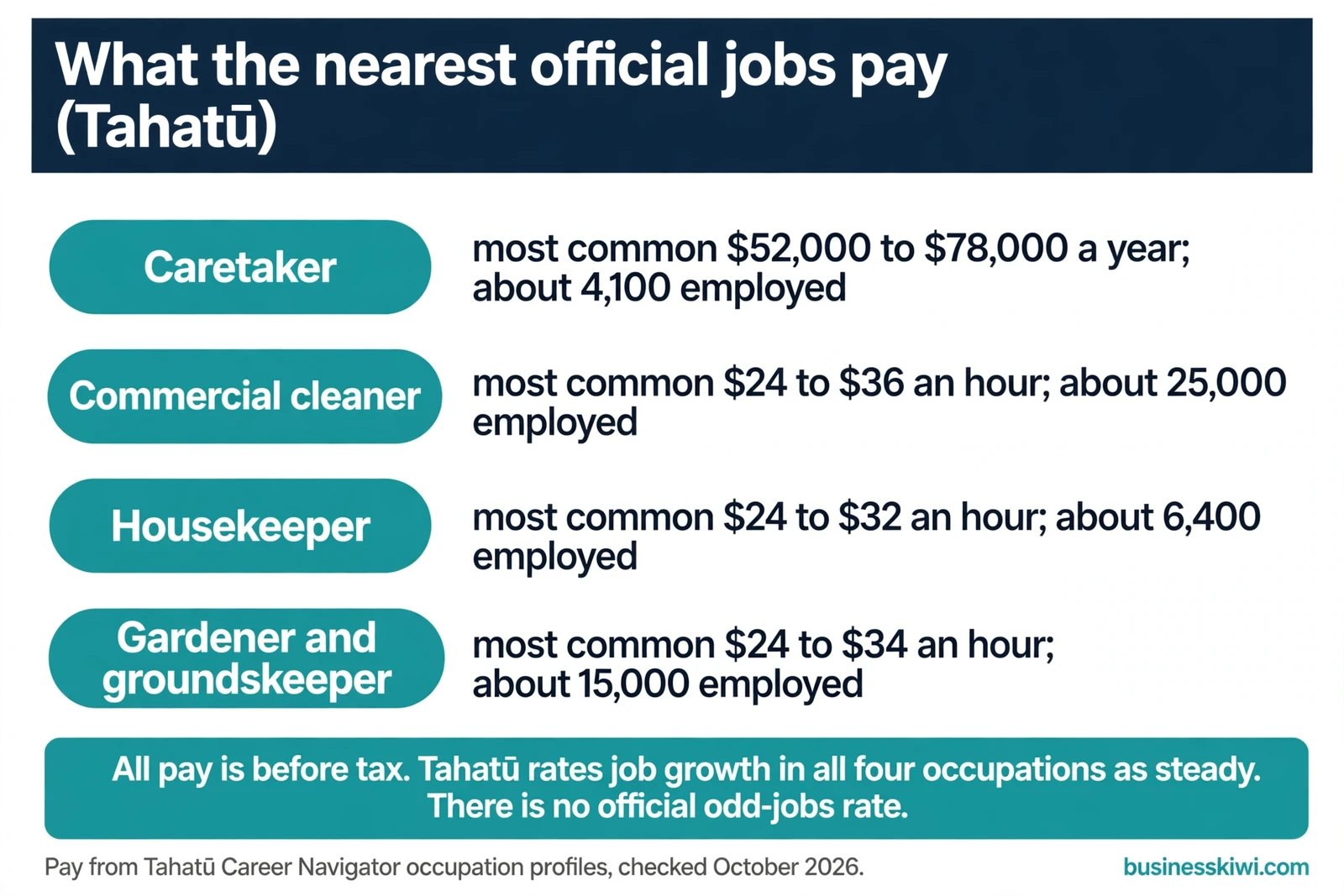
No official body publishes an odd-jobs rate, and this article will not invent one. What Tahatū publishes is pay for whole occupations, drawn from official earnings data. Those occupations are the nearest formal relatives of odd-job work. Their figures describe people doing the work as an ongoing occupation, many of them full-time employees. They are context for what the market pays for the same skills, not a price list for a Saturday morning job. Every figure is before tax.
| Occupation (Tahatū) | Most common pay | Lower and upper figures | People employed |
|---|---|---|---|
| Caretaker | $52,000 to $78,000 a year | $50,000 lower, $102,000 upper | About 4,100 |
| Commercial cleaner | $24 to $36 an hour | $24 lower, $46 upper | About 25,000 |
| Housekeeper | $24 to $32 an hour | $24 lower, $40 upper | About 6,400 |
| Gardener and groundskeeper | $24 to $34 an hour | $24 lower, $43 upper | About 15,000 |
Read the table with the framing in mind. A caretaker, as Tahatū describes the role, maintains and cleans buildings such as schools, apartments, hospitals and office buildings, and the caretaker title covers building custodians and property supervisors. That is steadier and broader work than a one-off repair, which is why the occupation is paid as a salary. The cleaning and gardening figures are hourly, and they cluster tightly: the most common band starts at $24 an hour for all three hourly occupations. Tahatū lists the commercial cleaner band as $50,000 to $74,000 a year in its summary listings, which is the same band expressed annually.
Tahatū rates the employment change for all four occupations as steady, and none of them needs much training to enter: no specific training for commercial cleaners, up to a year for caretakers and housekeepers, and up to three years for gardeners and groundskeepers. That low barrier is part of why odd-job work is so widely offered. The price for any single task is still a private agreement between the worker and the householder, shaped by the task, the tools needed, travel and how long the job actually takes.
Tax: odd-job income is taxable income
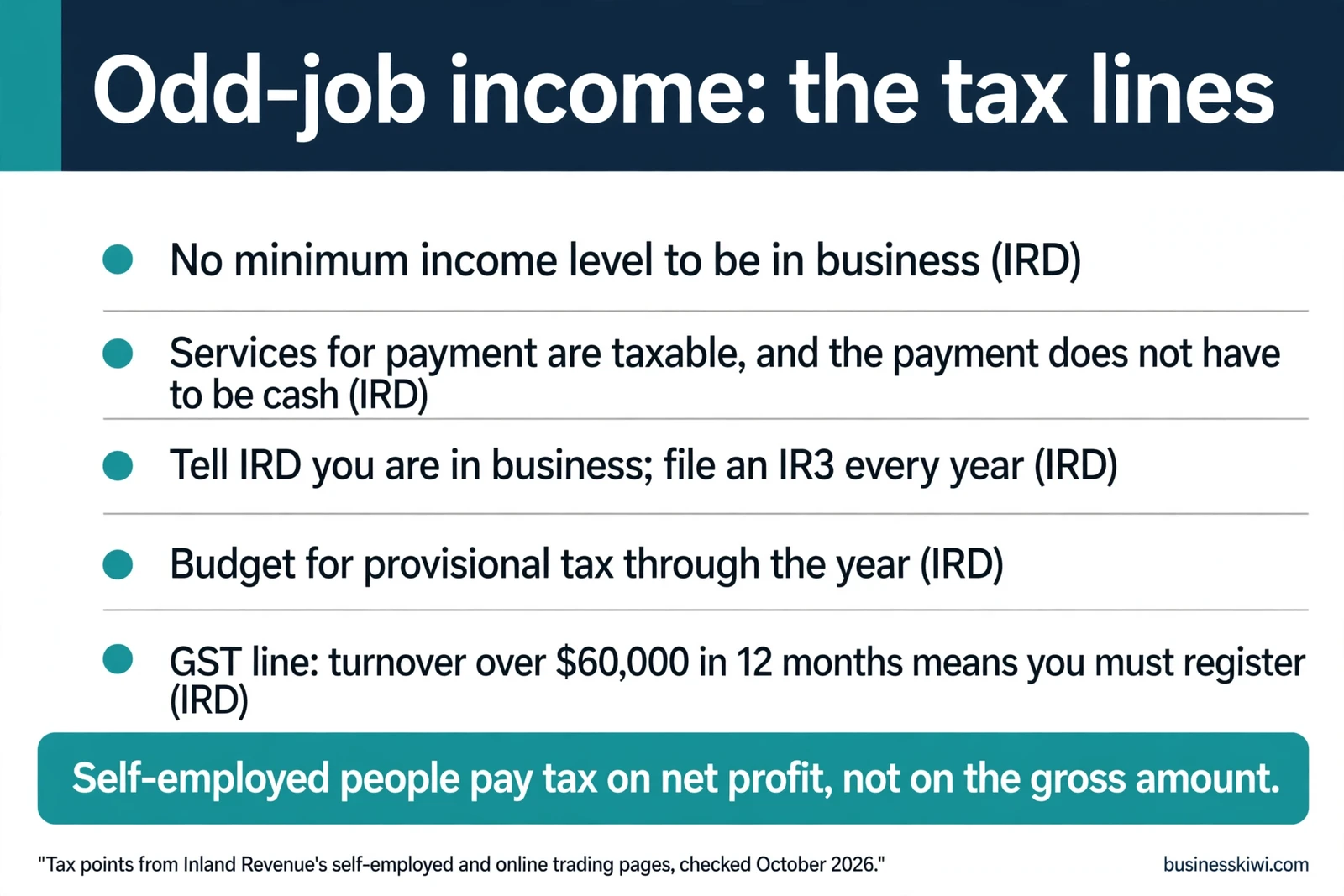
The tax position starts with a simple rule. If you provide services in return for payment, the income is taxable and belongs in your tax return. IRD’s online trading guidance states the tests it applies: you provided services for payment, you intended to make a profit, or you do the work regularly. Its sharpest point for odd-job workers is this: there is no minimum income level to be in business. Small amounts count. Cash counts too in the other direction, because IRD notes that the payment does not have to be cash. Being paid in goods or services still leaves you with taxable income.
Most odd-job workers are self-employed in tax terms, often as sole traders. IRD describes self-employment as carrying out business activity on your own, and says a self-employed person can usually start in business without formal or legal set-up tasks. You use your individual IRD number, and you pay tax on your net profit through your individual income return.
Status is not decided by what either side calls the arrangement. IRD states there is no single test and that the working conditions determine the outcome. Its self-employed indicators include providing your own major equipment, controlling when and how you work, being able to work for other people, advertising for work and risking your own money. Its employee indicators point the other way: set hours, a set rate, being told what to do and how, and having to do the work personally. IRD also stresses that each arrangement is tested separately. A person can be employed in a weekday job and self-employed in weekend odd jobs at the same time, and someone who helps several households may be self-employed for one arrangement and an employee in another.
One caution belongs here. IRD notes that even where a worker meets the tests for self-employment, tax may still have to be deducted from some payments they receive. Where that applies, it is handled through the payer and the worker’s return, and the return is where it is squared up.
Records, expenses and provisional tax
If you are self-employed, IRD lists four duties. Tell IRD that you are in business. Complete an individual tax return (IR3) each year. Budget to make regular payments of provisional tax and end-of-year income tax. Register for GST if your turnover crosses the threshold covered in the next section.
Provisional tax surprises many first-time odd-job workers. In a job, tax comes out of each pay before you see it. Working for yourself, nobody deducts it, so the money has to be set aside as you earn. IRD’s instruction is to budget for regular provisional tax payments through the year and a final wash-up in the end-of-year return. Keeping a simple record of every job, its date, what it paid and what it cost you makes the IR3 straightforward instead of a reconstruction exercise.
Expenses are the other side of the return. IRD confirms that self-employed people can claim expenses for the business activity they carry out, and pay tax on the net profit rather than the gross amount. Fuel for travel between jobs, tools, materials you supply and safety gear are the kinds of costs that belong in that record, each backed by a receipt. Keeping business money movements tidy, even in a single notebook or spreadsheet, is what makes both the expense claims and the ACC levy calculation below run smoothly, because both draw on the same return.
GST: the $60,000 line
GST registration for odd-job work turns on one number. IRD states that you must register for GST if your turnover was over $60,000 in the last 12 months, or will be over $60,000 in the next 12 months. Turnover means your sales from the work, not your profit. Most people doing odd jobs as a sideline sit far below that line and never need to register. A worker whose task business grows into a full-time operation with several regular clients is the one who needs to watch the rolling 12-month total, because the test looks backwards and forwards at the same time.
Below the threshold, registration is optional. IRD confirms you may register voluntarily if you earn less than $60,000. Voluntary registration brings GST returns and paperwork with it, so it suits people whose clients are mostly GST-registered businesses rather than householders. Householders cannot claim GST back, which is why most small odd-job operators leave registration until the law requires it.
If you are hiring help instead
The status question cuts both ways. A householder who engages the same person every week, sets their hours, directs how each task is done and supplies all the equipment is building something that looks like employment, whatever the arrangement is called. IRD’s guidance is blunt about the mirror-image case: if the employee indicators fit but the worker is not treated as an employee with PAYE deducted, IRD needs to be contacted. Householders with a genuinely regular helper should test the arrangement against IRD’s two question lists before it becomes a habit. One-off and occasional tasks, where the worker sets their own hours, uses their own tools and works for many households, sit comfortably on the self-employed side of the line.
ACC cover when you work for yourself
Injury cover follows you into self-employment automatically. ACC states that self-employed people and contractors are placed on its standard CoverPlus cover, with CoverPlus Extra as an optional alternative. Under CoverPlus, if you have an accident and cannot work, ACC pays compensation at up to 80 percent of your taxable income, based on the most recently completed financial year. ACC’s own example puts income of $52,000 a year at up to $800 a week before tax. Weekly compensation starts a week after the injury, and ACC also helps with treatment and rehabilitation costs.
The levies that fund this cover are calculated from your tax return. ACC explains that Inland Revenue provides it with a summary of your earnings from your IR3, and that this is combined with your Classification Unit, the description of the work you do and the industry you are in, based on your Business Industry Classification code. CoverPlus invoices are issued around September each year and carry three levies: the Work levy, the Earners’ levy and the Working Safer levy. There is no sign-up step for standard cover, but there is an invoice to expect, sized by the income your return shows and the risk class of your work.
CoverPlus Extra works differently. It lets a self-employed person choose how much of their income they want covered, and compensation is then based on that chosen cover amount and option. For odd-job workers with very variable income, that choice is the difference between compensation based on a thin first-year return and compensation based on a level they picked deliberately. Either way, the cover is for injury. It responds when you are hurt, not when a job goes wrong.
Staying safe and sorting the practical cover questions
Odd jobs put people on ladders, behind mowers and into other people’s homes, so a few habits carry most of the safety load. Agree the exact task before starting and stop if the job grows into work you are not equipped for. Use the right gear for heights, blades and cleaning chemicals, and make sure someone knows where you are working when you are alone at a property. For householders, clear the work area, keep children and pets out of it, and say up front if you know about a hazard such as a rotten step or a wasp nest.
On cover, separate the two questions. Your own injury cover as a self-employed worker is the ACC position described above. Damage to a householder’s property, or injury to someone else caused by your work, is a different matter, and ACC does not answer it. That is the point where a worker doing regular paid tasks should talk to an insurer about liability cover, and where a householder booking a bigger job should ask what cover the worker carries. Neither step is a legal requirement stated in the sources for this article, but both are cheaper than an argument after something breaks.
Related guides: our casual contract guide covers casual employment agreements, our GST registration guide covers the GST rules in depth, and our sole trader guide covers setting up properly. More work and careers guides are in the Jobs and Education section.
Frequently asked questions
Do I have to declare the money from one small job for a neighbour?
If you provided a service in return for payment, yes. IRD states there is no minimum income level to be in business, and its tests cover providing services for payment, intending a profit, or doing the work regularly. The payment does not have to be cash for the income to count.
I already have a regular job. Does odd-job income still count as taxable?
Yes. IRD confirms a person can be employed and self-employed at the same time. Your wages are taxed through PAYE by your employer, and your odd-job income is declared in your individual tax return, where you pay tax on the net profit after expenses.
When do I have to register for GST?
When your turnover from the work was over $60,000 in the last 12 months, or is expected to go over $60,000 in the next 12 months. Below that line, registration is voluntary. Turnover means total sales, not profit.
How much should I charge for an odd job?
There is no official odd-jobs rate. The official context is Tahatū’s pay for the nearest occupations: most commonly $24 to $36 an hour for commercial cleaners, $24 to $32 an hour for housekeepers, $24 to $34 an hour for gardeners and groundskeepers, and $52,000 to $78,000 a year for caretakers, all before tax. Your actual price is an agreement with the householder and should reflect the task, travel, tools and time.
Am I an employee or self-employed if I help the same household every week?
There is no single test. IRD looks at the real conditions: who controls the hours and the method, who supplies equipment, whether you can work for others and whether you risk your own money. Regular hours, set pay and close direction point toward employment. Each arrangement is judged on its own facts, so test yours against IRD’s question lists.
What happens if I get hurt while doing odd jobs for myself?
ACC places self-employed people on CoverPlus automatically. If an accident stops you working, compensation can reach up to 80 percent of your taxable income from your most recently completed financial year, starting a week after the injury. Levies are invoiced around September each year and are worked out from your IR3 earnings and your Classification Unit.
Can I claim my tools, fuel and safety gear against tax?
IRD confirms self-employed people can claim expenses for the business activity they carry out, and tax is paid on net profit. Keep receipts and a simple record of each job and its costs, because the same figures feed your tax return and your ACC levy calculation.
The bottom line
Odd jobs run on trust and small agreements, but the official framework around them is real. Treat the income as taxable from the first job, keep records as you go, and watch the $60,000 GST line if the work grows. Use Tahatū’s occupation pay as context when you set a price, not as a promise. Know that ACC has you on CoverPlus from the start, with an invoice each year based on what your return says you earned. Clear agreements, tidy records and honest tax handling are what let a sideline stay a sideline, or grow into a business, without surprises.
Sources
- Inland Revenue, Self-employed: https://www.ird.govt.nz/roles/self-employed
- Inland Revenue, Self-employed or employee: http://www.ird.govt.nz/roles/employees/self-employed-or-employee
- Inland Revenue, Online trading: https://www.ird.govt.nz/income-tax/income-tax-for-businesses-and-organisations/types-of-business-income/online-trading
- ACC, Cover for self-employed: https://www.acc.co.nz/for-business/understanding-your-cover-options/types-of-cover-for-self-employed
- Tahatū Career Navigator, Caretaker: https://tahatu.govt.nz/work/explore-career-ideas/occupation/T00596-caretaker
- Tahatū Career Navigator, Commercial cleaner: https://tahatu.govt.nz/work/explore-career-ideas/occupation/T00595-commercial-cleaner
- Tahatū Career Navigator, Housekeeper: https://tahatu.govt.nz/work/explore-career-ideas/occupation/T00597-housekeeper
- Tahatū Career Navigator, Gardener and groundskeeper: https://tahatu.govt.nz/work/explore-career-ideas/occupation/T00600-gardener-and-groundskeeper
- Tahatū Career Navigator, Cleaning, recycling and disposal (work area listing): https://tahatu.govt.nz/work/explore-career-ideas/159-cleaning-recycling-and-disposal
This article is general information about odd jobs in New Zealand. It is not tax, legal or financial advice for your situation. Tax status, GST and ACC levies depend on your own circumstances, so check the Inland Revenue and ACC pages linked above or talk to a tax professional before you rely on this guide.