Teacher Registration in NZ: How Registration and Practising Certificates Work

The short answer
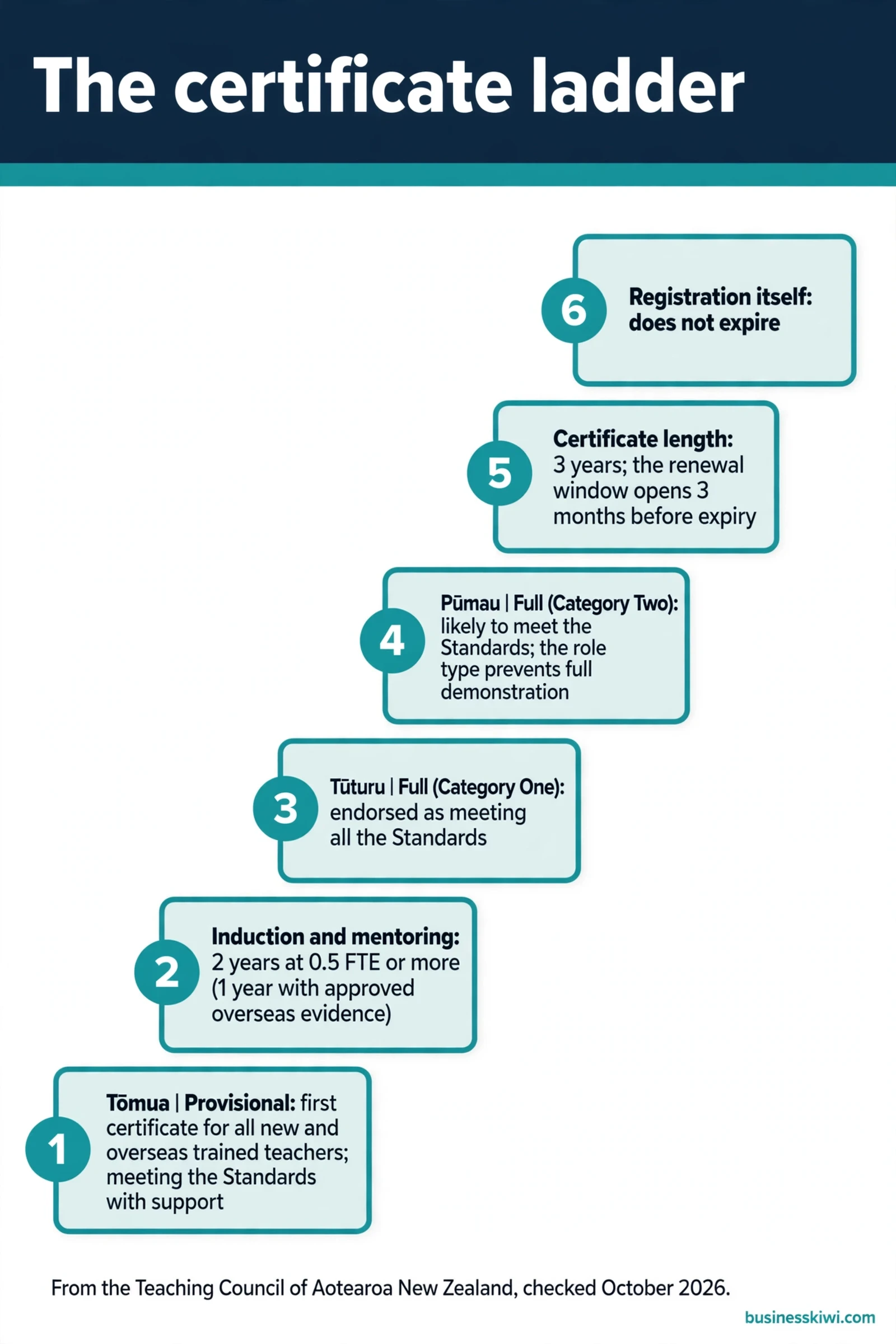
Every teacher in Aotearoa New Zealand must be registered with the Teaching Council of Aotearoa New Zealand and hold a current practising certificate to teach. Registration is granted once and lasts for life. The practising certificate is separate: it lasts three years and must be renewed to keep teaching lawfully. New teachers start on a provisional certificate, then move to a full certificate once endorsed as meeting the Standards for the Teaching Profession. People without a teaching qualification can sometimes teach under a Limited Authority to Teach.
Who has to be registered and certificated
The Council states the rule plainly: every teacher in Aotearoa must be registered and hold a current practising certificate to teach, and a certificate is required to be employed in a teaching position. Relief teachers must also hold the appropriate authority to teach.
There is one partial exception: the Council’s policy notes that some early childhood education positions do not require a practising certificate, because in some early childhood settings not all teachers must be registered and certificated.
The title is protected too: under the law, “registered teacher” can only be used by a person granted registration by the Council, and every registered teacher appears on the Council’s public register, showing certificate type and any conditions.
Registration and the practising certificate: two different things
Registration and certification are often confused, but the Council treats them as two separate steps.
Registration confirms that a person meets the professional and ethical standards to be a teacher. Once granted, it does not expire: a teacher keeps it for life unless they de-register or the Council cancels it, which can happen if it was issued in error or as an outcome of disciplinary proceedings. Registration alone does not allow anyone to teach.
The practising certificate is what allows a teacher to teach legally in New Zealand, and certificates are issued for three years. A teacher not currently teaching can let it lapse while staying registered, but to be employed as a teacher the certificate must be current.
Most people apply for both at once: a new graduate can apply for registration and a first practising certificate together, as soon as they have graduated or are eligible to graduate from an approved Initial Teacher Education (ITE) programme. Someone not planning to teach straight away can register only and seek a certificate later.
The practising certificate types
The Council issues three main practising certificate types. Which one a teacher holds depends on career stage and whether they can currently be endorsed against all of the Standards, Ngā Paerewa.
| Certificate | Who it is for | What it requires |
|---|---|---|
| Tōmua | Provisional Practising Certificate | All new and beginning teachers from New Zealand, and all overseas trained teachers starting in New Zealand | Meeting the Standards with support, while completing an induction and mentoring programme |
| Tūturu | Full Practising Certificate (Category One) | Experienced teachers | Endorsement as meeting all of the Standards, shown by satisfactory recent teaching service or a teacher refresh process |
| Pūmau | Full Practising Certificate (Category Two) | Experienced teachers whose role type means they cannot currently be endorsed against all of the Standards | Being considered likely to meet the Standards, even though the current role does not let them demonstrate all of them |
The provisional certificate, Tōmua, shows the teacher is meeting the Standards with support. To move to Tūturu, Full (Category One), most teachers complete two years of formal induction and mentoring in a teaching position of at least 0.5 FTE, supported by a mentor holding a Full (Category One) certificate. Teachers with Council-approved evidence of a year of induction, mentoring and teaching overseas may need only one year in New Zealand. The Council expects it finished within two to three years, although longer is possible.
Older teachers may remember Subject to Confirmation. It is a former type: those certificates stay valid until the holder renews into a current type, and Pūmau, Full (Category Two), now covers a similar situation.
The Council can also issue a Returning to Teaching in Aotearoa New Zealand certificate in limited circumstances: for previously fully certificated teachers whose certificate has expired, who lack satisfactory recent teaching experience, and who cannot use the extension to teach provisions. A Return to Practice Plan or Teacher Education Refresh may also be required.
What every applicant has to show
The Council’s Requirements for Teacher Registration, Practising Certificates and Limited Authority to Teach sets out what every applicant must demonstrate, giving effect to Schedule 3 of the Education and Training Act 2020.
Satisfactorily trained to teach. An applicant must hold an approved New Zealand ITE qualification at level 7 or above. An overseas qualification must either appear on the NZQA list of pre-approved qualifications, or have been assessed by NZQA through an International Qualifications Assessment (IQA) as comparable.
Good character. The Council states that teachers are required to be of good character and fit to be a teacher. Good character is shown by committing to and meeting the obligations in the Code of Professional Responsibility, Ngā Tikanga Matatika, and by receiving a satisfactory police vet. Applicants must also declare any dismissal from a teaching position in any country, any refusal or cancellation of registration in any country, and anything they are under investigation for bearing on the Code.
A satisfactory police vet. The Council applies to New Zealand Police for the vet on the applicant’s behalf, after a referee verifies identity. A new vet is required every three years. Anyone who has lived overseas for 12 months or more in the last 10 years also needs a police vet from that country, or a statutory declaration if one cannot be obtained.
Fit to be a teacher. The applicant must be physically and mentally able to carry out a teaching role safely and satisfactorily, and signs a health declaration to that effect.
Language competency and te reo Māori. Applicants must communicate competently in English and/or te reo Māori, using one of the evidence types in the Council’s language competency policy, and declare a commitment to develop and practise te reo me ngā tikanga Māori throughout their career.
The Registration Manager decides most applications; serious character or fitness concerns go to a Registration Panel of fully certificated teachers and a lay member. An applicant facing decline must be given a hearing, and decisions can be appealed to the District Court within 28 days.

How to apply, step by step
Applications are made online through the Council’s Hapori Matatū system. Before starting, an applicant needs an Educator Sector Login (ESL) and a My Rawa login, proof of identity as required under the Children’s Act, and a certified copy of their ITE qualification; an eQuals link or written confirmation from the provider can be used instead. Police vetting and the health and te reo Māori declarations sit within the application.
The Council publishes these steps for a registration application:
- Click “My Login” at the top right of the Teaching Council website. This opens the teacher portal, My Rawa.
- Scroll to the section called “I want to” and click the card called “Maintain my practising certificate”.
- Click “Apply Now”.
- Follow the prompts.
- Submit the application.
Payment is made at the “Finish and Pay” stage, by POLi internet banking or Visa and Mastercard. Cheques, cash and WINZ options are not accepted.
The Council states applications usually take 6 to 12 weeks, depending on complexity, and longer if a panel review is needed. Progress can be checked via Miromiro, the Council’s chatbot, using a registration or case number.
Fees: what the Council charges
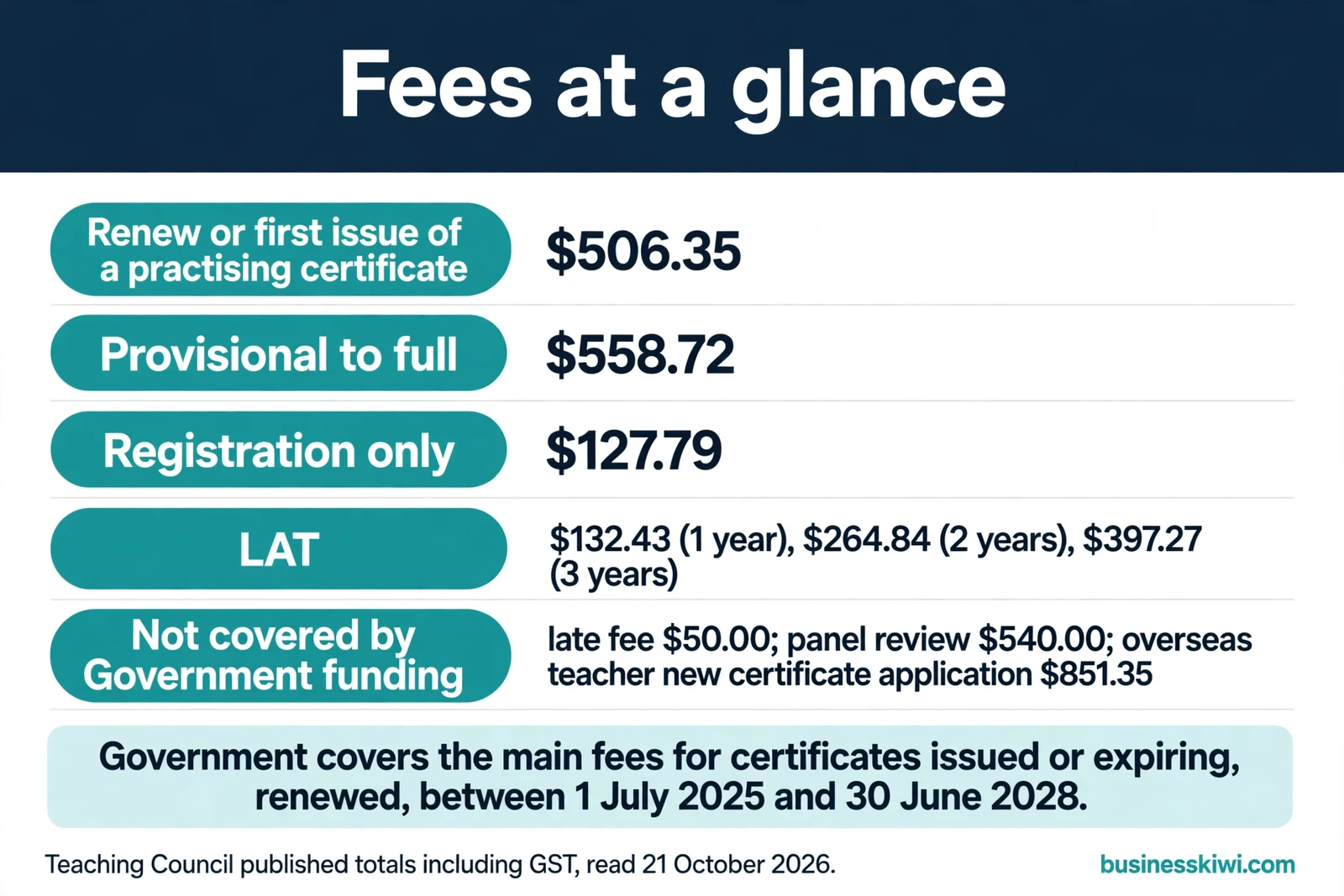
The Council publishes its fees and levy as combined totals including GST, read from its fees and levy page on 21 October 2026:
- Renewing a practising certificate: $506.35
- Issuing a practising certificate to a New Zealand ITE graduate: $506.35
- Moving from provisional to full certification: $558.72
- Limited Authority to Teach: $132.43 for one year, $264.84 for two years, $397.27 for three years
- Registration only, with no practising certificate issued: $127.79
Three further charges sit outside that table: a late fee of $50.00, $540.00 to apply for a review of a decision by a Registration or Discretionary Pathway panel, and $851.35 for an overseas teacher application for a new practising certificate.
Most teachers will not pay the standard amounts right now: under funding announced on 28 April 2025, the Government covers the main-table fees and levy for certificates issued or expiring, and renewed, between 1 July 2025 and 30 June 2028, with Hapori Matatū adjusting the amount automatically. The second group is not covered.
The late fee needs care. It applies if a renewal is submitted after expiry, or if the applicant holds no certificate or LAT while in a teaching position that requires one. It is added automatically, the application cannot be submitted until it is paid, and late fees are non-refundable.
Renewal and endorsement
A practising certificate lasts three years, and renewing it is a legal requirement for anyone who keeps teaching. Applications can be made up to three months before expiry; the Council recommends applying early. The online renewal takes about 10 minutes with everything ready.
The Education and Training Act requires the Council to be satisfied on several points before renewing:
- Satisfactory recent teaching. At least two years of uninterrupted teaching in the last five years, or a shorter period the Council approves, or completion of a teacher refresh process.
- Professional development. Satisfactory professional development in the past three years. The Council does not prescribe type or amount; the setting’s Professional Growth Cycle can count.
- Endorsement. The teacher’s professional leader, usually the tumuaki, principal or centre manager at their current or most recent setting, must endorse the application, confirming whether the teacher meets, meets with support, or is likely to meet the Standards, plus their progress in te reo me ngā tikanga Māori. The applicant needs the endorser’s registration number, full legal name and email.
- Fresh checks and declarations. A new police vet, plus the Code, fitness and te reo Māori declarations.
A provisional certificate can be renewed if the teacher has done some teaching but not yet met the requirements for full certification. The Council can require a Teacher Education Refresh if a provisional certificate has been held for over five years.
If a certificate expires before the renewal is processed, there are two safety nets. A registered teacher can continue in a teaching position for up to 20 half-days, or 10 days, in a year without a practising certificate. Beyond that, an extension to teach can be requested once the certificate has expired, provided the renewal was submitted and the professional leader endorses it.
Trained overseas? Registration for overseas teachers
Overseas trained teachers follow the same two steps: registration first, then a practising certificate. All are first issued a Tōmua, Provisional Practising Certificate when they start teaching in New Zealand.
The qualification comes first. If it is on NZQA’s list of pre-approved teaching qualifications, the teacher provides a certified copy and applies. If not, NZQA must assess it through a Teaching International Qualifications Assessment, known as a Teaching IQA, checking comparability with an approved New Zealand ITE qualification: tertiary level, at least level 7 on the New Zealand Qualifications Framework, with enough teacher education content.
If the qualification is not found comparable, the Council offers a discretionary pathway: the teacher supplies details of all teaching service, evidence of professional development and appraisals, and recent testimonials. Approvals this way are exceptions to policy, and a review of a panel decision costs $540.00.
The application needs more than the qualification. The Council’s overseas teacher page lists qualifications and transcripts, the Teaching IQA report where applicable, evidence of English language competency, an overseas police clearance, statements or a certificate of professional standing, testimonials from previous employers, assessments of teaching practice, evidence of induction and mentoring already completed, and a CV. Documents must be certified copies. Applications usually take 6 to 12 weeks, longer if a panel review is required.
Two cost points matter for overseas teachers. The overseas application, $851.35 including GST, is not covered by the Government funding that runs to 30 June 2028. Australian teachers have a separate route: under the Trans-Tasman Mutual Recognition Act, they may be eligible to hold the equivalent of their Australian practising certificate.
No teaching qualification? The Limited Authority to Teach
A Limited Authority to Teach, or LAT, lets a person without a teaching qualification teach in a specific situation. It is not a practising certificate and is not intended for registered teachers. It covers positions needing specialist skills, or skills in short supply, that are not permanent roles: teachers of musical instruments and languages are its examples, and its policy also names guidance counselling.
There are two main routes. A specialist skill is a high level of expertise in a subject area not widely available among registered and certificated teachers; evidence includes a certified copy of a New Zealand qualification at level 6 or above on the New Zealand Qualifications Framework, relevant to the skill. A skill in short supply means the position should be filled by a registered teacher, but none is available due to supply issues in a geographic region; the employer must demonstrate the need, considered in a regional context. LATs are also issued for employment-based ITE programmes.
LAT applicants must meet character and fitness requirements too: they commit to the Code, Ngā Tikanga Matatika, including a declaration honouring Te Tiriti o Waitangi, consent to a police vet, must be fit to hold a LAT, and must communicate competently in English and/or te reo Māori.
The process starts at the school. The applicant speaks with the Delegated Authoriser at the school or kura, who sends an Education Sector Logon invitation with the LAT role. A first application needs a full CV showing relevant industry experience, a written reference from an employer or practitioner in the field, and a proof of identity form. The applicant applies through My Rawa using the “Apply for a LAT” card, and the principal endorses the application and verifies identity. The Council advises applying well before the LAT is needed.
Fees depend on length: $132.43 for one year, $264.84 for two years and $397.27 for three years, including GST, and covered by Government funding until 30 June 2028. Specialist skill holders are likely to be granted three years; short supply LATs one year. One caution: teaching done under a LAT does not count towards the teaching service needed for a practising certificate later, and a LAT holder who wants to register must first complete an approved New Zealand ITE programme.
Teaching without a current practising certificate
The position is strict. A registered teacher must hold a current practising certificate to teach lawfully and renew it every three years, and submitting a renewal does not mean it has been approved. The only general allowance is the 20 half-days, or 10 days, per year described above, plus an approved extension to teach while a renewal is processed.
Money consequences follow lateness: renewing after expiry triggers the $50.00 late fee, as does teaching in a position that requires a certificate while holding neither a certificate nor a LAT. Holding the right authority is a shared responsibility of the Council, teachers and employers, and the Council can cancel a certificate or LAT or place conditions on one. Teacher status can be checked free on the public register.
Related guides: our teacher salary NZ guide covers what teachers earn, our study ECE online guide covers early childhood study routes, and our private tutor guide covers tutoring outside schools. More education guides are in the Jobs and Education section.
Frequently asked questions
Does teacher registration expire?
No. Registration lasts for life unless the teacher de-registers or the Council cancels it. It is the practising certificate that expires, after three years.
What is the difference between Full (Category One) and Full (Category Two)?
Both are full certificates held by experienced teachers. Category One holders are endorsed as meeting all of the Standards for the Teaching Profession. Category Two holders are considered likely to meet them, but their current role type does not let them demonstrate all of them. Category Two replaced the former Subject to Confirmation certificate.
How much does registration cost right now?
The Council’s published totals, including GST, are $506.35 to issue or renew a practising certificate and $558.72 to move from provisional to full. From 1 July 2025 to 30 June 2028 the Government covers those amounts for eligible certificates, so most New Zealand teachers pay nothing. The $50.00 late fee and the $851.35 overseas application charge are not covered.
How long does a registration application take?
The Council says applications usually take 6 to 12 weeks, depending on complexity, and longer if a panel review is needed.
Can I keep teaching if my certificate expires while my renewal is processed?
Yes, within limits. A registered teacher can be employed for up to 20 half-days, or 10 days, in a year without a practising certificate. If more time is needed, an extension to teach can be requested after expiry, endorsed by the professional leader, provided the renewal was submitted.
I trained overseas. Do I start again on a provisional certificate?
Yes. All overseas trained teachers start on a Tōmua, Provisional Practising Certificate. Approved evidence of overseas induction, mentoring and teaching can cut the New Zealand induction period from two years to one.
Can I teach in a school without a teaching qualification?
Only under a Limited Authority to Teach, in a non-permanent position needing specialist skills or skills in short supply. A LAT is not a practising certificate, and teaching done under one does not count towards one later.
The bottom line
Teacher registration in New Zealand is a two-part system run by the Teaching Council. Registration is for life and shows a teacher meets the profession’s entry standards. The practising certificate is the working licence: three years at a time, renewed on evidence of recent teaching, professional development and a professional leader’s endorsement. Check the Council’s website for the details that apply to your situation before applying.
Sources
- Teaching Council of Aotearoa New Zealand, Register to teach: https://teachingcouncil.nz/en/become-a-teacher/based-in-aotearoa-new-zealand/register-to-teach
- Teaching Council of Aotearoa New Zealand, Register to teach in New Zealand as an overseas-trained teacher: https://teachingcouncil.nz/en/become-a-teacher/overseas-trained-teacher-coming-to-Aotearoa/register-to-teach-as-an-overseas-teacher
- Teaching Council of Aotearoa New Zealand, Types of Practising Certificates: https://teachingcouncil.nz/en/become-a-teacher/based-in-aotearoa-new-zealand/types-of-practising-certificates
- Teaching Council of Aotearoa New Zealand, Authority to teach: https://teachingcouncil.nz/en/maintain-my-practising-certificate/role-requirements-and-responsibilities/authority-to-teach
- Teaching Council of Aotearoa New Zealand, Fees and levy information: https://teachingcouncil.nz/en/maintain-my-practising-certificate/role-requirements-and-responsibilities/fees-and-levy-information
- Teaching Council of Aotearoa New Zealand, Apply to renew your practising certificate: https://teachingcouncil.nz/en/maintain-my-practising-certificate/manage-my-practising-certificate/apply-to-renew-your-practising-certificate
- Teaching Council of Aotearoa New Zealand, Apply for a LAT: https://teachingcouncil.nz/en/become-a-teacher/For-Limited-authority-to-teach-holders/apply-for-a-lat
- Teaching Council of Aotearoa New Zealand, Requirements for Teacher Registration, Practising Certificates and Limited Authority to Teach (April 2020, updated 12 July 2022), linked from the Council’s registration pages.
- Teaching Council of Aotearoa New Zealand, FAQs: Fee payment and processing (Hapori Matatū FAQs), teachingcouncil.nz.
This article is general information about teacher registration in New Zealand, based on the Teaching Council of Aotearoa New Zealand’s published requirements and fees at the time of reading. It is not legal or career advice for any individual situation. Check the Teaching Council’s website for the rules and charges that apply to you before applying.