How to Become a Chiropractor in NZ: Study, Registration and Pay

The short answer
Becoming a chiropractor in New Zealand takes five years of study, then registration with the Chiropractic Board before you can practise. There is only one place in the country that teaches the degree, the New Zealand College of Chiropractic in Auckland, and there is one intake a year.
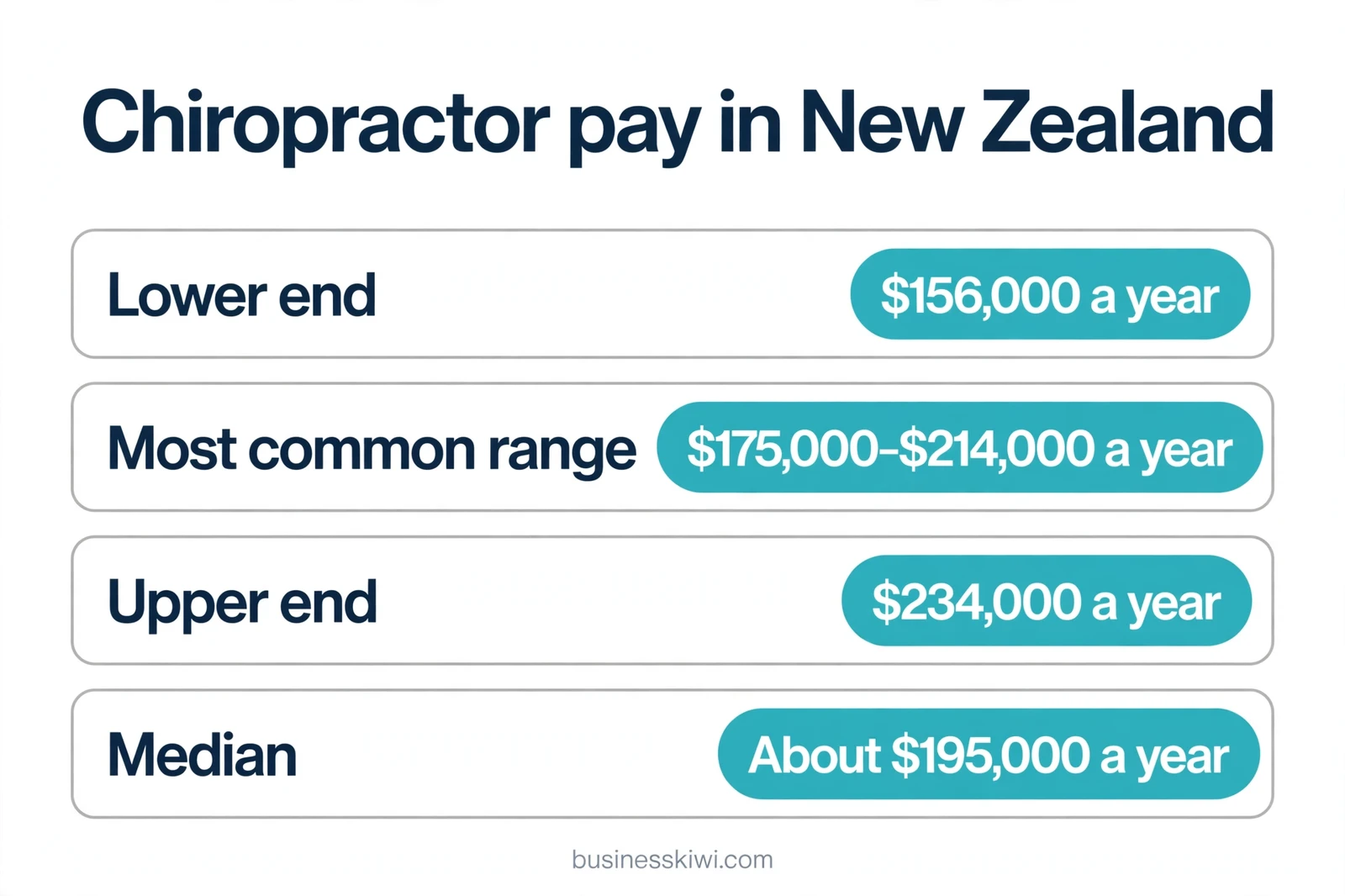
Pay is strong once you are established: Tahatū, the government careers service, lists $156,000 at the lower end, $175,000 to $214,000 as the most common range, and $234,000 at the upper end. This guide covers what the job involves, what you need before you apply, the training path, what it costs, how registration works, and where the career can go.
What a chiropractor actually does
Chiropractors treat people with nerve, muscular and skeletal health problems. They may adjust the spine or joints to treat issues like back and neck pain. The Chiropractic Board describes chiropractic as a primary healthcare profession concerned with the relationship between structure, primarily of the spine, and function, primarily of the nervous system, as that relationship may affect the restoration, preservation and promotion of health and well-being.
A working day in a clinic usually includes questioning, examining and x-raying the patient, discussing methods of care with the patient, adjusting the spine, and advising patients on posture, ergonomics and function. Chiropractors also advise patients on other factors that affect spinal health, such as diet, exercise and lifestyle, and they refer patients to other health care professionals when a problem sits outside their scope. Some chiropractors also do chiropractic work with animals.
The knowledge behind the work is specific. Chiropractors need to know the human body, particularly the spine and nervous system, diseases and illnesses relating to the spine and joints, up-to-date chiropractic information and methods, and radiographic techniques and interpretation. Because most chiropractors are self-employed, they also need business skills: running a clinic means managing bookings, billing, staff and premises as well as treating patients.
Chiropractors usually work regular business hours in private clinics and health centres. Those who support sports teams may work overtime or during weekends. The work is physical, and chiropractors need to be reasonably fit and healthy. It is also a people job: much of the day is spent talking with patients, explaining what is wrong in plain language, and building the trust that keeps patients coming back.

How much do chiropractors earn in NZ
Pay is the first question most people ask, and the honest answer is that it varies a lot. Tahatū publishes the current headline figures for the occupation. The older careers.govt.nz figures, still shown on the Wintec mirror of that data, tell a different story for new graduates. Both are worth knowing, because they describe different stages of the same career.
| What the figure is | Amount | Source |
|---|---|---|
| Lower end of the range | $156,000 a year | Tahatū (tahatu.govt.nz) |
| Most common range | $175,000 to $214,000 a year | Tahatū (tahatu.govt.nz) |
| Upper end of the range | $234,000 a year | Tahatū (tahatu.govt.nz) |
| Median | About $195,000 a year | Tahatū (tahatu.govt.nz) |
| Up to five years’ experience | $49,000 to $60,000 a year | careers.govt.nz (older figures, via Wintec) |
| More than five years’ experience | $60,000 to $150,000 a year | careers.govt.nz (older figures, via Wintec) |
The gap between the two sets of figures is large, and it reflects how the profession is structured. More than 84 percent of chiropractors are self-employed and run their own private practices. A new graduate working as an associate in someone else’s clinic earns far less than an established practitioner who owns a busy practice. Tahatū’s figures describe the occupation as a whole, including practice owners, while the older experience-based bands describe employed chiropractors. Neither set is wrong. They measure different things, and anyone weighing this career should look at both.
What that means in practice is that the first years are lean. A new graduate typically works as an associate, building a patient base and repaying a student loan, before income rises. The financial reward comes later, and it comes with the risks and costs of running a business. Anyone who chooses this path for the pay alone, without an interest in the work itself or in running a practice, is likely to be disappointed in the early years.
What you need before you apply
There is no single school subject that decides whether you get in, but some preparation helps. A tertiary entrance qualification is required to enter further training. The College lists no mandatory school subjects, though Biology, Chemistry, Physics, Health or Physical Education are a good base. Tahatū adds health education and maths to the useful list. The science content of the degree is demanding, so a student who has avoided science at school will find the first year harder than one who has not.
Useful experience is broader than school subjects. Health care work of any kind helps, and so do leadership roles in school, sports clubs or the community. The College is looking for people who can show they understand what the work involves and why they want to do it, not just strong grades.
The personal qualities matter as much as the academic record. Chiropractors need to be patient and understanding, concerned for and wanting to help others, good communicators, motivated, and good at organising and planning their own work. They also need an awareness and understanding of a range of cultures and ages, since patients come from every background. Physical fitness matters too, because adjusting patients is hands-on work done standing up, all day.
There is one legal point worth knowing early. The Children’s Act 2014 (formerly the Vulnerable Children Act 2014) means that if you have certain serious convictions, you cannot be employed in a role where you are responsible for, or work alone with, children. Chiropractors do treat children, so a serious conviction can close off parts of the profession. The Chiropractic Board also checks fitness for registration, including criminal history, before it registers anyone.
The training path, step by step
There is only one route to becoming a chiropractor in New Zealand, and it runs through one institution. The New Zealand College of Chiropractic, established in 1994 and based in Mt Wellington, Auckland, is the only chiropractic training institution in the country. It holds the highest NZQA accreditation rating, Category 1. The qualification is the Bachelor of Chiropractic, a Level 7 degree worth 600 credits, listed on the NZ Qualifications Framework and last reviewed in May 2023.
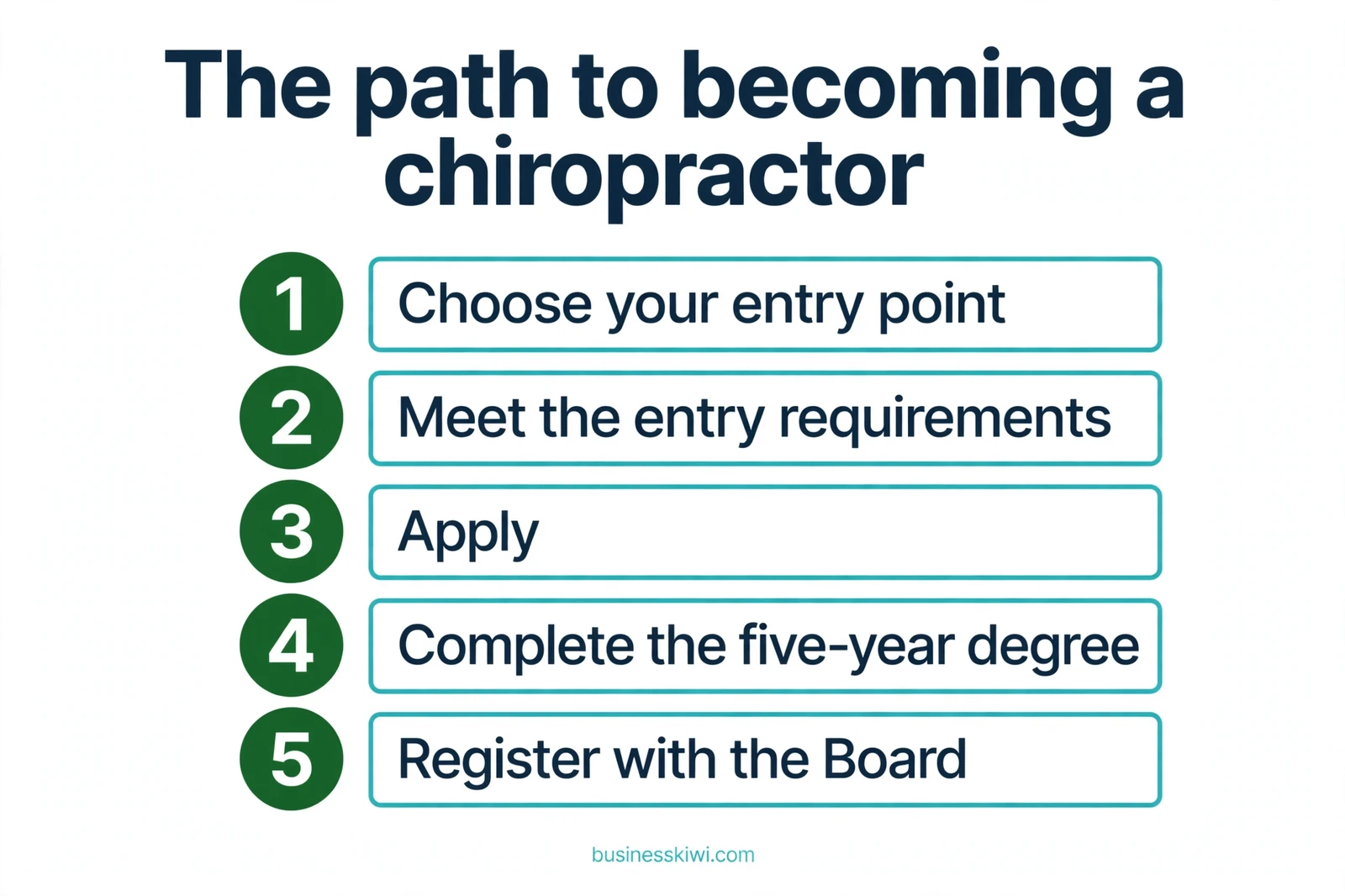
1. Choose your entry point. There are two levels of entry. You can enter at Year 1, the foundation year, and complete the whole five-year programme at the College. Or, if you have already completed approved prerequisite courses at another provider, you can enter at Year 2. The prerequisites for Year 2 entry are 120 credits of study at NZQA level 5: Human Anatomy and Physiology (30 credits), Biochemistry (15 credits), Biophysics (15 credits), Microbiology (15 credits), and three elective courses (45 credits). You do not need a full undergraduate degree to qualify for entry. The College recommends the Diploma in Applied Science (Pre-Chiropractic) at Auckland University of Technology as the prerequisite pathway, and other providers’ courses must be approved by the College first.
2. Meet the entry requirements. For Year 1 entry, school leavers need NCEA Level 3 or equivalent, with a rank score of at least 200. There are no mandatory subjects. Applicants over 20 with work and life experience may be eligible for direct entry if they can show they are able to undertake study at the required level, and they may need to complete distance learning foundation courses in basic science first.
3. Apply. The College has one intake a year, in early February, and accepts applications all year round. Places are limited and enrolment is competitive. The application includes an admissions interview and a 500-word essay on why you are pursuing a career in chiropractic and your current understanding of chiropractic principles. Applicants are expected to have performed well academically and to show a good understanding of chiropractic.
4. Complete the five-year degree. The Bachelor of Chiropractic runs over five years of full-time study, in two semesters a year. Technique classes begin in Year 1, so hands-on work starts from day one. The programme covers the principles and practice of chiropractic, basic science, chiropractic clinical science, and behavioural and social sciences and ethics. In Year 4 you begin your internship in the College’s on-campus Chiropractic Centre, caring for real patients under supervision. Year 5 is spent building confidence in a real-world setting, and you graduate practice-ready. Graduates are eligible to register as chiropractors in New Zealand and to sit registration exams internationally.
Tahatū lists the length of training as four to five years. The five-year figure is the full degree. The four-year figure reflects entry at Year 2, for students who already hold the prerequisite science courses.
What it costs to study
Chiropractic is an expensive degree, and the cost is a real part of the decision. The College publishes its fees a year ahead. For 2027, a full-time domestic student pays $14,160 for Year 1 and $22,320 a year for Years 2 to 5. Worked out from those published annual fees, tuition for the full five years comes to $103,440. On top of that, every student pays a compulsory student services fee of $500 a year, and the College recommends allowing around $1,000 a year for course-related costs such as textbooks, course materials, the Chiropractic Centre manual, special clothing, physical examination equipment and travel.
| Year of study | Domestic tuition (2027) |
|---|---|
| Year 1 (foundation year) | $14,160 a year |
| Years 2 to 5 | $22,320 a year |
| Total tuition, five years | $103,440 |
| Student services fee | $500 a year |
| Course-related costs (recommended allowance) | Around $1,000 a year |
International students pay considerably more: $31,788 for Year 1 and $40,700 a year for Years 2 to 5 in 2027.
Most New Zealand students fund the degree through StudyLink. If you are a New Zealand citizen or resident, you may be eligible for a Student Loan to cover course fees, up to $1,000 a year in course-related costs, and living costs while you study full time. You may also be eligible for a Student Allowance, which you do not have to pay back. The College recommends applying to StudyLink when you apply to the College, so funding is in place before classes begin. The government sets eligibility and loan amounts, and they can change, so check the current StudyLink details before you rely on them. The College also runs a scholarship programme with the New Zealand Chiropractors’ Association.
Registration: the step you cannot skip
A degree alone does not make you a chiropractor. Under the Health Practitioners Competence Assurance Act 2003, it is a legal requirement to be registered by the Chiropractic Board, Te Poari Kaikorohiti o Aotearoa, and to hold a current practising certificate before you can practise. It is illegal to call yourself a chiropractor, use the title of Doctor, or practise as a chiropractor in any capacity, including voluntary work, without being registered and holding a current Annual Practising Certificate.
The Board’s job is to protect public safety and oversee professional and ethical standards in the profession. To register, you must be competent to practise within the scope of practice, hold a prescribed qualification, and be fit for registration. For New Zealand graduates, the prescribed qualification is the Bachelor of Chiropractic from the New Zealand College of Chiropractic. Recent New Zealand graduates are deemed competent for registration.
The application itself is straightforward for a New Zealand graduate. You apply online to the Board once you have completed the degree, with proof of qualification such as a letter of confirmation from the College sent directly to the Board, a transcript, or a degree certificate. You must also provide a current criminal history record from the Ministry of Justice, dated within six months of the Board receiving it, and two professional references from registered chiropractors. For new graduates, references may come from clinic tutors. The Board also checks that you can communicate and comprehend effectively in English. Most complete applications are processed within one to two working days.
The Annual Practising Certificate year runs from 1 April to 31 March. If you register between 1 November and 31 March, you are eligible for a reduced fee. The Board does not publish a fixed fee on its registration pages; it directs applicants to the latest Gazette notice for current fees, so check that before you budget for it.
There are two other routes to registration. Chiropractors trained overseas who graduated from an institution accredited by a member body of the Council on Chiropractic Education International must pass an examination set by the Board, after an assessment run by the Council on Chiropractic Education Australasia. And under the Trans-Tasman Mutual Recognition Act 1997, a chiropractor registered by the Chiropractic Board of Australia can apply for registration in New Zealand.
Overseas-trained chiropractors should also know that the occupation sits on Immigration New Zealand’s Green List. Chiropractor (ANZSCO 252111) is listed as a Tier 1 occupation, with registration with the New Zealand Chiropractic Board and a Bachelor of Chiropractic as the Green List requirements. Tier 1 is the Straight to Residence pathway.
Where the career can go
Most chiropractors work for themselves. More than 84 percent are self-employed and have private practices. The remainder are employed at private practices, natural health care clinics, education institutions as teachers, or chiropractic institutions doing research. Starting out, most new graduates work as associates in an established clinic, building experience and a patient base before deciding whether to stay employed, become a locum, or open their own practice.
The usual career moves are into senior clinical work, practice ownership, or management. Some chiropractors work as locums, covering other practitioners’ clinics around New Zealand or overseas, which suits those who want variety and travel. Postgraduate training opens teaching and research roles, and the College itself employs graduates as tutors and researchers. The most recognised specialisation is chiropractic radiology: chiropractic radiologists diagnose bone disorders from x-rays.
Demand is good. Tahatū rates job opportunities as good and employment change as steady, with about 500 chiropractors working in New Zealand. The 2018 Census counted 504. The number is growing because more New Zealanders are willing to try alternative health care methods, ACC funds chiropractic treatment, modern technology is leading to posture problems, and New Zealanders are ageing and looking for alternatives to treat age-related health problems. The College says its graduates are highly sought after and highly employable on graduation, and its international reputation means the qualification is recognised in many countries.
The business side is not optional for most chiropractors. Because the great majority are self-employed, the skills that decide long-term success include marketing a clinic, managing staff, keeping records, handling ACC claims and insurance billing, and staying on top of tax and compliance. Our guide to registering as a sole trader covers the business structure many new practitioners start with, and our guide to starting your own business covers the wider steps of setting up a practice.

Is it worth it?
It depends on what you want from a career, and it is worth weighing the trade-offs plainly before committing to five years of study and more than $100,000 in tuition.
The case for it is clear. It is a respected primary healthcare profession with strong demand, good job prospects, and a clear path to running your own business. The training is thorough and hands-on from the first year, graduates are employable, and the qualification is recognised internationally. Pay at the established end is high, and the work is varied, independent and directly helpful to people in pain.
The case against it is just as clear. Five years is a long time, the fees are high, and the first years after graduation are lean, with new associates earning far less than the headline figures. More than four in five chiropractors are self-employed, which means income can be uneven and you carry the costs and risks of a business. The work is physical, and your body is your main tool. And the profession sits in a contested space in healthcare: chiropractic’s ideas about health are not accepted by all other health professionals, and you should expect that debate to follow you through your career.
The people who do well are those who are genuinely interested in the work itself, comfortable with hands-on physical work, good with people, and willing to run a business. If that sounds like you, and the cost and length of training do not put you off, it is a solid profession with a short list of competitors and steady demand. If you want a quick qualification, a guaranteed salary, or a large employer with a long career ladder, look elsewhere.
If you are ready to apply, start with the College’s entry requirements and application dates, and put together a strong CV and cover letter for any clinic work you do along the way. Our NZ CV template and cover letter guide set out the format New Zealand employers expect.
For more on jobs and careers in New Zealand, browse the Jobs and Education section.
Frequently asked questions
How long does it take to become a chiropractor in NZ?
Five years of full-time study for the Bachelor of Chiropractic, if you enter at Year 1. If you already hold the prerequisite science courses, you can enter at Year 2, which means four years of study at the College. After graduation you must register with the Chiropractic Board and hold a current Annual Practising Certificate before you can practise.
What qualifications do I need to become a chiropractor in NZ?
You need the Bachelor of Chiropractic from the New Zealand College of Chiropractic, the only institution in the country that teaches it. To enter, school leavers need NCEA Level 3 with a rank score of at least 200, or you can enter at Year 2 with 120 credits of prerequisite science study at NZQA level 5. No full undergraduate degree is required.
How much does it cost to study chiropractic in NZ?
For 2027, domestic tuition is $14,160 for Year 1 and $22,320 a year for Years 2 to 5, which works out to $103,440 for the full five years. Add a $500-a-year student services fee and around $1,000 a year for course costs. Eligible New Zealand students can use a StudyLink Student Loan and may qualify for a Student Allowance.
Do I need to be registered to practise as a chiropractor in NZ?
Yes. Under the Health Practitioners Competence Assurance Act 2003, you must be registered by the Chiropractic Board and hold a current Annual Practising Certificate. It is illegal to call yourself a chiropractor, use the title of Doctor, or practise in any capacity, including voluntary work, without both.
How much do chiropractors earn in NZ?
Tahatū lists $156,000 at the lower end, $175,000 to $214,000 as the most common range, and $234,000 at the upper end, with a median of about $195,000. These figures cover the occupation as a whole, including self-employed practice owners. Older careers.govt.nz figures for employed chiropractors were much lower: $49,000 to $60,000 with up to five years’ experience, and $60,000 to $150,000 with more experience. New graduates working as associates earn far less than established practice owners.
Can I work as a chiropractor overseas with a NZ qualification?
Yes, in many countries. Graduates of the Bachelor of Chiropractic are eligible to sit registration exams internationally, and the College’s international reputation means its graduates are sought after overseas. Each country has its own registration rules, so check the requirements of the country you want to work in before you go.
Is chiropractic on the Green List?
Yes. Chiropractor (ANZSCO 252111) is a Tier 1 occupation on Immigration New Zealand’s Green List, with registration with the New Zealand Chiropractic Board and a Bachelor of Chiropractic as the requirements. Tier 1 is the Straight to Residence pathway.
This guide is general information only. It is not career, legal or immigration advice. Pay, fees, entry requirements and registration rules were checked against the sources named in the article at the time of writing, in November 2026. Fees change from year to year, so check the current pages at the New Zealand College of Chiropractic, the Chiropractic Board, Tahatū and Immigration New Zealand before you apply or enrol.