Au Pairs in New Zealand: A Guide for Host Families and Au Pairs

Hosting an au pair looks, from the outside, like one of the simpler forms of childcare. A young person from overseas moves into your home, helps with the children, and receives a room, meals and weekly pocket money in return. For the au pair, it is a way to live inside a Kiwi family, improve their English and see the country while earning towards their travels.
What surprises many families is how much ordinary New Zealand employment law sits underneath that friendly arrangement. There is no special au pair visa and no special au pair pay rate. Once an au pair starts work in a New Zealand home, the arrangement is employment, with an employer, an employee, a written agreement, minimum wage rules and tax obligations. This guide walks through how it works from both sides: for families thinking of hosting, and for travellers thinking of becoming an au pair here.
What an au pair is, and how the arrangement usually works
An au pair is a young person from overseas who lives with a New Zealand family and provides childcare in the family home. The idea grew out of cultural exchange rather than ordinary hiring: the au pair becomes part of the household, shares meals and family routines, and helps with the children and light child-related housework in return for board, lodging and a weekly wage, called pocket money.
Typical duties wrap around the children: getting them up, dressed and fed, school and kindergarten runs, supervising play and homework, preparing the children’s meals, and tidying up after them. Placements are usually measured in months. Au Pair Link, New Zealand’s largest au pair agency, works on placements of 6 to 12 months, with au pairs working 20 to 40 hours a week depending on the family.
Families who host tend to be those whose needs do not fit centre hours: parents who start early or finish late, or families with several children of different ages. The au pair gets a base, a family and a supported way into New Zealand life, which is why agencies talk about matching and cultural fit as much as hours and pay.
Au pair or nanny: what is the difference?
In everyday language the two words overlap, but they describe different starting points. A nanny is a childcare worker hired for the job itself, often with qualifications or substantial experience, and usually already living in New Zealand. An au pair is defined by the exchange element: they have come from overseas, they live in, and the role is time-limited by their visa.
Legally, though, the distinction matters far less than most people expect. Neither Immigration New Zealand nor Employment New Zealand operates a separate legal category for au pairs. Inland Revenue’s guidance for private domestic workers names nannies expressly, and au pairs working in a family home sit in the same territory: a person working in your home, under your direction, for pay.

The visa position: there is no au pair visa
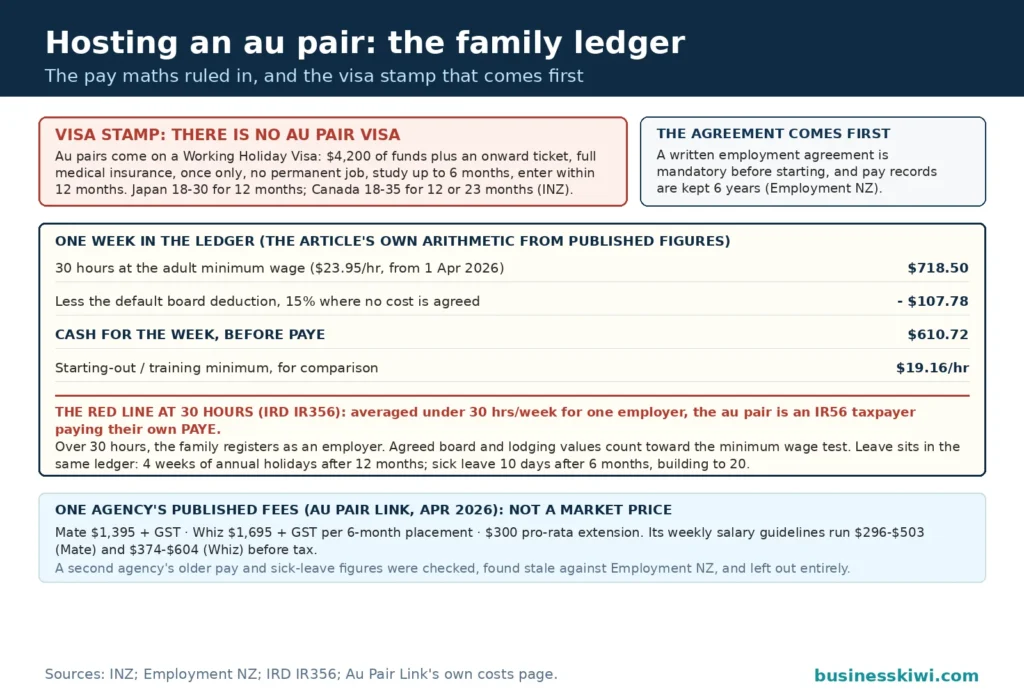
The first thing both sides need to understand is that New Zealand has no au pair visa. Immigration New Zealand does not offer one, and no agency can arrange one. Au pairs come here under the Working Holiday scheme, and everything about their stay flows from that visa’s conditions.
Working holiday visas rest on reciprocal agreements between New Zealand and a range of countries. Immigration New Zealand publishes a separate page for each country’s scheme, and the details differ between them, so the page for your own country is the one that counts. The common shape of the scheme looks like this:
- Applicants are young adults. Many schemes are open to people aged 18 to 30; some, including Canada’s, run from 18 to 35.
- The standard stay is up to 12 months. A small number of schemes allow longer; Canadians can apply for 12 or 23 months.
- You do not need a job offer to apply, and you can only ever be granted a New Zealand working holiday visa once.
- You must show at least NZD $4,200 to live on, plus a ticket home or the money to buy one, and hold full medical insurance for your stay.
- You can work in temporary jobs, study or train for up to 6 months in total, and travel in and out of New Zealand while the visa is valid. You cannot take a permanent job or run a business as its owner.
Two consequences matter for placements. First, because the visa is built around temporary work and travel, a placement is naturally time-limited, and some country schemes also limit how long you can spend with a single employer, so check your own country’s page before committing to a long placement. Second, the visa belongs to the au pair, not the family: a host family cannot sponsor an au pair or extend their stay.
Host families should sight the au pair’s visa and check its expiry date before the start date, and an au pair should never start work on a visitor visa or before their working holiday visa is granted.
The employment position: an au pair is an employee
This is the part of au pairing in New Zealand that catches people out, because the homely language of pocket money and joining the family makes the arrangement feel informal. Employment New Zealand’s position, which applies to everyone working here, is that the reality of the relationship decides what someone is, not the label the parties choose. Employees work for you, under your direction; contractors are self-employed people running their own business who invoice for their work. The legal tests look at the actual situation on the ground.
An au pair lives in the employer’s home, works the hours the family sets, cares for the family’s children using the family’s things, and is paid a regular weekly amount. On any realistic view that is employment. Employment New Zealand confirms that migrant workers here have the same minimum employment rights as New Zealand workers, including at least the minimum wage, and runs a free reporting line, 0800 20 90 20, for anyone who believes they are paid less.
Being an employee means the standard framework applies to the household:
- The au pair must be given a written employment agreement. Employment New Zealand states that every employee must have one, and that both sides should sign it before the employee starts work.
- The au pair must be paid at least the minimum wage for every hour worked.
- The au pair is entitled to holidays and leave on the same basis as any other employee, covered below.
- The family must keep proper records: wages, time, holidays and leave for each employee, kept for 6 years. Wage records must show the pay due before any deduction for accommodation.
- The family takes on tax duties as an employer, covered in the tax section below.
None of this is optional because the workplace is a spare bedroom rather than an office, and none of it can be signed away. An agreement offering less than the legal minimums does not become valid because both parties were happy with it at the time.

Pay: how pocket money, board and lodging fit together
“Pocket money” is the phrase the au pair world uses, but in New Zealand law the weekly payment is wages. Employment New Zealand’s rules are plain. Wages must be paid in money; an employer cannot substitute benefits for cash, except that deductions the employee has agreed to, for things like accommodation, can form part of the picture. Where accommodation is part of a pay package and the employee has agreed to its cost coming out of their wages, that agreed amount counts when working out whether the minimum wage has been met. Under the Minimum Wage Act 1983, “board” means accommodation and meals together; “lodging” means accommodation only.
The practical mechanics for a host family are these:
- Start with hours. Every hour worked must be paid at no less than the minimum wage. The adult minimum wage is $23.95 an hour from 1 April 2026. The starting-out rate of $19.16 an hour applies only in narrow situations, such as a 16 or 17 year old in their first 6 months with an employer, and a role that includes supervising others cannot be paid at the starting-out or training rate at all. Rates are reviewed each year and change on 1 April.
- Agree the value of board or lodging, and record it. The arrangement and its cost should be spelled out, the cost should be reasonable, and the arrangement should be separate from the employment agreement or able to be separated from it. If there is no agreement on the cost, Employment New Zealand says the employer can deduct 15 percent of wages, calculated at the relevant minimum wage rate, for board, or 5 percent for lodging.
- Pay the balance in money, every week, in full. The minimum wage must be met for each hour worked and cannot be averaged out over a season or a longer period.
Agency pay tables need the same care. Au Pair Link publishes pre-tax weekly salary guidelines: for its Mate programme, $296 for 20 hours rising to $503 for 40 hours, and for its more experienced Whiz programme, $374 to $604 across the same hours, including a $20 a week completion bonus after 6 months. Au Pair Link states that the combined value of the weekly payment, accommodation and meals must meet minimum wage requirements and be paid in full each week regardless of the childcare hours provided. Those are one agency’s guidelines, not legal rates. The legal test is always Employment New Zealand’s: hours worked, minimum wage, agreed board value, cash paid.
Also note that employer superannuation contributions, such as KiwiSaver employer contributions, must be paid on top of at least the minimum wage; they cannot be folded into it to make the numbers work.
Hours, evenings and overnight presence
Live-in arrangements blur the line between being at work and being at home, and families often ask whether an au pair who sleeps in the house while the parents are out is working all night. Employment New Zealand does not publish an au pair specific rule on on-call or overnight hours, and this guide will not invent one. What it does say is that payments for callouts should be negotiated and recorded in the employment agreement.
So deal with it on paper before the placement starts: define the working hours and what counts as evening duty, agree how callouts or extra hours are paid, and keep the time records Employment New Zealand requires.
Holidays and leave
An au pair accrues the same leave entitlements as any other employee.
Annual holidays are 4 weeks of paid leave after each 12 months of continuous employment. Many placements end before the 12-month mark, and Employment New Zealand’s guidance covers that: in limited cases an employee can agree to be paid holiday pay as they go, at no less than 8 percent of gross earnings on top of their usual pay, instead of taking holidays themselves. That pay-as-you-go option is only available on a fixed-term agreement of less than 12 months, or where work is so irregular that providing 4 weeks of holidays is impractical, and it must be genuinely agreed. When employment ends, unused entitlements are paid out in final pay. Agencies commonly pace holidays across a placement; Au Pair New Zealand, for example, describes its au pairs taking holidays progressively rather than in one block at the end.
Sick leave is 10 days a year once the employee has been working continuously for 6 months, or has worked over a 6-month period for an average of at least 10 hours a week with at least 1 hour in every week or 40 hours in every month. Unused sick leave can accumulate up to 20 days. Public holidays that fall on a day the au pair would otherwise have worked are also part of the standard framework.
Tax: the family as employer, and the IR56 exception
Somebody has to run PAYE on an au pair’s wages. There are two routes, and the dividing line is hours.
The default route is that the host family registers with Inland Revenue as an employer. The family deducts PAYE from the au pair’s pay, along with anything else that applies, such as student loan repayments or KiwiSaver deductions if the au pair is enrolled, files employment information and pays the deductions to Inland Revenue. Inland Revenue’s own example in its IR56 guide, IR356, makes the point with a nanny: a nanny working 8 hours a day, Monday to Friday, for one employer is outside the part-time scheme because she works more than 30 hours a week for that employer, and her employer must register as an employer.
The exception is the IR56 scheme for private domestic workers. Inland Revenue defines a private domestic worker as someone who works in the employer’s private home, doing work unrelated to the employer’s business, is paid directly by the employer, and does not work full-time for any one employer, meaning less than 30 hours a week on average for that employer. Nannies are named in the guide as an example. A part-time au pair who fits that definition registers with Inland Revenue as an IR56 worker and takes responsibility for their own PAYE: choosing a tax code, calculating and paying their deductions monthly, and filing monthly employment information returns. IR56 workers are employees, not self-employed, a point Inland Revenue states expressly. The guide also covers the ACC levies applying to IR56 income, and notes a private domestic worker can choose to make KiwiSaver compulsory employer contributions themselves, on top of their own deductions.
Whichever route applies, the au pair needs an IRD number; Immigration New Zealand’s working holiday pages make the same point, that everyone who works here pays tax on what they earn and needs an IRD number to do it. Families using an agency often get payroll help as part of the service; Au Pair Link includes employment agreement and payroll advice in its programme fees. Families arranging things privately carry the registration and filing duties themselves.
Board and lodging also have a tax dimension, and Employment New Zealand advises both sides to get their own advice on the tax implications of accommodation deductions.
Arranging a placement: agencies and private arrangements
Most au pairs in New Zealand are placed through agencies. An agency recruits and screens au pairs overseas through partner organisations, matches them with families, and supports the placement while it runs. Au Pair Link describes screening that includes references and verified medical and police checks, with families interviewing shortlisted candidates before a match is made. Its published programme fees, as at October 2026, are $1,395 plus GST for its Mate programme and $1,695 plus GST for its Whiz programme, each for a 6-month placement, with no registration fee, an optional extension of up to 12 months for $300 calculated pro-rata, and a free rematch or refund guarantee if a placement fails early despite mediation. Au Pair New Zealand similarly supplies the written family contract, covering start and end dates, weekly hours, net weekly pocket money, holidays, sick leave and notice, with 4 weeks’ notice on either side if a placement breaks down.
Those fees buy screening, matching, the agreement paperwork, payroll advice and support during the placement. They do not buy a visa, and they do not transfer the family’s legal duties: the family remains the employer whichever route it takes.
Private arrangements, through matching websites, social media or word of mouth, carry no agency fee, but everything the agency would have done lands on the two parties. The family should run its own reference checks, ask for police vetting and a medical clearance, and verify the visa personally. The au pair should verify the family just as carefully and insist on the written agreement before travelling. Immigration New Zealand may also ask a working holiday applicant for police certificates, so expect background checking at both ends.
Two practical points round out the picture. Insurance: Immigration New Zealand requires working holiday makers to hold full medical insurance for their stay. ACC covers injuries in New Zealand for visitors as well as residents, but as Au Pair New Zealand points out to its families, ACC is not travel insurance: it does not cover illness, disrupted travel or an emergency flight home, so au pairs are advised to carry health and travel insurance from home. Driving: many au pairs are expected to drive children to school and activities, but no official source relied on for this guide publishes au pair specific driving rules, so settle it expressly: check the au pair’s licence, talk to your insurer about the family car, and put the arrangement in writing.
For au pairs: how to check an arrangement is lawful
If you are coming to New Zealand as an au pair, the checks are straightforward, and a good family will expect them.
- You have a written employment agreement, given to you with time to read it and get advice before you start, signed by you and the family.
- Your agreement states your hours and your pay, and the value placed on your board and lodging is written down.
- Your pay each week, counting any agreed board or lodging deduction the way Employment New Zealand describes, is at least the minimum wage for the hours you actually worked. Keep your own record of your hours; your employer must keep wage and time records for 6 years, and you can ask about your time, pay and leave.
- Tax is being handled properly, either by the family as a registered employer or by you under the IR56 scheme if you are a part-time private domestic worker, and you have an IRD number.
If something is wrong, Employment New Zealand is the place to go. It provides free help to employees and employers, including early resolution and mediation, and its minimum wage guidance invites anyone who thinks they are paid less than the minimum wage to report it on 0800 20 90 20, where concerns are handled in a safe environment. Being on a working holiday visa does not reduce your employment rights.
Frequently asked questions
Is there an au pair visa for New Zealand?
No. Immigration New Zealand has no au pair visa. Au pairs work here on a working holiday visa, under the scheme for their own country, with the age limits, stay length and conditions that scheme sets. If you are not eligible for a working holiday visa, there is no au pair route around that.
Is an au pair an employee or a contractor?
An employee. An au pair works in the family’s home, at the family’s direction, for regular weekly pay, which is employment under the tests Employment New Zealand applies. Calling the payment pocket money, or the au pair a contractor, does not change the legal reality, and Inland Revenue’s IR56 guide states that even its part-time domestic workers are employees, not self-employed.
How much should an au pair be paid?
At least the minimum wage for every hour worked: $23.95 an hour for an adult from 1 April 2026. Where board or lodging is part of the package, an agreed value for it counts towards that total and the rest must be paid in money. If no value has been agreed, Employment New Zealand’s defaults are a deduction of 15 percent of wages at the minimum wage rate for board, or 5 percent for lodging. Agency salary tables, such as Au Pair Link’s published weekly guidelines, are programme guidelines only and do not replace the legal test.
Does a host family have to register as an employer and deal with tax?
Usually, yes. A family whose au pair works more than 30 hours a week for them must register with Inland Revenue as an employer and deduct and pay PAYE. The exception is the IR56 scheme: a private domestic worker who works less than 30 hours a week on average for one employer, in the home and paid directly, registers as an IR56 worker and pays their own PAYE instead. Either way the tax is accounted for; only who files it changes.
What holidays and leave does an au pair get?
The standard employee entitlements. Annual holidays are 4 weeks after 12 months of continuous employment, with an 8 percent pay-as-you-go option available by agreement for fixed-term arrangements under 12 months, and unused entitlements paid out in final pay. Sick leave is 10 days a year after 6 months. Public holidays on otherwise working days are also covered.
How much does it cost to use an au pair agency?
Each agency’s own published fees are the only reliable guide. Au Pair Link, as at October 2026, charges $1,395 plus GST for its Mate programme and $1,695 plus GST for its Whiz programme, each for a 6-month placement with no registration fee, covering screening and police and medical checks, matching, an employment agreement and payroll advice, and a rematch guarantee. The family’s ongoing costs, wages, tax and board, sit on top of the agency fee.
What if the au pair is needed overnight or on call?
There is no published au pair specific rule on overnight or on-call hours in Employment New Zealand’s guidance. Its minimum wage guidance says payments for callouts should be negotiated and put in the employment agreement. Agree the hours, define what overnight duty means, attach a payment, and keep time records.
Can an au pair work for more than one family?
A working holiday visa allows temporary work and does not tie the holder to one employer, so part-time work for more than one household is possible within the visa’s conditions, and some country schemes limit time with a single employer. For tax, Inland Revenue’s IR56 rules look at hours per employer: under 30 hours a week on average for each employer keeps a private domestic worker in the IR56 scheme even if combined hours are full-time.
Sources
- Immigration New Zealand, Japan Working Holiday Visa (immigration.govt.nz)
- Immigration New Zealand, Canada Working Holiday Visa (immigration.govt.nz)
- Employment New Zealand, Minimum wage rates and types (employment.govt.nz)
- Employment New Zealand, Hiring your first employee (employment.govt.nz)
- Employment New Zealand, Taking annual holidays (employment.govt.nz)
- Employment New Zealand, Taking sick leave (employment.govt.nz)
- Inland Revenue, IR56 workers: IR356 guide, February 2026 edition (ird.govt.nz)
- Au Pair Link, Host Family Costs in New Zealand (aupairlink.co.nz)
- Au Pair New Zealand, Obligations as an employer (aupairnewzealand.co.nz)
This article is general information about how au pair arrangements work in New Zealand, based on the official guidance published by Immigration New Zealand, Employment New Zealand and Inland Revenue, and on the published programme information of the agencies named. It is not legal, tax or immigration advice for your particular situation. Visa conditions, minimum wage rates and agency fees change over time, so check the current position with Immigration New Zealand, Employment New Zealand or Inland Revenue, or take professional advice, before relying on it.