Avondale Christian Kindergarten: Fees, Hours and What Parents Need to Know
Avondale Christian Kindergarten has been part of its West Auckland neighbourhood for more than 40 years. It sits on St Georges Road in Avondale, on the grounds of a small primary school, and it operates as a community early learning centre with an explicitly Christian character. For parents weighing it up against the other options in the area, the practical questions are usually the same: what does it cost, what hours can a child actually attend, and what did the Education Review Office make of the place at its most recent visit?
This profile pulls those answers together from the official record. The details come from the Ministry of Education’s Education Counts directory, the kindergarten’s own website, and the Education Review Office (ERO) Akarangi quality evaluation report published in April 2026. Where a figure parents often ask about is not published by any of those sources, this article says so rather than guessing.
Avondale Christian Kindergarten at a glance
One figure is missing from that table because no official source publishes it: the kindergarten’s Equity Index (EQI) rating does not appear in the Education Counts profile, the ERO report or the kindergarten’s own pages read for this profile, so it is not stated here.
A community kindergarten governed by the local Reformed Church
Avondale Christian Kindergarten is governed by the Trust Board of the Reformed Church of Avondale. ERO’s April 2026 report describes a board whose members represent the local community and include a parent representative, and it notes that the board is kept well informed through monthly reports from the centre manager covering both operations and curriculum priorities. The kindergarten describes itself as a community early learning centre, and that community flavour runs through its staffing as well. Its manager, Ann Hunt, first arrived at the kindergarten as a parent 39 years ago, sent her own five sons there, and has managed the centre since February 2015.
Longevity is a theme. The kindergarten says it has served the community for over 40 years, and its ERO report records a roll drawn from a wide range of ethnic and cultural backgrounds. In April 2026 ERO recorded the roll as 58 children, with the largest groups being NZ European and Pākehā children (25 percent), Ethiopian (13 percent), Samoan (12 percent), Tongan (9 percent) and Indian (8 percent), alongside Māori children at 5 percent and smaller groups including African, Niuean and Filipino families. That mix matters for how the centre runs day to day, and it shows up in the teaching team’s own languages, which include Samoan, Hindi, Gujarati and Marathi.
Although the roll sits at 58, the licence caps attendance at 50 children at any one time, and the service takes no children under the age of two. Education Counts records the service as providing for two-year-olds and over, while the kindergarten’s own FAQ tells parents it takes children from the age of two and a half. Parents of a young two-year-old should check the current position with the centre, because the two official statements do not line up exactly.
The Christian character: what it means in practice
This is not a kindergarten with a faith label on the sign and little behind it. The philosophy statement on the kindergarten’s website says every child is regarded as a gift created by God, and that the early childhood curriculum, Te Whāriki, is deliberately underpinned by Christian values and beliefs. Spiritual development sits at the core of its philosophy, woven together with children’s cognitive, social, cultural, physical and emotional development, and its centre vision describes the graduate it hopes to send on to school: a child who is emotionally stable, sees themselves as a capable and competent learner, and is secure in who they have been made to be.
ERO tested that philosophy against practice in its April 2026 evaluation and found it holds up. The evaluators reported that the integration of Christian values is well embedded through the curriculum, and that a daily Bible story reading is part of the programme, supporting children’s early literacy as well as the centre’s faith focus. Curriculum planning and the teachers’ professional growth cycle both align with the Christian values and with the strands and principles of Te Whāriki.
For parents, the practical reading is straightforward. Faith is part of the daily rhythm here, not an optional extra, and the kindergarten is upfront about that in everything it publishes. Families who do not share the faith will want to talk with the manager about how that feels in practice before enrolling. The philosophy also commits the kindergarten to valuing the different cultural backgrounds and values that families bring, and to teaching te reo Māori and tikanga Māori through what it calls a biblical lens.

The programme: Te Whāriki with an individual plan for every child
Avondale Christian Kindergarten follows Te Whāriki, the New Zealand early childhood curriculum, and builds an individual learning plan for each child. According to its Teaching and Learning page, teachers develop that plan together with parents, based on the child’s own interests, and then weave in the learning the centre values most. That valued learning is broad: social skills and self-help skills, kindness and consideration for others and the environment, imagination and creativity, growing independence, early numeracy and literacy, communication skills, perseverance and problem solving, and the habits of mind the centre calls dispositions for lifelong learning, such as self-control, courage and curiosity. It also names tuakana teina, the idea of children being both learners and teachers to one another.
The day itself mixes structure with freedom. The kindergarten’s FAQ describes a programme that balances structured and non-structured experiences, combining mat times, small and large group activities, and periods of free play. ERO’s evaluators described a rich, well-embedded curriculum in April 2026. They found children had access to a wide range of learning opportunities indoors and outdoors, in environments intentionally designed to support independence and choice, and they noted close, trusting relationships between children and teachers. Planning and assessment for individual children makes links to the learning outcomes of Te Whāriki, and teachers work in partnership with parents and the child to set a planning focus that reflects each child’s strengths and interests.
The environment is part of the pitch. The kindergarten says its indoor and outdoor spaces are set up intentionally to create a sense of wonder and curiosity, and teachers review the environment regularly. Support reaches beyond the teaching team when a child needs it: ERO recorded that leaders and teachers work with external agencies and community groups, including a speech-language therapist, family support personnel and additional teacher aides for children with additional needs.
Parents are treated as partners in the planning, not just kept informed. The individual plan for each child is built with the family around the child’s interests, and the centre’s philosophy stresses strong links between home and kindergarten so that learning pathways continue in both places. Its statement of valued learning includes two small but telling items: that each child knows they are valued at kindergarten, and that children grow in physical self-confidence. ERO’s evaluators picked up the same thread from the other side, finding that the philosophy is clearly reflected in teacher practice and documentation, and that curriculum planning aligns with both the Christian values and the principles of Te Whāriki. In other words, the written philosophy and the observed programme match, which is not something every centre can claim when ERO comes to check.
Hours, sessions and term dates
The kindergarten is open from 8:00am to 4:30pm on weekdays during school terms, and it closes for the school holidays so children and teachers come back refreshed. Rather than fixed sessions, families choose from a menu of start and finish times. Start times are 8:00am, 8:30am, 8:45am and 12:30pm. Finish times are 11:45am, 12:30pm, 3:30pm, 4:00pm and 4:30pm. The kindergarten gives three common patterns as examples: a morning session from 8:45am to 11:45am or 12:30pm, a short day from 8:30am to 3:30pm, and a long day from 8:00am to 4:30pm. Half-day and full-day attendance can be mixed across the week to suit the family.
For 2026, the kindergarten’s published term dates are:
Two practical points from the kindergarten’s own FAQ are worth knowing before you start. Children bring their own healthy packed lunch, plus fruit to share for morning and afternoon tea. And children do not need to be toilet trained: those still in nappies are welcome, and the teachers will work with the family on toilet training when the time is right.
Fees and 20 Hours ECE
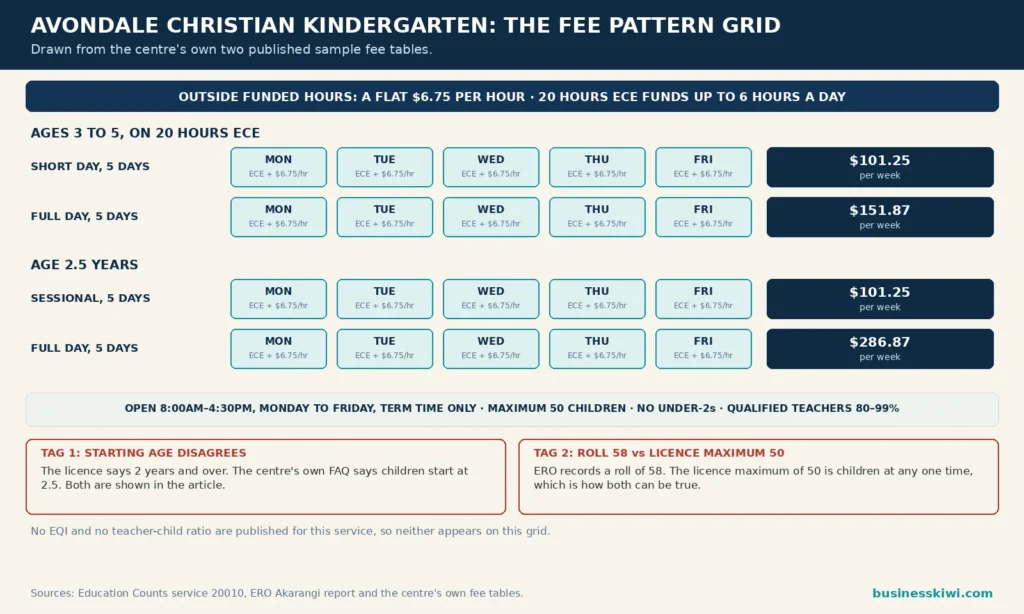
Avondale Christian Kindergarten offers 20 Hours ECE, the government scheme that funds up to 20 hours a week of early childhood education for three, four and five year olds, with a maximum of six funded hours in any one day. Education Counts confirms the service offers the scheme. Hours beyond the funded ones are charged at a flat rate of $6.75 per hour, and the kindergarten notes that Work and Income (WINZ) subsidies are available for families who qualify.
Because sessional and morning patterns fit inside the funded hours, many three to five year olds attend those patterns at no cost. The kindergarten publishes sample weekly fees on its website. For three, four and five year olds using 20 Hours ECE, the samples are:
Children under three do not qualify for 20 Hours ECE, so two and a half year olds are charged at the standard hourly rate across all their hours. The kindergarten’s published samples for two and a half year olds are:
Treat these as samples, exactly as the kindergarten labels them. If the hours you want differ from the patterns in the tables, the centre asks you to talk with Ann or with Mana, its administrator, and fees and funded hours change over time, so confirm the current figures when you visit. One more detail parents often miss: the six-hour daily cap on funded hours means a long day of eight and a half hours always includes some charged time, even for a four year old using the full 20 Hours ECE.
The third birthday is the single biggest fee event in a child’s time at the kindergarten. A two and a half year old attending full days, five days a week, samples at $286.87 a week because every hour is charged. Once that child turns three and the 20 Hours ECE funding starts, the identical pattern samples at $151.87 a week, and shorter patterns fall further or become free. Families budgeting for a start before age three should plan for that step down rather than assuming the first fee they pay is the fee they will pay throughout.
What ERO found in April 2026
The most recent ERO evaluation is an Akarangi quality evaluation, with the review team on site in December 2025 and the confirmed report dated 20 April 2026. Akarangi is ERO’s current framework for early childhood services. It judges how well a service’s learning and organisational conditions support equitable and excellent outcomes for all children, and it separately considers children’s health and safety, where ERO recorded that the kindergarten is taking reasonable steps.
The report is a positive one. On learning conditions, ERO found that teachers implement a rich, well-embedded curriculum that promotes children’s exploration, decision making and positive relationships. Children experience close, trusting relationships with teachers and kind friendships with each other, which ERO linked to growing social and emotional competency, and teachers use a wide range of intentional strategies to extend children’s thinking and communication. Professional learning is a strength: leaders and teachers make ongoing improvements supported by targeted professional development, a systematic professional growth process and regular mentoring.
On organisational conditions, ERO found leadership and teaching practices developing strength through an embedded collaborative culture, with leaders demonstrating relational trust. Governance came in for measured praise: the board provides strong governance, the strategic plan links clearly to an annual plan, and monthly manager reports keep board members well informed. The main weakness ERO identified sits in the same area. Internal evaluation is improvement-focused, but leaders and teachers do not yet clearly assess the effectiveness and impact of their actions on outcomes for learners, and limited monitoring of the strategic plan reduces their ability to measure progress.
Progress since the previous Akarangi evaluation in December 2021 has been good. That report set two quality improvement actions: deepening teachers’ knowledge of how to support children’s social and emotional development, and consistently monitoring all processes against licensing criteria and early childhood regulations. ERO found good progress on both, with extensive professional learning clearly visible in teaching practice and documentation.
ERO also named where the kindergarten goes next. Two actions will feed into its quality improvement planning: improving monitoring and evaluation so the impact of changes on children’s learning is clearly demonstrated, including for groups of children, and increasing teachers’ use of te reo Māori and tikanga Māori in daily practice. On the second point, ERO noted that leaders and teachers are already building cultural capability through some kupu Māori, waiata and basic tikanga practices, and continue to develop confidence in using te reo Māori meaningfully through the day. Earlier ERO reports for the service date from December 2021 and May 2017, and all are linked from the kindergarten’s website.
The team
Day to day, the centre is led by manager Ann Hunt, with team leader Kirsten Alger, who holds a Bachelor of Teaching in early childhood education. The teaching team listed on the kindergarten’s website includes teachers holding ECE degrees and graduate diplomas, among them a teacher with close to three decades of teaching experience, alongside a teacher assistant, an administrator and a dedicated family support person whose role is to partner with and encourage parents. ERO recorded that between 80 and 99 percent of the teaching team are qualified teachers. That qualified proportion, rather than any exact staffing ratio, is the figure the official sources publish: neither the ERO report nor the kindergarten’s website states a specific adult to child ratio, so none is quoted here.
Enrolling: what to do next
The kindergarten keeps enrolment personal. Its advice is to phone Ann, the manager, on 09 828 3222 for a chat about your child’s needs, and to arrange a time to visit and look around. Enquiries can also go by email to admin@ackindy.org, and an enrolment form is available from the centre and linked from the enrolment page of its website.
A few questions are worth asking on that visit. Ask how places are looking for your preferred days, because attendance is capped at 50 children at any one time and session patterns are popular at different times of the year. Ask the centre to work through the fee for your child’s exact pattern of hours, including how the six-hour daily cap on 20 Hours ECE applies across your chosen days, and whether a WINZ subsidy might apply to your family. And ask about the starting age for your child, given the difference between the licensed age of two and the two and a half starting age in the kindergarten’s FAQ. If faith is a consideration either way, that visit is also the moment to talk honestly about the Christian character of the programme and how it will sit with your family.
Frequently asked questions
Where is Avondale Christian Kindergarten?
It is at 63 St Georges Road in Avondale, Auckland, on the grounds of a small primary school. The Ministry of Education service number is 20010, and the phone number is 09 828 3222.
What ages does Avondale Christian Kindergarten take?
The service is licensed for children aged two and over, with no children under two, and its own FAQ says it takes children from the age of two and a half. Children usually stay until they start school at five.
What are the opening hours?
The kindergarten is open from 8:00am to 4:30pm, Monday to Friday, during school terms. It closes for the school holidays. Families choose start and finish times within the day rather than attending for the whole span.
How much does Avondale Christian Kindergarten cost?
Hours outside the 20 Hours ECE funding are charged at a flat $6.75 per hour. For three, four and five year olds, sessional and morning patterns are free, a short day over five days samples at $101.25 a week, and a full day over five days samples at $151.87 a week. Two and a half year olds, who are not yet eligible for the funding, sample at $101.25 a week for a sessional pattern over five days and $286.87 for full days over five days. These are the kindergarten’s published samples, so confirm your own pattern with the centre.
Does it offer 20 Hours ECE?
Yes. Education Counts records the service as offering 20 Hours ECE, and the kindergarten applies it to all three, four and five year olds, up to 20 hours a week and no more than six hours in a day.
Does my child need to be toilet trained before starting?
No. The kindergarten’s FAQ says children still in nappies are welcome, and the teachers will work together with the family on toilet training at the appropriate time.
What did ERO say about Avondale Christian Kindergarten?
ERO’s Akarangi quality evaluation report, dated 20 April 2026, found a rich, well-embedded curriculum, close and trusting relationships, strong governance and good progress on the actions set in 2021. It recorded the service as taking reasonable steps on children’s health and safety, and set two next steps: clearer evaluation of the impact of improvements on children’s learning, and more te reo Māori and tikanga Māori in daily practice.
How do I enrol my child?
Phone the manager, Ann, on 09 828 3222, or email admin@ackindy.org. The kindergarten invites parents to arrange a visit, talk through their child’s needs, and complete an enrolment form. It is worth asking about availability for your preferred days, because attendance is capped at 50 children at any one time.
Sources
- Ministry of Education, Education Counts, Avondale Christian Kindergarten: Profile and Contact Details: https://www.educationcounts.govt.nz/find-an-els/els/profile-and-contact-details?district=7611&ece=20010®ion=2
- Avondale Christian Kindergarten, Home: https://www.ackindy.org/
- Avondale Christian Kindergarten, Why Choose Us?: https://www.ackindy.org/why-choose-us/
- Avondale Christian Kindergarten, Philosophy: https://www.ackindy.org/why-choose-us/philosophy/
- Avondale Christian Kindergarten, Teaching & Learning: https://www.ackindy.org/teaching-and-learning/
- Avondale Christian Kindergarten, Session Times: https://www.ackindy.org/why-choose-us/session-times/
- Avondale Christian Kindergarten, Fees: https://www.ackindy.org/fees/
- Avondale Christian Kindergarten, Early Learning FAQ: https://www.ackindy.org/early-learning-faq/
- Avondale Christian Kindergarten, Enrolment: https://www.ackindy.org/enrolment/
- Avondale Christian Kindergarten, The Team: https://www.ackindy.org/the-team/
- Education Review Office, ERO Akarangi Quality Evaluation Report for Avondale Christian Kindergarten, April 2026: https://www.ackindy.org/wp-content/uploads/2026-Confirmed-Akarangi-Quality-Evaluation-Report-ACK-20010-200426.pdf
This article is general information about Avondale Christian Kindergarten, drawn from the official sources listed above at the time of writing. Fees, hours, term dates and staffing change over time, and ERO reports reflect the service as it was when the review team visited. Confirm the details that matter to your family directly with the kindergarten before making enrolment decisions.