Commercial Ice Cream Machines in NZ: Types, Costs and What to Check Before You Buy
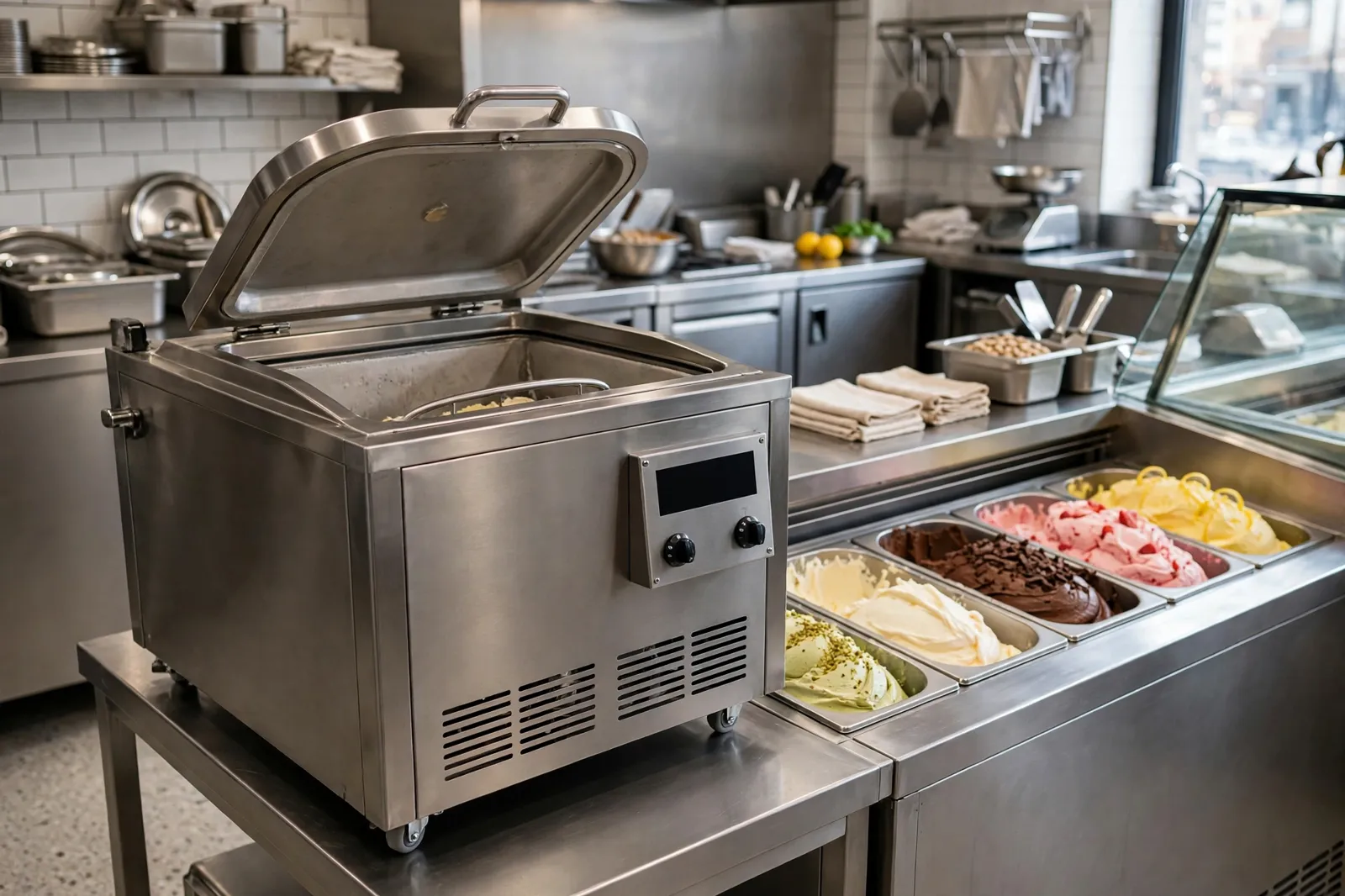
A commercial ice cream machine is one of those purchases that looks simple from the outside and turns out to be anything but. The machines sold to New Zealand cafes, gelato shops, dairies, food trucks and dessert bars range from a countertop soft serve unit that one person can run all day, through to floor standing batch freezers that anchor a full gelato production kitchen. Prices, power requirements, cleaning routines and output figures differ just as widely, and the headline numbers on a product page only make sense once you know what they measure.
This guide works through the main types of commercial ice cream machine sold in New Zealand, how to read capacity and output figures, what to check about power, space and installation, the cleaning and food safety obligations that come with selling ice cream, and what named machines actually cost on the sellers’ own New Zealand pages.
How commercial machines differ from domestic ones
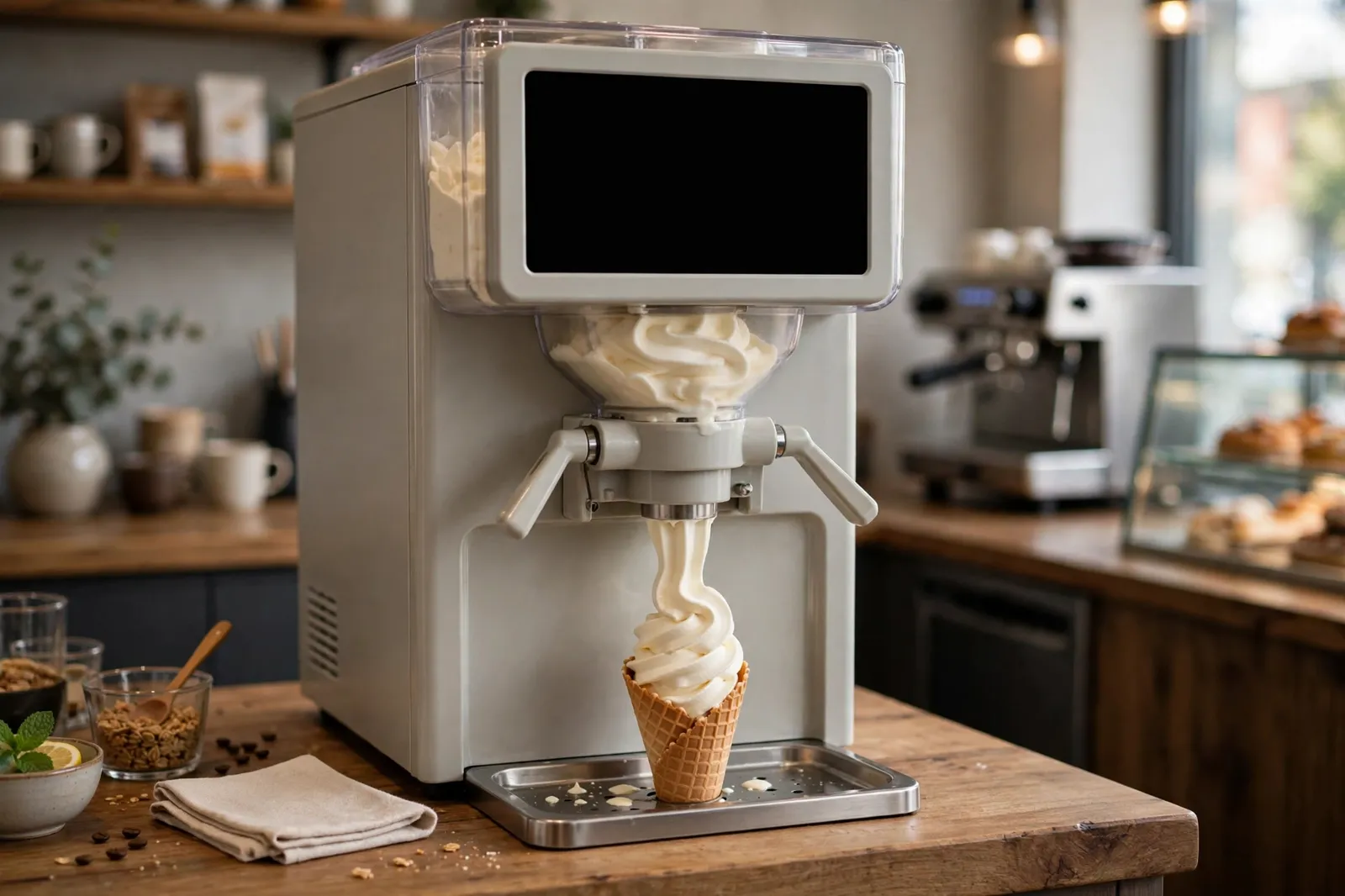
A domestic ice cream maker is built for occasional batches at home. A commercial machine is built to produce food for sale, all day, every day, and that difference shows up in almost every specification.
The first difference is the refrigeration system. Commercial machines carry their own compressors sized for continuous work, so they can freeze mix, hold it at serving consistency and recover quickly between serves during a lunch rush. The second is construction: food contact parts are stainless steel or food grade materials designed to be pulled apart, washed, sanitised and reassembled on a regular cycle. The third is control. Commercial machines monitor consistency electronically rather than relying on a timer, because the texture of the product is the product.
There is also a regulatory difference. Ice cream sold to the public is food prepared for sale, so the machine sits inside your food safety system, not beside it.
When you buy a commercial machine you are also buying a cleaning routine, a set of records and a place in your food control plan.
Finally, there is support. Commercial machines are sold through importers and dealers who hold spare parts, employ or contract technicians and offer training. When a soft serve machine stops on a Saturday in January, that support network is worth as much as the machine itself.
The main types of commercial ice cream machine
Most commercial machines fall into two families. Soft serve machines dispense product to order, one cone or cup at a time. Batch freezers make a set quantity of ice cream or gelato in the back room, which is then stored and scooped or sold from a display cabinet. A gelato shop often needs both: a batch freezer for its scooped range and, if it offers soft serve as well, a separate dispensing machine.
Soft serve machines. A soft serve machine holds liquid mix in a refrigerated hopper, draws it into a freezing cylinder where a beater churns and freezes it while incorporating air, and dispenses it through a tap at a soft, swirled consistency. The customer is served straight from the machine, so there is no separate storage step. Taylor machines, sold in New Zealand through JL Lennard, and Carpigiani soft serve machines, imported by Majors Group, are the two best known ranges in this category, alongside brands such as Spaceman and Pasmo sold through equipment dealers.
Batch freezers for hard ice cream and gelato. A batch freezer works more like a churn. You pour a measured quantity of mix into the cylinder, the machine freezes and beats it to the target consistency, signals when the batch is ready, and you extract the finished product into tubs or trays for the freezer or display cabinet. Carpigiani’s Labo range is the main example sold in New Zealand. The floor standing Labo XPL P models handle between 3 kg and 5 kg of mix per cycle, depending on the model, and run separate freezing programmes for gelato, sorbet, slush fruit and ice cream, because each product needs the cold managed differently.
Gelato versus ice cream. Suppliers treat gelato as a distinct product rather than a flavour of ice cream, and the distinction is built into the machinery. Gelato is denser, with less air beaten into it. Carpigiani describes its gravity fed soft serve configuration, which allows up to 40 percent overrun, as producing a compact, dense gelato style product, while pump fed versions go up to 80 percent overrun for a lighter, creamier result. Batch freezer programmes apply more cold to build body in milk based gelato and less for delicate fruit sorbets. If gelato is your core product, buy a machine designed and programmed for gelato rather than assuming any ice cream machine will do.
Countertop versus floor standing. Countertop machines sit on a bench and suit lower volumes and tight spaces. The Taylor C152, for example, is a single flavour countertop soft serve machine. Floor standing machines carry bigger hoppers and cylinders, often twin flavours with a twist option, and suit high volume sites. Batch freezers follow the same split: Carpigiani makes a compact countertop batch freezer, the Labo 8 12 E, aimed at restaurants and catering, as well as the floor standing Labo XPL P range.
Gravity feed versus pump feed. This is the choice that most affects texture and output on a soft serve machine. In a gravity fed machine, mix flows down into the cylinder through a feed tube and air is metered in through holes in that tube. In a pump fed machine, a pump pressurises the mix and forces more air into it. Carpigiani puts numbers on the difference for its 191 Steel countertop machine: the gravity version, with an 18 litre hopper, allows up to 40 percent overrun, while the pump version, with a 12 litre hopper, can incorporate up to 80 percent. More overrun means a lighter product and more servings from the same volume of mix; a denser, lower overrun product is what gelato buyers usually want. Match the feed system to the product you intend to sell.
Single flavour, twin flavour and combination machines. Entry machines dispense one flavour. Twin machines hold two flavours and usually offer a third tap that twists them together. At the top end there are combination units: JL Lennard lists the Taylor C606, which combines a high capacity pump fed soft serve side with a thickshake side that injects flavoured syrup as it dispenses, aimed at high volume sites.
Capacity and output, explained
Output figures cause more confusion than any other part of buying one of these machines, because soft serve and batch machines are measured in different units, and neither unit tells the whole story.
Soft serve machines are usually rated in servings per hour, based on a standard serve size. Carpigiani rates its 191 Steel at more than 250 servings of 75 g in one hour. That is a production ceiling under good conditions, not a promise for your site. Actual output depends on the mix you use, the temperature of the mix going in, the room temperature around an air cooled machine, and how steadily customers arrive. A machine that can produce 250 serves in an even flow may still struggle with 60 people in ten minutes, because what matters in a rush is recovery: how fast the cylinder refreezes after each draw. Hopper size matters too. A 12 litre or 18 litre hopper tells you how much mix the machine holds before someone has to refill it, and the freezing cylinder size (1.75 litres on the Carpigiani 191) tells you how much product is at serving consistency at any moment.
Batch freezers are rated by quantity per cycle and, often, production per hour. The per cycle figure is the one to plan production around: the Labo XPL P range works between a minimum of 3 kg and a maximum of 5 kg per cycle. Your daily output is that figure multiplied by the number of cycles you can run, allowing time for extraction, cleaning between flavours and hardening before the product is ready to sell.
Overrun is the third figure worth understanding. It is the percentage by which the mix expands as air is incorporated during freezing: a mix at 40 percent overrun turns 10 litres of liquid into about 14 litres of finished product. Higher overrun stretches your mix further and softens texture; lower overrun gives a denser product with a more intense flavour per spoonful. Compare running costs between machines at a similar overrun, or the comparison is meaningless.
The honest way to size a machine is to work backwards from your menu and your busiest hour. Estimate serves in your peak hour, decide whether product is dispensed to order or made ahead in batches, and then check that the machine’s rated output, hopper capacity and recovery behaviour leave you headroom. Buying exactly to your forecast peak leaves no room for a hot day or a school holiday rush.
Power, space and installation
Commercial ice cream machines are heavy, power hungry appliances, and installation details are where purchases most often go wrong.
Power supply. Small countertop machines may run on a standard single phase supply. The Taylor C152 listed by SilverChef NZ is single phase, 10 amp, about as undemanding as commercial equipment gets. Larger machines step up quickly. SilverChef lists the Pasmo Pascal S121, a twin flavour air pump soft serve machine, as three phase, 10 amp. JL Lennard states plainly that the Taylor C606 combination machine requires three phase power. If your premises do not have three phase supply, getting it installed is a separate cost to budget for, and in a leased site it may need your landlord’s agreement. Check the exact requirement for the specific model before you commit.
Cooling and clearance. Machines are air cooled or water cooled, and some offer a choice. Air cooled machines reject heat into the room and need breathing space: JL Lennard specifies 150 mm clearance on both sides of the Taylor C606 for adequate air flow. A machine shoehorned into a sealed alcove will run hot and recover slowly. Water cooled machines avoid dumping heat into the room but need a water supply and drainage, a plumbing cost and a constraint on where the machine can sit. Carpigiani’s Labo XPL P batch freezers are water cooled as standard, with an air cooled condenser at extra cost, while its 191 soft serve machine is air cooled with water cooling optional.
Size and weight. Measure your bench or floor space against the machine’s footprint, then measure your doorways against the machine. The Taylor C152 is 444 mm wide, 745 mm deep and 673 mm high and weighs 94 kg. The Pasmo S121 is 530 mm wide, 890 mm deep and 980 mm high and weighs 250 kg. A floor standing machine at that weight needs a suitable floor and a safe path into position.
Installation costs. Do not assume installation is included. SilverChef states that its equipment rental does not include installation, which customers arrange at their own cost, although some dealers offer it as an optional extra. Majors Group, by contrast, builds set up and training into its Carpigiani offer, including machine set up, recipe development and demonstrations at its Auckland and Christchurch showrooms. Ask exactly what the quoted price includes: delivery, positioning, electrical work, plumbing for water cooled models, commissioning, staff training and the first supply of mix and cleaning chemicals.
Cleaning and food safety
Ice cream mix is a dairy based, ready to eat food, which puts it in the higher care category of food safety. In New Zealand, selling it means operating under the Food Act 2014. Most cafes, shops and mobile vendors selling ice cream will work under a template food control plan, and MPI’s Simply Safe and Suitable template is the standard one. For a business in a single council area, that template plan is registered with the local council; MPI registers custom food control plans, the route for higher risk or wholesale manufacturing. Either way, your plan has to cover how the machine is cleaned, how temperatures are checked and recorded, and what happens when something goes wrong, and a verifier will expect to see those records.
Temperature control is the core discipline. The Food Standards Australia New Zealand guide to the food safety standards defines temperature control for chilled food as maintaining it at 5 degrees Celsius or below, and frozen food has to be kept frozen solid. In practice that means mix held in the machine’s refrigerated hopper at or below 5 degrees until it is frozen for service, finished product held properly frozen in storage, and temperatures checked and recorded as your plan requires. Soft serve machines help here: models with standby or overnight modes keep product refrigerated in the machine between trading periods.
Cleaning is the other discipline, and it is more involved than wiping a bench. A soft serve machine’s food contact parts, the cylinder, beater, seals and dispensing assembly, have to be emptied, washed and sanitised on the cycle the manufacturer specifies. Two technologies reduce, but do not remove, that burden. Heat treatment machines pasteurise the mix in the machine overnight; JL Lennard says that on the Taylor C606 this means full disassembly and brush cleaning is only required every 14 days. Carpigiani offers an automatic self pasteurisation system on its 191 Steel that allows the full washing to be scheduled at intervals of up to 42 days, with the machine locking itself if the deadline is missed. Batch freezers have their own aids, such as removable extraction chutes and delayed cleaning programmes that hold cylinder temperature after extraction so washing can wait until a break in production.
None of this removes the daily tasks: dispensing handles and drip trays cleaned, mix checked for date and temperature, hoppers topped up hygienically, and any product that has been held too long discarded. Build those tasks into your food control plan and your staff training from day one, and cost the labour honestly. Cleaning time is a real running cost of owning the machine.
Running costs and consumables
The purchase price is only the first cheque. Ongoing costs fall into four groups.
Mix and ingredients. Soft serve machines run on prepared mix. Majors Group supplies soft serve mix, frozen yoghurt premix and açaí mix alongside its machines, along with flavours, toppings, cups and spoons. Batch freezer operators make their own mix from raw ingredients or use prepared bases, which Carpigiani also supplies through its Rubicone range. Either way, mix is your biggest consumable cost per serve, and wastage at cleaning time is part of it: product left in the machine when it is emptied for washing is product you cannot sell.
Power and water. A machine with a large compressor draw that runs all day, plus refrigeration that holds product overnight, adds a measurable amount to your power bill, and a water cooled machine adds water use as well. High efficiency motors and condensers are a genuine selling point in the current ranges, but the figure that matters is the rated power of the model you are buying, multiplied by your trading hours.
Cleaning chemicals and wear parts. Seals, gaskets, scraper blades and beater parts wear and need scheduled replacement, and food grade lubricant and sanitiser are ongoing purchases. Carpigiani packages gaskets and brushes into its Carpi Care and Carpi Clean kits, sold through the dealer. Ask the supplier for the recommended replacement schedule and the price of the wear parts kit before you buy.
Servicing and breakdowns. An annual service, refrigerant checks and the occasional breakdown callout belong in the budget. This is where the dealer network matters: Majors Group promotes servicing and genuine Carpigiani spare parts support from its Auckland and Christchurch teams, and JL Lennard is the established Taylor agent in New Zealand. A cheap machine with no local parts support can be out of action for weeks waiting on an imported component.
What named machines cost in NZ
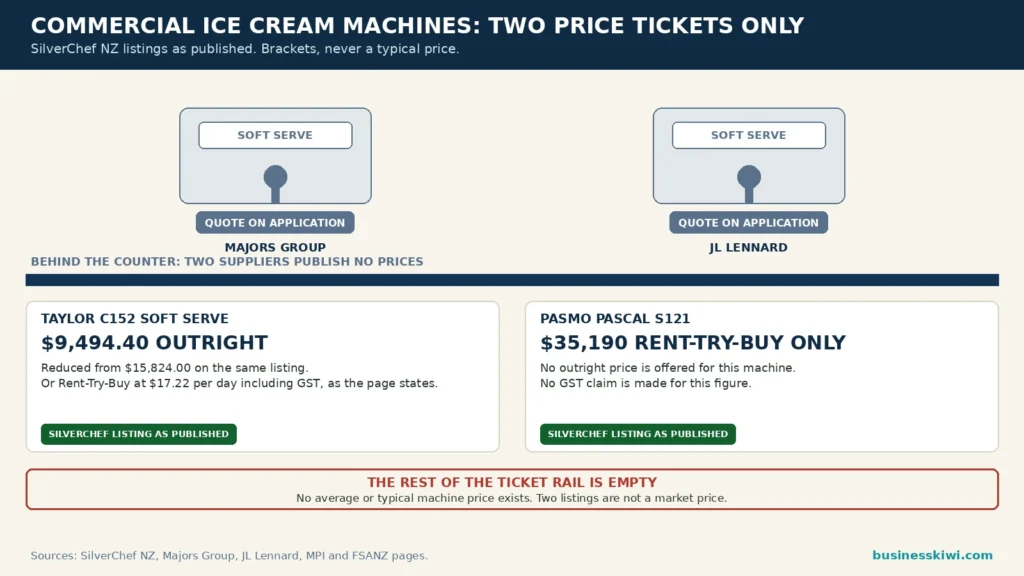
New Zealand suppliers of the major brands mostly sell by quotation, so published prices are thinner on the ground than buyers expect. Majors Group does not publish prices for its Carpigiani range: its pages invite buyers to request a quote, and it offers equipment finance of up to 100 percent. JL Lennard likewise lists its Taylor range without prices. The prices below are the ones New Zealand sellers publish on their own pages.
SilverChef NZ, the hospitality equipment finance and remarketing company, lists a Taylor C152 countertop soft serve machine at $9,494.40 to buy outright, reduced from $15,824.00, with its Rent-Try-Buy rental offered at $17.22 per day including GST. The C152 is a single flavour countertop machine, single phase 10 amp, weighing 94 kg. SilverChef sells both new and certified used equipment, so check the listing for the condition of the machine offered.
At the larger end, SilverChef lists the Pasmo Pascal S121, a new twin flavour air pump soft serve machine with two 9.5 litre hoppers, a pasteuriser cycle and three phase 10 amp power, at a listed price of $35,190. That listing is offered on the Rent-Try-Buy scheme rather than for outright purchase. Rent-Try-Buy is a 12 month rental agreement under which the equipment can be upgraded, returned at the end of the term or bought during the term.
For Carpigiani and Taylor machines bought new through their importers, treat those two published figures as brackets rather than a price list: a premium Italian or American machine will be quoted on application, and the quote will depend on configuration, options such as self pasteurisation or water cooling, and what is bundled with it. Get at least two written quotes for comparable specifications, and make sure each states whether it includes GST, delivery, installation and training.
Buying new versus used
There is an active second hand market in commercial ice cream machines in New Zealand, from certified used programmes run by equipment finance companies through to private sales of ex cafe equipment. Used can be a sensible route, particularly for a first machine, but go in with your eyes open.
The case for new is warranty, known history and support. A new machine from the importer comes with a manufacturer’s warranty (SilverChef notes that new commercial kitchen equipment typically carries at least a one year manufacturer’s warranty), current model parts availability, installation and training, and finance options from the dealer. The case for used is price: a refurbished machine can cost a fraction of its new price.
If you buy used, the checks that matter are these. Confirm the machine’s age, service history and who has been maintaining it, and have it run a full freeze cycle with mix before you pay. Check that seals, gaskets and scraper blades are present and serviceable, and price their replacement. Confirm that spare parts and a technician familiar with the brand are available in New Zealand. Check the electrical configuration matches your premises, especially if the machine is three phase. And factor in that a used machine’s warranty, where one exists, will be shorter than a new machine’s. A machine that has been sitting drained in storage is a particular risk, because dried mix residues and perished seals are expensive to put right.
Whether new or used, avoid importing a machine yourself from an overseas marketplace to save money. Voltage, refrigerant, parts support and food safety documentation all become your problem.
Before you buy: a short checklist
- Work out your peak hour demand in serves, then size the machine’s rated output and hopper capacity with headroom.
- Decide the product first: soft serve dispensed to order, batch made gelato or hard ice cream, or both. The product chooses the machine type.
- Choose gravity or pump feed based on the texture you want: lower overrun for dense gelato style product, higher overrun for light soft serve.
- Confirm the power supply the exact model needs, single phase or three phase, and whether your premises and lease allow any upgrade.
- Measure the space, the clearances for air flow, and the doorways the machine has to pass through. Check the weight against your floor and bench.
- If the machine is water cooled, confirm water supply and drainage at the position you plan to use.
- Ask what the quote includes: GST, delivery, installation, commissioning, training, first mix and cleaning kit.
- Ask for the cleaning cycle in writing: what is daily, what is periodic, how long a full wash takes, and what the wear parts kit costs.
- Confirm how the machine fits your food control plan, including temperature checks and cleaning records.
- Check warranty length, who services the machine in your region, and where parts are held.
- Compare at least two written quotes for comparable specifications before deciding.
Frequently asked questions
How much does a commercial ice cream machine cost in NZ?
Published New Zealand prices are limited because the major importers sell by quotation. As a guide to the brackets, SilverChef NZ lists a Taylor C152 countertop soft serve machine at $9,494.40 to buy outright, and a larger Pasmo Pascal S121 twin flavour machine at a listed price of $35,190 on a rental scheme. New Carpigiani and Taylor machines from their New Zealand importers are priced by quote, depending on model and configuration.
What is the difference between a soft serve machine and a batch freezer?
A soft serve machine holds mix in a refrigerated hopper and dispenses finished product to order, one serve at a time, at a soft consistency. A batch freezer makes a set quantity, typically a few kilograms per cycle, which is extracted into tubs, hardened in a freezer and then scooped or displayed for sale. Cafes and takeaway outlets usually want soft serve; gelato and ice cream producers usually want a batch freezer.
What does overrun mean, and why does it matter?
Overrun is the amount of air incorporated into the mix during freezing, expressed as a percentage increase in volume. On Carpigiani’s 191 Steel, the gravity fed version allows up to 40 percent overrun for a dense product, while the pump fed version reaches up to 80 percent for a lighter one. Higher overrun gives you more servings from the same mix and a softer texture; lower overrun gives a denser product with more flavour per spoonful, which is what gelato is known for.
Do I need three phase power for a commercial ice cream machine?
Some machines do and some do not. A small countertop machine such as the Taylor C152 runs on single phase 10 amp power. Larger machines, including the Pasmo Pascal S121 listed by SilverChef and the Taylor C606 combination machine sold by JL Lennard, require three phase power. Check the specification of the exact model, and check your premises can supply it, before you buy.
How often does a soft serve machine need to be cleaned?
It depends on the machine’s technology. Machines without heat treatment need regular full disassembly, washing and sanitising of food contact parts on the manufacturer’s cycle. Heat treatment models extend the interval: JL Lennard states that the Taylor C606’s overnight heat treatment cycle means full disassembly and brush cleaning is only required every 14 days, and Carpigiani’s optional self pasteurisation system allows washing intervals of up to 42 days. Daily tasks, such as cleaning dispensing parts and checking mix temperature and dates, still apply either way, and your food control plan must record the cleaning you do.
What food safety rules apply to selling ice cream in NZ?
Selling ice cream means operating under the Food Act 2014, usually with a food control plan. Most food service and retail businesses use MPI’s Simply Safe and Suitable template plan, registered with the local council for a single site; manufacturers and wholesalers may need a custom food control plan registered with MPI. Your plan covers cleaning, temperature control and record keeping. Chilled mix must be held at 5 degrees Celsius or below and frozen product kept frozen, consistent with the temperature control definitions in the Food Standards Australia New Zealand standards.
Is a used commercial ice cream machine a good buy?
It can be, if the machine has been properly maintained and is sold through a reputable channel such as a certified used equipment programme. Have the machine demonstrated running a full freeze cycle, check its service history, confirm seals and wear parts are serviceable, and make sure parts and technicians for the brand are available in New Zealand. Allow for a shorter warranty than a new machine carries.
Can one machine make both soft serve and gelato?
Not in the way most buyers hope. Soft serve machines are built to dispense a soft product continuously, and Carpigiani notes its soft serve machines can produce soft gelato styles, sorbets and frozen yoghurt as well as ice cream. Firm, scoopable gelato and hard ice cream are batch products, made in a batch freezer with programmes for each product type. If both styles are central to your menu, start with the machine that matches your main product.
Sources
- Majors Group New Zealand, Carpigiani 191 Steel counter top soft serve machine: https://majorsgroup.co.nz/products/carpigiani-191-counter-top-soft-serve-machine/
- Majors Group New Zealand, Carpigiani Labo XPL P batch freezer: https://majorsgroup.co.nz/products/carpigiani-labo-xpl-p-batch-freezer/
- Majors Group New Zealand, Carpigiani Labo 8 12 E countertop batch freezer: https://majorsgroup.co.nz/products/carpigani-labo-countertop-batch-freezer/
- JL Lennard New Zealand, Taylor C606 soft serve and shake combination machine: https://www.jllennard.co.nz/taylor-606-soft-serve-shake-combination-machine.html
- SilverChef NZ, Taylor C152 countertop soft serve machine: https://www.silverchef.co.nz/products/02irf000000dkcd_taylor-c152-countertop-soft-serve-machine
- SilverChef NZ, Pasmo Pascal S121 2 flavour air pump soft serve machine: https://www.silverchef.co.nz/collections/all-equipment/products/new-pasmo-pascal-s121-2-flavour-air-pump-soft-serve-machine
- Ministry for Primary Industries, Information for authorities that register food businesses: https://www.mpi.govt.nz/food-business/food-act-registration-authorities-verifiers-evaluators-and-food-safety-officers/information-registration-authorities
- Food Standards Australia New Zealand, A guide to the food safety standards (Standard 3.2.2, Safe Food Australia, fourth edition): https://www.foodstandards.govt.nz/sites/default/files/2024-11/Ch%203.2.2.pdf
This article is general information about buying and running a commercial ice cream machine in New Zealand. It is not legal, food safety or financial advice for your specific business. Prices and specifications were taken from the sellers’ own pages listed above at the time of writing and can change; confirm the current price, GST treatment and specification with the seller before you buy. Food safety requirements depend on your type of business, so confirm which food control plan or programme applies to you with MPI or your local council.