Debt Consolidation Loans in NZ: When Rolling Your Debts Into One Loan Actually Saves Money

Juggling a credit card, a store card, a car loan and a buy now pay later habit is exhausting. Every debt has its own due date, its own rate and its own way of charging you extra when life gets in the way. A debt consolidation loan promises to tidy all of that into one loan, one repayment and one end date.
Sometimes that promise stacks up. Sometimes it quietly makes things worse, because a smaller repayment stretched over a longer term can cost more than the debts you started with. This guide explains how consolidation works in New Zealand, what the big banks currently charge, the maths that decides whether you will actually save, the traps, and the alternatives, including free help that too few people use.
What a debt consolidation loan is and how it works
A debt consolidation loan is a new loan taken out to pay off several existing debts in one go. The new lender usually pays the old debts off directly, or lends you the money on the understanding it goes straight to clearing them. From then on you owe one lender instead of many, with a set repayment schedule and a date when the loan ends.
The debts lenders typically describe as suitable are the expensive, scattered kind: credit cards, store cards, hire purchases, car loans and other personal loans. ANZ lists exactly those categories on its debt consolidation page, and ASB describes combining the same kinds of debt under one interest rate. Buy now pay later balances count as debt too, and Sorted counts them among the multiple debts people juggle, but lenders do not always name them, so check whether a particular lender will include them. Student loans sit outside this kind of consolidation, with their own rules through Inland Revenue; rolling short-term debt into a mortgage is a different decision altogether, covered later.
Consolidation loans here are usually personal loans, and most bank personal loans are unsecured, meaning you do not offer your car or house as security. ASB states its personal loans are unsecured and that it no longer offers secured personal loans to new customers. Unsecured lending keeps your assets out of it, but the rate is higher than a lender would charge against security, because the lender carries more risk.
Variations worth knowing about: most people simply take a standard personal loan and use it for consolidation. Homeowners sometimes use a mortgage top-up, which Sorted discusses with a strong warning covered in the traps section below. And there are specialist debt consolidation companies, about which Sorted’s caution is blunt in substance: they may charge higher interest than a bank, so talk to your bank before signing up with a new company.

What the big banks charge right now
Rates and fees change, so treat the figures below as a snapshot from each bank’s own website in October 2026. Before applying anywhere, check the lender’s current published costs of borrowing, because that is the figure your contract will use.
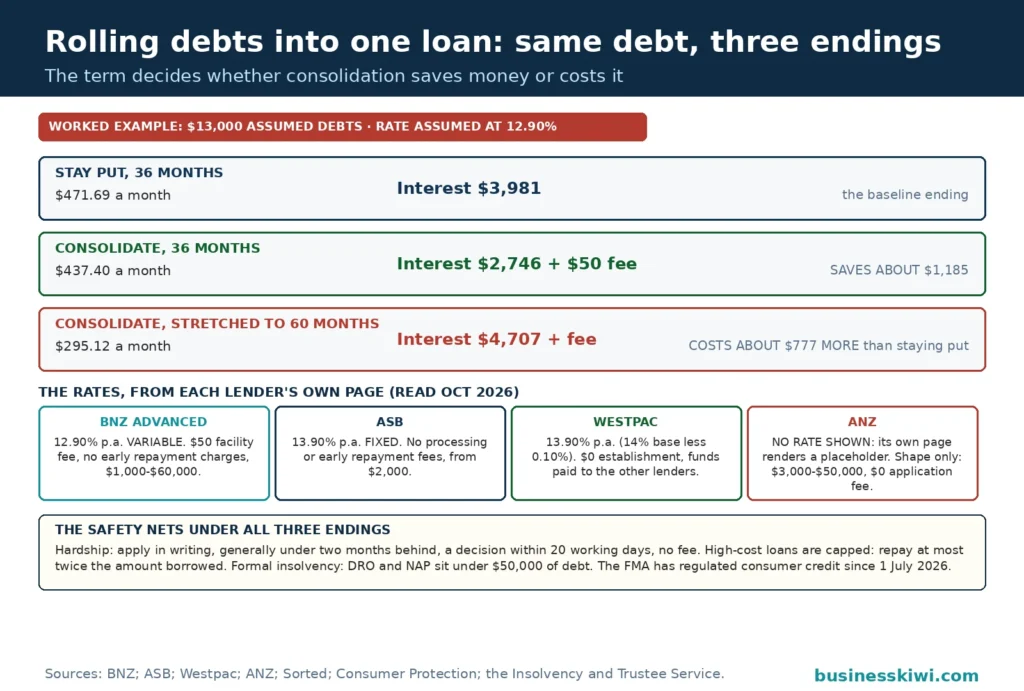
BNZ publishes a single interest rate of 12.90% per annum for its Advanced Personal Loan, and notes the rate is variable, so it can change during the loan. You can borrow between $1,000 and $60,000 over terms from three months to five years. There is a one-off loan facility fee of $50, which BNZ describes as its establishment fee, no monthly fees, no charge for extra repayments or paying the loan off early, and a $2 late payment fee. You need to be a BNZ customer, and BNZ’s online applications require an income of $35,000 or more a year.
ASB publishes a standard fixed rate of 13.90% per annum for its unsecured personal loans, and makes a point of saying you know the rate before you apply. There is no loan processing fee, extra repayments made online are free, and there are no early repayment fees. Terms run from six months to seven years, with a minimum loan of $2,000. Applicants need to be 18 or over, a New Zealand citizen, resident or work visa holder, and earn over $20,000 a year.
Westpac publishes 13.90% per annum for its debt consolidation loan, noting the rate is subject to change and is built from a personal loan base rate of 14% per annum less a margin of 0.10% per annum. You can borrow up to $70,000 over up to seven years, though applications for more than $50,000 or terms over five years are handled by phone or in branch. Westpac charges no establishment fee, no lump sum fee and no fee for paying the loan off early, and pays consolidation funds directly to your other lenders. If an overdue amount pushes your loan over its limit, the overlimit amount is charged at the loan rate plus 5% per annum after 14 days.
ANZ takes a different approach to publishing its price. Its debt consolidation page shows the standard personal loan interest rate as a placeholder rather than a figure, so no ANZ rate is quoted here; you would need to get the current rate from ANZ directly. What the page does publish is the shape of the product: loans from $3,000 to $50,000 (from $1,000 for eligible Jumpstart customers), terms from six months to seven years, a $0 application fee, and no charge to change your repayment amount, make a lump sum payment or pay the loan off entirely. Amounts not paid when due can be charged at your rate plus 5% per annum.

The maths that decides whether it saves you money
Forget the weekly repayment for a moment. The only fair comparison between your current debts and a consolidation loan is the total amount you will hand over, from today until the last payment, including interest and fees. Consumer Protection makes the same point in its own way: your credit contract should tell you the total amount you will repay, including admin fees and all interest. Ask for that total on the new loan, work out the equivalent total for staying put, and compare the two numbers.
Three things drive the total:
- The interest rate. Lower is better, but only in combination with the other two.
- The term. Every extra month is another month of interest on a declining but still substantial balance. This is where consolidation most often goes wrong.
- The fees. A new establishment fee, any fee to settle your old loans early, and any add-ons bundled in all eat into the saving.
BNZ, to its credit, states the term problem on its own page: consolidating resets your loan to whatever term you choose for the new loan, which may mean you pay more interest on the original amount than was originally disclosed, because you could be extending the term. Consumer Protection says the same thing generally: consolidation debt is generally paid over a longer term, so you might pay more overall even though each repayment is smaller.
There is a discipline trick hidden in the maths. If a lower rate gives you a smaller repayment, and you voluntarily keep paying the higher amount you were already managing, you clear the new loan well before its end date and bank the full interest saving. The trap is the opposite: taking the smaller repayment as spending money and letting the term do the damage.
A worked example, with every assumption labelled
The figures below are illustrative only. The debts, their rates and the consolidation rate are stated assumptions chosen to look like typical high-interest borrowing; they are not market data and not any lender’s current prices. The method is standard loan amortisation: equal monthly payments, interest charged monthly on the reducing balance. The same formula reproduces the banks’ own published examples, ASB’s roughly $1,965 of interest on $5,000 over five years at 13.90% per annum and Westpac’s $342 a month and $12,286 total on $10,000 over three years at 13.90% per annum, so you can check the method yourself.
The assumed starting debts, totalling $13,000:
- Credit card: $4,500 at an assumed 19.95% per annum
- Store card: $1,800 at an assumed 25.95% per annum
- Car loan: $6,700 at an assumed 14.95% per annum
Option A: keep the debts and clear each one over three years. Paying each debt off over 36 equal monthly payments costs $167.12 a month for the credit card (interest $1,516), $72.48 for the store card (interest $809) and $232.09 for the car loan (interest $1,655). Combined, that is $471.69 a month and $3,981 of interest. In practice most people pay less than this toward their cards, which stretches the debt out further; this version assumes real discipline.
Option B: consolidate over three years. A $13,000 loan at an assumed 12.90% per annum over 36 months costs $437.40 a month, with $2,746 of interest. Add an assumed establishment fee of $50 and the total cost is $2,796. Against Option A, that saves about $1,185, and the monthly outgo is about $34 lower as well. This is consolidation working as advertised: a genuinely lower rate, the same timeframe, and small fees.
Option C: consolidate over five years. The same loan at the same assumed rate, stretched over 60 months, drops the repayment to $295.12 a month, but the interest climbs to $4,707, or $4,757 with the $50 fee. That is about $777 more than Option A, and about $1,961 more than Option B, despite the rate being lower than every debt it replaced. The $142 a month of breathing room might be worth buying if you are at genuine risk of missing payments. But it is bought, not saved.
The traps that catch people out
The behaviour trap is the big one. Sorted is direct about it: consolidation will not help if you keep taking on new debt, and it often just frees up space on the credit cards, which then get used again. Their advice is to close the old cards and other facilities once they are paid out. BNZ effectively forces the issue by requiring proof that non-BNZ cards and loans being consolidated have been closed. If your honest plan is to keep a cleared card “for emergencies”, expect to end up with the consolidation loan plus a fresh card balance.
A longer term dressed up as a smaller repayment. Covered in the worked example, but worth repeating because it is how these loans are usually sold. A lower repayment is not a saving; it is usually just the same debt, rented for longer.
Fees stacking up quietly. You probably paid establishment fees on your original loans, and those are gone whether you consolidate or not. A new loan can add another set, which Sorted notes could cost hundreds of dollars, particularly away from the big banks. Check for fees to settle your existing loans early too: Sorted flags that lenders may charge extra for paying off existing loans early. The four bank products above charge nothing for early repayment, but older loans and finance company contracts vary.
Turning unsecured debt into debt against your home. Rolling card debt into a mortgage top-up gets a much lower rate, and Sorted accepts it can be cheaper, but only if you increase repayments so the payoff date does not drift out. Spread over a mortgage term, yesterday’s card balance can still be being paid off in twenty years, and the debt is now secured on your house. Consumer Protection’s warning applies to any secured borrowing: check what security you are giving, because if you do not keep up repayments the lender may be able to repossess what is listed.
Shopping with the wrong lenders. Consolidation is marketed hard at people in difficulty, which attracts high-cost lenders and intermediaries. Consumer Protection reminds borrowers to check the lender is registered, since an unregistered lender cannot legally give credit, and to take the contract away for advice rather than signing under pressure. High-cost loans, meaning annual rates of 50% or more, have legal caps under the CCCFA: interest and fees cannot exceed 0.8% of the unpaid balance per day averaged over the term, you cannot be required to repay more than twice what you borrowed, and default fees are generally capped at $30. If an offer looks anything like those numbers, walk away.
Who can get one: eligibility and credit checks
There is no entitlement to a consolidation loan. Each lender applies its own criteria on top of the legal requirement, under the CCCFA, that lenders act as responsible lenders. The FMA’s summary of the lender responsibility principles says lenders must make reasonable enquiries to be satisfied that the credit will meet the borrower’s needs and objectives, and that the borrower can make the payments without suffering substantial hardship. In plain terms, the lender has to test affordability, and an application from someone already drowning will often fail that test.
The banks’ published criteria give a flavour of the basics. All four require applicants to be 18 or older with a regular income, and residency status matters: ANZ asks for New Zealand citizenship, permanent residence, or a work visa issued for two years or longer with at least a year remaining, while ASB accepts citizens, residents and work visa holders on conditions. Income floors appear in the fine print: over $20,000 a year at ASB, and $35,000 or more a year for BNZ’s online applications. Westpac asks for detail on income from all sources, savings and assets, all debts and expenses, so expect to document your full position, not just the debts you want to roll in.
Your credit report will be checked, normally with your consent. Consumer Protection explains that lenders use it to assess risk, and may decline an application or offer a higher rate based on factors such as past missed payments, defaults on your file, how much you currently owe, recent applications for credit, and whether repayments are made on time. Two consequences follow. First, the very debts you are trying to escape may be why you are declined, or why the rate offered is worse than the published one. Second, applying repeatedly in a short space of time can itself count against you: Consumer Protection lists multiple applications in a short period among the things that can negatively affect a credit score, and notes that each application may lower your score. Apply once, to the lender you have actually chosen.
If you are declined, you can ask the lender to explain the main reason. Your credit report is free to obtain from each of the three credit reporting companies, Centrix, Equifax and Experian, and checking it for errors before you apply is worthwhile: a default over $125 that is more than 30 days overdue can stay on your record for five years even after you have paid it, and wrong listings do happen. Information generally stays on a report for four to five years, which is why time, plus a clean recent record, is often the real fix.
Since 1 July 2026, the regulator behind all of this has changed: the FMA took over regulatory responsibility for the CCCFA from the Commerce Commission under the Credit Contracts and Consumer Finance Amendment Act 2026, becoming the single conduct regulator for consumer credit. For borrowers, the day-to-day protections are the ones described above: responsible lending, clear disclosure, and contracts that must not be oppressive.
Alternatives worth trying first, or as well
Pay the debts off one at a time, without a new loan. Sorted’s two standard strategies cost nothing to set up. With the debt avalanche, you pay the minimum on everything and throw every spare dollar at the highest-interest debt first, which is mathematically the quickest and cheapest way out. With the debt snowball, you clear the smallest balance first for momentum, then roll its payment into the next. Neither adds fees, resets terms or puts a new application on your credit file.
Talk to your existing lenders. Consumer Protection points out that many lenders prefer to change your repayments rather than risk missed payments. More time, smaller payments for a period, or a repayment holiday will usually cost more in interest overall, but it can get payments to a level you can sustain, and it avoids a new loan entirely.
Make a formal hardship application. If an unexpected event, such as losing your job, a serious illness or injury, a relationship breakdown or the death of a partner, has made repayments genuinely difficult, the CCCFA gives you the right to apply to your lender to change the contract: a longer term, a payment holiday, or both. Apply in writing, say which change you want, explain the event and include proof, and apply early: Consumer Protection notes you generally need to be less than two months behind on payments. The lender must then give you its decision and reasons within 20 working days, cannot charge a fee for considering the application, and must suspend repossession action while deciding. It is a legal right, not a favour, and a financial mentor can help you prepare one.
Get a free financial mentor before you sign anything. MoneyTalks, the free financial helpline, can put you in touch with a local financial mentor. Mentors are free, work one-on-one, and are available face to face at more than 180 locations around the country through services in partnership with FinCap. A mentor can build a realistic budget and repayment plan, talk to lenders on your behalf, check whether a lender has done something it should not have, such as charging unfair fees or skipping the affordability test, and tell you honestly whether consolidation, a hardship application or something else fits your situation. MoneyTalks is on 0800 345 123, by text on 4029, or by email at help@moneytalks.co.nz.
Check Work and Income and microfinance before borrowing more. Some of the pressure that drives consolidation comes from one-off essential costs. Consumer Protection notes Work and Income can help with urgent or unexpected costs, from food and dental treatment to car repairs, whether or not you receive a benefit, with eligibility based on income and assets; some payments are repayable and some are not. For smaller amounts, microfinance providers offer low-interest or no-interest loans for people on lower incomes, typically under $5,000; Sorted keeps a list.
If the debt simply cannot be repaid, look at the formal insolvency options. These are serious steps with long-term effects, and the Insolvency and Trustee Service and Consumer Protection both say to try other options first and to talk them through with a financial mentor. A Debt Repayment Order suits someone who owes less than $50,000 in unsecured debt and can still make some repayments, giving more time to pay under a supervised plan. A No Asset Procedure clears the debts of someone who owes less than $50,000, has no assets and has no spare money for repayments. Bankruptcy clears debt where there is no realistic way to repay: you can be made bankrupt owing more than $1,000 in unsecured debt, and it is the only formal option over $50,000. Applications are made online to the Insolvency and Trustee Service with a Statement of Affairs. Insolvency shows on your credit record and can affect work, running a business and travel, so it is a last resort, but for some people it is a cleaner fresh start than a loan that was never going to be repaid.
Frequently asked questions
Does consolidating debt hurt my credit score?
Applying involves a credit check, and Consumer Protection notes that each application may lower your score and that multiple applications in a short period can count against you. After that, the effect runs the other way if you behave well: one loan paid on time builds a better record than scattered cards with missed payments. The damage usually comes from what happens next, either running the cards back up or missing payments on the new loan.
Can I consolidate if I already have bad credit?
You can apply, but be realistic. Lenders must be satisfied you can repay without substantial hardship, and a record of missed payments, defaults or a large debt load can lead to a decline or a higher rate. Higher-risk borrowers are exactly who high-cost lenders and specialist firms target, and their prices can erase any benefit. A free financial mentor can look at the whole picture first and may find a better route, such as hardship applications on the existing debts.
Is it better to consolidate or to pay debts off one at a time?
It depends on the totals, not the tidiness. If you can get a genuinely lower rate over the same or a shorter term, with minimal fees, and you will close the old facilities, consolidation usually wins on cost. If the only offer stretches the term, paying debts off one at a time using the avalanche method, highest interest first, is often cheaper and safer.
Can I roll debts into my mortgage instead?
Homeowners can sometimes increase their mortgage to clear higher-interest debts, at a much lower rate. Sorted’s condition is the important part: increase your repayments so the payoff date stays roughly the same, ideally paying the same total as the old repayments combined. Leave repayments unchanged and the total cost balloons, because consumer debt is then repaid over a mortgage-length term, secured on your home.
What happens if I cannot pay the consolidation loan?
Talk to the lender as soon as you know, not after you have missed payments. Lenders would generally rather restructure than chase, and if your difficulty comes from an unexpected event you may have the right to a formal hardship change: a longer term, a payment holiday, or both. Ignoring it leads to default fees, default interest, debt collection and a default listing that can stay on your credit record for five years.
Will I be charged for paying my old loans off early?
Sometimes, which is why you check each contract before consolidating. Sorted warns that lenders may charge extra for early payoff of existing loans. The four big-bank loans in this guide currently charge no early repayment fees, but older loans, fixed-term contracts and finance company agreements can differ, and any settlement figure should be part of your total-cost comparison.
Should I close the credit cards once they are paid out?
Yes, in almost every case. Sorted’s core warning is that consolidation fails when the cleared cards get used again, leaving you with both debts. Some lenders, BNZ among them, require proof that cards and loans from other lenders have been closed as a condition of consolidating. Closing them also removes the temptation.
Sources
- Sorted (Te Ara Ahunga Ora Retirement Commission), sorted.org.nz: Pros and cons of debt consolidation; Start tackling your debt; Debt and loans questions and answers
- ANZ, anz.co.nz: Debt consolidation and ANZ Personal Loans
- ASB, asb.co.nz: Debt consolidation loans
- BNZ, bnz.co.nz: Personal loans (Advanced Personal Loan)
- Westpac New Zealand, westpac.co.nz: Personal Loan for Debt Consolidation; Personal Loans terms, fees and rates
- Consumer Protection (Ministry of Business, Innovation and Employment), consumerprotection.govt.nz: Loans and lenders; Payment problems; Credit checks, scores and history
- Financial Markets Authority, fma.govt.nz: Credit Contracts and Consumer Finance Act (CCCFA); Lender responsibility principles; Assessing for affordability
- Commerce Commission, comcom.govt.nz: Consumer credit contracts overview and transfer of regulation to the FMA
- MoneyTalks, moneytalks.co.nz: Find a local financial mentor
- Ministry of Social Development, msd.govt.nz: MoneyTalks free financial helpline
- Insolvency and Trustee Service, insolvency.govt.nz: Personal debt, covering Debt Repayment Orders, the No Asset Procedure and bankruptcy
This article is general information about debt consolidation loans and other options for dealing with debt in New Zealand. It is not personal financial advice, and it does not take your income, debts or circumstances into account. Interest rates, fees and eligibility criteria change and vary between lenders, so check the current details with any lender before applying. If you are deciding what to do about debt, consider talking to a licensed financial adviser, or to a free financial mentor through MoneyTalks on 0800 345 123, before you commit to anything.